Page 2 - Symbols on the mac; The engine exhaust from this product
KEY T O SYMBOLS Symbols on the mac hine and/or in the manual: W ARNING! Clearing saws, brushcutters and trimmers can be dangerous! Careless or incorrect use can result in serious or fatal injury to the operator or others. It is extremely important that you read and understand the contents of the ope...
Page 3 - INTR
Note the f ollowing before starting: Please read the operator’s manual carefully. Maintenance, replacement, or repair of the emission control devices and system may be performed by any nonroad engine repair establishment or individual. The Emissions Compliance Period referred to on the Emission Comp...
Page 5 - Impor
GENERAL SAFETY PRECA UTIONS Impor tant Personal protective equipment HELMET A protectiv e helmet where there is a risk of falling objects HEARING PROTECTION Wear hearing protection that provides adequate noise reduction. EYE PROTECTION Always wear approved eye protection. If you use a visor then you...
Page 6 - Mac; Throttle lockout
GENERAL SAFETY PRECA UTIONS GLO VES Gloves should be worn when necessary, e.g., when fitting cutting attachments. BOOTS Wear sturdy, non-slip boots. CLOTHING Wear clothes made of a strong fabric and avoid loose clothing that can catch on twigs and branches. Always wear heavy, long pants. Do not wear...
Page 7 - GENERAL SAFETY PRECAUTIONS; Stop switch; Cutting attachment guard
GENERAL SAFETY PRECAUTIONS See instructions under the heading “Starting”. Start the machine and apply full throttle. Release the throttle and check that the cutting attachment stops and remains at a standstill. If the cutting attachment rotates with the throttle in the idle position then the carbure...
Page 8 - Cutting equipment; Trimmer head
GENERAL SAFETY PRECAUTIONS Cutting equipment This section describes how to choose and maintain your cutting equipment in order to: • Reduce the risk of blade thrust. • Obtain maximum cutting performance. • Extend the life of cutting equipment. Trimmer head • Only use the recommended trimmer heads an...
Page 9 - ASSEMBLY; itting the trimmer guard and
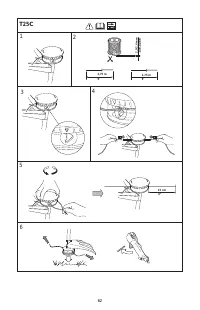
F itting the trimmer guard and trimmer head (Model 129 L) S Fit the correct trimmer guard (A) for use !"#$%!$%& $'#((&'!%&)*+!,--.!$%&!$'#((&'!/0)'*12-(3#4)5$#-4!/0)'*!-4$-!$%&!6#$$#4/!-4!$%&!7%)6$!)4*!7&20'&"#$%!$%&!3-8$!9:;+ NOTE: Make sure unit is a...
Page 10 - Assembling and dismantling the
ASSEMBLY Assembling and dismantling the two-piece shaft (129 LDX / LK) Assembly: • Loosen the coupling by turning the knob. • Align the tab of the attachment (A) with the arrow on the coupling (B). • Push the attachment into the coupling until the attachment snaps into place. Before using the unit, ...
Page 11 - FUEL HANDLING; Fuel safety; Transport and storage; Fuel; Gasoline
FUEL HANDLING Fuel safety Never start the machine: 1 If you have spilled fuel on it. Wipe off the spillage and allow remaining fuel to evaporate. 2 If you have spilled fuel on yourself or your clothes, change your clothes. Wash any part of your body that has come in contact with fuel. Use soap and w...
Page 12 - Mixing; Fueling
FUEL HANDLING Mixing • Always mix the gasoline and oil in a clean container intended for fuel. • Always start by filling half the amount of the gasoline to be used. Then add the entire amount of oil. Mix (shake) the fuel mixture. Add the remaining amount of gasoline. • Mix (shake) the fuel mixture t...
Page 13 - STARTING AND STOPPING; Check before starting; Starting; Stopping
STARTING AND STOPPING Check before starting • Check that the trimmer head and trimmer guard are not damaged or cracked. Replace the trimmer head or trimmer guard if they have been exposed to impact or are cracked. • Never use the machine without a guard or with a defective guard. • All covers must b...
Page 14 - WORKING TECHNIQUES; General working instructions; Basic safety rules
WORKING TECHNIQUES General working instructions Basic safety rules 1 Look around you: • To ensure that people, animals or other things cannot affect your control of the machine. • To ensure that people, animals, etc., do not come into contact with the cutting attachment or loose objects that are thr...
Page 15 - Basic working techniques
WORKING TECHNIQUES Basic working techniques Always slow the engine to idle speed after each working operation. Long periods at full throttle without any load on the engine can lead to serious engine damage. Grass trimming with a trimmer head Trimming• Hold the trimmer head just above the ground at a...
Page 16 - MAINTENANCE; Carburetor; Adjustment of the idle speed; Muffler
MAINTENANCE Carburetor Adjustment of the idle speed Before any adjustments are made, make sure that the air filter is clean and the air filter cover is fitted. Adjust the idle speed using the idle adjustment screw T, if it is necessary to readjust. First turn the idle adjustment screw T clockwise un...
Page 17 - Cooling system; Spark plug
MAINTENANCE Cooling system To keep the working temperature as low as possible the machine is equipped with a cooling system. The cooling system consists of: 1 Air intake on the starter. 2 Cooling fins on the cylinder. Clean the cooling system with a brush annually, more often in demanding conditions...
Page 18 - Air filter; Cleaning the air filter
MAINTENANCE Air filter The air filter must be regularly cleaned to remove dust and dirt in order to avoid: • Carburetor malfunctions • Starting problems • Loss of engine power • Unnecessary wear to engine parts • Excessive fuel consumption. Clean the filter daily. Cleaning the air filter Remove the ...
Page 19 - Maintenance schedule
MAINTENANCE Maintenance schedule The following is a list of the maintenance that must be performed on the machine. Most of the items are described in the Maintenance section. Maintenance Daily maintenance Weekly maintenance Yearly maintenance Clean the outside of the machine. X Make sure the throttl...
Page 20 - TECHNICAL DATA; Technical data
TECHNICAL DATA Technical data NOTE! This spark ignition system complies with the Canadian ICES-002 standard. Motor Cylinder displacement, cu.in/cm 3 Cylinder bore, inch/mm 1, /3 ,0 1, /3 ,0 Stroke, inch/mm 1,06/27 1,06/27 Idle speed, rpm 2800-3200 Recommended max. speed, rpm 00 Speed of output shaft...
Page 21 - EXPLICATION DES SYMBOLES
EXPLICATION DES SYMBOLES Symboles sur la machine et/ou dans le manuel: AVERTISSEMENT! Les débroussailleuses et les coupe-herbes peuvent être dangereux! Une utilisation erronée ou négligente peut occasionner des blessures graves, voire mortelles pour l’utilisateur ou d’autres personnes. Il est extrêm...
Page 22 - INTRODUCTION
Contrôler les points suivants avant la mise en marche: Lire attentivement le manuel d’utilisation. L’entretien, le remplacement ou la réparation des dispositifs et des systèmes antipollution peuvent être effectués par tout établissement ou personne qui répare des produits motorisés manuels. La pério...
Page 23 - QUELS SONT LES COMPOSANTS?
QUELS SONT LES COMPOSANTS? Quels sont les composants du coupe-herbe? 1 Tête de désherbage 2 Protection pour l’équipement de coupe 3 Tube de transmission 4 Poignée anneau 5 Commande de l’accélération 6 Bouton d’arrêt 7 Blocage de l’accélération 8 Chapeau de bougie et bougie 9 Poignée du démarreur 10 ...
Page 24 - INSTRUCTIONS GÉNÉRALES DE SÉCURITÉ
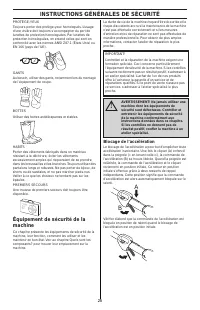
INSTRUCTIONS GÉNÉRALES DE SÉCURITÉ Important! Équipement de protection personnelle CASQUEUn casque de protection là où il y a risque de chute d’objets PROTÈGE-OREILLESPorter des protège-oreilles ayant un effet atténuateur suffisant. IMPORTANT!La machine est conçue uniquement pour le désherbage.Les s...
Page 25 - Blocage de l’accélération
INSTRUCTIONS GÉNÉRALES DE SÉCURITÉ PROTÈGE-YEUXToujours porter des protège-yeux homologués. L’usage d’une visière doit toujours s’accompagner du port de lunettes de protection homologuées. Par lunettes de protection homologuées, on entend celles qui sont en conformité avec les normes ANSI Z87.1 (Éta...
Page 26 - Bouton d’arrêt; Protection pour l’équipement de coupe
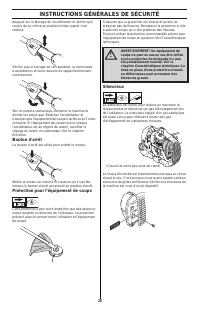
INSTRUCTIONS GÉNÉRALES DE SÉCURITÉ Appuyer sur le blocage de l’accélération et vérifier qu’il revient de lui-même en position initiale quand il est relâché. Vérifier que le blocage de l’accélération, la commande d’accélération et leurs ressorts de rappel fonctionnent correctement. Voir le chapitre D...
Page 27 - Équipement de coupe; Tête de désherbage
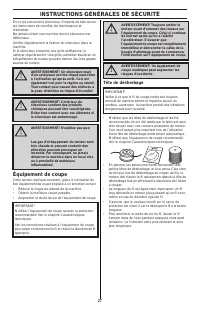
INSTRUCTIONS GÉNÉRALES DE SÉCURITÉ En ce qui concerne le silencieux, il importe de bien suivre les instructions de contrôle, de maintenance et d’entretien.Ne jamais utiliser une machine dont le silencieux est défectueux.Vérifier régulièrement la fixation du silencieux dans la machine.Si le silencieu...
Page 28 - MONTAGE
MONTAGE '0 3 $ ) "' 9 3 )$ N34" ;M O : ' B7C , - H 51 41 513 4 4 B/C + 7+, 4, , '0 3 "' $%0, 5)" : = " 41 ; " - 1 5) 41 : ' " 43 5" : 4 3 7 / 7 2 : ' 4H B2C 41 : * 41 943 4 4H T 4" : ! 1" BC 5 41 : K - B6C 6 : : " 455 4 , '0 3 $ ) "' 9 3 )$ N34" ;M...
Page 30 - MANIPULATION DU CARBURANT; Sécurité carburant; Transport et rangement; Carburant; Essence
MANIPULATION DU CARBURANT Sécurité carburant Ne jamais démarrer la machine:1 Si du carburant a été renversé. Essuyer soigneusement toute trace et laisser les restes d’essence s’évaporer. 2 Si vous avez renversé du carburant sur vous ou sur vos vêtements, changez de vêtements. Lavez les parties du co...
Page 31 - Mélange; Remplissage de carburant
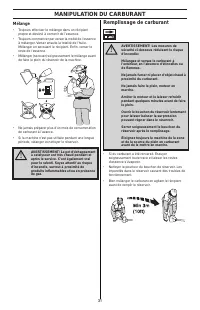
MANIPULATION DU CARBURANT Mélange • Toujours effectuer le mélange dans un récipient propre et destiné à contenir de l’essence. • Toujours commencer par verser la moitié de l’essence à mélanger. Verser ensuite la totalité de l’huile. Mélanger en secouant le récipient. Enfin, verser le reste de l’esse...
Page 32 - DÉMARRAGE ET ARRÊT; Contrôles avant la mise en marche; Démarrage
DÉMARRAGE ET ARRÊT Contrôles avant la mise en marche • Contrôler la tête de désherbage et le carter de protection afin de détecter d’éventuels dommages ou fissures. Remplacer la tête de désherbage ou le carter de protection si l’un ou l’autre a subi des dommages ou présente des fissures. • Ne jamais...
Page 33 - Arrêt
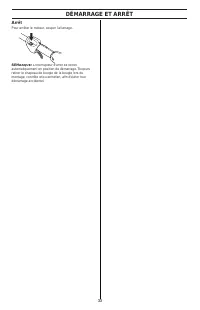
DÉMARRAGE ET ARRÊT Arrêt Pour arrêter le moteur, couper l’allumage. REMARQUE! L'interrupteur d'arrêt se remet automatiquement en position de démarrage. Toujours retirer le chapeau de bougie de la bougie lors du montage, contrôle et/ou entretien, afin d'éviter tout démarrage accidentel. 33
Page 34 - TECHNIQUES DE TRAVAIL; Méthodes de travail; Règles élémentaires de sécurité
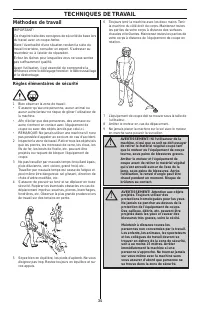
TECHNIQUES DE TRAVAIL Méthodes de travail Règles élémentaires de sécurité 1 Bien observer la zone de travail:• S’assurer qu’aucune personne, aucun animal ou aucun autre facteur ne risque de gêner l’utilisateur de la machine. • Afin d’éviter que des personnes, des animaux ou autre n’entrent en contac...
Page 35 - Techniques de travail de base
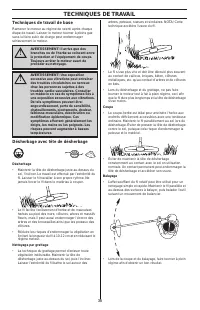
TECHNIQUES DE TRAVAIL Techniques de travail de base Ramener le moteur au régime de ralenti après chaque étape de travail. Laisser le moteur tourner à pleins gaz sans lui faire subir de charge peut endommager sérieusement le moteur. Désherbage avec tête de désherbage Désherbage• Maintenir la tête de ...
Page 36 - ENTRETIEN; Carburateur; Réglage du régime de ralenti; Silencieux
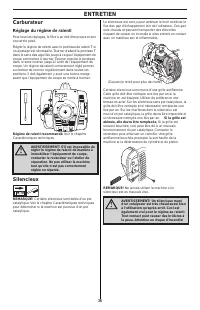
ENTRETIEN Carburateur Réglage du régime de ralenti Pour tous les réglages, le filtre à air doit être propre et son couvercle posé. Régler le régime de ralenti avec le pointeau de ralenti T si un ajustage est nécessaire. Tourner d’abord le pointeau T dans le sens des aiguilles jusqu’à ce que l’équipe...
Page 37 - Système de refroidissement; Bougie; Tube de transmission démontable
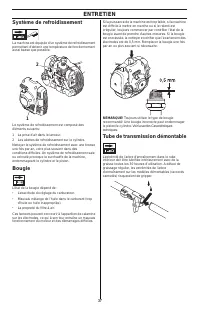
ENTRETIEN Système de refroidissement La machine est équipée d’un système de refroidissement permettant d’obtenir une température de fonctionnement aussi basse que possible. Le système de refroidissement est composé des éléments suivants: 1 La prise d’air dans le lanceur. 2 Les ailettes de refroidiss...
Page 38 - Filtre à air; Nettoyage du filtre à air
ENTRETIEN Filtre à air Le filtre à air doit être maintenu propre pour éviter: • Un mauvais fonctionnement du carburateur • Des problèmes de démarrage • Une perte de puissance • Une usure prématurée des éléments du moteur • Une consommation anormalement élevée de carburant Nettoyer le filtre tous les...
Page 39 - Schéma d’entretien
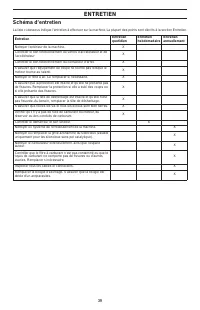
ENTRETIEN Schéma d’entretien La liste ci-dessous indique l’entretien à effectuer sur la machine. La plupart des points sont décrits à la section Entretien. Entretien Entretien quotidien Entretien hebdomadaire Entretien annuellement Nettoyer l’extérieur de la machine. X Contrôler le bon fonctionnemen...
Page 40 - CARACTÉRISTIQUES TECHNIQUES; Caractéristiques techniques
11,4/5,2 1, /3 ,0 1, /3 ,0 1,06/27 1,06/27 2800-3200 2800-3200 0000 0, / 00 0, / 00 50 50 NGK CMR6A NGK CMR6A 0,02/0,5 0,02/0,5 0,72/343 0,72/343 129 L, 129 LDX, 129 LK (A05328CCHV) (A05328CSHV) 85008500 10,1/4,6 CARACTÉRISTIQUES TECHNIQUES Caractéristiques techniques REMARQUE ! Ce système d'allumag...
Page 41 - ACLARACION DE LOS SIMBOLOS
ACLARACION DE LOS SIMBOLOS Símbolos en la máquina en/o el manual de instrucciones: ¡ATENCION! ¡Las desbrozadoras, quita arbustos y recortadoras pueden ser peligrosas! Su uso descuidado o erróneo puede provocar heridas graves o mortales al usuario o terceros. Es sumamente importante leer y comprender...
Page 42 - INTRODUCCIÓN
INTRODUCCIÓN Antes de arrancar, observe lo siguiente: Lea detenidamente el manual de instrucciones. El mantenimiento, sustitución o reparación de aparatos y sistemas de control de las emisiones puede efectuarlos cualquier establecimiento o individuo dedicado a la reperación de motores no de carreter...
Page 44 - INSTRUCCIONES GENERALES DE SEGURIDAD; Importante
INSTRUCCIONES GENERALES DE SEGURIDAD Importante Equipo de protección personal CASCO Casco protector cuando exista el riesgo de objetos que caen PROTECCION AUDITIVA Se debe utilizar protección auditiva con suficiente capacidad de reducción sonora. ¡IMPORTANTE! La máquina está destinada exclusivamente...
Page 45 - Fiador del acelerador
INSTRUCCIONES GENERALES DE SEGURIDAD PROTECCION OCULAR Se debe utilizar siempre protección ocular homologada. Si se utiliza visor, deben utilizarse también gafas protectoras homologadas. Por gafas protectoras homologadas se entienden las que cumplen con la norma ANSI Z87.1 para EE.UU. o EN 166 para ...
Page 46 - Botón de parada; Protección del equipo de corte
INSTRUCCIONES GENERALES DE SEGURIDAD Apriete el fiador del acelerador y compruebe que vuelva a su posición de partida al soltarlo. Compruebe que el acelerador y el fiador se muevan con facilidad y que funcionen sus muelles de retorno. Consulte las instrucciones bajo el título Arranque. Ponga en marc...
Page 47 - Equipo de corte; Cabezal de corte
INSTRUCCIONES GENERALES DE SEGURIDAD Nunca utilice una máquina que tenga un silenciador defectuoso. Compruebe regularmente que el silenciador esté firmemente montado en la máquina. Si el silenciador de su máquina lleva rejilla apagachispas, límpiela a intervalos regulares. La obturación de la rejill...
Page 48 - MONTAJE
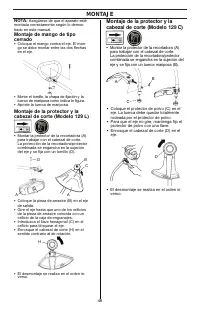
MONTAJE 1 # + / #!(# L# 7K : , @A ' + 8 H 5 ' ' # 4' @2A & < * < 6 1 - $ + : ' 6 45 ' : , 5 4' # 4 : 2 . : + @.A ' : D ' 5 4 + 4 ' ' : %+ 59 @A 4 ' : + @3A 3 : ' + 6 1 # + / #!(# L# 7K M : , @A ' + 8 H 5 ' ' # 4' @.A . : @A ' 8 : 0 ' 4' : + @2A ' : ' + 6 2 9 9 L) 48
Page 49 - Montaje y desmontaje del tubo
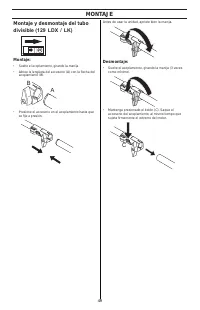
MONTAJE Antes de usar la unidad, apriete bien la manija. Desmontaje: • Suelte el acoplamiento, girando la manija (3 veces como mínimo). • Mantenga presionado el botón (C). Saque el accesorio del acoplamiento, al mismo tiempo que sujeta firmemente el extremo del motor. C Montaje y desmontaje del tubo...
Page 50 - MANIPULACION DEL COMBUSTIBLE; Transporte y almacenamiento; Carburante; Gasolina
MANIPULACION DEL COMBUSTIBLE Seguridad en el uso del combustible Nunca arranque la máquina: 1 Si derramó combustible sobre la máquina. Seque cualquier residuo y espere a que se evaporen los restos de combustible. 2 Si se salpicó el cuerpo o las ropas, cambie de ropas. Lave las partes del cuerpo que ...
Page 51 - Repostaje
MANIPULACION DEL COMBUSTIBLE Mezcla • Siempre haga la mezcla de gasolina y aceite en un recipiente limpio, homologado para gasolina. • Primero, ponga la mitad de la gasolina que se va a mezclar. Luego, añada todo el aceite y agite la mezcla. A continuación, añada el resto de la gasolina. • Agite bie...
Page 52 - ARRANQUE Y PARADA; Control antes de arrancar; Arranque
ARRANQUE Y PARADA Control antes de arrancar • Controle que el cabezal de corte y la protección de la recortadora no estén dañados ni presenten grietas. Cambie el cabezal o la protección de la recortadora si han recibido golpes o están agrietados. • Nunca utilice la máquina sin la protección o con un...
Page 53 - Parada
ARRANQUE Y PARADA Parada Para parar el motor, desconecte el encendido. ¡NOTA! El contacto de parada retorna automáticamente a la posición de arranque. Por consiguiente, antes de realizar trabajos de montaje, control y/o mantenimiento se debe quitar el capuchón de encendido de la bujía para evitar el...
Page 54 - TECNICA DE TRABAJO; Reglas básicas de seguridad
TECNICA DE TRABAJO Instrucciones generales de trabajo Reglas básicas de seguridad 1 Observe el entorno para: • Comprobar que no hayan personas, animales, etc., que puedan influir en su control de la máquina. • Para evitar que personas, animales, etc. entren en contacto con el equipo de corte u objet...
Page 55 - Técnica básica de trabajo
TECNICA DE TRABAJO Técnica básica de trabajo Después de cada momento de trabajo reduzca siempre la velocidad del motor a ralentí. Un tiempo demasiado largo a máxima velocidad sin que el motor esté cargado puede averiar seriamente el motor. Recorte de hierba con el cabezal de corte Recorte • Mantenga...
Page 56 - MANTENIMIENTO; Carburador; Reglaje del régimen de ralentí; Silenciador
MANTENIMIENTO Carburador Reglaje del régimen de ralentí Antes de hacer un ajuste, controle que el filtro de aire esté limpio y que tenga colocada la tapa. Regule el régimen de ralentí con el tornillo T, si es necesario un reajuste. Gire primero el tornillo de ralentí T en el sentido de las agujas de...
Page 57 - Sistema refrigerante
MANTENIMIENTO Sistema refrigerante Para lograr una temperatura de funcionamiento lo más baja posible, la máquina incorpora un sistema refrigerante. El sistema refrigerante está compuesto por: 1 Toma de aire en el mecanismo de arranque. 2 Aletas de enfriamiento en el cilindro. Limpie el sistema refri...
Page 58 - Filtro de aire; Limpieza del filtro de aire
MANTENIMIENTO Filtro de aire El filtro de aire debe limpiarse regularmente de polvo y suciedad para evitar: • Fallos del carburador • Problemas de arranque • Reducción de la potencia • Desgaste innecesario de las piezas del motor • Un consumo de combustible excesivo Limpie el filtro cada 25 horas de...
Page 59 - Programa de mantenimiento
MANTENIMIENTO Programa de mantenimiento A continuación incluimos una lista con los puntos de mantenimiento a efectuar en la máquina. La mayoría de los puntos se describen en el capítulo “Mantenimiento”. Mantenimiento Mantenimientodiario Mantenimientosemanal Mantenimientoanualmente Limpie la parte ex...
Page 60 - DATOS TECNICOS; Datos técnicos
10,1/4,6 11,4/5,2 DATOS TECNICOS Datos técnicos NOTA: este sistema de encendido mediante una chispa cumple con la norma canadiense ICES-002. Motor Cilindrada, pulgadas/cm 3 Diámetro del cilindro, pulgadas/mm Carrera, pulgadas/mm Régimen de ralentí, rpm Régimen máximo de embalamiento recomendado, r.p...

















 Husqvarna 115iHD55
User Manual
Husqvarna 115iHD55
User Manual
 Husqvarna 115iL
User Manual
Husqvarna 115iL
User Manual
 Husqvarna 115iPT4
User Manual
Husqvarna 115iPT4
User Manual
 Husqvarna 120
User Manual
Husqvarna 120
User Manual
 Husqvarna 120iTK4-P
User Manual
Husqvarna 120iTK4-P
User Manual
 Husqvarna 120 Mark II
User Manual
Husqvarna 120 Mark II
User Manual
 Husqvarna 122C
User Manual
Husqvarna 122C
User Manual
 Husqvarna 122HD45
User Manual
Husqvarna 122HD45
User Manual
 Husqvarna 122L
Quick Guide
Husqvarna 122L
Quick Guide
 Husqvarna 122LK
User Manual
Husqvarna 122LK
User Manual
 Husqvarna 122LKE
Quick Guide
Husqvarna 122LKE
Quick Guide
 Husqvarna 122LKH
Quick Guide
Husqvarna 122LKH
Quick Guide
 Husqvarna 122LKP
Quick Guide
Husqvarna 122LKP
Quick Guide
 Husqvarna 122RJ
Quick Guide
Husqvarna 122RJ
Quick Guide
 Husqvarna 125B
User Manual
Husqvarna 125B
User Manual