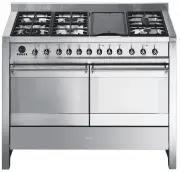
Page 2 - Table of Contents; INSTRUCTIONS FOR THE INSTALLER: these are intended for the
Table of Contents 1. PRECAUTIONS FOR SAFETY AND USE ____________________________ 4 2. INSTALLING THE APPLIANCE ____________________________________ 6 3. ADAPTATION TO DIFFERENT TYPES OF GAS______________________ 12 4. FINAL OPERATIONS ___________________________________________ 14 5. DESCRIPTION OF ...
Page 3 - Presentation; PRECAUTIONS FOR SAFETY AND USE
Presentation 1. PRECAUTIONS FOR SAFETY AND USE THIS MANUAL IS AN INTEGRAL PART OF THE APPLIANCE. TAKE GOOD CARE OF IT AND KEEP IT TO HAND THROUGHOUT THE COOKER'S LIFE CYCLE. USERS ARE ADVISED TO READ THIS MANUAL AND ALL THE INSTRUCTIONS IT CONTAINS BEFORE USING THE COOKER. ALSO KEEP THE SET OF NOZZL...
Page 5 - Instructions for the Installer; INSTALLING THE APPLIANCE; It is the law that all gas appliances are installed by; Positioning and levelling the appliance
Instructions for the Installer 6 2. INSTALLING THE APPLIANCE It is the law that all gas appliances are installed by authorised persons . Clearance around the cooker must comply with the requirements of AS5601. 2.1 Positioning and levelling the appliance The appliance is equipped with wheels and adju...
Page 6 - use
Instructions for the Installer 7 For operation on 380-415V3N ∼ : use an H05RR-F-type five-core cable (5 x 1.5 mm 2 ). For operation on 380-415V2N ∼ : use an H05RR-F-type four-core cable (4 x 2.5 mm 2 ). For operation on 220-240V ∼ : use an H05RR-F-type three-core cable (3 x 4 mm 2 ). The cable end t...
Page 7 - Gas connection; annealed copper pipe or
Instructions for the Installer 8 2.3 Gas connection This appliance is suitable for installation with Natural Gas or ULPG (propane). Refer to page 12 for the relevant burner pressure and appropriate injector sizes. When the appliance is to be connected to Natural Gas then the pressure regulator suppl...
Page 8 - Room ventilation; for appliances not equipped with gas safety; Clearance above and around domestic cookers
Instructions for the Installer 9 2.4 Room ventilation Caution – This cooker may only be installed and operated in rooms permanently ventilated in accordance with current regulations. For proper operation of a gas appliance it is essential for the air necessary for combustion of the gas to be able to...
Page 9 - 0 mm or more, or the horizontal surface shall be above the
Instructions for the Installer 10 REQUIREMENTS 1 Overhead clearances – (Measurement A) Range hoods and exhaust fans shall be installed in accordance with the manufacturer’s instructions. However, in no case shall the clearance between the highest part of the hob of the cooking appliance and a range ...
Page 10 - Instruction for wall fixing; installed. Please refer to instruction below.
Instructions for the Installer 11 2.6 Instruction for wall fixing In order to prevent accidental tipping of the appliance, for example by a child climbing onto the open door, the stabilizing means must be installed. Please refer to instruction below. 1) Fix the screw to the wall and hook the chain (...
Page 11 - ADAPTATION TO DIFFERENT TYPES OF GAS; Changing nozzles; unscrew the burner nozzles with a 7 mm socket wrench
Instructions for the Installer 12 3. ADAPTATION TO DIFFERENT TYPES OF GAS Before performing any cleaning or maintenance work, switch off the power supply to the appliance. The cooking hob of the cooker is preset for natural gas at a pressure of 1.0 kPa. In the case of functioning with other types of...
Page 12 - Burner and nozzle characteristics table; ULPG; Hob burner layout
Instructions for the Installer 13 3.2 Burner and nozzle characteristics table Burner ULPG ( PROPANE ) – 2.75 KPa Nominal gas consumption (MJ/h) Injector (mm) Auxiliary 3.9 0.54 Semi rapid 6.3 0.68 Rapid 10.8 0.88 WOK 15 1.05 Fish pan 6.8 0.72 Burner NG ( NATURAL GAS ) – 1.0 KPa Nominal gas consumpti...
Page 13 - FINAL OPERATIONS; for the new gas. The label is supplied in the bag with the nozzles.; Adjusting the minimum setting for town gas and natural; Fix the splash-back to the hob by tightening the screws C.
Instructions for the Installer 14 4. FINAL OPERATIONS After changing the nozzles, put the pan stands, the burner caps and flame diffuser rings back in place. After adjusting for use of a gas other than the gas used for testing the appliance, replace the gas setting label on the appliance with the la...
Page 14 - Instructions for the User; DESCRIPTION OF CONTROLS; The front panel; At first use after a power blackout, press the middle knob; LEFT-HAND OVEN THERMOSTAT KNOB
Instructions for the User 5.1 5. DESCRIPTION OF CONTROLS The front panel All the cooker's control and monitoring devices are placed together on the front panel. At first use after a power blackout, press the middle knob for 1 / 2 seconds to enable oven cooking operations. KEY TO SYMBOLS FRONT LEFT-H...
Page 15 - LEFT-HAND OVEN FUNCTION SELECTOR KNOB; HOB BURNER CONTROL KNOB
Instructions for the User 16 LEFT-HAND OVEN FUNCTION SELECTOR KNOB Turn the knob to select one of the following functions: NO FUNCTION SET GRILL ELEMENT + FAN TOP AND BOTTOM HEATING ELEMENTS TOP AND BOTTOM HEATING ELEMENTS + FAN BOTTOM HEATING ELEMENT + FAN GRILL ELEMENT BOTTOM HEATING ELEMENT + FAN...
Page 16 - RIGHT-HAND OVEN THERMOSTAT KNOB; Turn the knob to select one of the following functions:
Instructions for the User RIGHT-HAND OVEN THERMOSTAT KNOB The cooking temperature is set by turning the knob clockwise to the value required, between 50° and 280° ( )C. The light comes on to indicate that the oven is heating up. This light goes out when the set temperature is reached. When it flashe...
Page 17 - Electronic Analogue Clock; LIST OF FUNCTIONS; Setting the time; for setting the current time. Press the value modification keys
Instructions for the User 18 5.2 Electronic Analogue Clock LIST OF FUNCTIONS MINUTE-MINDER BUTTON END OF COOKING BUTTON CLOCK ADJUSTMENT AND RESET VALUE DECREASE BUTTON VALUE INCREASE BUTTON 5.2.1 Setting the time When the oven is used for the first time, or after an interruption in the electricity ...
Page 19 - Programming
Instructions for the User 20 5.2.3 Programming Cooking duration: the 2nd button can be pressed to set the cooking duration. Before it can be set, the thermostat must be turned to the cooking temperature required and the function selector knob to any setting. To set the cooking duration, proceed as f...
Page 21 - USING THE HOB; Lighting the hob burners; The special pan stand
Instructions for the User 22 6.1 6. USING THE HOB Lighting the hob burners Before lighting the hob burners check that the flame diffuser rings are correctly in place with their respective burner caps, making sure that the holes A in the flame diffusers are aligned with the plugs and thermocouples. T...
Page 22 - Practical hints for using the hob burners
Instructions for the User 6.2 Practical hints for using the hob burners For better burner efficiency and to minimise gas consumption, use pans with lids of suitable size for the burner, so that flames do not reach up the sides of the pan (see point "6.3 Pan Diameters"). Once the contents com...
Page 23 - USING THE OVENS; Precautions and General Advice; not interfere with the hot air circulation inside the oven.; Oven light; It comes on when the function selector is turned to any setting.; Cooling fan system; Caution: when the ovens are in use, the bottom inside surface of the
Instructions for the User 24 7.1 7. USING THE OVENS Precautions and General Advice When the oven is used for the first time, it should be heated to the maximum temperature (250-220°C) for long enough to burn off any oily residues left by the manufacturing process, which might contaminate foods with ...
Page 24 - Precautions for using the pizza plate
Instructions for the User 8. USING THE "PIZZA" FUNCTION This appliance is equipped with a function specially developed for cooking pizza. This function is identified by the symbol on the oven functions knob. To cook a pizza, proceed as described below. Set the oven functions knob on the symb...
Page 25 - Attention; Grilling processes must never last more than 60 minutes.; To save energy
Instructions for the User 26 8.2 Attention • Grilling processes must never last more than 60 minutes. • The oven door must be closed during grill and grill + rotisserie cooking operations. • To prevent hazardous overheating, the appliance's glass lid must always be raised when using the oven or gril...
Page 26 - ACCESSORIES AVAILABLE
Instructions for the User 9. ACCESSORIES AVAILABLE The oven is fitted with 4 runners for placing trays and shelves at different heights. Oven shelf: for cooking food on plates, small cakes or roasts or foods requiring light grilling. Tray grid: for placing on top of a tray for cooking foods which ma...
Page 27 - Optional accessories
Instructions for the User 28 Pizza plate: specially designed for cooking pizza. For use as described in point "8 Using the "pizza" function". Optional accessories The bottom plinth and self-cleaning oven liners can be ordered through our Authorised Service Centres. Before using acces...
Page 28 - COOKING ADVICE; The oven should always be preheated in fan mode to 30/40°C above the; FUNCTION SELECTOR
Instructions for the User 10. COOKING ADVICE The oven should always be preheated in fan mode to 30/40°C above the cooking temperature. This considerably shortens cooking times and reduces electricity consumption, as well as giving better results. The oven door must be closed during cooking operation...
Page 30 - and appearance are retained intact.
Instructions for the User 10.4 Hot-air grilling (left/right oven) FUNCTION SELECTOR THERMOSTAT FROM 50° C TO 250°C THERMOSTAT FROM 50° TO 280°C ( ) Allows uniform heat distribution with better penetration to the core of foods. Foods are lightly browned on the outside but still soft on the inside. Du...
Page 31 - is being kept constant.
Instructions for the User 32 10.6 Rotisserie cooking (left-hand oven) FUNCTION SELECTOR THERMOSTAT SET AT 50 -200°C Recommended for small pieces of meat. Prepare the rotisserie rod with the food, tightening the screws A of the prongs. Fit the shelf B onto the third runners from the bottom. Remove th...
Page 32 - Recommended cooking tables; CONVENTIONAL COOKING; GRILLING
Instructions for the User 10.7 Recommended cooking tables Cooking times, for meat in particular, vary depending on the food's thickness and quality and personal preference. CONVENTIONAL COOKING RUNNER HEIGHT FROM BOTTOM TEMPERATURE (°C) TIME IN MINUTES (*) PASTA LASAGNE PASTA BAKES 2 - 3 2 - 3 210 -...
Page 34 - CLEANING AND MAINTENANCE; Never use a jet of steam for cleaning the inside of the oven; Cleaning stainless steel; after each use, first allowing it to cool.; Routine daily cleaning
Instructions for the User 11. CLEANING AND MAINTENANCE Never use a jet of steam for cleaning the inside of the oven . 11.1 Cleaning stainless steel To keep stainless steel in good condition, it must be cleaned regularly, after each use, first allowing it to cool. 11.1.1 Routine daily cleaning When c...
Page 35 - Cleaning the hob components; Before carrying out any operation involving access to live parts,; Barbecue griddle plate
Instructions for the User 36 11.2 Cleaning the hob components Before carrying out any operation involving access to live parts, disconnect the appliance from the electricity supply. 11.2.1 Barbecue griddle plate After leaving it to cool, remove the barbecue plate by lifting it from the front as show...
Page 36 - The burner caps, flame diffuser rings and burners; To keep the ovens in good condition, they must be cleaned regularly,
Instructions for the User 11.2.4 The burner caps, flame diffuser rings and burners The burner caps and flame diffuser rings can be removed for easier cleaning; wash them in hot water and non-abrasive detergent, taking care to remove all deposits, and wait for them to dry completely. Replace the burn...
Page 37 - Oven liners; Replace the liners in their original positions.
Instructions for the User 38 11.3.1 Oven liners The oven is fitted with enamelled liners that are continuously self-cleaning. These liners simplify cleaning of the oven and ensure it continues to perform well over time. 11.3.2 Using the self-cleaning liners To keep the inside of the oven clean and f...
Page 38 - Door glazing; The pizza plate must be washed separately
Instructions for the User 11.4 Door glazing The glass in the door should always be kept thoroughly clean. Use absorbent kitchen roll; remove stubborn dirt with a damp sponge and ordinary detergent. Do not use abrasive or corrosive cleaners for cleaning the door glazing. (e.g. powder products, oven-c...
Page 39 - Never use detergents
Instructions for the User 40 • Before cleaning, remove any dirt burnt onto the stone with the aid of a metal spatula or a scraper of the kind used for cleaning ceramic hobs; • For best results, the stone must still be warm; otherwise, wash it in hot water; • Use metal mesh or non-abrasive scouring p...
Page 40 - EXTRAORDINARY MAINTENANCE; Changing the light bulbs
Instructions for the User 12. EXTRAORDINARY MAINTENANCE Occasionally, the ovens will require minor servicing procedures or the replacement of parts subject to wear and tear, such as gaskets, light bulbs, etc. The specific operations for each procedure of this kind are provided below. Before carrying...
Page 41 - Removing the door
Instructions for the User 42 12.2 Removing the door Open the door completely and insert the pins (supplied) into the holes fromthe inside. Close the door to an angle of about 45° and lift it off. Toreassemble, fit the hinges into their grooves, then lower the door into placeand extract the pins. 12....