Page 2 - Instructions; General safety instructions
Instructions 4 1 Instructions 1.1 General safety instructions Risk of personal injury • During use the appliance and its accessible parts become very hot. Never touch the heating elements during use. • Protect your hands by wearing oven gloves when moving food inside the oven. • Never try to put out...
Page 4 - Risk of damaging the appliance
Instructions 6 damaged, contact technical support immediately and they will replace it. Risk of damaging the appliance • Do not use abrasive or corrosive detergents (e.g. scouring powders, stain removers and metallic sponges) on glass parts. • Use wooden or plastic utensils.• Racks and trays should ...
Page 5 - Installation
Instructions 7 EN • Do not use a steam cleaner to clean the appliance. • Do not use harsh abrasive cleaners or sharp metal scrapers to clean the oven glass door since they can scratch the surface, which may result in shattering of the glass. • Do not use cleaning products containing chlorine, ammoni...
Page 7 - For this appliance
Instructions 9 EN For this appliance • WARNING: Ensure that the appliance is switched off before replacing the lamp to avoid the possibility of electric shock. • This appliance is not intended to be operated by means of external timer or separate remote control system. • Do not rest any weight or si...
Page 8 - How to read the user manual
Instructions 10 1.6 To save energy • Only preheat the appliance if the recipe requires you to do so. • Unless otherwise indicated on the package, defrost frozen foods before placing them in the oven. • When cooking several types of food it is recommended to cook the foods one after the other to make...
Page 9 - Description; General Description
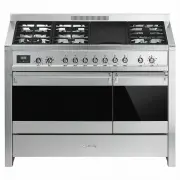
Description 11 EN 2 Description 2.1 General Description 1 Cooking hob 2 Control panel 3 Seals 4 Main oven door 5 Auxiliary oven door 6 Fan 7 Inside lights 8 Storage compartment Rack/tray support frame shelf
Page 10 - = Fish kettle burner
Description 12 2.2 Cooking hob AUX = Auxiliary burner SR = Semi-rapid burner FB = Fish kettle burner R = Rapid burner UR2 = Ultra-rapid burner BBQ = Barbecue plate 2.3 Control panel 1 Programmer clock Useful for displaying the current time, setting programmed cooking operations and programming the m...
Page 12 - Available accessories; WOK ring
Description 14 Available accessories WOK ring Useful when using a wok. Raised pan support To prevent damage to the worktop, a raised pan support is available to place under pans having a diameter greater than those indicated in the “Cookware diameters” table in section 3.3 “Using the hob”. The pan s...
Page 13 - Use; Tray rack
Use 15 EN Tray rack To be placed over the top of the oven tray; for cooking foods which may drip. Rack Used for supporting containers with food during cooking. Rotisserie Useful for cooking chicken and all foods that require uniform cooking over their entire surface. The oven accessories intended to...
Page 14 - Danger of burns
Use 16 3 Use 3.1 Instructions High temperature inside the oven during use Danger of burns • Keep the oven door closed during cooking. • Protect your hands wearing heat resistant gloves when moving food inside the oven. • Do not touch the heating elements inside the appliance. • Do not pour water dir...
Page 15 - Using the accessories
Use 17 EN 3.2 First use 1. Remove any protective film from the outside or inside of the appliance, including accessories. 2. Remove any labels (apart from the technical data plate) from the accessories and from the oven cavity. 3. Remove all the accessories from the appliance and clean them (see 4 C...
Page 16 - Ring reducers
Use 18 and towards the oven back. Ring reducers The ring reducers have to be placed on the hob grids. Make sure they are placed properly. Rotisserie (auxiliary oven) 1. Position the rotisserie support on the third shelf of the auxiliary oven. 2. Screw on the handle provided so that you can handle th...
Page 17 - and wait 60 seconds before trying
Use 19 EN 3.4 Using the hob All the appliance’s control and monitoring devices are located together on the front panel. The burner controlled by each knob is shown next to the knob. The appliance is equipped with an electronic ignition device. Simply press the knob and turn it anti-clockwise to the ...
Page 18 - Barbecue plate
Use 20 Barbecue plate For grilling, cooking au gratin or as a barbecue.1. Remove the barbecue plate before starting cooking. 2. Lift heating element A and hold it in place with stop B . 3. In the tray under the heating element you can put: • Water to catch the fat and any grease dripping from the co...
Page 19 - Switching on the main oven; and
Use 21 EN 3.5 Using the ovens Switching on the main oven To switch on the oven:1. Select the cooking function using the function knob. 2. Select the temperature using the temperature knob. Main oven functions Regular flashing of the thermostat indicator light during cooking is normal and indicates t...
Page 20 - Auxiliary oven functions
Use 22 Auxiliary oven functions Fan with round heating element. The combination of the fan and the round heating element (incorporated in the rear of the oven) allows you to cook different foods on several levels, as long as they need the same temperatures and same type of cooking. Hot air circulati...
Page 21 - Using the storage compartment; General advice
Use 23 EN 3.6 Using the storage compartment The storage compartment is at the bottom of the cooker. To open it, pull the handle towards you. It can be used to store cookware or metallic objects necessary when using the appliance. 3.7 Cooking advice General advice • Use a fan assisted function to ach...
Page 22 - Advice for defrosting and proving
Use 24 • While cooking desserts or vegetables, excessive condensation may form on the glass. In order to avoid this, open the door very carefully a couple of times while cooking. Advice for defrosting and proving • Place frozen foods without their packaging in a lidless container on the first shelf ...
Page 23 - Setting the time
Use 25 EN Setting the time On the first use, or after a power failure, the digits will be flashing on the appliance’s display. 1. Hold down the clock key for two seconds. The dot between the hours and the minutes flashes. 2. The time can be set via the value increase key and value decrease key . Kee...
Page 24 - Programmed cooking
Use 26 7. Press the clock key to reset the programmer clock. Programmed cooking 1. Set the cooking time as described in the previous point “Timed cooking”. 2. Hold the menu key down for 2 seconds. 3. Press the menu key again. The display will show the digits and the text in sequence, while the symbo...
Page 25 - Minute minder timer
Use 27 EN 10. Return the function and temperature knobs to 0 . 11. To turn off the buzzer just press any key of the programmer clock. 12. Press the and keys at the same time to reset the set program. Minute minder timer The minute minder timer can be activated at any time. 1. Keep the clock key pres...
Page 26 - Modifying the set data
Use 28 Modifying the set data 1. Press the clock key . 2. Use the value increase and value decrease keys to set the number of minutes required. Deleting the set data 1. Press the clock key . 2. Hold down the value increase and value decrease keys at the same time. 3. Then switch off the oven manuall...
Page 27 - Auxiliary oven cooking information table
Use 29 EN Auxiliary oven cooking information table Food Weight (Kg) Function Runner position from the bottom Temperature (°C) Time (minutes) Spit-roast chicken 1.2 Rotisserie 220 - 250 70 - 80 Rotisserie pork neck 2.5 Rotisserie 200 200 - 220 Roast rabbit 1 Static 2 190 - 200 85 - 90 Roast chicken 1...
Page 28 - Main oven
Use 30 Main oven cooking information table Food Weight (Kg) Function Runner position from the bottom Temperature (°C) Time (minutes) Lasagne 3 - 4 Static 1 220 - 230 45 - 50 Pasta bake 3 - 4 Static 1 220 - 230 45 - 50 Roasted veal 2 Fan with round heating element. 2 180 - 190 90 - 100 Pork loin 2 Fa...
Page 29 - Cleaning and maintenance; Cleaning the appliance; Improper use
Cleaning and maintenance 31 EN 4 Cleaning and maintenance 4.1 Instructions 4.2 Cleaning the appliance To keep the surfaces in good condition, they should be cleaned regularly after use. Let them cool first. Ordinary daily cleaning Always use specific products only that do not contain abrasives or ch...
Page 30 - Igniters and thermocouples; Removing the doors; Grasp the door on both sides with both; Cleaning the door glazing
Cleaning and maintenance 32 Igniters and thermocouples For correct operation the igniters and thermocouples must always be perfectly clean. Check them frequently and clean them with a damp cloth if necessary. Remove any dry residues with a wooden toothpick or a needle. 4.3 Removing the doors For eas...
Page 31 - Cleaning the inside of the ovens; • Clean the oven racks with warm water; Extraordinary maintenance; Replacing the internal light bulbs
Cleaning and maintenance 33 EN 4.5 Cleaning the inside of the ovens To keep the ovens in perfect condition, clean them regularly after allowing them to cool. • Take out all removable parts. • Clean the oven racks with warm water and non-abrasive detergents. Carefully rinse and dry damp parts. Removi...
Page 32 - turning it anticlockwise.
Cleaning and maintenance 34 1. Remove the bulb protector ( A ) by turning it anticlockwise. 2. Replace the bulb with one of the same type ( B ). 3. Re-fit the protective cover. Proceed in the same way to replace the bulb for the auxiliary oven. Installing and removing the seal To remove the seal:To ...
Page 33 - Installation; Minimum clearance to combustible surfaces; Freestanding cooker
Installation 35 EN 5 Installation 5.1 Minimum clearance to combustible surfaces Freestanding cooker A 600 mm (Overhead) measured from the highest part of the highest burner and 750 mm for an exhaust fan. B 200 mm (Vertical combustible surface) measured form the edge of the nearest burner. C 10 mm (H...
Page 34 - Natural Gas
Installation 36 This appliance is suitable for connection with rigid pipe or flexible hose. The isolating manual shut-off valve connection point must be accessible when the appliance is installed.Flexible hose assembly must be certified to AS/NZS 1869 class B or D, be of appropriate internal diamete...
Page 35 - Room ventilation
Installation 37 EN Room ventilation The appliance should be installed in rooms that have a permanent air supply in accordance with the standards in force. The room where the appliance is installed must have enough air flow for the regular combustion of gas and the necessary air change in the room it...
Page 36 - Adaptation to different types of; Replacing nozzles
Installation 38 5.3 Adaptation to different types of gas In case of operation with other types of gas, the burner nozzles must be changed and the minimum flame adjusted on the gas cocks. Replacing nozzles 1. Remove the grids, burner caps and flame-spreader crowns to access the burner cups. 2. Replac...
Page 37 - Heavy appliance
Installation 39 EN Adjusting the minimum setting for LPG Tighten the screw located at the side of the cock rod clockwise all the way. Lubricating the gas cocks Over time the gas cocks may become difficult to turn and get blocked. Clean them internally and replace the grease. Burner and nozzle specif...
Page 38 - Dimensions
Installation 40 Dimensions Position of gas and electrical connections (all measurements expressed in mm). Fastening to wall (where present) The fastening system provided must be installed to ensure the appliance is stable. If installed correctly, this system prevents the appliance from tipping over....
Page 39 - Connect the snap hook to the
Installation 41 EN 5. Connect the snap hook to the appropriate hole on the back of the appliance. Positioning and levelling the appliance After making the electrical and/or gas connections, properly level the appliance on the floor to ensure better stability. Screw or unscrew the bottom part of the ...
Page 40 - Electrical connection; General information
Installation 42 5.5 Electrical connection General information Check the mains characteristics against the data indicated on the plate. The identification plate bearing the technical data, serial number and brand name is visibly positioned on the appliance. Do not remove this plate for any reason. Pe...
Page 41 - Access to the terminal board
Installation 43 EN Access to the terminal board To connect the power supply cable, you must access the terminal board on the rear casing:1. Remove the screws fastening the plate to the rear casing. 2. Gently rotate the plate and remove it from its seat. 3. Proceed with installation of the power supp...
Page 42 - Testing; Instructions for the installer; DO NOT
Installation 44 Testing At the end of installation, carry out a brief inspection test. If the appliance fails to operate, after checking that you have followed the instructions correctly, unplug the appliance and contact Technical Support. 5.6 Instructions for the installer • The appliance must be i...