Page 3 - used by or near children.
I This household sewing machine is designed to comply with IEC/EN 60335-2-28 and UL1594. IMPORTANT SAFETY INSTRUCTIONS When using an electrical appliance, basic safety precautions should always be followed, including the following:Read all instructions before using this household sewing machine. Kee...
Page 4 - or mechanical adjustment.
II - Never operate this sewing machine if it has a damaged cord or plug, if it is not working properly, if it has been dropped or damaged, or dropped into water. Return the sewing machine to the nearest authorized dealer or service center for examination, repair, electrical or mechanical adjustment....
Page 5 - agent or a similarly qualified person, in order to avoid a hazard.; SAVE THESE INSTRUCTIONS; FOR CENELEC COUNTRIES ONLY:
III - Do not use the machine if it is wet. - If the LED lamp is damaged or broken, it must be replaced by the manufacturer or its service agent or a similarly qualified person, in order to avoid a hazard. - If the cord connected with the foot control is damaged, it must be replaced by the manufactur...
Page 6 - FOR NON CENELEC COUNTRIES:; SERVICING OF DOUBLE INSULATED PRODUCTS
IV FOR NON CENELEC COUNTRIES: This sewing machine is not intended for use by persons (including children) with reduced physical, sensory or mental capabilities, or lack of experience and knowledge, unless they have been given supervision or instruction concerning use of the sewing machine by a perso...
Page 7 - List of contents; Machine Basics
V List of contents Machine Basics Principal Parts of the Machine ..................................................................................................................................................1 Connecting Machine to Power Source .......................................................
Page 8 - Principal Parts of the Machine
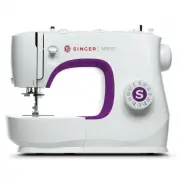
11 1. Thread tension dial 2. Thread take-up lever 3. Reverse sewing lever 4. Thread cutter 5. Presser foot 6. Needle plate 7. Removable extension table/ accessory storage 8. Stitch width dial 9. Bobbin stopper 10. Stitch length dial 11. Pattern selector dial 12. Buttonhole lever (Model M3300/ M3305/...
Page 10 - Connecting Machine to Power Source
3 Connect the machine to a power source as illustrated. (1) This appliance is equipped with a polarized plug which must be used with the appropriate polarized outlet. (2) Attention: Unplug power cord when machine is not in use. Foot control The foot control pedal regulates the sewing speed. (3) Atte...
Page 11 - Two Step Presser Foot Lifter
4 When sewing several layers or thick fabrics, the presser foot can be raised to a higher position for easy positioning of the work. (A) Attention: Your SINGER ® machine is adjusted to provide the best stitch result at normal room temperature. Extreme hot and cold temperatures can affect the sewn re...
Page 12 - Accessories
5 Standard accessories a. All purpose foot b. Zipper foot c. 4-Step buttonhole foot (Model M3200/ M3205) d. 1-Step buttonhole foot (Model M3300/ M3305/ M3400/ M3405/ M3500/ M3505) e. Button sewing foot f. L-screwdriver g. Seam ripper/ brush h. Pack of needles i. SINGER Class 15 bobbins (4x) j. Edge/...
Page 13 - Winding the Bobbin
6 Winding the Bobbin - Place thread and corresponding spool holder on to spool pin. (1/2) - Snap thread into thread guide. (3) - Wind thread clockwise around bobbin winder tension discs. (4) - Thread bobbin as illustrated and place on spindle. (5) - Push bobbin spindle to right. (6) - Hold thread en...
Page 14 - Inserting the Bobbin
7 When inserting or removing the bobbin, the needle must be fully raised. - Open the hinged cover. (1) - Pull the bobbin case tab (a) and remove the bobbin case. (2) - Hold the bobbin case with one hand. Insert the bobbin so that the thread runs in a clockwise direction (arrow). (3) - Pull the threa...
Page 15 - Thread Tension
8 Upper thread tension Basic thread tension setting: "4". To increase the tension, turn the dial to the next number up. To reduce the tension, turn the dial to the next number down. 1. Normal thread tension for straight stitch sewing. 2. Thread tension too loose for straight stitch sewing. T...
Page 16 - Threading the Upper Thread
9 This is a simple operation but it is important to carry out correctly as by not doing so several sewing problems could result. - Raise the needle to its highest position by turning the handwheel towards you (counterclockwise) so that the mark on the handwheel points directly up. Raise the presser ...
Page 17 - Automatic Needle Threader
10 - Raise the needle to its highest position. - Pass thread around thread guide (A). (1) - Press lever (B) down as far as it will go. (2) - The threader automatically swings to the threading position (C). - Pass the thread in front of the needle around the hook (D) from bottom to top. - Release lev...
Page 18 - Raising the Bobbin Thread
11 Hold the upper thread with the left hand. (1) Turn the handwheel towards you (counterclockwise) lowering, then raising needle. Note: If it is difficult to raise the bobbin thread, check to make sure the thread is not trapped by the hinged cover or the Removable Extension Table. Raising the Bobbin...
Page 19 - How to Choose Your Pattern
12 To select a stitch, simply turn the pattern selector dial. The pattern selector dial may be turned in either direction. For straight stitch, select pattern " " with the pattern selector dial. For zigzag stitch, select pattern " " with the pattern selector dial. To obtain the other...
Page 20 - Stitch Width Dial & Stitch Length Dial
13 Function of stitch width dial The maximum zigzag stitch width for zigzag stitching is 5mm; however, the width can be reduced on any patterns. The width increases as you move zigzag dial from "0" - "5". The stitch width dial is also the control for the straight stitch infinite need...
Page 21 - Sewing Straight Stitch
14 Sewing Straight Stitch To begin sewing, set the machine for straight stitch. (1) Place the fabric under the presser foot with the fabric edge lined up with the desired seam guide line on the needle plate. (2) Lower the presser foot lifter, and then step on the foot control to start sewing. (3)
Page 23 - Choosing Stretch Stitch Patterns
16 Choosing Stretch Stitch Patterns The stretch stitch patterns are indicated with a blue color on the pattern selector dial. To select these stitches, turn the pattern selector dial to the desired pattern. Then, turn the stitch length dial to the indicator marked "S1" or "S2". Thoug...
Page 24 - Blind Hem
17 For hems on curtains, trousers, skirts, etc. Blind hem for stretch fabrics. Blind hem for firm fabrics. Note: It takes practice to sew blind hems. Always make a sewing test first. Set the stitch length dial with the range shown on the diagram at the right. Blind hems, however, are normally sewn w...
Page 27 - Sewing on Buttons
20 Install the darning plate. (1) Change the all purpose foot to the button sewing foot. (2) Set the stitch length to "0". Place the button and fabric under the Button Sewing foot, as illustrated in (3). Set the machine for zig-zag stitch, then set the width to number "3" - "5�...
Page 28 - Zippers and Piping
21 Set the machine as illustrated. Change to zipper foot. The zipper foot can be attached right or left, depending on which side of the foot you are going to sew. (1) To sew past the zipper tab, lower the needle into the fabric, raise the presser foot and push the zipper tab behind the presser foot....
Page 29 - Installing the Removable Extension Table
22 Hold the removable extension table horizontally, and push it in the direction of the arrow. (1) To remove the extension table, pull it toward the left. Installing the Removable Extension Table General Information The inside of the removable extension table can be utilized as an accessory box. To ...
Page 30 - Changing the Presser Foot
23 Removing the presser foot Push the presser foot (e) to disengage from the cut-out (c). (1) Attaching the presser foot Install the pin (d) of the presser foot (e) into the cut-out (c) of the presser foot holder. (2) Removing and attaching the presser foot shank Raise the presser bar (a) with the p...
Page 32 - Darning Plate
25 For certain types of work, (e.g. darning or free-hand embroidery), the darning plate must be used. Install the darning plate as illustrated. For normal sewing, remove the darning plate. For free-motion sewing it is recommended to use a darning/ embroidery foot, available as an optional accessory ...
Page 33 - Inserting the Needle
26 Change the needle regularly, especially if it is showing signs of wear and causing problems. For best sewing results always use SINGER ® Brand Needles. Insert the needle as illustrated as follows: A. Loosen the needle clamp screw and tighten again after inserting the new needle. (1) B. The flat s...
Page 34 - Maintenance
27 Attention: Disconnect the machine from the electrical supply by removing the plug from the main socket. When cleaning the machine, it must always be disconnected from the electrical supply. Remove the needle plate: Turn the handwheel until the needle is fully raised. Open the hinged front cover a...
Page 35 - Troubleshooting Guide
28 Troubleshooting Guide Problem Cause Correction Upper thread breaks 1. The machine is not threaded correctly. 1. Rethread the machine. 2. The thread tension is too tight. 2. Reduce the thread tension. (lower number) 3. The thread is too thick for the needle. 3. Select a larger needle. 4. The needl...