Page 2 - Confirming the Package Contents
Confirming the Package Contents The following items are included in the package. If something is missing please contact the retail outlet at which you purchased the product. You may not be able to achieve the full performance of this camera with the included memory card. g a b d e h Camera AA-size A...
Page 3 - This guide is divided into the following two sections.; Learning More; The PDF Manuals are included in the supplied CD-ROM.
Let’s Get Started! 1 Let’s Get Started! This guide is divided into the following two sections. This section explains how to prepare the camera for use and the basics of shooting, viewing and printing images. Start out by familiarizing yourself with the camera and mastering the basics. Once you have ...
Page 4 - Table of Contents; Items marked with a; Components Guide
Table of Contents 2 Table of Contents Items marked with a are lists or charts that summarize camera functions or procedures. Please Read . . . . . . . . . . . . . . . . . . . . . . . . . . . . . . . . . . . . 6 Components Guide 40 Indicators . . . . . . . . . . . . . . . . . . . . . . . . . . . . . ...
Page 5 - Shooting Using the Mode Dial; Check the Focus and Facial Expressions of Subjects
Table of Contents 3 Changing the Compression (Still Images) . . . . . . . . . . . . . 64 Adjusting the ISO Speed . . . . . . . . . . . . . . . . . . . . . . . 65 Shooting Using the Mode Dial 66 Mode Dial . . . . . . . . . . . . . . . . . . . . . . . . . . . . . . . . . . . . . . 66Shooting Modes for...
Page 7 - Symbol Conventions in this Guide; About this Guide; : This mark denotes issues that may affect the camera’s
Table of Contents 5 Symbol Conventions in this Guide About this Guide : This mark denotes issues that may affect the camera’s operation. : This mark denotes additional topics that complement the basic operating procedures. Explanations in this guide are based on the camera’s default settings at time...
Page 8 - Please Read; Test Shots
Please Read 6 Please Read Test Shots Before you try to photograph important subjects, we highly recommend that you shoot several trial images to confirm that the camera is operating and being operated correctly.Please note that Canon Inc., its subsidiaries and affiliates, and its distributors are no...
Page 9 - Video Format; Please see; Camera Body Temperature
Please Read 7 Video Format Please set the camera’s video signal format to the one used in your region before using it with a TV monitor (p. 141) . Language Setting Please see Setting the Display Language (p. 14) to change the language setting. Camera Body Temperature If your camera is used for prolo...
Page 11 - Getting Started
9 z Preparations z Shooting Still Images z Viewing Still Images z Erasing z Printing z Embedding the Date in the Image Data z Shooting Movies z Viewing Movies z Downloading Images to a Computer z System Map Getting Started
Page 12 - Preparations; Slide and hold the battery cover lock (; Installing the Batteries and Memory
Preparations 10 Getting Started Preparations 1. Slide and hold the battery cover lock ( a ), then slide ( b ) and open ( c ) the cover. 2. Install two batteries. Installing the Batteries and Memory Card Slide the cover ( b ). Open the cover ( c ). b c a Battery Cover Lock Positive end (+) Insert the...
Page 13 - Insert the memory card until it clicks into place.
Preparations 11 Getting Started 3. Insert the memory card until it clicks into place. 4. Close the cover ( d ), and press downward as you slide it until it clicks into place ( e ). Ensure that the memory card is correctly oriented before inserting it in the camera. Inserting it backward may cause th...
Page 14 - Open the cover and remove the batteries.; To Remove the Memory Card; Take care that you do not drop the batteries.
Preparations 12 Getting Started To Remove the Batteries Open the cover and remove the batteries. To Remove the Memory Card Use a finger to push the memory card in until you hear a click, then release it. Take care that you do not drop the batteries. Use the wrist strap to avoid dropping the camera d...
Page 15 - or; To Change a Previously Set Date/Time; Setting the Date and Time
Preparations 13 Getting Started The Date/Time settings menu will appear the first time the power is turned on. 1. Press the ON/OFF button. 2. Select the month, day, year and time, and the display order. 1. Use the or button to select an option. 2. Use the or button to set the value. 3. Press the but...
Page 16 - Set the mode switch to; Setting the Display Language
Preparations 14 Getting Started You can change the language displayed in the LCD monitor menus and messages. 1. Set the mode switch to (playback). 2. Hold down the button and press the button. 3. Use the , , or button to select a language. 4. Press the button. The date/time setting screen will appea...
Page 17 - Shooting Still Images; • The start-up sound will play and the start-up image will display in; Select a shooting mode.; Set the mode switch to; Aim the camera at the subject.; • When the camera focuses, it beeps twice and the indicator lights.; Avoiding Camera Shake
Shooting Still Images 15 Getting Started Shooting Still Images 1. Press the ON/OFF button. • The start-up sound will play and the start-up image will display in the LCD monitor. • Pressing the ON/OFF button again turns the power off. 2. Select a shooting mode. 1. Set the mode switch to (shooting). 2...
Page 18 - • If you hold the shutter button down after a shot, the image will; To Shoot Images in Focus; Mute Setting; When you hold down the
Shooting Still Images 16 Getting Started 5. Press the shutter button fully (all the way) to shoot. • The shutter sound will play once and the image will record.• Recorded images are displayed on the LCD monitor for approximately 2 seconds immediately after shooting (Rec. Review). You can shoot by pr...
Page 19 - Set the mode dial to; MENU
Shooting Still Images 17 Getting Started Shooting in Easy Mode This camera features a shooting mode, Easy mode, that automatically selects all camera settings except the flash. This mode is ideal for first time camera users, or users who do not make many settings. You can select whether or not to us...
Page 20 - Viewing Still Images
Viewing Still Images 18 Getting Started Viewing Still Images 1. Press the ON/OFF button. 2. Set the mode switch to (playback). 3. Use the or button to display the image you wish to view. • Use the button to move to the previous image and the button to move to the next image. • The images advance mor...
Page 21 - Erasing
Erasing 19 Getting Started Erasing 1. Set the mode switch to (playback). 2. Use the or button to select an image to erase and press the button. 3. Confirm that [Erase] is selected and press the button. To exit instead of erasing, select [Cancel]. Please note that erased images cannot be recovered. E...
Page 22 - Printing; Connect the camera to a direct print compatible printer.; Direct Print User Guide
Printing 20 Getting Started Printing 1. Connect the camera to a direct print compatible printer. • Open the terminal cover and plug the interface cable in all the way. • See the printer’s user guide for connection instructions.• Since this camera uses a standard protocol (PictBridge), you can use it...
Page 23 - Press the; Printing Images in a Print List; Connect the camera to the printer.
Printing 21 Getting Started Printing from a Print List You can add images directly to a print list by merely pressing the button immediately after shooting or playing back an image. You can then print the images from the print list easily, when connecting the camera to a printer. Add to the Print Li...
Page 24 - Embedding the Date in the Image Data; • The image size is fixed to the 2M (1600 × 1200) setting and the; • You can also make this setting in other shooting modes
Embedding the Date in the Image Data 22 Getting Started Embedding the Date in the Image Data This section explains how to embed date information on images as they are recorded (Date Stamp).• The date stamp cannot be deleted from the image data once it has been embedded. Ensure that the camera’s date...
Page 25 - Select
Embedding the Date in the Image Data 23 Getting Started 3. Select (Date Stamp). 1. Press the button. 2. Use the or button to select . 3. Use the or button to select . • The area that will not print displays in gray. • Press the button to switch to [Date & Time] with the or button. You can use th...
Page 26 - Shooting Movies
Shooting Movies 24 Getting Started Shooting Movies 1. Press the ON/OFF button. 2. Select a shooting mode. 1. Set the mode switch to (shooting). 2. Set the mode dial to (Movie). 3. Press the button. 4. Use the or button to select (Standard). 5. Press the button. 3. Aim the camera at the subject. z Do...
Page 28 - Viewing Movies; • Images with a; Use the or button to select; button
Viewing Movies 26 Getting Started Viewing Movies 1. Press the ON/OFF button. 2. Set the mode switch to (playback). 3. Use the or button to display a movie and press the button. • Images with a icon are movies. 4. Use the or button to select (Play) and press the button. • The movie will start playing...
Page 29 - Downloading Images to a Computer; We recommend to use the supplied software.; Items to Prepare; Windows
Downloading Images to a Computer 27 Getting Started Downloading Images to a Computer We recommend to use the supplied software. Items to Prepare • Camera and computer• Canon Digital Camera Solution Disk supplied with the camera• Interface cable supplied with the camera System Requirements Please ins...
Page 30 - Installing the software.; Place the Canon Digital Camera Solution Disk in the; Macintosh; Preparing to Download Images
Downloading Images to a Computer 28 Getting Started 1. Installing the software. Windows 1. Place the Canon Digital Camera Solution Disk in the computer’s CD-ROM drive. 2. Click [Easy Installation]. Follow the onscreen messages to proceed with the installation. 3. Click [Restart] or [Finish] once t...
Page 31 - Connecting the camera to a computer.; Connect the supplied interface cable to the computer’s; Preparing to download images to the computer.
Downloading Images to a Computer 29 Getting Started 2. Connecting the camera to a computer. 1. Connect the supplied interface cable to the computer’s USB port and to the camera’s DIGITAL terminal. Open the camera’s terminal cover and insert the interface cable all the way into the connector. 3. Prep...
Page 32 - Open the CameraWindow.
Downloading Images to a Computer 30 Getting Started 4. Open the CameraWindow. Windows Select [Canon CameraWindow] and click [OK]. CameraWindow appears. Macintosh The CameraWindow will appear when you establish a connection between the camera and computer. If it fails to appear, click the [Camera...
Page 33 - Downloading Images Using the Camera
Downloading Images to a Computer 31 Getting Started Use this method to download images using camera operations (except Windows 2000). 1. Confirm that the Direct Transfer menu is displayed on the camera’s LCD monitor. • The button will light blue. • Press the MENU button if the Direct Transfer menu f...
Page 34 - All Images
Downloading Images to a Computer 32 Getting Started You can also use the following options in the Direct Transfer menu to set the method for downloading images. All Images/New Images/DPOF Trans. Images 1. Use the or button to select , or and press the button. • The images will download. The button w...
Page 35 - • The images will download. The; • You will return to the Direct Transfer
Downloading Images to a Computer 33 Getting Started 2. Use the or button to select images to download and press the button. • The images will download. The button will blink blue while downloading is in progress. 3. Press the button after downloading finishes. • You will return to the Direct Transfe...
Page 36 - System Map; Supplied with Camera
System Map 34 Getting Started System Map Wrist Strap WS-800 Supplied with Camera Interface Cable IFC-400PCU* 1 Memory Card (32 MB) Canon Digital Camera Solution Disk AV Cable AVC-DC300* 1 AC Adapter Kit ACK800 Battery and Charger Kit CBK4-300* 4 Battery Charger CB-5AH/CB-5AHE AA-size NiMH batter...
Page 38 - • AC Adapter Kit ACK800; Optional Accessories
System Map 36 Getting Started The following camera accessories are sold separately.Some accessories are not sold in some regions, or may no longer be available. Flash • High-Power Flash HF-DC1 This attachable supplementary flash can be used to capture photographic subjects that are too distant for t...
Page 39 - • SD Memory Card; Use this cable to connect the camera to a TV set.
System Map 37 Getting Started Other Accessories • SD Memory Card SD memory cards are used to store images recorded by the camera. Canon brand cards are available in 128 MB and 512 MB capacities. • Interface Cable IFC-400PCU Use this cable to connect the camera to a computer, Compact Photo Printer (S...
Page 40 - For more information, visit your nearest Canon retailer.; Direct Print Compatible Printers
System Map 38 Getting Started Canon offers the following separately sold printers for use with the camera. You can produce photo quality prints quickly and easily by connecting them to the camera with a single cable and operating the camera’s controls. • Compact Photo Printers (SELPHY series)• Inkje...
Page 42 - Front View
40 Components Guide Front View a Microphone (pp. 24 , 122) b AF-assist Beam (p. 49) c Red-Eye Reduction Lamp (p. 76) d Self-Timer Lamp (p. 61) e Viewfinder Window (p. 41) f Flash (p. 59) g Terminal Cover h Lens i A/V OUT (Audio/Video output) Terminal (p. 141) j DIGITAL Terminal (p. 29) k DC IN (Po...
Page 43 - Back View; Using the Viewfinder
Components Guide 41 Back View a LCD Monitor (p. 53) b Viewfinder c Speaker d Wrist Strap Mount (p. 12) e Memory Card Slot / Battery Cover Lock (p. 10) f Memory Card Slot / Battery Cover (p. 10) g Tripod Socket Using the Viewfinder The viewfinder can be used to conserve power by turning the LCD mon...
Page 44 - Controls
42 Controls a Indicators (p. 43) b ON/OFF button (p. 15) c Mode Dial (pp. 15 , 66) d Zoom Lever (pp. 55 , 103) Shooting: (Wide Angle)/ (Telephoto) Playback: (Index)/ (Magnify) e Shutter Button (p. 15) f Mode Switch (p. 18) g (Print/Share) Button (pp. 20 , 31 , 101) h FUNC./SET (Function/Set) Butto...
Page 45 - Green; • Lower Indicator; Indicators
Components Guide 43 The camera indicators will light or blink under the following conditions. • Upper Indicator Green : Ready to shoot (camera beeps twice)/when connected to a computer/when display off Blinking Green : Camera starting up/Image recording/reading/ erasing/transferring (when connected ...
Page 46 - Basic Operations; This menu sets many of the common shooting functions.; Menus and Settings; Some items may not be selectable in some shooting modes.; Use the or button to select an option for; • You can select further options with the
44 Basic Operations Settings for the shooting or playback modes or such camera settings as the print settings, date/time and sounds are set using the FUNC. menu or the Rec., Play, Print or Set up menu. FUNC. Menu ( Button) This menu sets many of the common shooting functions. Menus and Settings 1 Se...
Page 48 - Shooting Mode; Information Displayed on the LCD
46 Shooting Mode Information Displayed on the LCD Monitor and Menus Available Shooting Modes p. 189 Information Displayed Setting Method a Shooting Mode Mode dial b Exposure Compensation, Recording Pixels, etc. FUNC./SET button (FUNC. menu) c Display Overlays MENU button (Rec. menu) d Digital Tele-C...
Page 49 - About the Battery Charge Indicator
47 Basic Operations Playback Mode (Detailed) The following information may also be displayed with some images. About the Battery Charge Indicator When the battery charge is low, will blink in red in the LCD monitor. Change the battery as soon as possible if you intend to use the camera for an extend...
Page 53 - Set up Menu
51 Basic Operations Set up Menu Menu Item Options Summary/Reference Page Mute On/Off * Set to [On] to silence all operation sounds. (Except for when the memory card slot/battery cover is opened during recording.) Volume Off/ 1 / 2*/ 3 / 4 / 5 Adjusts the volume of the start-up sound, operation sound...
Page 54 - Print Method
52 Print Method The connection method with the printer can be changed for printing. Although it is normally not necessary to change the setting, select when borderless printing an image shot in (Widescreen) mode on wide size paper using Canon compact photo printer SELPHY CP750/CP740/CP730/CP720/CP71...
Page 55 - Switching LCD Monitor Display Modes; Information Displayed on the LCD Monitor and Menus; Using the LCD Monitor
53 Basic Operations Switching LCD Monitor Display Modes Each press of the DISP. button, changes the display mode of the LCD monitor. See Information Displayed on the LCD Monitor and Menus for details (p. 46) . The following are the screens that display when shooting in mode. Shooting Mode Playba...
Page 56 - Night Display
54 z The LCD monitor will not switch to the detailed display or focus check display in magnified display (p. 103) , or index playback mode (p. 104) . z Overexposure Warning In the following cases, overexposed portions of the image blink.- When reviewing an image right after shooting in the LCD monit...
Page 57 - Using the Optical Zoom; Press the zoom lever; Using the Digital Zoom/; Commonly Used Shooting Functions
55 Commonly Used Shooting Functions The zoom can be adjusted from 35 – 140 mm (focal length) in 35mm film equivalent terms. The zoom bar appears when you press the zoom lever. You can combine digital zoom with optical zoom when shooting.The available shooting characteristics and focal lengths (35mm ...
Page 59 - Shooting with the Digital Zoom
57 Commonly Used Shooting Functions Shooting with the Digital Zoom 1 Select [Digital Zoom]. 1. Press the button. 2. In the menu, use the or button to select [Digital Zoom]. 2 Make settings. 1. Use the or button to select [Standard]. 2. Press the button. 3 Press the zoom lever toward and shoot. • The...
Page 62 - To Cancel the Macro Mode:
60 Use this mode to shoot close-ups of flowers or small items. The image area at the minimum shooting distance from the end of the lens to the subject (5 cm) (2.0 in.) is 59 × 44 mm (2.3 × 1.7 in.). To Cancel the Macro Mode: Press the button and use the or button to select (Normal). Shooting Close-u...
Page 64 - Changing the Delay Time and Number of Shots ( )
62 To Cancel the Self-Timer: Press the button and the or button to select . Changing the Delay Time and Number of Shots ( ) 2 Shoot. • When you press the shutter button fully, the self-timer lamp will blink.* * When [Red-Eye Lamp] is set to [On] in [Flash Settings] in the Rec. menu, the self-timer l...
Page 65 - Approximate Values for Recording Pixels; Changing the Recording Pixels; Select the recording pixels.
63 Commonly Used Shooting Functions Approximate Values for Recording Pixels : Approximate recording pixel numbers are shown. (M is short for megapixels.) * Paper sizes vary according to region. Changing the Recording Pixels (Still Images) Available Shooting Modes p. 189 1 Select the recording pixels...
Page 66 - Approximate Values for Compression Settings; Select a compression; Memory Cards and Estimated Capacities
64 Approximate Values for Compression Settings z See Memory Cards and Estimated Capacities (p. 181) z See Image Data Sizes (Estimated) (p. 182) Changing the Compression (Still Images) Available Shooting Modes p. 189 1 Select a compression setting. 1. Press the button. 2. Use the or button to select ...
Page 67 - Adjusting the ISO Speed
65 Commonly Used Shooting Functions Raise the ISO speed to use a fast shutter speed when you wish to reduce the effects of camera shake or avoid blurry subjects, or to turn the flash off when shooting in a dark area. Adjusting the ISO Speed Available Shooting Modes p. 189 1 Press the button. 1. Use ...
Page 68 - The camera automatically selects settings.; Mode Dial
66 Shooting Using the Mode Dial The camera automatically selects settings. : Auto (p. 15) : Easy (p. 17) Image Zone When a shooting mode appropriate for the shooting conditions is selected, the camera automatically adjusts settings for optimal shooting. : Portrait : Landscape : Night Snapshot : Ki...
Page 69 - Shooting Modes for Specific Scenes; Set the mode dial to ,; Portrait
67 Shooting Using the Mode Dial When a shooting mode appropriate for the shooting conditions is selected, the camera automatically adjusts settings for optimal shooting. , , , , or (Special Scene) Shooting Modes for Specific Scenes Available Shooting Modes p. 189 1 Set the mode dial to , , , , or . ...
Page 72 - Shooting in the Manual Mode
70 Allows you to select settings yourself, such as the exposure compensation, white balance or My Color settings. Shooting in the Manual Mode Available Shooting Modes p. 189 1 Set the mode dial to . 2 Shoot.
Page 73 - Movie Shooting; Standard
71 Shooting Using the Mode Dial The following movie modes are available.The recording time will differ according to the memory card used (p. 182) . *1 When a super high-speed memory card is used, such as the recommended SDC- 512MSH. *2 Even if the file size has not reached 4 GB, the recording is sto...
Page 75 - You can use digital zoom during the movie shooting in
73 Shooting Using the Mode Dial z Adjust the zoom setting before shooting. The combined digital and optical zoom factor will display on the LCD monitor. When the zoom factor displays in blue, the image will deteriorate. z You can use digital zoom during the movie shooting in mode only. z QuickTime i...
Page 77 - To Cancel Continuous Shooting:; Continuous Shooting; Advanced Shooting Functions
75 Advanced Shooting Functions In this mode, the camera shoots continuously while the shutter button is held down.If you use the recommended memory card*, you can shoot continuously (smooth continuous shooting) at a set shooting interval until the memory card is full (p. 181) . To Cancel Continuous ...
Page 78 - Flash Settings; Setting the Flash; About Red-Eye Correction
76 You can make detailed flash settings to fit the shooting conditions. Flash Settings z The interval between shots lengthens when the built-in memory of the camera fills. z If the flash is used, the interval between shots lengthens because the flash must charge. Setting the Flash Available Shooting...
Page 80 - Zooming the AF Frame and Shooting; Checking the Focus and Peoples’
78 You can zoom the display of the AF frame to check focus when shooting or right after taking a shot. Zooming the AF Frame and Shooting When [AF Frame] is set to [Face Detect] or [Center], the AF frame area can be zoomed to check focus while shooting. When you want to capture people’s expressions, ...
Page 81 - Press the shutter button halfway.; • Pressing the shutter button halfway zooms a section of the; Press the shutter button fully to shoot.
79 Advanced Shooting Functions 3 Press the shutter button halfway. • Pressing the shutter button halfway zooms a section of the display according to the following AF Frame mode settings (p. 82) . - [Face Detect] : The face detected as the main subject will appear zoomed. - [Center] : The center of t...
Page 82 - Checking Focus Right After Shooting
80 Checking Focus Right After Shooting (Focus Check) Allows you to check the focus of an image taken. It is also easy to check peoples’ expressions and look for closed eyes when shooting because a frame the size of the face displays when AF frame mode is set to [Face Detect] (p. 82) . You are recomm...
Page 84 - Selecting an AF Frame Mode
82 The AF frame indicates the area of the composition on which the camera focuses. Selecting an AF Frame Mode Available Shooting Modes p. 189 Face Detect The camera detects a face and sets the focus, exposure* 1 and white balance* 2 . In addition, the camera meters the subject so that the face is co...
Page 85 - Face Detect Feature; - Faces turned to the side or at a diagonal, or faces with a portion
83 Advanced Shooting Functions z [Face Detect] cannot be used when the LCD monitor is turned off. z The AF frame appears as follows when the shutter button is pressed halfway.- Green : In focus - Yellow : Focusing difficulty ([Center] option) - No AF frame : Focusing difficulty ([Face Detect] or [Ai...
Page 86 - Selecting a Subject to Focus On (Face; Select a face you wish to focus on.
84 Once the focus is fixed to a subject’s face, the frame can be set to follow the subject within a certain range. Selecting a Subject to Focus On (Face Select and Track) Available Shooting Modes p. 189 To use the Face Select and Track function, first configure the following settings.- Set [AF Frame...
Page 87 - ) of main subject will change into; button is pressed to display the menu
85 Advanced Shooting Functions 3. Press the button again. • The camera exits face designation mode, and the face frame ( ) of the main subject will change to white (the frame will continue to follow the subject within a certain range). 2 Press the shutter button halfway. • The face frame ( ) of main...
Page 89 - Press the shutter button halfway and press the; makes
87 Advanced Shooting Functions To Release the AF Lock: Press the button. 3 Press the shutter button halfway and press the button. • will display. 4 Recompose the image and press the shutter button fully. z When shooting with the focus lock or AF lock using the LCD monitor, setting [AF Frame] to [Cen...
Page 90 - Turn on the LCD monitor.
88 You can set the exposure and focus separately. This is effective when shooting on ski slopes, beaches and other scenes where there is an extremely strong contrast between the background and a backlit subject, or a mix of bright and dark areas. You can set an exposure that best matches the shot yo...
Page 91 - Shooting with FE Lock
89 Advanced Shooting Functions You can use FE lock to set the flash output for the best exposure of your subject regardless of the composition of the shot. To Release the FE Lock: Press the button. Shooting with FE Lock Available Shooting Modes p. 189 1 Turn on the LCD monitor. 2 Press the button to...
Page 92 - To Cancel the Exposure Compensation:; Adjusting the Exposure Compensation; Adjust the exposure
90 Adjust the exposure compensation to a positive value to avoid making the subject too dark when it is backlit or shot against a bright background. Adjust the exposure compensation to a negative value to avoid making the subject too bright in night shots or when shot against a dark background. To C...
Page 93 - Switching between Metering Modes; Change the metering mode.
91 Advanced Shooting Functions Switching between Metering Modes Available Shooting Modes p. 189 Evaluative Appropriate for standard shooting conditions, including backlit scenes. The camera divides images into several zones for metering. It evaluates complex lighting conditions, such as the position...
Page 94 - Setting a Slow Shutter Speed; Select the Long Shutter
92 You can set the shutter speed to a slow setting to make dark subjects appear brighter. Setting a Slow Shutter Speed (Long Shutter Mode) Available Shooting Modes p. 189 1 Select the Long Shutter Mode. 1. Press the button. 2. Use the or button to select . 3. Press the button. 2 Adjust the setting. ...
Page 96 - Select a white balance
94 Normally, the (Auto) white balance setting selects an optimal white balance. When the setting cannot produce natural looking colors, change the white balance using a setting appropriate for the light source. Adjusting the Tone (White Balance) Available Shooting Modes p. 189 Auto Settings are auto...
Page 97 - Using the Custom White Balance
95 Advanced Shooting Functions Using the Custom White Balance Take a custom white balance (Custom) reading for the following situations that are difficult for the (Auto) setting to detect correctly.• Shooting subjects of monotone color (such as sky, sea or forest)• Shooting with a particular source ...
Page 99 - Shooting in a My Colors Mode; Select a My Colors setting.
97 Advanced Shooting Functions You can change the look of an image when it is shot. / / / Shooting in a My Colors Mode Available Shooting Modes p. 189 My Colors Off Records normally with this setting. Vivid Emphasizes the contrast and color saturation to record bold colors. Neutral Tones down the co...
Page 101 - Setting the Display Overlays
99 Advanced Shooting Functions You can display vertical and horizontal grid lines, a 3:2 print area guide, or both on the LCD monitor while shooting to help check the position of your subject. Setting the Display Overlays Available Shooting Modes p. 189 Off – Grid Lines Displays grid lines to divide...
Page 102 - Categorizing Images Automatically
100 If you set Auto Category to [On], images are automatically sorted into preset categories as they are recorded. Categorizing Images Automatically (Auto Category) Available Shooting Modes p. 189 People For images shot in , or mode, or images with faces detected when [AF Frame] is set to [Face Dete...
Page 103 - Registering Settings to the
101 Advanced Shooting Functions You can register a function that you often use when shooting with the button. To Cancel the Shortcut Button: Select in Step 2. Registering Settings to the Button Available Shooting Modes p. 189 Menu Item Page Menu Item Page Not Assigned – Red-Eye Corr. p. 76 Face Sele...
Page 105 - To Cancel the Magnified Display:; Viewing Magnified Images
103 Playback/Erasing Please also see Viewing Still Images (p. 18) . To Cancel the Magnified Display: Press the zoom lever toward . (You can also cancel it immediately by pressing the MENU button.) Viewing Magnified Images 1 Press the zoom lever toward . • will display at the upper right and a magnif...
Page 106 - To Return to Single Image Playback:; Viewing Images in Sets of Nine (Index
104 To Return to Single Image Playback: Press the zoom lever toward . Viewing Images in Sets of Nine (Index Playback) 1 Press the zoom lever toward . • Up to nine images can be viewed at once in index playback. • Use the , , or button to change the image selection. Switching between Sets of Nine Ima...
Page 107 - Displaying the Focus Check; Check the Focus and Facial Expressions
105 Playback/Erasing Focus Check display allows you to check the focus of images taken. Moreover, as you can change the display size and switch images, you can easily check facial expressions and whether a subject’s eyes are closed. Displaying the Focus Check Check the Focus and Facial Expressions o...
Page 108 - Changing the Display Size and Switching Frames; To Cancel Changing the Display Position:; Switching Frames
106 Changing the Display Size and Switching Frames To Cancel Changing the Display Position: Press the MENU button. Switching Frames 3 Press the zoom lever toward . • Bottom right of the screen will be displayed prominently and the display size and display position can be changed. 4 Change the settin...
Page 109 - Jumping to Images; In single image playback mode, press the
107 Playback/Erasing When you have many images recorded onto a memory card, it is handy to use the search keys below to jump over images to find the object of your search. Jumping to Images Jump Shot Date Jumps to the first image of each shooting date. Jump to My Category Jumps to the first image of...
Page 111 - Organizing Images by Category
109 Playback/Erasing You can organize images into prepared categories. Once organized into categories, you can jump to and display the image you want (p. 107) . Organizing Images by Category (My Category) People My Category 1 – 3 Scenery To Do Events 1 Select [My Category]. 1. Press the button. 2. I...
Page 113 - Operating the Movie Control Panel
111 Playback/Erasing Operating the Movie Control Panel Exit Ends playback and returns to single image playback. Print An icon will display when a printer is connected. See the Direct Print User Guide for details. Play Play. Slow Motion You can use the button to slow down or the button to speed up pl...
Page 114 - Rotating Images in the Display
112 Images can be rotated clockwise 90° or 270° in the display. Rotating Images in the Display 1 Select [Rotate]. 1. Press the button. 2. In the menu, use the or button to select . 3. Press the button. 2 Rotate the image. 1. Use the or button to select an image to rotate. 2. Press the button. • Cycl...
Page 115 - Playback with Transition Effects
113 Playback/Erasing You can select the transition effect displayed when switching between images. Playback with Transition Effects No transition effect.The displayed image darkens and the next image gradually brightens until it is displayed.Press the button to have the previous image display from t...
Page 117 - Red-Eye Correction Function
115 Playback/Erasing You can correct red eyes in recorded images. 3 Play. 1. Press the button. • The following functions are available during slide shows. - Pausing/resuming the slide show: Press the FUNC./SET button. - Fast forwarding/rewinding the slide show: Press the or button (continue to hold ...
Page 119 - Display the saved image.
117 Playback/Erasing 4 Save the image. 1. Use the or button to select [New File] or [Overwrite]. 2. Press the button. • [New File]: Saved as new file with a new name. The uncorrected image is stored. The new image is stored as the last file. • [Overwrite]: Saved with the same file name as the uncorr...
Page 122 - Resizing Images
120 You can resave images that were recorded at high recording pixel settings at lower settings. Resizing Images 1600 × 1200 pixels 640 × 480 pixels 320 × 240 pixels 1 Select [Resize]. 1. Press the button. 2. In the menu, use the or button to select . 3. Press the button. 2 Select an image. 1. Use t...
Page 124 - Attaching Sound Memos to Images
122 In playback mode, you can attach sound memos (up to 1 min.) to an image. The sound data is saved in the WAVE format. Attaching Sound Memos to Images 1 Select [Sound Memo]. 1. Press the button. 2. In the menu, use the or button to select . 3. Press the button. 2 Select an image. 1. Use the or but...
Page 125 - Sound Memo Panel
123 Playback/Erasing Sound Memo Panel Use the or button to select an option and press FUNC./SET button. Exit Returns to the playback screen. Record Starts recording.Pause Pauses recording or playback.Play Begins playback. Erase Erases sound memos. (Select [Erase] and in the confirmation screen press...
Page 126 - Protecting Images
124 You can protect important images and movies from accidental erasure. Protecting Images 1 Select [Protect]. 1. Press the button. 2. In the menu, use the or button to select . 3. Press the button. 2 Protect an image. 1. Use the or button to select an image to protect. 2. Press the button. • The pr...
Page 127 - Erasing All Images
125 Playback/Erasing You can erase images from a memory card. Erasing All Images z Note that erased images cannot be recovered. Exercise adequate caution before erasing an image. z Protected images cannot be erased with this function. 1 Select [Erase all]. 1. Press the button. 2. In the menu, use th...
Page 128 - Print Settings/Transfer Settings; Setting the Print Style; Setting the DPOF Print Settings
126 Print Settings/Transfer Settings You can select images on a memory card for printing and specify the number of print copies in advance using the camera. The settings used on the camera comply with the Digital Print Order Format (DPOF) standards. This is extremely convenient for printing on a dir...
Page 130 - Single Images
128 Single Images When [Print Type] (p. 126) is set to [Standard] or [Both], the number of copies can be set. 1 Select [Select Images & Qty.]. 1. Press the button. 2. Use the or button to select the menu. 3. Use the or button to select [Select Images & Qty.]. 4. Press the button. 2 Select th...
Page 131 - All the Images on a Memory Card
129 Print Settings/Transfer Settings All the Images on a Memory Card One copy of every image will be set to print. 1 Select [Select All Images]. 1. Press the button. 2. Use the or button to select the menu. 3. Use the or button to select [Select All Images]. 4. Press the button. 2 Select [OK]. 1. Us...
Page 132 - Software Starter Guide; Setting the DPOF Transfer Settings; Select an order method.
130 You can use the camera to specify settings for images before downloading to a computer. Refer to the Software Starter Guide for instructions on how to transfer images to your computer. The settings used on the camera comply with the DPOF standards. Setting the DPOF Transfer Settings The icon may...
Page 134 - Configuring the Camera; Power Saving Function
132 Configuring the Camera This camera is equipped with a power saving function, which can automatically turn off the power or LCD monitor. Power Saving Function Auto Power Down When set to [On], the power will shut off in the following circumstances. Press the ON/OFF button again to restore power.S...
Page 136 - Formatting Memory Cards; Low Level Format
134 You should always format a new memory card or one from which you wish to erase all images and other data. Formatting Memory Cards Please note that formatting (initializing) a memory card erases all data, including protected images and other file types. 1 Select [Format]. 1. Press the button. 2. ...
Page 137 - Resetting the File Number
135 Configuring the Camera The images you shoot are automatically assigned file numbers. You can select how the file number is assigned. Resetting the File Number Continuous A number one higher than the last one recorded is assigned to the next image. This is convenient for managing all your images ...
Page 138 - File and Folder Numbers
136 File and Folder Numbers Recorded images are assigned consecutive file numbers starting with 0001 and ranging up to 9999, while folders are assigned numbers starting with 100 and ranging up to 999. Up to 2000 images can be saved into a single folder. • Images may be saved to a new folder when the...
Page 139 - Creating a Folder the Next Time You Shoot
137 Configuring the Camera You can create a new folder at any time and the recorded images will be automatically saved to that folder. Creating a Folder the Next Time You Shoot Creating an Image Destination (Folder) Create New Folder Creates a new folder the next time you shoot images. To create an ...
Page 141 - Setting the Auto Rotate Function
139 Configuring the Camera Your camera is equipped with an Intelligent Orientation sensor that detects the orientation of an image shot with the camera held vertically and automatically rotates it to the correct orientation when viewing it in the LCD monitor. Setting the Auto Rotate Function 1 Selec...
Page 143 - Shooting/Playback Using a TV; • Open the terminal cover and plug; Connecting to a TV
141 Connecting to a TV You can use the supplied AV cable to shoot or playback images using a TV. Shooting/Playback Using a TV 1 Turn off the camera and the TV. 2 Connect the AV cable to the camera’s A/V OUT terminal. • Open the terminal cover and plug the AV cable in all the way. 3 Plug the other en...
Page 145 - Camera will not operate.; Troubleshooting
143 Troubleshooting • Camera (p. 143) • When the power is turned on (p. 144) • LCD monitor (p. 144) • Shooting (p. 146) • Shooting movies (p. 150) • Playback (p. 151) • Battery (p. 152) • TV monitor output (p. 152) • Printing with a direct print compatible printer (p. 153) Camera Camera will not ope...
Page 146 - Sounds come from the camera interior.; When the power is turned on; Replace the lithium date battery; LCD monitor
144 Sounds come from the camera interior. The camera’s horizontal/vertical orientation was changed. z The camera’s orientation mechanism is operating. There is no malfunction. When the power is turned on “Card locked!” message appears. The SD memory card’s or SDHC memory card’s write protect tab is ...
Page 147 - A bar of light (purplish red) appears on the LCD; Raise the ISO speed
145 Troubleshooting Display flickers. Display flickers when shot under fluorescent lighting. z This is not a camera malfunction (flickering recorded in movies, but not in still images). A bar of light (purplish red) appears on the LCD monitor. Sometimes appears when shooting a bright subject, such a...
Page 148 - Shooting; Camera will not record.
146 Shooting Camera will not record. Camera is in playback mode or connecting to a computer/printer mode. z Switch to Shooting mode (p. 15) . Flash is charging. z When the flash is charged, the indicator will light orange. Shooting is now possible (p. 43) . Memory card is full. z Insert a new memory...
Page 149 - . Take care not to obstruct the; Subject in recorded image is too dark.; Set the built-in flash to; Subject in recorded image is too bright, or image
147 Troubleshooting AF-assist Beam is set to [Off]. z In dark places where it is difficult for the camera to focus, the AF-assist Beam will emit to assist focusing. As the AF-assist Beam will not function when turned off, set it [On] to activate it (p. 49) . Take care not to obstruct the AF-assist B...
Page 151 - Continuous shooting slows down.
149 Troubleshooting Eyes appear red. Light is reflected back from the eyes when the flash is used in dark areas. z Shoot with [Red-Eye Lamp] in the [Flash Settings] menu set to [On] (p. 76) . For this mode to be effective, the subject must be looking right at the red-eye reduction lamp. Try asking t...
Page 152 - Shooting movies; The recording time may not display properly or
150 Shooting movies The recording time may not display properly or shooting may stop unexpectedly. The following types of memory cards are used.- Slow recording cards.- Cards formatted on a different camera or a computer. - Cards which have had images recorded and erased repeatedly. z Although the r...
Page 153 - Playback; Images cannot be edited.; Some images shot with another camera cannot be edited.; Movies do not play back correctly.
151 Troubleshooting Playback Cannot play back. You attempted to play back images shot with another camera or images edited with a computer. z Computer images that cannot be played back may play back if they are added to the camera using the supplied software program ZoomBrowser EX or ImageBrowser. F...
Page 154 - Battery; Batteries consumed quickly.; See; If using Canon AA-size NiMH batteries; Replace both batteries with new ones.; TV monitor output; Image is distorted or not showing on TV monitor.
152 Battery Batteries consumed quickly. Battery is not being used to its full capacity. z See Battery (p. 164) . Batteries are not the right type. z Use only unused AA-size alkaline batteries or Canon AA-size NiMH batteries (p. 164) . Battery capacity drops due to low ambient temperatures. z If shoo...
Page 155 - Printing with a direct print compatible; Cannot print; Turn on the printer power.
153 Troubleshooting Printing with a direct print compatible printer Cannot print The camera and printer are not properly connected. z Securely connect the camera and printer with the specified cable. The printer power is not turned on. z Turn on the printer power. The print connection method is not ...
Page 156 - List of Messages; No memory card; The SD memory card or SDHC memory card is write protected; Memory card error; . However, if this error message appears; Memory card full
154 List of Messages The following messages may appear on the LCD monitor during shooting or playback. Please refer to the Direct Print User Guide for the messages that display during a printer connection. Busy... Image is being recorded onto the memory card, red eye correction is being processed.Re...
Page 157 - Incompatible JPEG; You attempted to play back a different type of RAW image.; Unidentified Image
155 List of Messages Naming error! The file name could not be created because there is an image with the same name as the folder that the camera is attempting to create, or the highest possible file number has already been reached. In the Set up menu, set [File Numbering] to [Auto Reset]; alternativ...
Page 160 - Appendix; Safety Precautions; Equipment; Store this equipment out of the reach of children and infants.; • Wrist strap: Placement of the strap around the child’s neck could
158 Appendix z Before using the camera, please ensure that you read the safety precautions described below and in the “Safety Precautions” section. Always ensure that the camera is operated correctly. z The safety precautions noted on the following pages are intended to instruct you in the safe and ...
Page 162 - The batteries should not be immersed in water or sea water.
160 Battery z Do not place the batteries near a heat source or expose it to direct flame or heat. z The batteries should not be immersed in water or sea water. z Do not attempt to disassemble, alter or apply heat to the batteries. z Avoid dropping or subjecting the batteries to severe impacts that c...
Page 163 - Others; Such items may lose data or stop working.
161 Appendix z Disconnect the battery charger and compact power adapter from both the camera and the power outlet after recharging or when not in use to avoid fire and other hazards. z Do not place anything, such as tablecloths, carpets, bedding or cushions, on top of the battery charger while it is...
Page 164 - Cautions; Be careful not to bump or strongly push the end of the lens.; The above-mentioned could lead to injury or damage the equipment.; Do not store the equipment in humid or dusty areas.
162 Cautions Equipment z Be careful not to bang the camera or subject it to strong impacts or shocks that could lead to injury or damage the equipment when wearing or holding it by the strap. z Be careful not to bump or strongly push the end of the lens. The above-mentioned could lead to injury or d...
Page 165 - Flash; Doing so could result in burns.
163 Appendix Flash z Do not operate the flash with dirt, dust or other items stuck to the surface of the flash. z Be careful not to cover the flash with your fingers or clothing when shooting. The flash may be damaged and emit smoke or noise. The resulting heat build-up could damage the flash. z Do ...
Page 166 - Preventing Malfunctions
164 Preventing Malfunctions Camera Avoid Strong Magnetic Fields z Never place the camera in close proximity to electric motors or other equipment generating strong electromagnetic fields. Exposure to strong magnetic fields may cause malfunctions or corrupt image data. Avoid Condensation Related Prob...
Page 167 - The partially used batteries may leak.; Do not install the batteries with their terminals (; The batteries may be short circuited.; Memory Card; SD Memory Card or SDHC Memory Card
165 Appendix z Never mix unused and partially used batteries. The partially used batteries may leak. z Do not install the batteries with their terminals ( and ) reversed. z Do not mix batteries of different types or from different manufacturers. z Before installing the batteries, wipe the battery te...
Page 169 - Using Rechargeable Batteries; • Do not insert and charge additional batteries once charging has
167 Appendix Using Rechargeable Batteries (Battery and Charger Kit CBK4-300) This kit includes a battery charger and four rechargeable AA-size NiMH (nickel metal hydride) batteries. Charge batteries as shown below. • After inserting the batteries, plug the charger (CB-5AH) into an outlet, or attach ...
Page 173 - Using an Externally Mounted Flash (Sold
171 Appendix High-Power Flash HF-DC1 This flash is used to supplement the camera’s built-in flash when the subject is too far away for proper illumination. Use the following procedures to affix the camera and High-Power Flash to the supporting bracket.Please read the instructions accompanying the fl...
Page 174 - Batteries; Charge becomes Severely Limited
172 Batteries z Charge becomes Severely Limited If the battery usage time has considerably diminished, wipe the battery terminals well with a dry cloth. The terminals may be dirty from fingerprints. z Usage in Cold Temperatures Get a spare generic lithium battery (CR123A or DL123). You are recommend...
Page 175 - Replacing the Date Battery
173 Appendix If the Date/Time in the Set up menu appears when the camera power is turned on, the date battery charge is low and the date and time settings have been lost. Please purchase a lithium coin battery (CR1220) and replace it as follows. Replacing the Date Battery The date battery is preinst...
Page 177 - Camera Body; Camera Care and Maintenance
175 Appendix Camera Body Gently wipe dirt off the camera body with a soft cloth or eyeglass lens wiper. Lens First use a lens blower brush to remove dust and dirt, then remove any remaining dirt by wiping the lens lightly with a soft cloth. Viewfinder and LCD Monitor Use a lens blower brush to remov...
Page 178 - Specifications
176 All data is based on Canon’s standard testing methods. Subject to change without notice. PowerShot A580 (W): Max. wide angle (T): Max. telephoto Specifications Camera Effective Pixels : Approx. 8 millionImage Sensor : 1/2.5-inch type CCD (Total number of pixels: Approx. 8.3 million pixels) Lens ...
Page 182 - Battery Capacity; Test Conditions
180 Battery Capacity z The actual figures will vary according to the shooting conditions and settings. z Movie data is excluded. z At low temperatures, the battery performance may diminish and the low battery icon (blinking red) may appear very rapidly. In these circumstances, the performance can be...
Page 183 - Recording Pixels
181 Appendix Memory Cards and Estimated Capacities : Memory card included with the camera This reflects standard shooting criteria established by Canon. Actual results may vary according to the subject and shooting conditions. Recording Pixels Compression 32 MB SDC-128M SDC-512MSH (Large) 3264 × 244...
Page 184 - Movie
182 Movie : Memory card included with the camera • Maximum movie clip length at : 3 min. The figures indicate the maximum continuous recording time. Image Data Sizes (Estimated) Recording Pixels/ Frame Rate 32 MB SDC-128M SDC-512MSH Standard 640 × 480 pixels20 frames/sec. 23 sec. 1 min. 36 sec. 6 mi...
Page 185 - MultiMediaCard
183 Appendix MultiMediaCard SD Memory Card NiMH Battery NB-3AH (Supplied with the separately sold NiMH Battery NB4-300 set or the Battery and Charger Kit CBK4-300) Interface Compatible with MultiMediaCard standards Dimensions 32.0 × 24.0 × 1.4 mm (1.26 × 0.94 × 0.06 in.) Weight Approx. 1.5 g (0.05 o...
Page 186 - Compact Power Adapter CA-PS800
184 Battery Charger CB-5AH/CB-5AHE (Supplied with the separately sold Battery and Charger Kit CBK4-300) *1 When charging four NB-3AH batteries*2 When charging two NB-3AH batteries loaded one on each side of the battery charger Compact Power Adapter CA-PS800 (Included with the separately sold AC Adap...
Page 187 - Index; Numerics
Index 185 Index Numerics 3:2 Guide ................................... 99 A AC Adapter Kit ACK800 ........... 170 Accessories................................ 36 AF Frame ............................. 46 , 82 AF-assist Beam.................... 40 , 49 AF-Point Zoom ........................... 78 Auto...
Page 188 - Memory Cards
Index 186 H High-Power Flash .................... 171 Histogram................................... 48 I Index Playback......................... 104 Indicators ................................... 43 ISO Speed ................................. 65 J Jump (Searching the Images) .. 107 L LCD Monitor Disp...
Page 191 - Functions Available in Each Shooting Mode
Functions Available in Each Shooting Mode 189 Functions Available in Each Shooting Mode Some functions may not be available, depending on the shooting mode. Check the functions available for each shooting mode in the table below. Shooting Mode Function Long Shutter Exposure Compensation (p. 90) { – ...


 Canon PowerShot A530 User Manual
 Canon PowerShot A540 Manual
 Canon PowerShot A540, A530 Manual
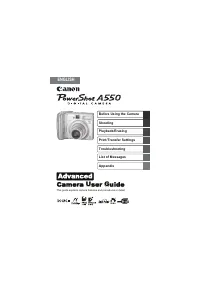 Canon PowerShot A550 User Manual
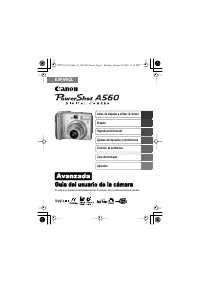 Canon PowerShot A560 User Manual
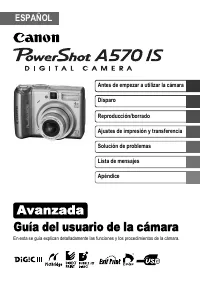 Canon Powershot A570 IS User Manual
 Canon PowerShot A590 IS User Manual
 Canon POWERSHOT A610 User Manual
 Canon POWERSHOT A620 User Manual
 Canon PowerShot A620, A610 Manual
 Canon POWERSHOT A630 User Manual
 Canon POWERSHOT A640 User Manual