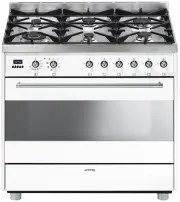
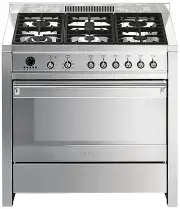
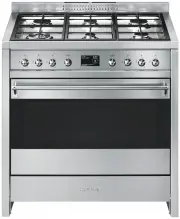
Page 2 - Instructions; General safety instructions; Risk of personal injury
Instructions 4 1 Instructions 1.1 General safety instructions Risk of personal injury • During use the appliance and its accessible parts become very hot. • Never touch the heating elements during use. • Keep children under eight years of age at a safe distance if they are not constantly supervised....
Page 3 - For this appliance; Identification plate; Power voltage
Instructions 5 EN • Use wooden or plastic utensils.• Do not seat on the appliance.• Do not use steam jets for cleaning the appliance. • Do not obstruct ventilation openings and heat dispersal slots. • Never leave the appliance unattended during cooking operations where fats or oils could be released...
Page 4 - How to read the user manual; Danger of suffocation
Instructions 6 • Consign the appliance to the appropriate selective collection centres for electrical and electronic equipment waste, or deliver it back to the retailer when purchasing an equivalent product, on a one for one basis. Our appliances are packed in non-polluting and recyclable materials....
Page 5 - Description; General description; Cooking hob
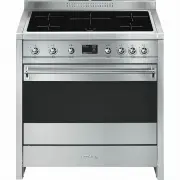
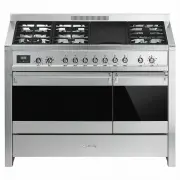
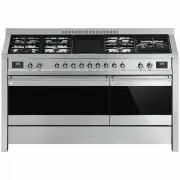
Description 7 EN 2 Description 2.1 General description 1 Cooking hob 2 Control panel 3 Oven light 4 Seal 5 Door 6 Fan 7 Storage compartment Rack/tray support frame shelf
Page 6 - Programmer clock
Description 8 2.2 Cooking hob AUX = AuxiliarySR = Semi-rapid R = RapidUR = Ultra rapid 2.3 Control panel 1 Programmer clock Useful for displaying the current time, setting programmed cooking operations and programming the minute minder timer. 2 Temperature knob This knob allows you to select the coo...
Page 7 - to light the
Description 9 EN 3 Indicator light The indicator light comes on to indicate that the oven is heating up. It turns off as soon as it reaches the set temperature. It flashes regularly to indicate that the temperature set inside the oven is kept constant. 4 Function knob The oven's various functions ar...
Page 8 - Available accessories; Rack
Description 10 2.5 Available accessories Rack Useful for holding cooking containers. Tray Useful for collecting fat from foods placed on the rack above and for cooking pies, pizzas and baked desserts. Rotisserie rod (on some models only) Useful for cooking chicken and all foods which require uniform...
Page 9 - Useful for cleaning the Teppanyaki plate.
Description 11 EN Teppanyaki plate (on some models only) Useful for cooking meat, fish and vegetables directly on the plate without adding fats or oils, staying true to the tradition of Japanese cuisine that seeks to exalt the natural flavours and aromas of food ensuring light nourishment while pres...
Page 10 - Use; Danger of burns
Use 12 3 Use 3.1 Instructions High temperature inside the oven during use Danger of burns • Keep the oven door closed during cooking. • Protect your hands using heat resistant gloves when moving food inside the oven. • Do not touch the heating elements inside the oven. • Do not pour water directly o...
Page 11 - Using the accessories; Racks and trays
Use 13 EN 3.2 First use 1. Remove any protective film from the outside or inside of the appliance, including accessories. 2. Remove any labels (apart from the technical data plate) from the accessories and from the cooking compartments. 3. Remove all the accessories from the appliance and clean them...
Page 12 - Tray rack
Use 14 Tray rack The tray can be used two different ways:• Inside the rack (with the anti-tip stop facing upwards) to collect grease during cooking. • Resting on the rack (with the anti-tip stop facing downwards) to cook sweets, biscuits, pastries etc. Rotisserie rod (on some models only) 1. Prepare...
Page 13 - To activate the rotisserie, turn the function
Use 15 EN 4. To activate the rotisserie, turn the function knob to position . 5. At the end of cooking, use the rotisserie handle provided to extract the rod from the hole and remove the frame in order to take the rotisserie rod out of the oven cavity. Reduction pan stands The reduction pan stands h...
Page 14 - and wait 60 seconds before trying
Use 16 3.4 Using the hob All the appliance's control and monitoring devices are located together on the front panel. The burner controlled by each knob is shown next to the knob. The appliance is equipped with an electronic ignition device. Simply press the knob and turn it anti-clockwise to the max...
Page 15 - Switching on the oven
Use 17 EN 3.5 Teppanyaki plate (on some models only) Use the Teppanyaki plate on the AUX+SR burners on the center of the hob or on the SR+R burners on the right of the hob. 3.6 Using the oven Switching on the oven To switch the oven on:1. Select the cooking function using the function knob. 2. Selec...
Page 16 - Using the storage compartment; Grill
Use 18 3.7 Using the storage compartment The storage compartment is at the bottom of the cooker. To open it, pull the handle towards you. It can be used to store cookware or metallic objects necessary when using the appliance. Small grill (on some models only) Using only the heat released from the c...
Page 17 - General advice
Use 19 EN 3.8 Cooking advice General advice • Use a fan-assisted function to achieve uniform cooking at several levels. • It is not possible to shorten cooking times by increasing the temperature (the food could be overcooked on the outside and undercooked on the inside). • Using more ovens at the s...
Page 18 - Advice for defrosting and proving
Use 20 Advice for defrosting and proving • Place frozen foods without their packaging in a lidless container on the first shelf of the oven. • Avoid overlapping the food.• To defrost meat, use the rack placed on the second level and a tray on the first level. In this way, the liquid from the defrost...
Page 19 - Setting the time
Use 21 EN Setting the time On the first use, or after a power failure, the digits will be flashing on the appliance's display. 1. Press the and keys at the same time. The dot between the hours and the minutes flashes. 2. The time can be set using or . Keep the key pressed in to increase or decrease ...
Page 20 - Programmed cooking
Use 22 Programmed cooking 1. Set the cooking time as described in the previous point “Timed cooking”. 2. Press . The sum of the current time plus the pre-set cooking duration will appear on the display. 3. Use the or key to set the required minutes. 4. Wait approx. 5 seconds without pressing any key...
Page 21 - Cooking information table
Use 23 EN Cooking information table Food Weight (Kg) Function Runner posi-tion from the bottom Temperature (°C) Time (minutes) Lasagne 3 - 4 Static 1 220 - 230 45 - 50 Pasta bake 3 - 4 Static 1 220 - 230 45 - 50 Roast veal 2 Turbo 2 180 - 190 90 - 100 Pork 2 Turbo 2 180 - 190 70 - 80 Sausages 1.5 Fa...
Page 22 - Cleaning and maintenance; Cleaning the appliance; Ordinary daily cleaning
Cleaning and maintenance 24 4 Cleaning and maintenance 4.1 Instructions 4.2 Cleaning the appliance To keep the oven surfaces in good condition, they should be cleaned regularly after use. Let them cool first. Ordinary daily cleaning Always use only specific products that do not contain abrasives or ...
Page 23 - Igniters and thermocouples; Removing the door; Grasp the door on both sides with both
Cleaning and maintenance 25 EN Igniters and thermocouples For correct operation the igniters and thermocouples must always be perfectly clean. Check them frequently and clean them with a damp cloth if necessary. Remove any dry residues with a wooden toothpick or a needle. 4.3 Removing the door For e...
Page 24 - To reassemble the door, put the hinges in; Cleaning the door glazing
Cleaning and maintenance 26 3. To reassemble the door, put the hinges in the relevant slots in the oven, making sure that grooved sections A are resting completely in the slots. Lower the door and once it is in place remove the pins from the holes in the hinges. 4.4 Cleaning the door glazing The gla...
Page 25 - Removing racks/trays support frames; Extraordinary maintenance; Replacing the internal light bulb
Cleaning and maintenance 27 EN Removing racks/trays support frames Removing the rack/tray support frames enables the sides to be cleaned more easily.Removing the rack/tray support frames:1. Unscrew the two fastening pins of the frame. 2. Pull out the frame toward the interior. If self-cleaning panel...
Page 26 - Removing the seal
Cleaning and maintenance 28 Removing the seal To permit thorough cleaning of the oven, the door seal can be removed. There are hooks on all four sides to attach it to the edge of the oven. Pull the edges of the seal outwards to detach the hooks. To keep the seals clean, use a non-abrasive sponge and...
Page 27 - Installation; Clearances above and around domestic appliances; Requirements
Installation 29 EN 5 Installation 5.1 Clearances above and around domestic appliances This appliance must be installed by an authorised person in accordance with this instruction manual, AS/NZS 5601.1 – Gas installations (installation and pipe sizing), local gas fitting regulations, local electrical...
Page 28 - Additional requirements for
Installation 30 3. Additional requirements for Freestanding and Elevated Cooking Appliaces – (Measurements D & E) Where D, the distance from the periphery of the nearest burner to a horizontal combustible surface is less than 200 mm, then E shall be 10 mm or more, or the horizontal surface shall...
Page 29 - The regulator supplied must be fitted
Installation 31 EN Connection of the appliance to the gas supply must be in accordance with the requirements of AS5601. A ½” BSP connector at the inlet is recommended and the gas supply line to the appliance must be of adequate length to allow sufficient withdrawal of appliance for service or discon...
Page 30 - Connection to liquid gas
Installation 32 Connection to liquid gas Use a pressure regulator and make the connection on the gas cylinder following the guidelines set out in the regulations in force.Make sure that the supply pressure complies with the values indicated in the paragraph “ Burner and nozzle characteristics table”...
Page 31 - Adaptation to different types of; Replacing nozzles
Installation 33 EN 5.3 Adaptation to different types of gas In case of operation with other types of gas, the burner nozzles must be changed and the minimum flame adjusted on the gas taps. Replacing nozzles 1. Remove the pan stands, burner caps and flame-spreader crowns to access the burner casings....
Page 32 - Lubrication of gas taps; Electrical connection; General information
Installation 34 Lubrication of gas taps Over time the gas taps may become difficult to turn and get blocked. Clean them internally and replace the lubrication grease. Burner and nozzle characteristics table 5.4 Electrical connection General information Check the grid characteristics against the data...
Page 33 - Use a
Installation 35 EN The appliance can work in the following modes:• 220-240 V 1N ~ Use a 3 x 2.5 mm² three-core cable. • 380-415 V 2N ~ Use a 4 x 1.5 mm² four-core cable. • 380-415 V 3N ~ Use a 5 x 1.5 mm² five-core cable. (on some models only) • 220-240 V 1N ~ use a 3 x 1,5 mm² three-core cable. Fix...
Page 34 - B - Class 2 subclass 1; Heavy appliance
Installation 36 5.5 Positioning General information This appliance may be installed next to walls, one of which must be higher than the worktop, at a minimum distance of 50 mm from the side of the appliance, as shown in figures A and C relative to the installation classes.Any wall units positioned a...
Page 35 - C - Class 2 subclass 1; Positioning and levelling
Installation 37 EN C - Class 2 subclass 1 (Built-in appliance) Positioning and levelling After making the electrical and/or gas connections, screw the four adjustable feet supplied with the appliance. 4. The appliance must sit level on the floor to ensure stability. Screw or unscrew the bottom part ...
Page 36 - Wall fixing
Installation 38 Wall fixing 1. Attach the chain to the cooker2. Stretch out the chain attached to the cooker horizontally so that the other end touches the wall. 3. Mark the wall in the position where the hole is to be drilled. 4. Drill the hole, insert a wall plug and attach the chain. Once the cha...