Safety and Troubleshooting Guide - Philips HD7461 - User Manual - Page 4
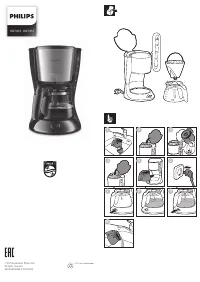
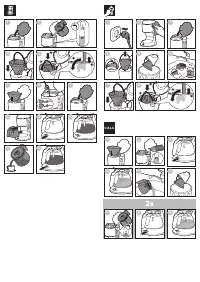



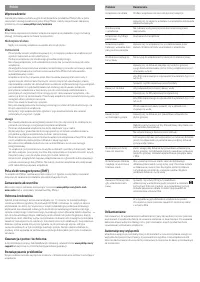


Table of Contents:
- Page 1 – Overview and Assembly Components
- Page 2 – Brewing and Cleaning Steps
- Page 4 – Safety and Troubleshooting Guide
- Page 5 – Estonian Manual Section
- Page 6 – Latvian Manual Section
- Page 7 – Lithuanian Manual Section
- Page 8 – Polish Manual Section
- Page 9 – Romanian Manual Section
- Page 10 – Russian Manual Section
- Page 11 – Ukrainian Manual Section
- Page 12 – Kazakh Manual and Storage Specs
English
Introduction
Congratulations on your purchase and welcome to Philips! To fully benefit from the support that Philips offers, register your product at www.philips.com/welcome.
Important
Read this user manual carefully before you use the appliance and save it for future reference.
Danger
- Never immerse the appliance in water or any other liquid.
Warning
- Check if the voltage indicated on the appliance corresponds to the local mains voltage before you connect the appliance.
- Connect the appliance to an earthed wall socket.
- Do not use the appliance if the plug, the mains cord or the appliance itself is damaged.
- If the mains cord is damaged, you must have it replaced by Philips, a service center authorized by Philips or similarly qualified persons in order to avoid a hazard.
- This appliance can be used by children aged from 8 years and above and by persons with reduced physical, sensory or mental capabilities or lack of experience and knowledge if they have been given supervision or instruction concerning use of the appliance in a safe way and if they understand the hazards involved. Cleaning and user maintenance shall not be made by children unless they are older than 8 and supervised. Keep the appliance and its cord out of reach of children aged less than 8 years.
- Children shall not play with the appliance.
- Do not let the mains cord hang over the edge of the table or worktop on which the appliance stands.
- Only use this appliance for its intended purpose to avoid potential hazard or injury.
Caution
- Do not place the appliance on a hot surface and do not let the mains cord come into contact with hot surfaces.
- Do not place the appliance in a cabinet when in use.
- Unplug the appliance before you clean it and if problems occur during brewing.
- During brewing and until you switch off the appliance, the filter holder, the lower part of the appliance, the hotplate, and the jug filled with coffee are hot.
- Do not put the jug on a stove or in a microwave to reheat coffee.
- This appliance is intended to be used in household and similar applications such as farm houses, bed and breakfast type environments, staff kitchen areas in shops, offices and other working environments, and by clients in hotels, motels and other residential type environments.
- Always return the appliance to a service centre authorised by Philips for examination or repair. Do not open the appliance or attempt to repair the appliance yourself.
Electromagnetic fields (EMF)
This Philips appliance complies with all applicable standards and regulations regarding exposure to electromagnetic fields.
Ordering accessories
To buy accessories or spare parts, visit www.philips.com/parts-and-accessories or go to your Philips dealer.
Recycling
This symbol means that this product shall not be disposed of with normal household waste (2012/19/EU) (Fig. 1).
Follow your country's rules for the separate collection of electrical and electronic products. Correct disposal helps prevent negative consequences for the environment and human health.
Warranty and support
If you need information or support, please visit www.philips.com/support or read the international warranty leaflet.
Troubleshooting
This chapter summarises the most common problems you could encounter with the appliance.
Problem Solution
The appliance does not work. Plug in and switch on the appliance.
Make sure that the voltage indicated on the appliance corresponds to the local mains voltage.
Water leaks out of the appliance. Do not fill the water tank beyond the MAX level.
The appliance takes a long time to brew coffee. Descale the appliance.
The appliance produces a lot of noise and steam during the brewing process. Make sure that the appliance is not blocked by scale. If necessary, descale the appliance.
Coffee grounds end up in the jug. Do not put too much ground coffee in the filter.
Make sure you put the jug on the hotplate with the spout facing into the appliance (i.e. not pointing sideways).
Use the right size of paper filter (type 1x4 or no. 4).
Make sure the paper filter is not torn.
The coffee is too weak. Use the right proportion of coffee to water.
Make sure the paper filter does not collapse.
Use the right size of paper filter (type 1x4 or no. 4).
Make sure there is no water in the jug before you start to brew coffee.
The coffee is not hot enough. Make sure that the jug is properly placed on the hotplate.
We advise you to brew more than three cups of coffee to ensure that the coffee has the right temperature.
Do not use cold milk straight from the refrigerator.
If your coffeemaker has an metal jug, preheat the metal jug with hot tap water before you start brewing coffee.
There is less coffee in the jug than expected. Make sure you place the jug properly on the hotplate. If the jug is not placed properly on the hotplate, the drip stop prevents the coffee from flowing out of the filter.
There are stubborn brown deposits in the metal jug. To remove stubborn deposits, put hot water and a spoonful of sodium carbonate in the metal jug. Leave the sodium carbonate solution in the metal jug for some time. Then empty the metal jug and use a soft brush to remove the deposits. Rinse the metal jug with fresh water.
The filter overflows while the appliance is brewing coffee. Check if you placed the filter holder into the appliance properly (see picture 3 in chapter ). If the filter holder is not in the correct position, the drip stop does not work, which may cause the filter holder to overflow.
If you remove the jug from the appliance for more than 20 seconds during brewing, the filter holder starts to overflow.
Descaling
Descale the appliance when you notice excessive steaming or when the brewing time increases. It is advisable to descale every two months. Only use white vinegar to descale, as other products may cause damage to the appliance.
Auto shut-off
The appliance switches off automatically after 30 minutes for energy saving and safety. This is according to EU regulation applicable to all drip-filter coffeemakers sold in the EU.
"Loading the manual" means you need to wait until the file loads and becomes available for online reading. Some manuals are very large, and the time they take to appear depends on your internet speed.
Summary
Illustrates the coffee maker and its parts, along with assembly diagrams and certification marks.
Step-by-step visuals for operating the machine, including filling water and coffee, brewing, and cleaning.
Covers safety warnings, EMF compliance, ordering accessories, recycling, warranty, and a troubleshooting table for common issues.
Tips
- Descale the appliance every two months using only white vinegar to avoid damage.
- The appliance automatically shuts off after 30 minutes for energy saving and safety.
- For stubborn deposits in the metal jug, use a solution of hot water and sodium carbonate.
- Ensure the jug is properly placed on the hotplate to avoid the drip-stop blocking coffee flow.
- Use paper filters type 1x4 or no. 4.