Page 2 - About The Manuals and Notations Used; General information; Types of Manual; Procedure
About The Manuals and Notations Used The documentation for your EPSON projector is divided into the following four manuals. Refer to the manuals in the order given below. Unpacking and Installation Guide This manual contains information on the procedures from unpacking the projector through to start...
Page 3 - Contents; Basic Operations
1 Contents Features of the Projector ................................................................................... 2 Basic Operations Turning On the Projector.................................................................................... 6 Connecting the Power Cord ..........................
Page 4 - Features of the Projector; screen; Uses five color modes
2 Features of the Projector 80-inch screen Adoption of a wide 1280 x 720 dot panel This panel allows high-definition images to be reproduced accurately. Adoption of a special high-resolution DCDi video circuit developed by Faroudja. This circuit greatly reduces the jagged edges that resulted from co...
Page 8 - Turning On the Projector; Remove the lens cover.; Connecting the Power Cord; Safety Instructions/World-Wide Warranty Terms
6 Turning On the Projector This section describes the procedure from turning on the power to projecting images. Procedure 1 Check that the power is turned off for the projector and all components connected to the projector. 2 Connect the computer or other video source to the projector. Refer to the ...
Page 9 - Turning On the Power and Projecting Images
7 Basic Operations Procedure 1 Turn on the power for all equipment connected to the projector. For a video source, press the [Play] button at the video source to start playback if necessary.Check that the indicator on the projector has stopped flashing and lights orange. 2 Press the [Power] button o...
Page 10 - Turning Off the Projector
8 Turning Off the Projector Follow the procedure below to turn off the power of the projector. Procedure 1 Turn off the power for the signal sources that are connected to the projector. Check that the power for all connected components has been tuned off. 2 Press the [Power] button on either the rem...
Page 11 - Attach the lens cover.
9 Basic Operations 6 Retract the front adjustable foot if it is extended. Gently push down on the projector while pressing the foot adjust button. 7 Attach the lens cover. Attach the lens cover to the lens when not using the projector, in order to stop the lens from getting dusty or dirty.
Page 12 - Adjusting the Screen Image; Adjusting the Image Size
10 Adjusting the Screen Image You can adjust the screen image in order to obtain the best possible picture. The size of the projected image is basically determined by the distance from the projector to the screen. (Refer to the Setup Guide.)The following procedures explain how to adjust the screen i...
Page 13 - Correcting Keystone Distortion
11 Basic Operations If the projector is set up so that it is at an angle to the screen, a type of distortion known as "keystone distortion" may occur.Keystone correction can be carried out if the angle of the projector is within a range of approximately 15 ° vertically from the perpendicular...
Page 14 - Displaying a Test Pattern
Adjusting the Screen Image 12 When setting up the projector, you can project a test pattern onto the screen and use this test pattern to adjust the projected images before a video source has been connected. The following two types of test pattern are available. •••• Crosshatch •••• Grayscale pattern...
Page 15 - Adjusting the Image Quality; Focusing the Screen Image; Selecting the Color Mode
13 Basic Operations Adjusting the Image Quality The quality of the screen images can be adjusted as follows. Procedure Turn the focus ring to adjust the image focus. The following five color modes have been preset for use with images with varying characteristics. You can use these color modes to obt...
Page 16 - Selecting the Image Aspect Ratio; Normal mode
Adjusting the Image Quality 14 The aspect ratio for projected images can be selected from the following five types of setting. However, the aspect ratio settings that can be selected will vary depending on the input signal. Procedure The aspect ratio changes as shown below each time the [Aspect] but...
Page 18 - Automatic Adjustment of Computer Images
Adjusting the Image Quality 16 This function lets you adjust computer images to the optimum settings.Automatic adjustment involves adjustment of tracking display position and synchronization (sync) . Procedure While an image is being projected from the computer, press the [Auto] button on the remote...
Page 20 - Functions for Enhancing Projection; Full menus; Using the Environment Setting Menus
18 Functions for Enhancing Projection This section describes the various useful functions that can be used to enhance projection. The functions described here are used to set the adjustment values using the projector’s environment setting menus.There are two types of projector’s environment setting ...
Page 21 - Confirm the selection.; Set other items in the same way.
Ad v anced Operations 19 3 Select a menu item. Press the [Select] button on either the projector's control panel or the remote control to accept a selection.The sub-menu corresponding to the selected item in the main menu appears. 4 Select a setting item in the sub-menu. If using the projector's con...
Page 22 - Select an item to be set.; Select the setting value.; Displaying and Operating Line Menus
Functions for Enhancing Projection 20 Procedure 1 Press the [Select] button on either the projector's control panel or the remote control. The line menu appears. 2 Select an item to be set. If using the projector's control panel, press the and buttons. If using the remote control, press the [Select]...
Page 23 - Description of Functions
Ad v anced Operations 21 This section describes commonly-used functions."Black Level" and "White Level" adjustments are the adjustment values that are in effect before the signals are sampled by the A/D converter, and so they are adjusted to match the input signal so that they do not...
Page 24 - Confirm the memory setting.; Saving and Retrieving Image Quality Settings (Memory)
Functions for Enhancing Projection 22 Up to a maximum of six adjustment values in the "Video" and "Advanced" menus can be memorize per input source, and settings for six different sources can be recorded, for a total of 36 possible settings. You can save the adjustment values for par...
Page 25 - Retrieving Saved Image Quality Settings
23 Ad v anced Operations Procedure Press one of the remote control memory buttons [1] to [6] corresponding to the image quality settings to be retrieved. The images being projected will be adjusted according to the settings that are retrieved. Retrieving Saved Image Quality Settings Remote control U...
Page 26 - Using the Menu Functions
24 Using the Menu Functions The environment setting menus can be used to carry out a variety of settings and adjustments. Two types of menu (full menus and line menus) can be used to make environment settings. This section describes all of the functions that are available in the environment setting ...
Page 32 - Setting Menu
Using the Menu Functions 30 Advanced Input B Selects the type of signal being input to the Input B port. RGB Setup Level (Adjustment is only possible when composite, S-Video, 525i/p or 625i/p signals are being input.)If using a foreign product that has different black level (setup level) settings, u...
Page 34 - Reset All Menu
Using the Menu Functions 32 Computer (D-RGB/A-RGB DVI-I, InputB (A-RGB)) Main menu Sub-menu Function Default setting About Lamp Displays the cumulative lamp operating time.When the lamp warning period is reached, the display characters appear in red. 0H Reset Lamp Timer Initializes the lamp operatin...
Page 35 - Troubleshooting
3 Troubleshooting This chapter describes troubleshooting procedures for the projector. Using the Help .................................................. 34 When Having Some Trouble ............................ 35 When the Indicators Provide No Help ............ 37
Page 36 - Using the Help
34 Using the Help If a problem occurs with the projector, the Help function uses on-screen displays to assist you in solving the problem. It uses a series of menus in a question and answer format. The questions vary depending on the type of video source. Procedure 1 Press the [Help] button on either...
Page 37 - When Having Some Trouble
35 T roub leshooting When Having Some Trouble If you are having a problem with the projector, first check the projector's indicators.The projector is provided with the following three indicators. These indicators alert you to problems with projector operation. The following tables show what the indi...
Page 39 - When the Indicators Provide No Help
37 T roub leshooting When the Indicators Provide No Help If any of the following problems occur and the indicators do not offer a solution, refer to the pages given for each problem. No images appear p.37, p.38 Images appear dark p.41 Poor image quality p.39 Images appear green p.41 Only par t of th...
Page 45 - Appendices
4 Appendices This chapter provides information on maintenance procedures to ensure the best level of performance for the projector for a long time. Maintenance ..................................................... 44 •••• Cleaning.........................................................................
Page 46 - Maintenance; Cleaning
44 Maintenance This section describes maintenance tasks such as cleaning the projector and replacing consumable parts. You should clean the projector if it becomes dirty or if the quality of projected images starts to deteriorate. Clean the projector case by wiping it gently with a soft cloth. If th...
Page 47 - Replacing Consumables
45 Appendices This section describes how to replace the lamp and the air filter. It is time to replace the lamp when: •••• The message "Lamp Replace" appears on the screen when projection star ts. •••• The indicator flashes orange or lights red. •••• The projected image gets darker or starts...
Page 48 - Loosen the two lamp fixing screws.; Replacing the Lamp
Maintenance 46 Procedure 1 Turn off the main power switch at the rear of the projector. (p.8) 2 Wait until the lamp has cooled down, and then remove the lamp cover. After the cool-down period has finished, it takes approximately a further 30 minutes for the lamp to be cool enough.Use the screwdriver...
Page 49 - Install the lamp cover.; Reset the lamp operating time.; Resetting the Lamp Operating Time
47 Appendices 6 Install the lamp cover. Insert the two cover tabs into the projector, and then press the other side of the lamp cover until it clicks into place. The projector has a built-in counter which keeps track of the lamp operating time. When the cumulative operating time reaches a certain po...
Page 50 - Install the new air filter.; Replacing the Air Filter
Maintenance 48 Procedure 1 Turn off the power switch at the rear of the projector, and then disconnect the power cord. (p.8) 2 Put your finger into the recess in the air filter hook, and lift up the air filter to remove it. In order to prevent any dust on the air filter from getting into the project...
Page 51 - Optional Accessories
49 Appendices Optional Accessories The following optional accessories are available for purchase if required. This list of optional accessories is current as of February 2002. Details of accessories are subject to change without notice. * A special method of installation is required in order to susp...
Page 52 - List of Supported Signal Resolutions; Component Video Input
50 List of Supported Signal Resolutions Units: dots Units: dots Component Video Input Signal Resolution Aspect Normal (Default) Squeeze Zoom Through Squeeze Through SDTV (525i, 60Hz) 640 × 480 640 × 360 (When zoomed) 960 × 720 (4:3 aspect) 1280 × 720 (16:9 aspect) 1280 × 720 (16:9 aspect) 590 × 442 ...
Page 53 - RGB Input
51 Appendices Units: dots * indicates resolutions that are compatible with both analog and digital formats.*1 This connection is not possible for models which are not equipped with a VGA output port. RGB Input Signal Resolution Aspect Normal (Default) Zoom Through PC98 640 × 400 1152 × 720 – 640 × 4...
Page 54 - Specifications
52 Specifications Product name Home Theatre Projector EMP-TW100 Dimensions 348 (W) x 104 (H) x 274 (D) mm (13.7 (W) x 4.09 (H) x 10.79 (D) inches) (not including protruding parts) Panel size 0.87 inches Display method Polysilicon TFT active matrix Drive method Full-line 12-phase block sequential wri...
Page 56 - Appearance
54 Appearance 274 (10.79) 114 (4.49) 348 (13.7) 104 (4.09) Units: mm (inch)
Page 57 - Part Names and Functions; Setup Guide
55 Appendices Part Names and Functions Front/Top Temperature indicator (p.35) Indicates abnormalities in the internal projector temperature. Lamp indicator (p.35) Indicates a problem with the projection lamp or that the lamp needs to be replaced. Operation indicator (p.35) Flashes or lights to indic...
Page 58 - Control Panel; and
Part Names and Functions 56 Control Panel [Power] button (p.7) Press to turn the projector power on and off. [Source] button (p.7) Switches the input source between InputA → InputB → S-Video → Video → D-RGB → A-RGB each time the button is pressed. [Menu] button (p.18) The environment setting menus t...
Page 59 - Trigger port; Rear adjustable foot
57 Appendices Rear Base Trigger port When the projector power is turned on, 12 V DC is output from this port. When the projector's power is turned off, the output becomes 0 V to communicate the projector's power ON/OFF status to an external device. Remote control light-receiving area( Setup Guide ) ...
Page 60 - Remote Control
Part Names and Functions 58 Remote Control Remote control light-emitting area ( Setup Guide ) Outputs infrared remote control signals. [Pattern] button (p.12) Projects a test pattern for image adjustment.The test pattern switches between Crosshatch → Grayscale Pattern → Off each time the button is p...
Page 61 - Glossary
59 Appendices Glossary Following is an explanation of some of the terms used in this guide which may be unfamiliar or which were not explained in the manual itself. Further information can be obtained by referring to other commercially-available publications. 3-2 pull-down function This function dir...
Page 63 - Index; General Terms
61 Appendices Index General Terms About menu........................................ 31Advanced menu ........................... 22, 29Air filter cleaning ............................... 44Air filter replacement ......................... 48Appearance ........................................ 54A-RGB/...
Page 65 - DECLARATION of CONFORMITY; According to 47CFR, Par t 2 and 15
We : EPSON AMERICA, INC. Located at : 3840 Kilroy Airport Way MS: 3-13 Long Beach, CA 90806 Tel : 562 - 290- 5254 Declare under sole responsibility that the product identified herein, complies with 47CFR Part 2 and 15 of the FCC rules as a Class B digital device. Each product marketed, is identical ...
Page 66 - receiver is connected.; WARNING
FCC Compliance Statement For United States Users This equipment has been tested and found to comply with the limits for a Class B digital device, pursuant to Par t 15 of the FCC Rules. These limits are designed to provide reasonable protection against harmful interference in a residential installati...


 Epson V11HB23020
User Manual
Epson V11HB23020
User Manual
 Epson C11CK75201
User Manual
Epson C11CK75201
User Manual
 Epson B11B272202
User Manual
Epson B11B272202
User Manual
 Epson V11HA52820
User Manual
Epson V11HA52820
User Manual
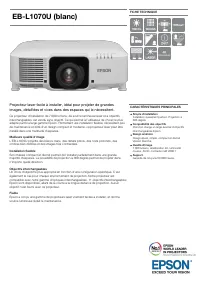 Epson V12H004UA3
Troubleshooting Guide
Epson V12H004UA3
Troubleshooting Guide
 Epson V12H004X0A
User Manual
Epson V12H004X0A
User Manual
 Epson A461H
Manual
Epson A461H
Manual
 Epson C11CH25401
User Manual
Epson C11CH25401
User Manual
 Epson C11CH72401
User Manual
Epson C11CH72401
User Manual
 Epson B11B257201
Manual
Epson B11B257201
Manual
 Epson V11HA85020
Installation Manual
Epson V11HA85020
Installation Manual
 Epson C11CK61201
User Manual
Epson C11CK61201
User Manual