Page 2 - Notations used in this guide
Indicates content that may cause the unit damage or malfunction. Indicates additional information and points that may be useful to know regarding a topic. s Indicates a page where useful information regarding a topic can be found. Indicates operating methods and the order of operations.The procedure...
Page 3 - Advanced Operations; Settings and Adjustments; Appendix; Contents
1 Quic k Star t Adv anced Oper ations Settings and Adjustments Appendix Contents ..................................................................... 1 Safety Instructions ..................................................... 2 Use and Storage ..........................................................
Page 4 - Safety Instructions
2 All safety and operating instructions should be read before using the unit. After you have read all instructions, save this information for later reference.The documentation and the unit use graphical symbols to show how to use the unit safely.Please understand and respect these caution symbols in...
Page 5 - Important safety instructions
3 Follow these safety instructions when setting up and using the projector : • Read these instructions. • Keep these instructions. • Heed all warnings. • Follow all instructions. • Do not use this apparatus near water. • Clean only with dry cloth. • Do not block any ventilation openings. Install in ...
Page 8 - Caution
6 Class 1 LASER Product Do not open the top cover. There are no user serviceable parts inside the unit. Do not use the unit in places where there are lots of humidity or dust, near cooking or heating appliances, or in places where it may come into contact with smoke or steam. Do not use or store thi...
Page 10 - Use and Storage; Notes on handling and storage
8 Take note of the following advice in order to prevent malfunction and damage. • Be sure to observe the operating temperatures and storage temperatures given in this guide when using and storing the projector. • Do not set up the unit in places where it might be subjected to vibration or shock. • D...
Page 12 - Readable disc types; Discs and USB Storage; Discs
10 Readable disc types The following discs can be played. • The performance and tonal quality of copy- control CD discs that do not conform to the compact disc (CD) standard cannot be guaranteed with this unit. CDs that conform to the CD standard will bear the following compact disc logo mark. Check...
Page 14 - Parts Name and Functions; Front
12 Parts Name and Functions Name Function A Slide lens cover knob. Slide the knob to open and close the slide lens cover. B Slide lens cover Close the lens cover to protect the lens when the unit is not in use.You can stop the projection completely by closing the lens cover during projection. Howeve...
Page 15 - Rear
13 Name Function A Audio input port Can be connected to the audio output port of the connected video device or a computer. s p. 43, 44 B Video input port Can be connected to the ordinary image output port of a video device. s p. 43 C Computer input port Can be connected to the RGB output port of a c...
Page 16 - Top
14 Name Function A Focusing ring Move to the left or right for image focusing. s p. 20 B Status indicator If a problem occurs in the unit, the status indicator blinks or lights up to indicate the problem. s p. 61 C Ambient light sensor Detects the brightness of the room. When “Auto” is selected in t...
Page 17 - Remote Control
15 Name Function A Remote control light- emitting area Emits remote control signals. s p. 16 B Turns power supply to the unit on or off. s p. 22 C Corrects keystone distortion of the screen image to square or rectangular. s p. 21 D Press this button to eject a disc from the disc slot. s p. 22 E Func...
Page 18 - Preparing the Remote Control; Inserting the batteries; Remote control usage range
16 At the time of purchase, the batteries are not installed into the remote control. Insert the batteries provided with this unit, before use. A Push in the catch on the rear of the remote control, then lift it upwards. B Insert the batteries observing correct polarity. C Close the battery cover. Pr...
Page 19 - Quick Start; Playback procedure
17 Quic k Star t Quick Start Playback procedure No complicated connections are necessary. You do not even need to select the television type or change the input. You can enjoy your DVDs on the big screen by following these four easy steps. The standard speakers support virtual surround sound system,...
Page 20 - Installation; Projection distance and screen size; Connecting the power cable
18 A Place the unit in a position that will enable the optimum size image to be projected on the screen. When you use a 16:9 ratio, 80” type widescreen, for example, place the unit approximately 241 cm away from the screen. * The distance from the center of the lens to the base of the screen. The fu...
Page 21 - Disc Playback; Playing a disc and projecting
19 Quic k Star t A Insert the disc into its slot by facing the disc label upward. If you are using a dual-side disc, face the side you wish to play downwards. Insert an 8-cm disc into the disc slot center position. A short beep sounds and the power comes on. Inserting the disc makes the Disc indicat...
Page 22 - Adjusting the projection position and volume
20 Adjust the volume and image being projected. Adjusting the projection position and volume Focusing (Focus ring) Volume control (Volume) Using the main unit Using the remote control Fine-tuning the projection size (Zoom) Adjust the projection size in the Visual Setup menu. s p. 57 A Press and sele...
Page 24 - Stopping playback
22 Press . After stopping, when you press , playback is resumed from the interrupted scene (resume). A When you have played back a disc, press to eject the disc from its slot. • Once you have pressed , if you want to play back the ejected disc again, you cannot push it back into the disc slot manual...
Page 25 - Basic Playback Operations; Pause
23 Quic k Star t From here on, operations are explained primarily using the buttons of the remote control. You can also use the buttons with the same markings as those on the unit control panel to achieve the same effect. Press during playback. • Press on the operation panel. The play is paused and ...
Page 26 - Skip
24 Press or during playback or when paused. If you press once during chapter/track playback, playback returns to the start of the chapter or track being played. After this, playback returns to the start of the previous chapter/track each time you press . After this, playback returns to the start of ...
Page 27 - Color Mode
25 Quic k Star t The break function is useful if, in the middle of a movie, you want to get up or move around, get a drink, or some food, and so on. By simply pressing the button you can pause the disc being played until you can get up to turn the lights on in the room. Press during playback. • The ...
Page 28 - Becoming a playback expert; Playback from a DVD menu
26 Advanced Operations Some discs have the following kinds of original menus saved in them. • Root Menu: When multiple titles (image and audio) have been recorded, this integrated disc information is displayed. • Menu: Title-specific playback data (chapter, angle, audio, and subtitle menus) is displ...
Page 29 - Playback a Video CD from the menu
27 Adv anced Oper ations 3 Press . You can play a disc by selecting the desired chapter from any of the following two menus. • PBC (Playback control) function: If a Video CD with “PBC (playback control) enabled” specified on the disc or jacket is inserted into the disc slot, a menu screen is display...
Page 30 - To play using the Preview function
28 If you select “Others” from the settings menu and set “PBC” to “Off”, the disc is played directly without displaying the menu screen. PBC is “On” by default. s p. 54 To play using the Preview function 1 If you press while a video CD is playing, the following Preview menu is displayed. • You can a...
Page 31 - playback
29 Adv anced Oper ations 3 Select the track you want to see using , and press . The selected track is played. Although the , or files stored in a disc and a USB storage device are played back by selecting the desired file from a File List, the function varies depending on the file, as follows. • If ...
Page 33 - When playing MP3/WMA audio
31 Adv anced Oper ations When playing MP3/WMA audio Once menu selection is complete and the audio begins, close the lens cover. You can enjoy just the music being played. Simultaneous MP3/WMA and JPEG playback If a disc contains a mix of MP3/WMA and JPEG files, you can enjoy the Slideshow with sound...
Page 34 - Playback by selecting the chapter or track number
32 During playback or when paused, select the chapter or track number you wish to play by pressing the numeric buttons. s “When using the numeric buttons” p. 26 Depending on the type of disc, you can loop playback within a range of titles, chapters, or tracks, as in the table below. Press during pla...
Page 36 - Program play
34 You can set titles, chapters, and tracks to playback in your order of preference. 1 Press during play or when paused. The program screen will appear for you to set a playback sequence. 2 Using the numeric keys, enter title and track/chapter numbers sequentially. s “When using the numeric buttons”...
Page 37 - Zoom In
35 Adv anced Oper ations You can zoom (enlarge or compress) the projection image on the unit screen. If the enlarged image exceeds the screen size, you can display it by panning. 1 Press during playback. The magnification (or zoom rate) is displayed. 2 Select the desired magnification by pressing re...
Page 38 - Changing the audio language
36 When a disc has been recorded with multiple audio signals or languages, you can switch to the available audio signal or language of your preference. 1 Press during playback. The current audio settings are displayed on the screen. 2 Select the desired settings by pressing repeatedly. You can choos...
Page 39 - Changing the angle
37 Adv anced Oper ations For discs that have been recorded with multiple camera angles, you can switch from the main angle to a different camera angle of your preference, such as from above, or from the right, during playback. 1 Press during playback. The current angle is displayed on the screen. 2 ...
Page 40 - Contents on the playback information screen
38 2 Pressing , position the pointer on the desired item and press . • You can set the title/chapter/track number and time by using the numeric keys, and set the play start time. s p. 26 • When the selected item appears, select the desired value using and press . • Press once and the playback inform...
Page 41 - Setting the sleep timer
39 Adv anced Oper ations When the time you set on the sleep timer has passed, the unit power switch is turned off automatically. You can prevent unnecessary power from being consumed if you fall asleep while watching a movie. If the sleep timer is set to “Sleep Off” and if play is stopped or finishe...
Page 42 - When projecting by using the built-in DVD player; Changing the aspect ratio
40 The unit automatically recognizes the aspect suitable for the input signal, and the image is projected in the appropriate aspect. If you want to change the aspect yourself, or if the aspect is not correct, you can change it in the following way. Press . • Each time you press the aspect ratio name...
Page 43 - When projecting computer images
41 Adv anced Oper ations When projecting component video (SDTV)/HDMI (SDTV), composite video images When projecting component video (HDTV)/HDMI (HDTV) images When projecting computer images Wide panel computer images are always projected at the normal (wide screen) setting. If wide panel computer im...
Page 44 - Connecting a USB storage device
42 You can attach a USB memory or multicard reader that conform to the USB 1.1 to the unit and play the following format files. • MP3/WMA files • JPEG files • DivX ® files The file playback and your operations during play are the same as when you play files of a using the standard DVD player. Playba...
Page 45 - Connecting with a video cable; Connecting to another video device, a TV set, or a Computer
43 Adv anced Oper ations Aside from the built-in DVD player, this unit can project images by connecting to a computer or the following devices with a video output port. - Video recorder - Game machine - Video device with built-in TV tuner - Video camera and others Connecting with a video cable Video...
Page 47 - Connecting with a computer
45 Adv anced Oper ations Connecting with a computer Use a cable marked “No resistance” when you use a commercially available 2RCA stereo mini-plug audio cable. To Audio out port 2RCA Stereo mini-pin audio cable (commercially available) Computer cable (commercially available) (Mini D-Sub 15-pin Mini ...
Page 48 - Projecting images from external video equipment or a computer
46 This unit automatically detects input signals and changes the projected image. The projector automatically detects signals being input from connected equipment, and the image being input from the equipment is projected. You can project the target image quickly as input ports with no image signal ...
Page 49 - When a computer image is not projected
47 Adv anced Oper ations When a computer image is not projected You can switch the image signal destination from the computer by holding down and pressing (the key is usually labeled or ). s Computer “Documentation” After switching, wait a few seconds for projection to start. Depending on the comput...
Page 50 - Audio Settings; Listening with headphones
48 Connecting commercially available headphones. Audio Settings Caution • When listening with headphones, make sure the volume is not too high. You may damage your hearing when listening to sounds at high volume over an extended period of time. • Do not set the volume too high from the outset. A lou...
Page 51 - Connecting a microphone
49 Adv anced Oper ations You can output microphone audio from the projector's speaker by connecting a microphone to the projector's Mic Input Port. To adjust audio from the Mic input port, press . • When the Mic Input Level is too low, adjust it using . s p. 64 • You can select "Mic Input Level&...
Page 52 - Selecting the surround sound mode
50 You can connect to AV amplifiers and so on or equipment capable of making digital recordings when they are equipped with a coaxial digital audio input port. When connecting, use a commercially available coaxial digital cable. When you turn the Virtual surround sound function on, you can enjoy rea...
Page 53 - Selecting the digital sound effects
51 Adv anced Oper ations You can select the sound effects appropriate to the musical genre of the current disc. 1 Press . The current settings are displayed on the screen. 2 Select the desired settings by pressing repeatedly. The sound effects, which you can select according to the inserted disc or ...
Page 54 - Using the setup menu
52 Settings and Adjustments The settings of this unit can be adjusted to suit the environment in which it is used. 1 Press during playback or when stopped. The following setup menu is displayed. 2 Press and select the desired icon. Setup Menu Operation and Functions Using the setup menu Language set...
Page 55 - Language page; Setup menu list
53 Settings and Adjustments 3 Press to select the item to be set, and then press . The settings are displayed on the right. 4 Select the setting you wish to change, and press . To display other setting pages, select a desired icon by repeatedly pressing . 5 After setup is complete, press to close th...
Page 57 - Language code list
55 Settings and Adjustments Abkhazian 6566 Gaelic; Scottish Gaelic 7168 Magyar 7285 Sinhalese 8373 Afar 6565 Gallegan 7176 Malayalam 7776 Slovensky 8373 Afrikaans 6570 Georgian 7565 Maltese 7784 Slovenian 8376 Amharic 6577 Gikuyu; Kikuyu 7573 Manx 7186 Somali 8379 Arabic 6582 Guarani 7178 Maori 7773...
Page 58 - “Digital Output” settings and output signals
56 Playback Disc “Digital Output” Settings Stream PCM Linear PCM DVD video Linear PCM Stereo DTS DVD video DTS bit stream 48 kHz, 16 bit linear PCM Dolby digital DVD video Dolby digital bit stream 48 kHz, 16 bit stereo linear PCM Audio CD, Video CD, SVCD 44.1 kHz, 16 bit stereo linear PCM/48 kHz, 16...
Page 59 - Operations on the Visual Setup menu
57 Settings and Adjustments You can adjust the brightness, contrast, and other values of the projected image. 1 Press during projection. The following menu is displayed. 2 Press to select the item to be set, and then press . 3 Press to select the item to be set, and then press to adjust. • When opti...
Page 60 - Visual Setup menu
58 Image page When the color mode is set to “Auto”, you cannot make the setting. s p. 25 Signal page Setting Item Setting Contents Brightness Adjusts the image brightness. Contrast Adjusts the difference between light and shade in the images. Color Saturation Adjusts the color saturation for the ima...
Page 61 - Option page
59 Settings and Adjustments Option page Info page Setting Item Setting Contents Mic Input Level Adjust if the Mic Input Level is too low to hear from the projector’s speaker, or if the level is too high making the audio crack. When the Mic Input Level is turned down to “0”, no audio is output from t...
Page 62 - Installing the wire lock; Security Functions
60 The projector includes the following security devices to prevent from being stolen. • Security slot The security slot is compatible with the Microsaver Security System manufactured by Kensington. You can find details about the Microsaver Security System on the Kensington homepage http://www.kensi...
Page 63 - Troubleshooting; When the; Reading the indicators
61 Appendix Appendix You can check the status of this unit using the indicators on the top panel. Check each condition in the following table and follow the steps to remedy the problem. * If all indicators are not lit, the power cable is not connected correctly or the unit is not powered. Troublesho...
Page 66 - When the indicators provide no help
64 If this unit is not functioning normally, check the following notes before requesting repairs. However, if the unit fails to improve, contact your dealer for advice. At these times Check here Reference page Power does not turn on • Did you press ? s p. 18 • Disconnect and reconnect the power cabl...
Page 67 - When using external video or computer mode
65 Appendix When using external video or computer mode At these times Check here Reference page No images appear • Is the power for the connected equipment turned on? Switch on the power to the connected equipment, or start playback depending on the playback method for the connected equipment. s p. ...
Page 68 - Maintenance; Cleaning
66 This section describes maintenance tasks such as cleaning the unit and replacing consumable parts. Cleaning the air filter and air intake vent When dust builds up on the air filter or the air intake vent, or the message “The unit is overheating. Make sure nothing is blocking the air vent, and cle...
Page 69 - Air filter replacement period; Lamp replacement period; Consumables; Consumables replacement period
67 Appendix Air filter replacement period When the air filter gets dirty or is broken Lamp replacement period • The message “Replace the lamp” appears on the screen when projection starts. • The projected image gets darker or starts to deteriorate. The following optional accessories and consumables ...
Page 70 - Replacing the air filter; How to replace consumables
68 Replacing the air filter 1 Turn the power switch off and when a short beep sounds, unplug the power cable. 2 Remove the air filter cover. 3 Take out the old air filter. 4 Install the new air filter. 5 Install the filter cover. Dispose of used air filters properly in accordance with your local reg...
Page 71 - Replacing the lamp
69 Appendix Replacing the lamp 1 Turn the power switch off, and when a short beep sounds, unplug the power cable. 2 Loosen the screws of the lamp cover attachment using the screwdriver that supplied with the replacement lamp. Slide the lamp cover toward you, and then lift it up to remove it. 3 Loose...
Page 72 - Resetting the lamp operating time
70 6 Tighten the lamp attachment screws firmly. 7 Install the lamp cover. Resetting the lamp operating time After the lamp has been replaced, make sure you initialize the Lamp Hours setting. The unit has a built-in counter that keeps track of the lamp operating time and the lamp replacement message ...
Page 74 - Projection Distance and Screen Size
72 Refer to the following table and place the unit in a position which allows the best possible projection for the size of the screen. Values are just reference. Units: cm Units: cm Units: cm Projection Distance and Screen Size 16:9 Screen Size Projection Distance Minimum (Zoom Adjustment Wide) - Ma...
Page 75 - Composite video; Compatible Resolution List
73 Appendix Composite video Units: Dots * Letterbox signal Component video Units: Dots * Letterbox signal HDMI Units: Dots Compatible Resolution List Signal Resolution Aspect Mode Normal Full Zoom TV (NTSC) 720 x 480 720 x 360 * 720 x 540 (4:3) 960 x 540 (16:9) 960 x 540 (16:9) TV (PAL, SECAM) 720 x...
Page 76 - Computer image
74 * Letterbox signal Computer image Units: Dots * 1 You cannot connect to models where the VGA output port is not installed. * 2 Letterbox signals Even when signals other than those mentioned above are input, it is likely that the image can be projected. However, not all functions may be supported....
Page 77 - Compatible MPEG format list
75 Appendix The file format must meet the following requirements • Resolution: up to 720 x 576 • GMC (global motion compensation) point: Up to one • Bit rate: CD: 5.6 Mbps DVD: 19Mbps USB: 5.57 Mbps (However, this may be slower depending on the performance of the USB storage.) Compatible MPEG format...
Page 78 - Specifications; Tilted angle
76 * The USB ports may not accept all USB-compatible devices. Specifications Product name EH-DM3 Dimensions 335W x 136H x 239D mm (Including projections) Panel size 0.54” wide Display method Polysilicon TFT active matrix Resolution 518,400 pixels (960W x 540H dots) x 3 Focus adjustment Manual Zoom a...
Page 80 - Disc related terms; Glossary
78 HDMI An abbreviated form of "High-Definition Multimedia Interface", which is the digital transmission standard for transmitting images and sound using one cable. The HDMI has been established primarily for digital home appliances and PCs, and this standard allows high-quality image signal...
Page 81 - Index
79 A Audio page ................................................................................ 54Auto Setup ................................................................................ 65 B Break ......................................................................................... 25Bright...
Page 82 - Inquiries
80 Inquiries This address list is current as of the 2nd of July, 2008. A more up-to-date contact address can be obtained from the corresponding website listed here. If you do not find what you need on any of these pages, please visit the main Epson home page at www.epson.com. < EUROPE, MIDDLE EAS...
Page 85 - Trademarks; ©SEIKO EPSON CORPORATION 2009. All rights reserved.
All rights reserved. No part of this publication may be reproduced, stored in a retrieval system, or transmitted in any form or by any means, electronic, mechanical, photocopying, recording, or otherwise, without the prior written permission of Seiko Epson Corporation. No patent liability is assumed...


 Epson V11HB23020
User Manual
Epson V11HB23020
User Manual
 Epson C11CK75201
User Manual
Epson C11CK75201
User Manual
 Epson B11B272202
User Manual
Epson B11B272202
User Manual
 Epson V11HA52820
User Manual
Epson V11HA52820
User Manual
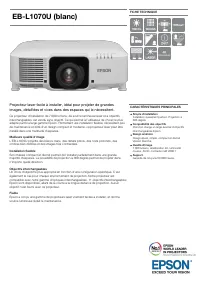 Epson V12H004UA3
Troubleshooting Guide
Epson V12H004UA3
Troubleshooting Guide
 Epson V12H004X0A
User Manual
Epson V12H004X0A
User Manual
 Epson A461H
Manual
Epson A461H
Manual
 Epson C11CH25401
User Manual
Epson C11CH25401
User Manual
 Epson C11CH72401
User Manual
Epson C11CH72401
User Manual
 Epson B11B257201
Manual
Epson B11B257201
Manual
 Epson V11HA85020
Installation Manual
Epson V11HA85020
Installation Manual
 Epson C11CK61201
User Manual
Epson C11CK61201
User Manual