Page 2 - Important Safety Information; Copyright Notice
2 Important Safety Information WARNING : Never look into the projector lens when the lamp is turned on; the bright light can damage your eyes. Never let children look into the lens when it is on. Never open any cover on the projector, except the lamp and filter covers. Dangerous electrical voltages ...
Page 3 - Contents; Welcome
3 - Contents Welcome . . . . . . . . . . . . . . . . . . . . . . . . . . . . . . . . . . . . . . 7 Using Your Documentation . . . . . . . . . . . . . . . . . . . . . . . . . . 8 Getting More Information . . . . . . . . . . . . . . . . . . . . . . . . 8 Registration and Warranty . . . . . . . . . . ....
Page 4 - Using the Remote Control
4 2 Using the Remote Control . . . . . . . . . . . . . . . . . . . 29 Using the Remote Control . . . . . . . . . . . . . . . . . . . . . . . . . . 30 Replacing the Batteries . . . . . . . . . . . . . . . . . . . . . . . . . . 30 Controlling the Picture and Sound . . . . . . . . . . . . . . . . . . ....
Page 8 - Using Your Documentation; Getting More Information
8 Welcome Using Your Documentation This electronic User’s Guide provides detailed instructions on using your projector. In addition, your projector software CD-ROM includes the EMP Monitor Operation Guide . Refer to this manual for detailed instructions on monitoring the projector from a remote loca...
Page 9 - Registration and Warranty
Welcome 9 Registration and Warranty Your projector comes with a warranty that lets you project with confidence. For details, see the warranty statement included with your projector. In addition, Epson offers free Extra Care SM Road Service. In the unlikely event of an equipment failure, you won’t ha...
Page 10 - Unpacking the Projector
10 Welcome Unpacking the Projector After unpacking the projector, make sure you have all the parts shown below: Save all packaging in case you need to ship the projector. Always use the original packaging (or the equivalent) when you need to send the projector to another location. If you are moving ...
Page 11 - Projector Parts
Welcome 11 Projector Parts Front A/V mute slide A/V mute slide lever Remote receiver Foot release lever Security slot Control panel Air filter Air filter cover switch Lamp cover Security bar Back Remote receiver Speaker LAN port USB Type B port Monitor Out port Computer1 and 2 ports and audio jacks ...
Page 12 - Additional Components
12 Welcome Additional Components Depending on how you plan to use the projector, you may need additional components: ■ To receive an S-video signal, you’ll need an S-video cable. One may be provided with your video equipment, or you can purchase one from Epson; see the list on page 13. ■ To receive ...
Page 13 - Optional Accessories
Welcome 13 Optional Accessories To enhance your use of the projector, Epson provides the following optional accessories: You can purchase screens, carrying cases, or other accessories from an Epson authorized reseller. To find the nearest reseller, call 800-GO-EPSON (800-463-7766). Or you can purcha...
Page 16 - Positioning the Projector; note; TBD
16 Displaying and Adjusting the Image Positioning the Projector If the projector isn’t already installed in the room you’re using, you’ll probably want to place it on a table in front of the screen. This lets you stand in the front of the room, face the audience, and remain close enough to the equip...
Page 17 - Turning the Projector On and Off
Displaying and Adjusting the Image 17 Ideally, you should place the projector directly in front of the center of the screen, facing it toward the screen squarely. The base of the lens should be at about the level of the bottom of the screen. If you place the projector below screen level, you’ll have...
Page 18 - Turning On the Projector
18 Displaying and Adjusting the Image Turning On the Projector Follow these steps to turn on the projector: 1. Open the A/V Mute slide (lens cover). 2. Plug one end of the power cable into the projector, and the other end into an electrical outlet. The P power light turns orange. note You can set th...
Page 19 - Using the Direct Power On Function; warning
Displaying and Adjusting the Image 19 3. Press the P power button on the remote control or on top of the projector. The projector beeps once and the P power light flashes green as the projector warms up, then an image begins to appear. When the P power light stops flashing and remains green, the pro...
Page 20 - Shutting Down the Projector; Selecting the Image Source
20 Displaying and Adjusting the Image Shutting Down the Projector This projector incorporates Instant Off technology. To turn it off, you can press its P power button as described below, unplug it, or turn off a power switch that supplies power to the projector. You don’t have to wait for the projec...
Page 21 - Troubleshooting Display Problems; You Can’t Project an Image
Displaying and Adjusting the Image 21 You can also use the Source buttons on the remote control to switch between devices connected to the ports identified on each button. (The LAN button does not work with the PowerLite 84.) Troubleshooting Display Problems Follow these guidelines if you’re having ...
Page 22 - If you’re using a PC notebook:
22 Displaying and Adjusting the Image The Projector and Notebook Don’t Display the Same Image If you’re projecting from a notebook, and you can’t see your image on the projection screen and on your computer at the same time, follow these guidelines. If you’re using a PC notebook: ■ On most systems, ...
Page 23 - Adjusting the Image
Displaying and Adjusting the Image 23 4. Click the Arrangement (or Arrange ) tab. 5. Make sure the Mirror Displays checkbox is selected. Adjusting the Image Once you see your image, you need to make certain adjustments: ■ If the image is too high or too low, you can reposition it. See page 24. ■ To ...
Page 24 - Adjusting the Height of Your Image
24 Displaying and Adjusting the Image Adjusting the Height of Your Image If the image is too low on the screen, you can use the front adjustable foot to raise it. 1. Stand behind the projector. Press the foot release lever up and lift the front of the projector. 2. Once the image is positioned where...
Page 25 - Adjusting the Image Shape
Displaying and Adjusting the Image 25 If the image still isn’t large enough, you may need to move the projector farther away from the screen. You can also use the E-Zoom buttons on the remote control to zoom in on a portion of the image. See page 33 for instructions. Adjusting the Image Shape In mos...
Page 26 - Using Keystone Correction; tip
26 Displaying and Adjusting the Image Using Keystone Correction To adjust your image when it is wider on the top or bottom, do the following: ■ Press one of the two keystone correction buttons on the projector’s control panel, as shown below. Continue pressing the button until you are satisfied with...
Page 27 - Correcting Computer Images
Displaying and Adjusting the Image 27 Correcting Computer Images If you’re connected to a computer and the image doesn’t look right, press the Auto button on the remote control or the Enter button on the projector. This automatically resets the projector’s tracking, sync, resolution, and position se...
Page 30 - Replacing the Batteries
30 Using the Remote Control Using the Remote Control Follow these tips for using the remote control: ■ Point the remote control at the front of the projector or at the screen. ■ Stand within 20 feet of the projector. ■ Avoid using the remote under bright fluorescent lamps or in direct sunlight, or t...
Page 31 - Controlling the Picture and Sound; Switching Between Picture Sources
Using the Remote Control 31 Controlling the Picture and Sound You can use the remote control to preview and select your picture sources, temporarily turn off the picture and sound, freeze the action, zoom in on the picture, and adjust the volume. Switching Between Picture Sources If your projector i...
Page 32 - Turning Off the Picture and Sound
32 Using the Remote Control Turning Off the Picture and Sound You can use the A/V Mute button on the remote control to turn off the image and sound. This does the same thing as the A/V Mute slide (shown on page 18) and is useful if you want to temporarily redirect your audience’s attention. ■ To tur...
Page 33 - Zooming Part of Your Image; Controlling the Volume
Using the Remote Control 33 Zooming Part of Your Image You can zoom in on a portion of the image using the E-Zoom buttons on the remote control. 1. Press the E-Zoom button on the remote control. You see a crosshair indicating the center of the zoom-in area. 2. Use the pointer buttons to position the...
Page 34 - Adjusting the Aspect Ratio; When Connected to Video Equipment
34 Using the Remote Control Adjusting the Aspect Ratio You can use the Aspect button on the remote control to adjust how an image fits into the display area. Each time you press the button, the projector changes to the next setting. When Connected to Video Equipment If you’re projecting from video e...
Page 35 - When Connected to a Computer; Adjusting the Color Mode
Using the Remote Control 35 When Connected to a Computer For computer images, Normal is usually the best setting to select. This displays the image at the largest possible size without stretching it. Depending on your computer display, you may see black bars at the edges. In that case, try selecting...
Page 37 - Highlighting Your Presentation; Using the Pointer Tool
Using the Remote Control 37 Highlighting Your Presentation You can display a pointer to call out important information on the screen. If you want to customize the pointer tool, you can choose from three alternative shapes. Using the Pointer Tool 1. To activate the pointer tool, press the Pointer but...
Page 40 - Connecting to a Computer; Connecting to the VGA Port
40 Connecting to Computers and Other Equipment Connecting to a Computer You can connect the projector to any computer that has a standard VGA output (monitor) port, including desktop models, PC notebook computers, MacBook ® , PowerBook ® , and iBook ® systems, and hand-held devices. You can also con...
Page 41 - Connecting to the USB Port
Connecting to Computers and Other Equipment 41 3. When you’ve finished making any connections, see page 18 for instructions on turning on the projector and adjusting the image. Once the projector is turned on, select the image source: press the Search button on the remote control or the Source Searc...
Page 43 - Connecting an External Monitor
Connecting to Computers and Other Equipment 43 2. Connect the square end of the cable to the projector’s Type B (square) USB port. 3. Connect the flat end of the cable to any available USB port on your notebook or desktop computer. 4. Set the USB Type B setting in the projector’s Extended menu to Wi...
Page 44 - Connecting to Video Equipment
44 Connecting to Computers and Other Equipment Connect the monitor’s cable to the projector’s Monitor Out port as shown. Connecting to Video Equipment You can connect several video sources to the projector at the same time. Before starting, look at your video equipment to determine its available vid...
Page 45 - Connecting a Composite Video Source
Connecting to Computers and Other Equipment 45 Connecting a Composite Video Source 1. Locate an RCA-style video cable (one is usually provided with your video equipment or you can purchase one from an electronics dealer). 2. Connect the cable to the yellow video output connector on your player and t...
Page 46 - Connecting an S-Video Source
46 Connecting to Computers and Other Equipment Connecting an S-Video Source 1. Locate an S-video cable (one is usually provided with your video equipment or you can purchase one from Epson; see page 13). 2. Connect the cable to the S-video connector on your player and the S-Video connector on the pr...
Page 47 - Connecting a Component Video Source
Connecting to Computers and Other Equipment 47 Connecting a Component Video Source You will need a component-to-VGA cable, or a component video cable and adapter, for this connection. You can order the component-to-VGA cable (ELPKC19) from Epson; see page 13 for more information. 1. Connect the VGA-...
Page 48 - Connecting an RGB Video Source
48 Connecting to Computers and Other Equipment Connecting an RGB Video Source 1. Locate the VGA computer cable provided with the projector. 2. Connect the cable to the video port on your player and the Computer1 or Computer 2 port on the projector. 3. If you want to play sound through the projector,...
Page 49 - Playing Sound Through the Projector; Playing Computer Audio
Connecting to Computers and Other Equipment 49 Playing Sound Through the Projector You can play sound through the projector’s speaker system or attach an external speaker system. You can also connect a microphone and output the sound through the projector. You can use the or Volume buttons on the pr...
Page 50 - Playing Sound from Video Equipment; Connecting a Microphone
50 Connecting to Computers and Other Equipment Playing Sound from Video Equipment For video equipment, use an RCA-style audio cable, which you can purchase from an electronics store. 1. Connect the red and white plugs on one end of the cable to the L and R Audio jacks on the projector. 2. Connect th...
Page 51 - Connecting External Speakers
Connecting to Computers and Other Equipment 51 Connecting External Speakers You can output sound from the projector to external speakers with a built-in amplifier. 1. Locate the appropriate cable to connect your speakers. Depending on your speakers, you may be able to use a standard audio cable with...
Page 54 - Connecting to a Wired Network
54 Using the Projector on a Network Connecting to a Wired Network With a shielded, Category-5 Ethernet cable, you can connect the projector to your network and configure it with an IP address. 1. Connect the projector to your network using a commercially available 100BaseTX or 10BaseT network cable....
Page 56 - Configuring Basic Settings
56 Using the Projector on a Network To enter numbers, use the buttons on the remote control to highlight the number you want to input, then press the Enter button. When you’re finished entering an address in the network menu, highlight Return , then press the Enter button. 9. To prevent the IP addre...
Page 58 - Using Projector E-mail Alerts
58 Using the Projector on a Network Using Projector E-mail Alerts When this feature is enabled, the projector sends you an e-mail alert if it has any problems. 1. Press the Menu button on the remote control, select the Network menu, then press Enter . 2. Choose Network Configuration and press Enter ...
Page 59 - Using SNMP to Monitor the Projector
Using the Projector on a Network 59 When the selected problem or warning occurs, an e-mail message is sent to the specified notification addresses. The subject line of the e-mail is EPSON Projector . The e-mail includes the following information: ■ Line 1: The name of the projector where the problem...
Page 60 - Using a Browser to Control the Projector
60 Using the Projector on a Network 224.0.0.0 to 255.255.255.255 (where x is a number from 0 to 255). 5. If your network environment uses an AMX controller, select ON to allow the projector to be detected by AMX Device Discovery. Using a Browser to Control the Projector You can use a standard web br...
Page 61 - Fine-Tuning the Projector
61 5 Fine-Tuning the Projector Y ou can use the projector’s on-screen menus to adjust the image, sound, and other features. This chapter covers the following information: ■ Using the menu system ■ Adjusting the image ■ Adjusting signal settings ■ Customizing projector features ■ Using the projector ...
Page 62 - Using the Menu System
62 Fine-Tuning the Projector Using the Menu System You can use the remote control or the projector’s control panel to access the menus and change settings. Follow these steps: 1. To display the menu screen, press the Menu button on the remote control or on the projector. You see a menu screen simila...
Page 63 - Restoring the Default Settings
Fine-Tuning the Projector 63 3. Once you’ve selected the menu, use the pointer buttons to scroll through the list of options. (Some of the options may be grayed out or unavailable, depending on the selected source.) 4. After highlighting the option you want to adjust, use the pointer buttons to chan...
Page 65 - Adjusting Signal Settings
Fine-Tuning the Projector 65 ■ Tint (video only) Adjusts the balance of green to magenta in the image (available only for component video or NTSC signals). ■ Sharpness Adjusts the sharpness of the image. ■ Color Adjustment Adjusts the color values. Select Abs. Color Temp . to adjust the overall valu...
Page 67 - Customizing Projector Features
Fine-Tuning the Projector 67 ■ Input Signal If the colors don’t look right on the Auto setting, select the setting for the type of equipment you’ve connected to the Computer1 or Computer2 port: RGB : For a computer connection. Component Video : For a video player that outputs a component video signa...
Page 69 - Using the Projector Security Features; Enabling Password Protection
Fine-Tuning the Projector 69 Using the Projector Security Features To prevent unauthorized use of the projector, you can do the following: ■ Assign a password; this can be disabled for a set period if you want to loan the projector to someone. ■ Create an identifying user logo that is displayed at s...
Page 70 - caution
70 Fine-Tuning the Projector The default setting for the Password Protect function is Off . Follow these steps to turn password protection on: 1. Press the Freeze button on the remote control for about five seconds. You see this screen: 2. Use the pointer buttons to set Power On Protect to On . Then...
Page 71 - Starting the Projector with a Password
Fine-Tuning the Projector 71 9. To enable network setting protection, select Network Protect and press Enter . Select On and press Enter . When this feature is on, none of the network settings on the menu can be changed. Starting the Projector with a Password When the password function is enabled, y...
Page 72 - Creating Your Own Startup Screen; Capturing the Image
72 Fine-Tuning the Projector If you have forgotten the password, contact Epson with the request code number that appears in the Password Protect Release screen for assistance. See “Where To Get Help” on page 102. Creating Your Own Startup Screen You can transfer any image from your computer or video...
Page 73 - Choosing When to Display the Image; Disabling the Projector’s Buttons
Fine-Tuning the Projector 73 5. When you see the message Select this Image? , highlight Yes and press Enter . 6. Use the arrow buttons to select a zoom factor (display size) and press Enter . 7. When the message Save this image as the user’s logo? appears, select Yes and press Enter . Saving the log...
Page 74 - Customizing Power and Operation
74 Fine-Tuning the Projector 4. Select Yes and press Enter to confirm the setting. 5. Press the Menu button to exit. Customizing Power and Operation You can use the Extended menu to customize the way the projector displays images, enable quick startup, turn sleep mode on or off, and customize other ...
Page 77 - Maintaining the Projector
77 6 Maintaining the Projector Y our projector needs little maintenance. All you have to do is keep the lens clean. You may also need to clean the air filter and vent. A clogged air filter or vent can block ventilation needed to cool the projector. The only parts you should replace are the lamp and ...
Page 78 - Cleaning the Lens; Cleaning the Projector Case
78 Maintaining the Projector Cleaning the Lens Clean the lens whenever you notice dirt or dust on the surface. To remove dirt or smears on the lens, use lens-cleaning tissue. If necessary, moisten a soft cloth with lens cleaner and gently wipe the lens. Cleaning the Projector Case Before you clean t...
Page 79 - Cleaning the Air Filter and Vent
Maintaining the Projector 79 Cleaning the Air Filter and Vent Your projector includes an air filter to ensure the best performance. If dust collects on the air filter or vent, clean them as described below. Dust clogs prevent proper ventilation and can cause overheating and damage the projector. If ...
Page 80 - Replacing the Lamp and Air Filter; Replacing the Lamp
80 Maintaining the Projector Replacing the Lamp and Air Filter The life span of the projection lamp is about 5000 hours if Brightness Control in the Setting menu is set to High (default), and 6000 hours if Brightness Control is set to Low . It is time to replace the lamp when: ■ The projected image ...
Page 84 - Replacing the Air Filter
84 Maintaining the Projector Replacing the Air Filter If the filter is difficult to clean or damaged, or if the overheating message appears after cleaning, you need to replace the filter. Contact your dealer or call Epson at 800-GO-EPSON (800-463-7766) to obtain a new filter. 1. Turn off the project...
Page 86 - Resetting the Lamp Timer
86 Maintaining the Projector Resetting the Lamp Timer After you replace the lamp, you need to reset the lamp timer using the projector’s menus. 1. Press the Menu button on the remote control or on the projector’s control panel. You see the main menu. 2. Use the buttons on the remote control (or the ...
Page 87 - Transporting the Projector
Maintaining the Projector 87 Transporting the Projector The projector contains many glass and precision parts. Follow these guidelines to prevent damage: ■ Close the A/V Mute slide (lens cover) to protect the lens. ■ When shipping the projector for repairs, use the original packaging material if pos...
Page 89 - Solving Problems
89 7 Solving Problems T his chapter helps you solve problems with your projector, and tells you how to contact technical support for problems you can’t solve yourself. The following information is included: ■ Using the projector’s on-screen help system ■ What to do when the projector’s status lights...
Page 90 - Checking Projector Status
90 Solving Problems Using On-Screen Help If the image doesn’t look right or your audio isn’t working, you can get help by pressing the ? Help button on top of the projector or on the remote control. 1. Press the ? Help button on the remote control or on the projector. You see the Help Menu. 2. Use t...
Page 91 - What To Do When the Lights Flash
Solving Problems 91 What To Do When the Lights Flash The lights on top of the projector indicate the projector’s status. Refer to the following table for a complete description of the projector’s status lights: Temperature light Lamp light Power light Status lights Light Status Description Orange Th...
Page 93 - Viewing Lamp Usage and Other Information; Solving Projector Operation Problems; The power doesn’t turn on.
Solving Problems 93 Viewing Lamp Usage and Other Information Use the Info menu to view information about the display settings of your computer and the number of hours the lamp has been used. Press the Menu button and highlight the Info menu. You see the lamp usage hours and various input signal sett...
Page 94 - No image appears on the screen.
94 Solving Problems You hear the projector’s fan after the power has been turned off. If Standby Mode is set to Communication On , the fans continue to operate after the projector has cooled down. See page 75 for more information about this setting. Solving Problems with the Image or Sound No image ...
Page 96 - The message
96 Solving Problems 6. Make sure the Mirror Displays checkbox is selected. The message Not Supported is displayed. ■ Make sure the correct Input Signal is selected in the Signal menu (see page 67). ■ Make sure your computer’s resolution doesn’t exceed UXGA (1600 × 1200) and the frequency or refresh ...
Page 97 - The image contains static or noise.
Solving Problems 97 The image isn’t square, but keystone-shaped. ■ If the top or bottom of the image is broader, press the or button on the projector until the image is square. ■ If the projector is angled toward the screen from the left or right, the image will be broader on one side. Center the pr...
Page 99 - The image is too light or dark, or colors are incorrect.; There is no sound, or the sound is not loud enough.
Solving Problems 99 3. Adjust the Sync setting to increase the image sharpness. The image is too light or dark, or colors are incorrect. ■ Press the Color Mode button to select a different color mode (see page 35). ■ Try adjusting the brightness and color settings in the Image menu (see page 64). ■ ...
Page 100 - Solving Network Problems; You are not receiving mail when a projector problem occurs.
100 Solving Problems ■ Make sure the audio cable is connected securely at both ends. For computer audio, connect the cable to your computer’s headphone jack or audio out jack. ■ Make sure the volume control on your computer is not turned all the way down or muted. In Windows, you may be able to use ...
Page 101 - The projector doesn’t respond to remote control commands.
Solving Problems 101 Solving Problems with the Remote Control The projector doesn’t respond to remote control commands. ■ The remote control’s batteries may not be installed correctly or may be low on power. To change the batteries, see page 30. ■ Make sure you are within about 20 feet (6 meters) of...
Page 102 - Where To Get Help; Internet Support; Speak to a Support Representative
102 Solving Problems Where To Get Help Epson provides these technical support services: Internet Support Visit Epson’s support website at www.epson.com/support and select your product for solutions to common problems. You can download utilities and documentation, get FAQs and troubleshooting advice,...
Page 103 - Purchase Supplies and Accessories
Solving Problems 103 Purchase Supplies and Accessories You can purchase screens, carrying cases, or other accessories from an Epson authorized reseller. To find the nearest reseller, call 800-GO-EPSON (800-463-7766). Or you can purchase online at www.epsonstore.com (U.S. sales) or www.epson.ca (Cana...
Page 105 - Projector Installation
105 A Projector Installation T his appendix provides guidelines on installing the projector in a permanent location, such as a classroom or conference room. The projector can be installed for four different viewing setups: front projection, ceiling projection, rear projection onto a semi-transparent...
Page 107 - Technical Specifications; General
107 B Technical Specifications General Type of display Epson poly-silicon TFT active matrix Resolution(native format) 1024 × 768 pixels (XGA) Color reproduction 16.8 million colors Light output High Brightness mode:2600 lumens white light output (ISO 21118 standard)2600 lumens color light output Low...
Page 108 - Projection Lamp
108 Technical Specifications Projection Lamp Type UHE (Ultra High Efficiency) Power consumption 200 W Lamp life Approx. 5000 hours (High Brightness mode)Approx. 6000 hours (Low Brightness mode) Part number V13H010L50 Remote Control Range 20 feet (6 meters) Batteries Two AA Dimensions Height 3.7 inch...
Page 109 - Environmental
Technical Specifications 109 Environmental Temperature Operating: 41 to 95 °F (5 to 35 °C)Storage: 14 to 140 °F (–10 to 60 °C) Humidity(non-condensing) Operating: 20 to 80% RH Storage: 10 to 90% RH Operating altitude 0 to 7,500 ft (0 to 2,286 m) Safety United States FCC 47CFR Part 15B Class B (DoC)U...
Page 110 - Compatible Video Formats
110 Technical Specifications Compatible Video Formats The projector supports NTSC, PAL, and SECAM international video standards, as well as the monitor display formats listed below. To project images output from a computer, the computer’s video card must be set at a refresh rate (vertical frequency)...
Page 113 - Notices; Important Safety Instructions
113 C Notices T his appendix includes safety instructions and other important information about your PowerLite projector. Important Safety Instructions Follow these safety instructions when setting up and using the projector: ■ Do not look into the lens when the projector is on. The bright light can...
Page 116 - FCC Compliance Statement; For United States Users
116 Notices FCC Compliance Statement For United States Users This equipment has been tested and found to comply with the limits for a Class B digital device, pursuant to Part 15 of the FCC Rules. These limits are designed to provide reasonable protection against harmful interference in a residential...
Page 117 - Index
117 Index A A/V Mute, 32, 73, 94Accessories, 13Adapter, audio, 50Air filter cleaning, 79ordering, 13replacing, 80 to 85 Altitude, 75, 109Anti-theft device, 13, 17Aspect ratio, 34 to 35, 107Aspect setting, 34 to 35, 67Audio adapter, 50connecting equipment, 49 to 51controlling volume, 33problems, trou...


 Epson V11HB23020
User Manual
Epson V11HB23020
User Manual
 Epson C11CK75201
User Manual
Epson C11CK75201
User Manual
 Epson B11B272202
User Manual
Epson B11B272202
User Manual
 Epson V11HA52820
User Manual
Epson V11HA52820
User Manual
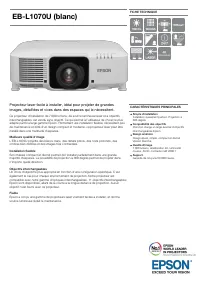 Epson V12H004UA3
Troubleshooting Guide
Epson V12H004UA3
Troubleshooting Guide
 Epson V12H004X0A
User Manual
Epson V12H004X0A
User Manual
 Epson A461H
Manual
Epson A461H
Manual
 Epson C11CH25401
User Manual
Epson C11CH25401
User Manual
 Epson C11CH72401
User Manual
Epson C11CH72401
User Manual
 Epson B11B257201
Manual
Epson B11B257201
Manual
 Epson V11HA85020
Installation Manual
Epson V11HA85020
Installation Manual
 Epson C11CK61201
User Manual
Epson C11CK61201
User Manual