Epson 710/700/500- Manuals
Epson 710/700/500– User Manual, Manual in PDF format online.
Manuals:
User Manual Epson 710/700/500
Summary
Important Information Please read the following important information about your projector. Important Safety Information Warning: Never look into the projector lens when the lamp is switched on as the bright light can damage your eyes. Never let children look into the lens when it is on. Warning: Ne...
Button Function Power Turns the projector on or off. Help Displays the Help menu. Source Switches the image source in order of computer → S-video → composite video. If there is no S-video input, the switch toggles between computer and composite video. Enter Selects a menu option when the Help menu i...
® D A T A / V I D E O P R O J E C T O R Owner’s Manual
■ ■ ■ ■ ■ ■ iii ■ ■ ■ ■ ■ ■ ■ ■ ■ ■ ■ ■ ■ ■ ■ Contents Contents iii Introduction vii Getting the Most Out of Your Projector ................................ ix Optional Accessories ...................................................................ix About This Manual...................................
Contents ■ ■ ■ ■ iv 2 Using the Projector 27 Turning the Equipment On and Off .....................................29 Turning the Projector On and Off ............................................ 29 Focusing and Positioning the Screen Image ..........................31 Resize Button ...................
■ ■ ■ ■ ■ ■ ■ ■ ■ ■ ■ ■ ■ ■ ■ ■ ■ ■ ■ ■ ■ vii Introduction Y our compact, lightweight EPSON EMP-710/700/500 projector lets you project full-color images and video onto a large screen for presentations. You can connect it simultaneously to two image sources: one PC or Apple® Macintosh® computer image...
Getting the Most Out of Your Projector ■ ■ ■ ■ ■ ■ ix Getting the Most Out of Your Projector Your projector comes with a full set of features that enable you to control the settings for the image display, video and audio. To get the most out of your projector, read this section for a quick summary o...
Introduction ■ ■ ■ ■ x About This Manual Chapter 1, “Installation”, gives step-by-step instructions on how to set up the projector and connect it to your computer, video source, or other external speaker or PA system. Read the installation procedures that apply to your configuration. Chapter 2, “Usi...
Safety Instructions ■ ■ ■ ■ ■ ■ xi Safety Instructions Follow these safety instructions when setting up and using the projector: 1. Do not place the projector on an unstable cart, stand, or table. 2. Do not use the projector near water or sources of heat. 3. Use attachments only as recommended. 4. U...
Where to Get Help ■ ■ ■ ■ ■ ■ xiii Where to Get Help If you are having trouble setting up or running your projector, first see Chapter 5, “Troubleshooting”. If you cannot resolve the problem, contact the appropriate representative listed in the section entitled “World -Wide Warranty Terms” at the en...
Introduction ■ ■ ■ ■ xiv Transporting your projector The projector contains many glass parts and precision parts. If you need to transport it, please follow these packing guidelines to prevent damaging the projector: • When shipping the projector for repairs, use the original packaging material. If ...
■ ■ ■ ■ ■ ■ ■ ■ ■ ■ ■ ■ ■ ■ ■ ■ ■ ■ ■ ■ ■ 1 1 Installation T his chapter describes how to unpack and set up your projector, and connect it to other equipment. The projector must be connected to a computer or a video source such as a video tape deck, camcorder, digital camera or laser disc player bef...
■ ■ ■ ■ 2 Unpacking the Projector When you unpack the projector, make sure you have all these components: • Projector • Remote control • 2 AA batteries • Power cord • Computer cable • Audio/Video cable (A/V cable) • PS/2 mouse cable • USB mouse cable • Mac mouse cable (ADB mouse cable) • Owner’s man...
Unpacking the Projector ■ ■ ■ ■ ■ ■ 3 Additional Components Depending on how you plan to use the projector, you may need these additional components: • To receive an S-Video signal, you need an S-Video cable. (One is usually provided with your video device.) A separate cable is required for each vid...
■ ■ ■ ■ 4 Setting Up the Projector 1. Place the projector on a sturdy, level surface within five feet of the computer or video source. ♦ Caution: Do not hold the projector by the lens. This can damage the lens. 2. Place the projector at a correct distance from the screen. The distance between the pr...
■ ■ ■ ■ 6 Connecting to a Computer You can connect the projector to a computer capable of VGA, SVGA, XGA, SXGA and UXGA output. (EMP-500 supports VGA, SVGA, XGA, and SXGA resolutions. EMP-710/700 support VGA, SVGA, XGA, SXGA and UXGA resolutions.) To connect the computer and mouse cables (to use the...
Connecting to a Computer ■ ■ ■ ■ ■ ■ 7 Connecting to a PC Desktop Computer To connect the projector to your PC desktop computer, you need to: • Connect the computer cable • Connect the audio cable (if you’ll be projecting with audio) Follow the steps in each section for the cables you need to connec...
■ ■ ■ ■ 8 1. If you will be viewing the video on your computer monitor as well as the projector screen, disconnect the monitor cable from the video port on the back of your computer. 2. Connect one end of the computer cable to the projector’s Computer port. 3. Connect the other end of the computer c...
Connecting to a Computer ■ ■ ■ ■ ■ ■ 9 1. Connect the 9-pin end of the PS/2 mouse cable or, the USB mouse cable to the Mouse/Com or USB mouse port on the projector. 2. Disconnect your mouse from the mouse port on the back of your computer and replace it with the other end of the PS/2 mouse cable or ...
■ ■ ■ ■ 10 Connecting to a PC Laptop Computer To connect the projector to your PC laptop computer, you need to: • Connect the computer cable • Connect the mouse cable (if you want to use the remote control as a mouse) • Connect the audio cable (if you’ll be projecting with audio) Follow the steps in...
Connecting to a Computer ■ ■ ■ ■ ■ ■ 13 Connecting to a Desktop Macintosh To connect the projector to your desktop Macintosh, you need to: • Connect the computer cable • Connect the mouse cable (if you want to use the remote control as a mouse) • Connect the audio cable (if you’ll be projecting with...
Connecting to a Computer ■ ■ ■ ■ ■ ■ 17 Connecting to a PowerBook Your PowerBook must have video-out capability in order to connect to the projector. To connect the projector to your PowerBook, you need to: • Connect the computer cable • Connect the mouse cable (if you want to use the remote control...
■ ■ ■ ■ 22 Connecting to a Video Source You can connect a VCR, a camcorder, a laser disc player, DVD player, or any other compatible video image source to your projector. The projector can receive composite video or S-Video. Your equipment has composite video if your video source has a one-pin RCA v...
■ ■ ■ ■ ■ ■ ■ ■ ■ ■ ■ ■ ■ ■ ■ ■ ■ ■ ■ ■ ■ 27 2 Using the Projector T his chapter provides the following information about using your projector: • Turning the equipment on and off • Focusing and positioning the screen image • Controlling the projector with the remote control and the operation panel •...
Turning the Equipment On and Off ■ ■ ■ ■ ■ ■ 29 Turning the Equipment On and Off Turn on the projector and its attached equipment in the following order. 1. Video source 2. Audio source (if different from computer or video source) 3. Projector 4. External speaker or PA system (if necessary) 5. Compu...
Focusing and Positioning the Screen Image ■ ■ ■ ■ ■ ■ 33 Resize Button The Resize button allows you to select the projection method for certain types of image input signals from a computer. With images up to XGA size (1024 × 768) or SVGA size (800 x 600), you can choose from two projection methods. ...
■ ■ ■ ■ 34 Controlling the Projector You can use the operation panel on top of the projector or the remote control to perform the following actions: • Turn the power on or off • Auto set-up of the computer image • Switch between input images (Computer, video-computer) • Access the projector menus to...
Controlling the Projector ■ ■ ■ ■ ■ ■ 35 Using the Remote Control To use the remote control, point it towards the remote control receivers located at the front and back of the projector. To be able to use the remote control as a cordless mouse, connect the mouse cable to the projector and your compu...
■ ■ ■ ■ 38 Using the Operation Panel You can use the operation panel to control the projector instead of the remote control. However, you can program and access the custom features only using the remote control. The following table summarizes the functions on the operation panel. Button Function Pow...
Projector Status Indicators ■ ■ ■ ■ ■ ■ 39 Projector Status Indicators The power and lamp indicators at the top of the projector tell you its operating status. ♦ Caution: A red indicator warns you if a serious problem occurs. See Chapter 5, “Troubleshooting,” for what to do if a warning light comes ...
■ ■ ■ ■ 40 Lamp Indicator Displays lamp condition. This indicator is off when the projector is in a normal condition. Temperature Indicator Displays the internal temperature condition. This indicator is off when the projector is in a normal condition. Color Status Meaning - Off Lamp is functioning n...
■ ■ ■ ■ ■ ■ ■ ■ ■ ■ ■ ■ ■ ■ ■ ■ ■ ■ ■ ■ ■ 41 3 Using the Projector Menus T he eight projector menus let you to control your projector. • The Video menu controls the look and quality of the projected image, whether the image source is a computer or video. • The Audio menu controls audio features, suc...
■ ■ ■ ■ 42 Accessing the Main Menu To display the Main menu, press the Menu button on the remote control. The Main menu appears: Press the Menu button again to hide the menu.
Changing a Menu Setting ■ ■ ■ ■ ■ ■ 43 Changing a Menu Setting To change a menu setting: 1. Press the Menu button on the remote control to display the Main menu. 2. Press the top or bottom of the Enter button to scroll through the menu choices. 3. Press the Enter button to display a submenu. Power F...
Menu Options ■ ■ ■ ■ ■ ■ 45 Menu Options Video Menu (Image source = Computer) The Video menu lets you make adjustments to the projected image. The following options are available when the image source is Computer. ♦ Note: The computer must be connected and operating, and the image source on the proj...
■ ■ ■ ■ 48 Audio Menu The Audio menu lets you make adjustments related to audio. Mode Specifies the image signal mode. User can select from Auto, NTSC, NTSC4.43, PAL, M-PAL, N-PAL, PAL 60, SECAM. Reset Returns all menu items to their initial factory defaults.Select this item and then press the Enter...
Menu Options ■ ■ ■ ■ ■ ■ 51 Storing a User Logo Follow these steps to capture and store a logo. 1. Display the image(with the projector) you wish to use as a logo. 2. Press the Menu button to open the Menu window. 3. Select the User’s Logo menu option by pressing the pointer button. Then press the E...
■ ■ ■ ■ 52 Assigning the Logo to the A/V Mute Button Follow these steps to assign the logo to the A/V Mute button: 1. Press the Menu button to open the Menu window. 2. Select the Setting menu and press the Enter button. 3. Select the Blank option (A/V Mute), then highlight User Logo. 4. Press the Me...
Menu Options ■ ■ ■ ■ ■ ■ 53 Advanced Menu The Advanced menu enables you to set various projector options. Menu item Description Language Selects the menu language from Japanese, English, German, French, Italian, Spanish, Portuguese, Chinese and Korean. Startup Screen Displays the user logo during th...
■ ■ ■ ■ 54 About Menu The About menu displays the following information about your projector. Image source = Computer or Component Video Image source = Video Menu item Description Lamp Displays the number of hours the current lamp has been used. The lamp light turns red when the projector lamp needs...
■ ■ ■ ■ ■ ■ ■ ■ ■ ■ ■ ■ ■ ■ ■ ■ ■ ■ ■ ■ ■ 55 4 Maintenance Y our projector needs little maintenance. You should keep the lens clean because any dirt or smears appear on the screen. You also need to periodically clean the air filter. A clogged air filter can block ventilation needed to cool the proje...
Cleaning the Air Filter ■ ■ ■ ■ ■ ■ 57 Cleaning the Air Filter Clean the air filter at the top of the projector after every 100 hours of use. If it is not cleaned periodically, it can become clogged with dust, preventing proper ventilation. This can cause overheating and damage the projector. To cle...
■ ■ ■ ■ 58 Replacing the Lamp Replace the lamp when: • The projected image gets darker or starts to deteriorate. • The projection lamp indicator is flashing orange . • The message “LAMP REPLACE” appears on the screen when the projector lamp comes on. ♦ Note: To keep the initial brightness and image ...
■ ■ ■ ■ ■ ■ ■ ■ ■ ■ ■ ■ ■ ■ ■ ■ ■ ■ ■ ■ ■ 61 5 Troubleshooting T his chapter describes the problems indicated by the warning lights and provides information on how to solve problems with the projector. It is divided into the following sections: • Problems with the projector. See this section if the ...
■ ■ ■ ■ 62 Problems with the Projector If you have problems with the projector, first turn it off and unplug it. Then plug the power cord back in and turn on the projector. If this does not solve the problem, check the warning lights at the top of the projector. These lights alert you to problems wi...
Problems with the Projector ■ ■ ■ ■ ■ ■ 63 ❑ The temperature indicator is red. The projector is overheating, which turns the lamp off automatically. Let the projector cool for a few minutes, then turn it back on. Make sure nothing is blocking the ventilation vents. The air filter may be clogged. Cle...
■ ■ ■ ■ 64 Problems with the Image or Sound ❑ An image does not appear on the screen. Check that the power light is on and the lens cover is off. Also make sure the cables are installed correctly, as described in Chapter 1. The correct image source may not be selected. Press the Source button on the...
Problems with the Image or Sound ■ ■ ■ ■ ■ ■ 65 ❑ A blank screen is displayed. The computer signal cannot be interpreted by the projector. Verify the display format (see page 69, 70). When you see a blank screen, you cannot access the projector menus. ❑ The image or parts of the image are blurred or...
■ ■ ■ ■ ■ ■ ■ ■ ■ ■ ■ ■ ■ ■ ■ ■ ■ ■ ■ ■ ■ 67 6 Technical Specifications General Type of display Poly-silicon TFT Size of liquid crystal panels 0.9 inches (22.9 mm) Resolution 1024 (horizontal) x 768 (vertical) pixels (EMP-710/700) 800 (horizontal) x 600 (vertical) pixels (EMP-500) Projection distanc...
Supported Monitor Displays ■ ■ ■ ■ ■ ■ 69 Supported Monitor Displays The projector displays images at a resolution of 1024 x 768 (EMP-710/700) or 800 x 600 (EMP-500) pixels. To display a higher resolution image, the projector compresses it to 1024 x 768 (EMP-710/700) or 800 x 600 (EMP-500). The foll...
Technical Specifications ■ ■ ■ ■ 72 DECLARATION of CONFORMITY/DICHIARAZIONE di CONFORMITÀ/KONFORMITÄUNG/DECLARACIÓN de CONFORMIDAD/DECLARATION de CONFORMITE according to ISO/IEC Guide 22 and EN 45014/secondo la Guida ISO/IEC 22 e EN 450014/entsprechend ISO/CEI Anleitung 22 und EN 45014/De acuerdo co...
■ ■ ■ ■ ■ ■ ■ ■ ■ ■ ■ ■ ■ ■ ■ ■ ■ ■ ■ ■ ■ 73 Glossary Brightness. The balance of light and dark shades in an image. Composite video. A type of video signal that encodes colours, luminance and sychronization information so it can be carried in one signal. Contrast. A measure of the luminance differen...
■ ■ ■ ■ ■ ■ 75 ■ ■ ■ ■ ■ ■ ■ ■ ■ ■ ■ ■ ■ ■ ■ Index A Audio cable 9Audio In jack 9Audio Menu 48Audio Out jack 25 B Brightness 73 C Cleaning the Air Filter 57Color 47Contrast 73cooling 62 D DAR viii E Effect Menu 49External Speaker 1, 25 F Format 69 G Glossary 73 I Image 64Installation x M Mac mouse c...
■ ■ ■ ■ ■ ■ 77 World-Wide Warranty Terms The EPSON Multi-Media Projector you purchased includes Epson’s World-Wide Warranty, which allows you to obtain repair service for your product outside the country where you purchased it in over 45 countries in the world. Please note that the terms stated in t...
World-Wide Warranty Terms ■ ■ ■ ■ 78 2) This warranty service will be implemented based on the warranty term and conditions that have been established by EPSON (or its authorized servicer) in the country where service is sought. However, Epson guarantees at least these service terms: - The period of...
DECLARATION of CONFORMITY According to 47CFR, Part 2 and 15 Declare under sole responsibility that the product identified herein, complies with 47CFR Part 2 and 15 of the FCC rules as a Class B digital device. Each product marketed, is identical to the representative unit tested and found to be comp...
Manual Epson 710/700/500
Epson Manuals
-
Epson V11HB23020
User Manual
-
Epson V11HB23020
Manual
- Epson C11CJ61201 N User Manual
-
Epson C11CK75201
User Manual
-
Epson B11B272202
User Manual
-
Epson V11HA52820
User Manual
-
Epson V11HA67820
User Manual
-
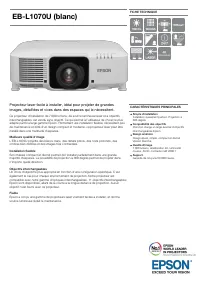
Epson V12H004UA3
Troubleshooting Guide
-
Epson V12H004X0A
User Manual
- Epson V12H004Y0A User Manual
-
Epson A461H
Manual
-
Epson A461H
User Manual
-
Epson A462E
Manual
-
Epson A462E
User Manual
-
Epson C11CH25401
User Manual
-
Epson C11CH72401
User Manual
-
Epson B11B257201
Manual
-
Epson V11HA85020
Installation Manual
-
Epson C11CK61201
User Manual
-
Epson C11CK65201
User Manual