Page 2 - Confirming the Package Contents
Confirming the Package Contents The following items are included in the package. If something is missing please contact the retail outlet at which you purchased the product. A memory card is not included. • Adobe Reader is required to view the PDF manuals. Microsoft Word Viewer 2003 can be installed...
Page 3 - This guide is divided into the following two sections.; Learning More; • The electronic manuals are included in the supplied CD-ROM.
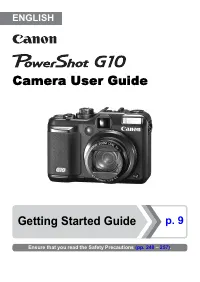
Let’s Get Started! 1 Let’s Get Started! This guide is divided into the following two sections. Next... Learning More p. 39 First... p. 9 Getting Started Guide This section explains how to prepare the camera for use and the basics of shooting, viewing and printing images. Start out by familiarizing y...
Page 4 - Table of Contents; Items marked with a; Components Guide; Using the Digital Zoom/Digital Tele-Converter
Table of Contents 2 Table of Contents Items marked with a are lists or charts that summarize camera functions or procedures. Please Read . . . . . . . . . . . . . . . . . . . . . . . . . . . . . . . . . . . . 7 Components Guide 40 Using the Control Dial . . . . . . . . . . . . . . . . . . . . . . . ...
Page 5 - Shooting Using the Mode Dial
Table of Contents 3 Shooting Close-ups (Macro) . . . . . . . . . . . . . . . . . . . . . 74Using the Self-Timer . . . . . . . . . . . . . . . . . . . . . . . . . . . 75 Changing the Recording Pixels (Still Images) . . . . . . . . . . 80Changing the Compression (Still Images) . . . . . . . . . . . . ...
Page 6 - Checking the Focus and People’s Expressions; Print Settings/Transfer Settings
Table of Contents 4 Using the ND Filter. . . . . . . . . . . . . . . . . . . . . . . . . . . . . . 140 Switching between Metering Modes . . . . . . . . . . . . . . 141 Adjusting the Tone (White Balance) . . . . . . . . . . . . . . . . 143Shooting in a My Colors Mode . . . . . . . . . . . . . . . . ....
Page 7 - Attaching an Externally Mounted Flash (for Macro Ring Lite
Table of Contents 5 Setting the World Clock . . . . . . . . . . . . . . . . . . . . . . . . . . 217Low Level Formatting Memory Cards . . . . . . . . . . . . . . . 220Resetting the File Number . . . . . . . . . . . . . . . . . . . . . . . . 221Creating an Image Destination (Folder) . . . . . . . . . ...
Page 8 - Symbol Conventions in this Guide; About this Guide; : This mark denotes issues that may affect the camera’s
About this Guide 6 Symbol Conventions in this Guide About this Guide : This mark denotes issues that may affect the camera’s operation. : This mark denotes additional topics that complement the basic operating procedures. Explanations in this guide are based on the camera’s default settings at time ...
Page 9 - Please Read; Test Shots
Please Read 7 Please Read Test Shots Before you try to photograph important subjects, we highly recommend that you shoot several trial images to confirm that the camera is operating and being operated correctly.Please note that Canon Inc., its subsidiaries and affiliates, and its distributors are no...
Page 10 - Video Format; Please see; Camera Body Temperature
Please Read 8 Video Format Please set the camera’s video signal format to the one used in your region before using it with a TV monitor (p. 228) . Language Setting Please see Setting the Display Language (p. 15) to change the language setting. Camera Body Temperature If your camera is used for prolo...
Page 12 - Ge; Preparations; Insert the battery until it clicks into the battery charger.; Charging takes approximately 2 hours 20 minutes.; Charging the Battery
Preparations 10 Ge tting Started Guide Preparations 1. Insert the battery until it clicks into the battery charger. 2. Plug the battery charger (CB-2LZ) into a power outlet, or attach the power cord to the battery charger (CB-2LZE) and plug it into a power outlet. 3. Remove the battery after chargin...
Page 13 - Getting Started Gui; Push the battery lock in the direction of the arrow (; Installing the Battery and Memory Card
Preparations 11 Getting Started Gui de 1. Slide the cover ( a ) and open it ( b ). 2. Push the battery lock in the direction of the arrow ( c ) and insert the battery until it locks. Installing the Battery and Memory Card b a c Battery Lock
Page 14 - Insert the memory card until it clicks into place.
Preparations 12 Ge tting Started Guide 3. Insert the memory card until it clicks into place. 4. Close the cover ( d ) and slide until it clicks ( e ). Ensure that the memory card is correctly oriented before inserting it in the camera. Inserting it backward may cause the camera to fail to recognize ...
Page 15 - Attaching the Neck Strap
Preparations 13 Getting Started Gui de To Remove the Battery Push the battery lock in the direction of the arrow and hold it while pulling the battery out. To Remove the Memory Card Push the memory card with your finger until the memory card clicks and then release it. Attaching the Neck Strap Batte...
Page 16 - or; • You can also set the value by using; To Change a Previously Set Date/Time; Setting the Date and Time
Preparations 14 Ge tting Started Guide The Date/Time settings menu will appear the first time the power is turned on. 1. Press the power button. 2. Select the month, day, year and time, and the display order. 1. Use the or button to select an option. 2. Use the or button to set the value. • You can ...
Page 17 - Press the; Setting the Display Language
Preparations 15 Getting Started Gui de You can change the language displayed in the LCD monitor menus and messages. 1. Press the (Playback) button. 2. Hold down the button and press the MENU button. 3. Use the , , or button to select a language. 4. Press the button. z A rechargeable lithium battery ...
Page 18 - Press the power button.; Formatting Memory Cards; and sound data
Preparations 16 Ge tting Started Guide You should always format a new memory card or one from which you wish to erase all images and other data. 1. Press the power button. 2. Select [Format]. 1. Press the MENU button.2. Use the or button to select the menu. 3. Use the or button to select [Format]. 4...
Page 19 - Shooting Still Images; • The start-up sound will play and the start-up image will display in; Select a shooting mode.; Set the mode dial to; Aim the camera at the subject.; Avoiding Camera Shake
Shooting Still Images 17 Getting Started Gui de Shooting Still Images 1. Press the power button. • The start-up sound will play and the start-up image will display in the LCD monitor. • Pressing the power button again turns the power off. 2. Select a shooting mode. 1. Set the mode dial to . 3. Aim t...
Page 20 - Mute Setting
Shooting Still Images 18 Ge tting Started Guide 5. Press the shutter button fully (all the way) to shoot. • The shutter sound will play and the image will record.• Movement of the camera or subject while the shutter sound is playing may result in blurred images. • Recorded images are displayed on th...
Page 21 - Viewing Still Images; • Use the
Viewing Still Images 19 Getting Started Gui de Viewing Still Images 1. Press the (Playback) button. 2. Use the or button to display the image you wish to view. • Use the button to move to the previous image and the button to move to the next image. • The images advance more quickly if you keep the b...
Page 22 - Erasing; You can also select images by using the control dial.
Erasing 20 Ge tting Started Guide Erasing 1. Press the (Playback) button. 2. Use the or button to select an image to erase and press the button. You can also select images by using the control dial. 3. Confirm that [Erase] is selected and press the button. To exit instead of erasing, select [Cancel]...
Page 23 - Printing; Connect the camera to a direct print compatible printer.; • Open the camera’s terminal cover and insert the interface cable; Press the camera’s; • The
Printing 21 Getting Started Gui de Printing 1. Connect the camera to a direct print compatible printer. • Open the camera’s terminal cover and insert the interface cable all the way into the terminal. • See the printer’s user guide for connection instructions.• Since this camera uses a standard prot...
Page 24 - Direct Print User Guide
Printing 22 Ge tting Started Guide 4. Use the or button to select an image to print and press the button. • The button will blink blue and printing will start. • You can also select images by using the control dial.• After you finish printing, turn off the camera and the printer and disconnect the i...
Page 25 - Printing Images in a Print List; Connect the camera to the printer.
Printing 23 Getting Started Gui de Printing from a Print List You can add images directly to a print list by merely pressing the button immediately after shooting or playing back an image. You can then print the images from the print list easily, when connecting the camera to a printer. Add to the P...
Page 26 - Shooting Movies
Shooting Movies 24 Ge tting Started Guide Shooting Movies 1. Press the power button. 2. Select a shooting mode. 1. Set the mode dial to (Movie). 2. Use the control dial to select (Standard). 3. Aim the camera at the subject. z Do not touch the microphone while recording. z The sound that buttons and...
Page 28 - Viewing Movies
Viewing Movies 26 Ge tting Started Guide Viewing Movies 1. Press the (Playback) button. 2. Use the or button to display a movie and press the button. • Images with a icon are movies. • You can also select images by using the control dial. 3. Use the or button to select (Play) and press the button. •...
Page 29 - Downloading Images to a Computer; We recommend using the supplied software.; Items to Prepare; Windows
Downloading Images to a Computer 27 Getting Started Gui de Downloading Images to a Computer We recommend using the supplied software. Items to Prepare • Camera and computer• Canon Digital Camera Solution Disk supplied with the camera• Interface cable supplied with the camera System Requirements Plea...
Page 30 - Macintosh; Installing the software.; Place the Canon Digital Camera Solution Disk in the; Preparing to Download Images
Downloading Images to a Computer 28 Ge tting Started Guide Macintosh 1. Installing the software. Windows 1. Place the Canon Digital Camera Solution Disk in the computer’s CD-ROM drive. 2. Click [Easy Installation]. Follow the onscreen messages to proceed with the installation. 3. Click [Restart] or ...
Page 31 - Connecting the camera to a computer.; Connect the supplied interface cable to the computer’s; Preparing to download images to the computer.
Downloading Images to a Computer 29 Getting Started Gui de Macintosh Double-click the icon in the CD- ROM window. When the installer panel appears, click [Install]. Follow the onscreen instructions to proceed. 2. Connecting the camera to a computer. 1. Connect the supplied interface cable to the com...
Page 33 - MENU; Downloading Images Using the Camera
Downloading Images to a Computer 31 Getting Started Gui de Use this method to download images using camera operations. 1. Confirm that the Direct Transfer menu is displayed on the camera’s LCD monitor. • The button will light blue. • Press the MENU button if the Direct Transfer menu fails to appear....
Page 34 - All Images
Downloading Images to a Computer 32 Ge tting Started Guide You can also use the following options in the Direct Transfer menu to set the method for downloading images. All Images/New Images/DPOF Trans. Images 1. Use the or button to select , or and press the button. • The images will download. The b...
Page 36 - System Map; Supplied
System Map 34 Ge tting Started Guide System Map Neck Strap NS-DC8 Battery Pack NB-7L* 1 (With Terminal Cover) Waterproof Case Weight WW-DC1 AC Adapter Kit ACK-DC50 Supplied with Camera Interface Cable IFC-400PCU* 1 Canon Digital Camera Solution Disk AV CableAVC-DC300* 1 Waterproof Case WP-DC28 Soft ...
Page 38 - • Conversion Lens Adapter LA-DC58K; Flash; • EX-Series Speedlites; • Speedlite Transmitter ST-E2
System Map 36 Ge tting Started Guide The following camera accessories are sold separately.Some accessories are not sold in some regions, or may no longer be available. Lenses, Lens Adapter • Conversion Lens Adapter LA-DC58K This adapter is required for mounting the Tele-converter, Macro Ring Lite or...
Page 39 - A battery charger for Battery Pack NB-7L.; • AC Adapter Kit ACK-DC50; Other Accessories; • Interface Cable IFC-400PCU; Use this cable to connect the camera to a TV set.; • Waterproof Case WP-DC28; A set of lens rings in three different colors.
System Map 37 Getting Started Gui de • Macro Ring Lite MR-14EX / Macro Twin Lite MT-24EX These flashes are specially designed to allow a wider range of macro shooting with a flash.The Conversion Lens Adapter LA-DC58K (sold separately), Off Camera Shoe Cord OC-E3 (sold separately), and Bracket BKT-DC...
Page 40 - • Remote Switch RS60-E3; For more information, visit your nearest Canon retailer.; Direct Print Compatible Printers
System Map 38 Ge tting Started Guide • Remote Switch RS60-E3 Connecting the remote switch to the camera allows you to release the shutter button without touching the camera, thereby reducing the risk of camera shake. You are recommended to shoot with the camera attached to a tripod or other device. ...
Page 42 - Front View
40 Components Guide Front View a Lamp (AF Assist Beam: p. 56 , Red-Eye Reduction Lamp: p. 114 , Self-Timer Lamp: p. 75 ) b Strap Mount (p. 13) c Hot Shoe (p. 265) d Flash (p. 73) e Speaker f Ring Release Button (pp. 261 , 264) g Ring (p. 264) h Lens The LCD monitor may be covered with a thin plast...
Page 43 - Com; Back View; Using the Optical Viewfinder to Shoot
Com p o n ents Guid e 41 Back View a Screen (LCD Monitor) (p. 63) b Viewfinder c Terminal Cover d DC Coupler Cable Cover (p. 259) e Memory Card/Battery Cover (p. 11) f Tripod Socket g A/V OUT (Audio/Video output) Terminal (p. 228) h Remote Terminal (p. 274) i DIGITAL Terminal (pp. 21 , 29) Using t...
Page 44 - Controls
42 Controls a Indicators (p. 45) b Diopter Adjustment Dial c (Shortcut)/ (Print/Share) Button (pp. 21 , 31 , 155) d Exposure Compensation Dial (p. 137) e Exposure Compensation Lamp f ISO Speed Lamp g Microphone (pp. 194 , 195) h Mode Dial (pp. 17 , 24 , 90) i ISO Speed Dial (p. 87) j Shutter Butto...
Page 45 - The Shooting Functions; Using the Control Dial
Com p o n ents Guid e 43 Turning the control dial counterclockwise is equivalent to pressing the button, while turning the control dial clockwise is equivalent to pressing the button (it is equivalent to pressing the or button with some functions).You can perform the following operations when you tu...
Page 46 - Using the; Playback Mode; Shooting Mode
44 The button can turn the camera on/off and switch between the shooting/playback modes. * The amount of time before the lens automatically retracts can be set in [Lens Retract] in the (Set up) menu (p. 60) . Using the Button Shutter Button Power Button Button Lens retracted* Press the button Press ...
Page 47 - Green; • Lower Indicator; Yellow; Indicators
Com p o n ents Guid e 45 The indicators on the back of the camera will light or blink under the following conditions. • Upper Indicator Green : Ready to shoot (camera beeps twice)/when display off Blinking Green : Image recording/reading/erasing/transferring (when connected to a computer/printer) Or...
Page 48 - Displaying the Clock
46 Displaying the Clock You can display the current date and time for a 5-second* interval using the following two methods. * Default setting. a Hold the FUNC./SET button down while turning on the power. b In a shooting/playback mode, hold the FUNC./SET button down for more than one second. If you h...
Page 49 - Basic Operations; This menu sets many of the common shooting functions.; Menus and Settings; Set the mode dial to the shooting mode you; Some items may not be selectable in some shooting modes.; Use the or button to select an option for; • Items showing the; eratio
47 Basic Operations Settings for the shooting or playback modes or such camera settings as the print settings, date/time and sounds are set using the FUNC. menu or the Rec., Play, Print, Set up, My Camera or My Menu menus. FUNC. Menu ( Button) This menu sets many of the common shooting functions. Me...
Page 50 - Press the MENU button.
48 Rec., Play, Print, Set up, My Camera and My Menu Menus (MENU Button) Convenient settings for shooting, playback or printing can be set with these menus. 1 Press the MENU button. 2 Use the or button to switch between menus. • You can also use the zoom lever to switch between menus.• The following ...
Page 51 - Information Displayed on the LCD
49 Basic Op eratio ns Shooting Mode Information Displayed on the LCD Monitor and Menus Available Shooting Modes p. 298 Information Displayed Setting Method a White Balance or Recording Pixels, etc. FUNC./SET button (FUNC. menu) b Exposure Compensation ( … ) Exposure compensation dial c Digital Tele-...
Page 52 - About the Battery Charge Indicator
50 i Auto Rotate ( ) MENU button (Set up menu) j Shooting Mode Mode dial, control dial k Image Stabilization( ) MENU button (Rec. menu) l i-Contrast ( ) MENU button (Rec. menu) m Audio ( ) MENU button (Set up menu) n Create Folder ( ) MENU button (Set up menu) o Time Zone ( ) MENU button (Set up men...
Page 54 - Histogram Function; and
52 The following information may also be displayed with some images. A sound file in a format other than the WAVE format is attached or the file format is not recognized.JPEG image not conforming to Design rule for Camera File System Standards (p. 279) . AVI data typeUnrecognized data type z Informa...
Page 59 - Play Menu
57 Basic Op eratio ns Play Menu Menu Item Reference Page Slide Show p. 177 My Category p. 165 Erase p. 202 Protect p. 197 i-Contrast p. 187 Red-Eye Correction p. 182 Trimming p. 168 Resize p. 192 My Colors p. 189 Sound Recorder p. 195 Rotate p. 175 Transfer Order p. 214 Resume p. 19 Transition p. 17...
Page 60 - Print Menu
58 Print Menu Menu Item Options Reference Page Print Displays the print menu. – Select Image & Qty. Configures print settings for individual images as you view them. p. 207 Select Range Selects a range of sequential images and makes print settings for all the images in that range. Select by Date...
Page 61 - Set up Menu
59 Basic Op eratio ns Set up Menu Menu Item Options Summary/Reference Page Mute On/Off * Set to [On] to silence all operation sounds (except for when the memory card/battery cover is opened during recording). Volume Off/ 1 / 2*/ 3 / 4 / 5 Adjusts the volume of the start-up sound, operation sound, se...
Page 65 - Switching LCD Monitor Display Modes; Information Displayed on the LCD Monitor and Menus; The LCD Monitor Display
63 Basic Op eratio ns Switching LCD Monitor Display Modes Each press of the DISP. button, changes the display mode of the LCD monitor. See Information Displayed on the LCD Monitor and Menus for details (p. 49) . (The following are the screens that display when shooting in mode.) Shooting Mode (The...
Page 67 - LCD Monitor Brightness; • Changing settings using the Set up menu; button for; Night Display
65 Basic Op eratio ns LCD Monitor Brightness The brightness of the LCD monitor can be changed in the following two ways. • Changing settings using the Set up menu (p. 59) • Changing settings using the DISP. button (Quick-bright LCD Function) You can set the LCD monitor to the brightest setting regar...
Page 68 - Customizing Display Information
66 You can select which LCD monitor display modes are enabled when the DISP. button is pressed, as well as select which of the following information is displayed in each mode. Customizing Display Information Available Shooting Modes p. 298 LCD/Viewfinder( / / ) Select whether to enable or disable ea...
Page 70 - Commonly Used Shooting Functions; Using the Optical Zoom; Press the zoom lever toward; Wide Angle: Zooms out from the
68 Commonly Used Shooting Functions The zoom can be adjusted from 28 – 140 mm (focal length) in 35mm film equivalent terms. You can also use the control dial to select shooting modes or FUNC. menu options. See p. 43 . Using the Optical Zoom 1 Press the zoom lever toward or . • Telephoto: Zooms in on...
Page 71 - Using the Digital Zoom/
69 Com m o n ly U sed Sh ooting Functio n s You can combine digital zoom with optical zoom when shooting.The available shooting characteristics and focal lengths (35mm film equivalent) are as follows. Using the Digital Zoom/ Digital Tele-Converter Available Shooting Modes p. 298 Selection Focal Leng...
Page 72 - About the Safety Zoom
70 About the Safety Zoom Depending on the number of recording pixels set, you can shift from optical zoom to digital zoom without pausing up to a factor where the image quality does not deteriorate (Safety Zoom). displays when reaching the maximum zoom factor without image deterioration.Pressing the...
Page 73 - Shooting with the Digital Zoom; Press the zoom lever toward and shoot.
71 Com m o n ly U sed Sh ooting Functio n s Shooting with the Digital Zoom 1 Select [Digital Zoom]. 1. Press the MENU button. 2. In the menu, use the or button to select [Digital Zoom]. 2 Make settings. 1. Use the or button to select [Standard]. 2. Press the MENU button. 3 Press the zoom lever towar...
Page 74 - Shooting with the Digital Tele-Converter; Adjust the zoom level with
72 Shooting with the Digital Tele-Converter The digital tele-converter feature uses digital zoom to achieve the effects of a tele-converter (a lens used in telephoto shooting). 1 Select [Digital Zoom]. 1. Press the MENU button. 2. In the menu, use the or button to select [Digital Zoom]. 2 Make setti...
Page 76 - To Cancel the Macro Mode:
74 Use this mode to shoot close-ups of flowers or small items. The image area at the minimum shooting distance from the end of the lens to the subject (1 cm (0.39 in.)) is 32 × 23 mm (1.26 × 0.91 in). To Cancel the Macro Mode: Press the button and use the or button to select (Normal). Shooting Close...
Page 78 - Changing the Delay Time and Number of Shots ( )
76 To Cancel the Self-Timer: Follow Step 3 to select . Changing the Delay Time and Number of Shots ( ) 2 Make settings. 1. Use the or button to select [Self-Timer]. 2. Use the or button to set. 3. Press the button. 4. Press the MENU button. 3 Press the button. 1. Use the or button to select the self...
Page 80 - Set the number of shots.; Compose the image and
78 2 Set the number of shots. 1. Press the MENU button. 2. In the menu, use the or button to select [Drive Settings]. 3. Press the button. 4. Use the or button to select [FaceSelf-Timer]. 5. Use the or button to set a value. 6. Press the button. 7. Press the MENU button. • You can set the number of ...
Page 81 - Have the other subject enter the composition; Face Detect Feature
79 Com m o n ly U sed Sh ooting Functio n s 5 Have the other subject enter the composition and face the camera. • When the new face is detected, the blinking of the self-timer lamp and the self-timer sound speed up, and the shutter releases approx. 2 seconds later. • When the number of shots is set ...
Page 82 - Approximate Values for Recording Pixels; Changing the Recording Pixels; Select the recording pixels.
80 Approximate Values for Recording Pixels : Approximate values for recording pixels with decimal fractions rounded off. *1 rounded up to two significant figures according to CIPA standards. M is short for megapixels.*2 Paper sizes vary according to region. Changing the Recording Pixels (Still Image...
Page 83 - Approximate Values for Compression Settings; Select a compression; Memory Cards, Estimated Capacities and Image Data
81 Com m o n ly U sed Sh ooting Functio n s Approximate Values for Compression Settings See Memory Cards, Estimated Capacities and Image Data Sizes (Estimated) (p. 282) . Changing the Compression (Still Images) Available Shooting Modes p. 298 1 Select a compression setting. 1. Press the button. 2. U...
Page 84 - Changing the Image Type
82 This camera records images as either JPEG images or RAW images. JPEG image ( / / / / / ) When pictures are taken as JPEG images, the images are processed inside the camera for optimum image quality, and also compressed to allow a larger number of images to be stored on the memory card. However, t...
Page 87 - Setting the Image Stabilizer Function
85 Com m o n ly U sed Sh ooting Functio n s The lens-shift type image stabilizer function allows you to minimize the camera shake effect (blurred images) when you shoot distant subjects that have been magnified or when you shoot in dark conditions without a flash. * If you are using a converter lens...
Page 89 - Adjusting the ISO Speed
87 Com m o n ly U sed Sh ooting Functio n s Raise the ISO speed to use a fast shutter speed when you wish to reduce the effects of camera shake or avoid blurry subjects, or to turn the flash off when shooting in a dark area. Adjusting the ISO Speed Available Shooting Modes p. 298 1 Select an ISO Spe...
Page 90 - Reducing Camera Shake When Shooting
88 When the camera shake warning icon ( ) appears during shooting, this function allows you to increase ISO speed and to shoot at a shutter speed which minimizes the effects of camera shake by pressing the button. Reducing Camera Shake When Shooting (Auto ISO Shift) Available Shooting Modes p. 298 z...
Page 91 - Press the shutter button
89 Com m o n ly U sed Sh ooting Functio n s 3 Press the shutter button halfway. • When is displayed, the button lights in blue. 4 Press and hold the shutter button halfway, then press the button. • The ISO speed after adjustment is displayed. • While pressing the shutter button halfway, pressing the...
Page 92 - The camera automatically selects settings.
90 Shooting Using the Mode Dial The camera automatically selects settings. : Auto (p. 17) Image zone When a shooting mode appropriate for the shooting conditions is selected, the camera automatically adjusts settings for optimal shooting (p. 91) . : Special Scene (p. 91) : Portrait : Landscape : N...
Page 93 - Shooting Modes for Specific Scenes; Set the mode dial to; Portrait; Produces a soft effect when photographing people.; Landscape; Optimized for shooting landscape scenes which
91 Shooti n g U sin g th e Mode D ia l When a shooting mode appropriate for the shooting conditions is selected, the camera automatically adjusts settings for optimal shooting. Shooting Modes for Specific Scenes Available Shooting Modes p. 298 1 Set the mode dial to . 2 Select the scene mode. 1. Use...
Page 97 - Program AE; Set the mode dial to .; - Adjust the ISO Speed
95 Shooti n g U sin g th e Mode D ia l The camera automatically sets the shutter speed and aperture value to match the brightness of the scene. You can set the ISO speed, exposure compensation and white balance. Program AE Available Shooting Modes p. 298 1 Set the mode dial to . 2 Shoot. z When a co...
Page 98 - Setting the Shutter Speed; • When using the control dial, the
96 When you set the shutter speed, the camera automatically selects an aperture value to match the brightness.Faster shutter speeds allow you to catch an instantaneous image of a moving subject, while slower speeds create a flowing effect and allow you to shoot without a flash in dark areas. Setting...
Page 99 - Safety Shift
97 Shooti n g U sin g th e Mode D ia l The nature of CCDs is such that noise in the recorded image increases at slow shutter speeds. This camera, however, applies special processing to images shot at shutter speeds slower than 1.3 seconds to eliminate the noise, thereby producing high-quality images...
Page 100 - Setting the Aperture
98 The aperture adjusts the amount of light entering through the lens. When you set the aperture value, the camera automatically selects a shutter speed to match the brightness.Selecting a lower aperture value (opening the aperture) allows you to blur the background and create a beautiful portrait. ...
Page 104 - Shooting Panoramic Images
102 Stitch Assist can be used to shoot overlapping images that can later be merged (stitched) to create one panoramic image on a computer. Shooting Panoramic Images (Stitch Assist) Available Shooting Modes p. 298 1 Set the mode dial to . The overlapping seams of several adjacent images can be joined...
Page 106 - Movie Shooting
104 The maximum size for a single movie is 4 GB*, and shooting will continue until your memory card is full. Actual maximum recording times vary depending on your memory card (p. 283) . The following movie modes are available. * Even if the file size has not reached 4 GB, the recording stops when th...
Page 107 - Changing the Colors and
105 Shooti n g U sin g th e Mode D ia l 2 Select a movie mode. 1. Use the control dial to select a movie mode. • See Changing the Colors and Shooting (p. 148) for the procedures for using and . 3 Shoot. • Pressing the shutter button halfway automatically sets the exposure, focus and white balance se...
Page 109 - Changing Movie Recording Pixels
107 Shooti n g U sin g th e Mode D ia l Changing Movie Recording Pixels 1 Select the recording pixels. 1. Press the button. 2. Use the or button to select and the or button to change the option. 3. Press the button. Recording Pixels Frame Rates 640 × 480 30 frames/sec. 320 × 240 30 frames/sec. z See...
Page 110 - Setting the Recording Functions; Set the microphone level.
108 The microphone level (sound recording level) of the movie, sound memos (p. 194) and sound recorder (p. 195) and wind filter setting (p. 195) can be changed. Setting the Recording Functions Available Shooting Modes p. 298 1 Select [Audio]. 1. Press the MENU button. 2. Use the or button to select ...
Page 111 - Saving Custom Settings; Switch to the shooting mode you wish to save
109 Shooti n g U sin g th e Mode D ia l You can save frequently used shooting modes and various shooting settings to the (Custom) mode. When necessary, you can then shoot images with previously saved settings by simply turning the mode dial to or . Settings that are not retained when the shooting mo...
Page 113 - Various Shooting Methods; Continuous Shooting; Continuous
111 Various Shooting Methods The camera shoots continuously while the shutter button is held down. * The focus position of first image is fixed. You can also use the control dial to select shooting modes or FUNC. menu options. See p. 43 . Continuous Shooting Available Shooting Modes p. 298 Focus whi...
Page 114 - To Cancel Continuous Shooting:
112 To Cancel Continuous Shooting: Follow procedure 1 to select . 2 Shoot. • The camera will continue to record successive images while the shutter button is held down. Recording will cease when the shutter button is released. z When in , will be the default setting. cannot be set. z In and manual f...
Page 115 - Built-in Flash Settings; Setting the Flash
113 Vari ous Sh ooting Meth ods You can make detailed built-in flash and external flash* settings to fit the shooting conditions. * See Setting the Externally Mounted Flash (p. 268) . Built-in Flash Settings Setting the Flash Available Shooting Modes p. 298 Menu Item Summary Note Flash Mode When set...
Page 116 - About Red-Eye Correction
114 Slow Synchro The flash timing is adjusted to slow shutter speeds. This reduces the chance that only the background will appear dark when a night scene or an interior shot is taken. Using Slow Synchro increases the chances for camera shake. Use of a tripod is recommended. Red-Eye Corr. Automatica...
Page 118 - Zooming the AF Frame and Shooting; Checking the Focus and People’s
116 You can zoom the display of the AF frame to check focus when shooting or right after taking a shot. Zooming the AF Frame and Shooting When [AF Frame] is set to other than [AiAF], the AF frame area can be zoomed to check focus while shooting. When you want to capture people’s expressions, set [AF...
Page 119 - Press the shutter button halfway.; • Pressing the shutter button halfway zooms a section of the; Press the shutter button fully to shoot.
117 Vari ous Sh ooting Meth ods 3 Press the shutter button halfway. • Pressing the shutter button halfway zooms a section of the display according to the following AF Frame mode settings (p. 121) . [Face Detect] : The face detected as the main subject will appear zoomed. [Center] : The center of the...
Page 120 - Checking Focus Right After Shooting (Focus
118 Checking Focus Right After Shooting (Focus Check) Allows you to check the focus of an image taken. It is also easy to check people’s expressions and look for closed eyes when shooting because a frame the size of the face displays when Face Select and Track (p. 121) or AF frame mode is set to [Fa...
Page 122 - Switching between Focus Settings
120 You can set the AF mode. Switching between Focus Settings Available Shooting Modes p. 298 Continuous The camera is continually focusing on whatever it is aimed at even when the shutter button is not pressed, allowing you to shoot without missing opportunities. Single The camera only focuses when...
Page 123 - Selecting an AF Frame Mode; Select an AF frame mode.; Changing the AF Frame Size
121 Vari ous Sh ooting Meth ods The AF frame indicates the area of the composition on which the camera focuses. Selecting an AF Frame Mode Available Shooting Modes p. 298 Face Detect The camera detects a face and sets the focus, exposure* 1 and white balance* 2 . In addition, the camera meters the s...
Page 124 - - Faces turned to the side or at a diagonal, or faces with a portion
122 z If the LCD monitor display is turned off, the focus setting will change as follows (only [AiAF] and [Center] are available). - [Face Detect] will change to [AiAF].- [FlexiZone] will change to [Center]. z The AF frame appears as follows when the shutter button is pressed halfway.- Green: In foc...
Page 127 - Selecting a Subject to Focus On; Select a face to focus on.
125 Vari ous Sh ooting Meth ods Once the focus is fixed to a subject’s face, the frame can be set to follow the subject within a certain range. The AF frame mode is set to [Face Detect] in advance (p. 121) . Selecting a Subject to Focus On (Face Select and Track) Available Shooting Modes p. 298 1 Se...
Page 128 - ) of main subject will change into; Press the shutter button all the way to shoot.; button is pressed to display the menu
126 2 Press the shutter button halfway. • The face frame ( ) of main subject will change into . • If the camera has difficulty focusing, the face frame will display in yellow. 3 Press the shutter button all the way to shoot. In the following cases, the face select mode will be canceled.- When turnin...
Page 129 - Shooting with Servo AF
127 Vari ous Sh ooting Meth ods With Servo AF, the focus remains on a subject for as long as the shutter button is pressed halfway, so you do not miss opportunities to capture a moving subject. Shooting with Servo AF Available Shooting Modes p. 298 1 Select [Servo AF]. 1. Press the MENU button. 2. I...
Page 130 - composition
128 It may be difficult to focus on the following types of subjects.• Subjects with extremely low contrast to the surroundings• Scenes with a mixture of near and far subjects• Subjects with extremely bright objects at the center of the composition • Subjects that are moving quickly• Subjects through...
Page 131 - Press and hold the shutter button halfway and
129 Vari ous Sh ooting Meth ods To Release the AF Lock: Press the MF button. 3 Press and hold the shutter button halfway and press the MF button. • and MF Indicator will be displayed to confirm the distance from the subject. 4 Re-aim the camera to compose the shot as desired and shoot. When [Servo A...
Page 132 - Shooting in Manual Focus Mode; The focus can be manually set.; Turn on the LCD monitor.; • With each press of the
130 Shooting in Manual Focus Mode The focus can be manually set. 1 Turn on the LCD monitor. 2 Press the MF button to display . • The MF indicator is displayed.• When the menu’s [MF-Point Zoom] is set to [On], the portion of the image in the AF frame will appear magnified*. When the AF mode (p. 120) ...
Page 134 - Focus the camera with the manual focus, then; • The camera focuses to a more accurate focusing point.; To shoot, press the shutter button all the way
132 2 Make settings. 1. Use the or button to select [On]. 2. Press the MENU button. 3 Focus the camera with the manual focus, then press the shutter button halfway. • The camera focuses to a more accurate focusing point. 4 To shoot, press the shutter button all the way down (press fully).
Page 135 - Shoot the image with manual focus
133 Vari ous Sh ooting Meth ods The camera automatically takes three shots: one at the manual focus position, and one each with focus positions preset farther and nearer. The three shots are taken at the same interval as continuous shooting (p. 111) . The farther and nearer focus positions can be se...
Page 136 - To Release the AE Lock:
134 You can set the exposure and focus separately. This is effective when the contrast is too strong between the subject and background or when a subject is backlit. To Release the AE Lock: Operate a button other than the button or the control dial. Locking the Exposure Setting (AE Lock) Available S...
Page 137 - • The exposure setting will lock, and
135 Vari ous Sh ooting Meth ods Changing the Shutter Speed and Aperture Value Combination The automatically selected combinations of shutter speeds and aperture values can be freely changed without altering the exposure to shoot images (Program Shift). 1 Aim the camera at the subject on which you wi...
Page 138 - To Release the FE Lock:; Operate a button other than the; Locking the Flash Exposure Setting; • If you are using an externally mounted flash, please refer to its; Aim the camera at the subject on which you; will display in the LCD monitor.; Re-aim the camera to compose the shot as
136 You can lock the flash exposure so that the exposure settings are correctly set regardless of the composition of your subject. To Release the FE Lock: Operate a button other than the button or the control dial. Locking the Flash Exposure Setting (FE Lock) Available Shooting Modes p. 298 1 Turn o...
Page 139 - Adjusting the Exposure Compensation; Adjust the exposure
137 Vari ous Sh ooting Meth ods Adjust the exposure compensation to a positive value to avoid making the subject too dark when it is backlit or shot against a bright background. Adjust the exposure compensation to a negative value to avoid making the subject too bright in night shots or when shot ag...
Page 140 - Shooting while Brightening Dark Areas
138 When shooting scenes in which faces or subjects appear darkened, you can set the camera to automatically detect faces and dark areas and compensate brightness levels while shooting. Shooting while Brightening Dark Areas (i-Contrast) Available Shooting Modes p. 298 1 Select [i-Contrast]. 1. Press...
Page 141 - Adjust the compensation
139 Vari ous Sh ooting Meth ods In this mode, the camera automatically changes the exposure within a set range to take three shots at the same interval as continuous shooting (p. 111) . The images are shot in the following order: Standard exposure, underexposure and overexposure. To Cancel the AEB M...
Page 142 - To Cancel the ND Filter:; Using the ND Filter
140 The ND filter reduces light intensity to 1/8 (3 stops) of the actual level, allowing for slower shutter speeds and smaller aperture values. To Cancel the ND Filter: Select . Using the ND Filter Available Shooting Modes p. 298 Always use a tripod to prevent camera shake in this mode. 1 Select . 1...
Page 143 - Switching between Metering Modes; Change the metering mode.
141 Vari ous Sh ooting Meth ods Switching between Metering Modes Available Shooting Modes p. 298 Evaluative Appropriate for standard shooting conditions, including backlit scenes. The camera divides images into several zones for metering. It evaluates complex lighting conditions, such as the positio...
Page 145 - Select a white balance
143 Vari ous Sh ooting Meth ods Normally, the (Auto) white balance setting selects an optimal white balance. When the setting cannot produce natural looking colors, change the white balance using a setting appropriate for the light source. Adjusting the Tone (White Balance) Available Shooting Modes ...
Page 147 - Setting the flash to
145 Vari ous Sh ooting Meth ods z You are recommended to set the shooting mode to and the exposure compensation setting to [±0] before setting a custom white balance. The correct white balance may not be obtained when the exposure setting is incorrect (image appears completely black or white). z Whe...
Page 148 - Shooting in a My Colors Mode
146 You can change the look of an image when it is shot. * If the image contains colors that are the same as human skin, those colors will also be changed. You may not obtain the expected results depending on the skin color. Shooting in a My Colors Mode Available Shooting Modes p. 298 My Colors Off ...
Page 149 - Select a My Colors setting.
147 Vari ous Sh ooting Meth ods / / / / / / / / / / (Setting the Custom Color Mode) 1 Select a My Colors setting. 1. Press the button. 2. Use the or button to select and the or button to change the option. 3. Press the button. 1 Select . 1. Press the button. 2. Use the or button to select and choose...
Page 150 - Changing the Colors and Shooting
148 You can easily change the colors in an image or movie, allowing you to enjoy producing various effects. Depending on the shooting conditions, however, the images may appear rough, or you may not get the expected color. Before photographing important subjects, we recommend taking trial shots and ...
Page 152 - The default Color Accent is green.
150 z The default Color Accent is green. z You may not obtain the expected results after color input mode if you use the flash. z The specified Color Accent and color range retained even if the camera’s power is turned off.
Page 153 - Shooting with
151 Vari ous Sh ooting Meth ods Shooting with Color Swap Mode 1 Select or . Still image:1. Set the mode dial to . 2. Use the control dial to select . Movie:1. Set the mode dial to . 2. Use the control dial to select . Original Color(Before Swapping) Desired Color(After Swapping) Still image: Movie:
Page 155 - Saving Original Images
153 Vari ous Sh ooting Meth ods Saving Original Images Not only can you save images with altered colors when shooting still images with the Color Accent or Color Swap modes, but you can also choose to save the original images (before the color change). 1 Select [Save Original]. 1. Press the MENU but...
Page 156 - Categorizing Images Automatically
154 If you set [Auto Category] to [On], images are automatically sorted into preset categories as they are recorded. Categorizing Images Automatically (Auto Category) Available Shooting Modes p. 298 People For images shot in , or mode, or images with faces detected when in face select mode or [AF Fr...
Page 157 - Registering Functions to the Button; Select [Set Shortcut
155 Vari ous Sh ooting Meth ods You can register a function that you often use when shooting with the button. To Cancel the Shortcut Button: Select in Step 2. Registering Functions to the Button Available Shooting Modes p. 298 Menu Item Page Menu Item Page Not Assigned – Red-Eye Corr. p. 113 ND Filt...
Page 159 - Setting My Menu; Select the menu items to
157 Vari ous Sh ooting Meth ods You can quickly access commonly used menu items from a single screen by registering them in My Menu. You can also configure My Menu to appear immediately after pressing the MENU button in shooting mode. Setting My Menu Available Shooting Modes p. 298 1 Select [My Menu...
Page 161 - Viewing Still; Viewing Magnified Images; Press the zoom lever; Playb
159 Playback/Erasing To Cancel the Magnified Display: Press the zoom lever toward . (You can also cancel it immediately by pressing the MENU button.) In playback mode, you can select images with the control dial. Turning it counterclockwise selects the previous image while turning it clockwise selec...
Page 162 - Viewing Images in Sets of Nine; To Return to Single Image Playback:
160 To Return to Single Image Playback: Press the zoom lever toward . Viewing Images in Sets of Nine (Index Playback) 1 Press the zoom lever toward . • Up to nine images can be viewed at once in index playback. • Use the , , or button or control dial to change the image selection. Switching between ...
Page 163 - Displaying the Focus Check; Press the DISP. button
161 Playb ack/Erasing Focus Check display allows you to check the focus of images taken. Moreover, as you can change the display size and switch images, you can easily check facial expressions and whether a subject’s eyes are closed. Displaying the Focus Check Checking the Focus and People’s Express...
Page 165 - Jumping to Images; In single image playback mode, press the
163 Playb ack/Erasing When you have many images recorded onto a memory card, it is handy to use the search keys below to jump over images to find the object of your search. Jumping to Images Jump Shot Date Jumps to the first image of each shooting date. Jump to My Category Jumps to the first image o...
Page 167 - Category Selection Methods; Organizing Images by Category; Choose a selection method.
165 Playb ack/Erasing You can organize images into prepared categories. Category information recorded with the [Auto Category] function (p. 154) can be edited. You can also organize one image into multiple categories. The following operations can be performed if the images are sorted into categories...
Page 168 - Categorize the images.; Select the first image.
166 [Select] [Select Range] 3 Categorize the images. 1. Use the or button to select images to categorize. 2. Use the or button to select a category. 3. Press the button. • Pressing the FUNC./SET button again cancels the setting. • This also can be set in the index playback mode.• Press the MENU butt...
Page 169 - Select the last image.
167 Playb ack/Erasing 4 Select the last image. 1. Use the button to select [Last image]. 2. Press the button. 3. Use the or button to select the last image in the range to categorize. 4. Press the button. • An image with a lower number than the first image cannot be selected as the last image. • Up ...
Page 170 - Trimming a Portion of an Image
168 You can trim a required portion of a recorded image and save it as a new image file. Trimming a Portion of an Image 1 Select [Trimming]. 1. Press the MENU button. 2. In the menu, use the or button to select . 3. Press the button. 2 Select an image. 1. Use the or button to select an image for tri...
Page 171 - Adjust the trimming frame.
169 Playb ack/Erasing 3 Adjust the trimming frame. • You can change the size of the trimming frame using the zoom lever. However, the resolution of the saved image will differ according to the size of the trimmed image. • You can change the position of the trimming frame using the , , or button. • P...
Page 174 - Operating the Movie Control Panel
172 Operating the Movie Control Panel * Printing is possible only from printers that support (PictBridge) connections. For details, refer to the operating instructions for your printer. Exit Ends playback and returns to single image playback. Print An icon will display when a printer is connected*.S...
Page 175 - Editing Movies
173 Playb ack/Erasing You can delete portions of recorded movies. Editing Movies Movies 1 second or longer before editing can be edited in 1-second increments, but those that are protected or less than 1 second long cannot be edited. 1 Select [Edit]. 1. In the movie control panel, use the or button ...
Page 177 - Rotating Images in the Display
175 Playb ack/Erasing Images can be rotated clockwise 90° or 270° in the display. Rotating Images in the Display 1 Select [Rotate]. 1. Press the MENU button. 2. In the menu, use the or button to select . 3. Press the button. 2 Rotate the image. 1. Use the or button to select an image to rotate. 2. P...
Page 178 - Playback with Transition Effects
176 You can select the transition effect displayed when switching between images. Playback with Transition Effects No transition effect.The displayed image darkens and the next image gradually brightens until it is displayed.Press the button to have the previous image display from the left and the b...
Page 179 - Select a playback method.
177 Playb ack/Erasing Automated playback of memory card images. Image settings for slide shows are based on the Digital Print Order Format (DPOF) standard (p. 207) . Automated Playback (Slide Shows) All Images Plays all images on a memory card in order. Date Plays images bearing a specified date in ...
Page 180 - Transition Effects
178 To Stop the Slide Show: Press the MENU button. Transition Effects You can select the transition effect used when one image is replaced by another. 3 Start the slide show. 1. Press the button. 2. Use the or button to select [Start]. 3. Press the button. • The following functions are available dur...
Page 183 - Adjusting the Play Time and Repeat Settings; • Play Time; Configure the setting.
181 Playb ack/Erasing Adjusting the Play Time and Repeat Settings • Play Time Sets the duration that each image displays. Choose between 3 – 10 seconds, 15 seconds and 30 seconds. Displaying time can vary slightly depending on the image. • Repeat Sets whether the slide show stops when all the slides...
Page 184 - Red-Eye Correction Function
182 You can correct red eyes in recorded images. Red-Eye Correction Function Red eyes may not be automatically detected in some images or the results may not turn out as you intended. We recommend that you use [New File] to save corrected images.Examples:- Faces near the screen edges or faces that a...
Page 185 - Display the saved image.
183 Playb ack/Erasing 3 Correct the image. 1. Use the , , or button to select [Start]. 2. Press the button. 4 Save the image. 1. Use the , , or button to select [New File] or [Overwrite]. 2. Press the button. • [New File]: Saved as new file with a new name. The uncorrected image is stored. The new i...
Page 187 - Add Correction Frame
185 Playb ack/Erasing Add Correction Frame 1 Select [Add Frame]. 1. Use the , , or button to select [Add Frame]. 2. Press the button. • A green frame will display. 2 Adjust the position of the correction frame. 1. Use the , , or button to move the frame. • Size of the frame can be changed with the z...
Page 189 - Select the image to
187 Playb ack/Erasing You can automatically detect and brighten dark areas in an image, and then save it as a new image. Brightening Dark Areas (i-Contrast) 1 Select [i-Contrast]. 1. Press the MENU button. 2. In the menu, use the or button to select . 3. Press the button. 2 Select the image to brigh...
Page 191 - Adding Effects with the My Colors
189 Playb ack/Erasing You can add effects to recorded images (stills only) using the My Colors function. The following selection of My Colors effects is available. For details, see p. 146 . Adding Effects with the My Colors Function Vivid Lighter Skin Tone Neutral Darker Skin Tone Sepia Vivid Blue B...
Page 193 - Color in images taken using My Colors
191 Playb ack/Erasing z You cannot add effects to RAW images using the My Colors function. z When there is not enough space left on the memory card, the My Colors effects cannot be added. z Although My Colors effects can be added any number of times to an image, the image quality will gradually dete...
Page 194 - Resizing Images
192 You can resave images that were recorded at high recording pixel settings at lower settings. Resizing Images 1600 × 1200 pixels 640 × 480 pixels 320 × 240 pixels 1 Select [Resize]. 1. Press the MENU button. 2. In the menu, use the or button to select . 3. Press the button. 2 Select an image. 1. ...
Page 196 - Sound Memo Panel; Attaching Sound Memos to Images; Press the button while playing back images.
194 In playback mode, you can attach sound memos (up to 1 min.) to an image. The sound data is saved in the WAVE format. Sound Memo Panel Use the or button to select and press the FUNC./SET button. Attaching Sound Memos to Images 1 Press the button while playing back images. • The sound memo control...
Page 198 - Sound Recorder Panel; Estimated Sound Recorder File Sizes and Recording
196 Sound Recorder Panel Use the or button to select an option and press the FUNC./SET button. Exit Returns to the menu screen. Record Starts recording. Pause Stops recording, playback. Play Use the or button to select a sound to play and press the FUNC./SET button. Rewind Holding down the FUNC./SET...
Page 199 - Protecting Images
197 Playb ack/Erasing You can protect important images and movies from accidental erasure. Protecting Images Select You can configure the protection settings for each image singly while viewing them. Select Range You can select a first and last image and protect all the images in the range. Select b...
Page 204 - Erasing Images; Select an erasure method.
202 You can erase images from a memory card. Erasing Images z Note that erased images cannot be recovered. Exercise adequate caution before erasing an image. z Protected images cannot be erased with this function. Select Erase images after selecting them one at a time. Select Range For picking a fir...
Page 209 - Setting the Print Style; Setting the DPOF Print Settings; rin
207 Print Settings/Transfer Settings You can select images on a memory card for printing and specify the number of print copies in advance using the camera. The settings used on the camera comply with the Digital Print Order Format (DPOF) standards. This is extremely convenient for printing on a dir...
Page 211 - Single Images
209 P rin t Setting s/Tran sfer Setting s Single Images Select Images & Qty. Configures print settings for single images as you view them. Select Range For picking a first and last image and printing all the images in the range. Select by Date Configures print settings for images corresponding t...
Page 214 - Configure the print settings.
212 [Select by Date]/[Select by Category]/[Select by Folder] 4 Configure the print settings. 1. Press the button to select [Order]. 2. Press the button. • The screen will return to the selection method screen. • Pressing the MENU button cancels the print settings for the selected range of images. 2 ...
Page 216 - Software Starter Guide; Setting the DPOF Transfer Settings; Select an order method.
214 You can use the camera to specify settings for images before downloading to a computer. Refer to the Software Starter Guide for instructions on how to transfer images to your computer. The settings used on the camera comply with the DPOF standards. Setting the DPOF Transfer Settings The icon may...
Page 218 - Configuring the Camera; Power Saving Function
216 Configuring the Camera This camera is equipped with a power saving function, which can automatically turn off the power or LCD monitor. Power Saving Function Auto Power Down When set to [On], the power will shut off in the following circumstances. Press the power button again to restore power. S...
Page 219 - Setting the Home/World Time Zones; Setting the World Clock; Select
217 Conf igurin g th e Cam era When traveling abroad, you can record images with local dates and times simply by switching the time zone setting if you pre-register the destination time zones. You can enjoy the convenience of not having to switch the Date/Time settings. Setting the Home/World Time Z...
Page 222 - Low Level Formatting Memory Cards
220 We recommend you select [Low Level Format] when you think that the recording/reading speed of a memory card has dropped. Low Level Formatting Memory Cards Please note that formatting (initializing) a memory card erases all data (including protected images (p. 197) and sound data recorded with th...
Page 223 - Resetting the File Number
221 Conf igurin g th e Cam era The images you shoot are automatically assigned file numbers. You can select how the file number is assigned. Resetting the File Number Continuous A number one higher than the last one recorded is assigned to the next image. This is convenient for managing all your ima...
Page 224 - File and Folder Numbers
222 File and Folder Numbers Recorded images are assigned consecutive file numbers starting with 0001 and ranging up to 9999, while folders are assigned numbers starting with 100 and ranging up to 999. Up to 2000 images can be saved into a single folder. • Images may be saved to a new folder when the...
Page 225 - Creating a Folder the Next Time You Shoot
223 Conf igurin g th e Cam era You can create a new folder at any time and the recorded images will be automatically saved to that folder. Creating a Folder the Next Time You Shoot Creating an Image Destination (Folder) Create New Folder Creates a new folder the next time you shoot images. To create...
Page 227 - Setting the Auto Rotate Function
225 Conf igurin g th e Cam era Your camera is equipped with an Intelligent Orientation sensor that detects the orientation of an image shot with the camera held vertically and automatically rotates it to the correct orientation when viewing it in the LCD monitor. Setting the Auto Rotate Function 1 S...
Page 229 - Resetting Settings to Their Default
227 Conf igurin g th e Cam era Resetting Settings to Their Default Values 1 Select [Reset All]. 1. Press the MENU button. 2. Use the or button to select the menu. 3. Use the or button to select [Reset All]. 4. Press the button. 2 Make settings. 1. Use the or button to select [OK]. 2. Press the butto...
Page 230 - Connecting to a TV; Shooting/Playback Using a TV; • Open the terminal cover, and plug the
228 Connecting to a TV You can use the supplied AV cable to shoot or playback images using a TV. Shooting/Playback Using a TV 1 Turn off the camera and the TV. 2 Connect the AV cable to the camera’s A/V OUT terminal. • Open the terminal cover, and plug the AV cable in all the way. 3 Plug the other e...
Page 232 - Customizing the Camera (My Camera Settings); Changing My Camera Settings
230 Customizing the Camera (My Camera Settings) My Camera allows you to customize the start-up image and start-up, operation, self-timer and shutter sounds. You can change and register these settings, enabling you to customize the camera to suit your own tastes. You can also use the control dial to ...
Page 233 - Registering My Camera Settings; Select the menu item.
231 Custom izing the Camera (My Cam era Setting s) Images recorded onto the memory card and newly recorded sounds can be added as My Camera settings to the menu items. You can also use the supplied software to upload your computer’s images and sounds to the camera. Registering My Camera Settings A c...
Page 234 - Register the setting.
232 [Start-up Sound]/[Operation Sound]/[Self-timer Sound]/[Shutter Sound]1. Use the or button to select (Record). 2. Press the button. 3. After recording, use the or button to select (Register). 4. Press the button. • Recording will automatically stop when the recording time elapses. • To play it, s...
Page 235 - Troubleshooting; Camera; Camera will not operate.
233 Troubleshooting • Camera (p. 233) • When the power is turned on (p. 234) • LCD monitor/Viewfinder (p. 234) • Shooting (p. 236) • Shooting movies (p. 241) • Playback (p. 241) • Battery/Battery Charger (p. 242) • TV monitor output (p. 243) • Printing with a direct print compatible printer (p. 243)...
Page 237 - A bar of light (purplish red) appears on the LCD; Raise the ISO speed
235 T roublesh ooting The display darkens. The image in the LCD monitor will darken in strong sunlight or bright light. z This is a normal occurrence in devices containing CCDs and does not constitute a malfunction. This image will not be recorded when shooting still photos, but it will be recorded ...
Page 238 - Shooting; Camera will not record.; Switch to the shooting mode
236 appears. This displays when using a memory card that has print settings or transfer settings set by other DPOF-compliant cameras. z These settings will be overwritten by those set by your camera (pp. 177 , 207 , 214) . Noise displays./Subject’s movements are irregular. Camera automatically light...
Page 239 - Image Seen in Viewfinder vs. Recorded Image.; appears”
237 T roublesh ooting Memory card is not formatted correctly. z Format the memory card (pp. 16 , 220) . z If reformatting does not work, the memory card logic circuits may be damaged. Consult the nearest Canon Customer Support Help Desk. SD memory card or SDHC memory card is write protected. z Slide...
Page 240 - Subject in recorded image is too dark.; Set the built-in flash to; Subject in recorded image is too bright, or image; Change the shooting angle.
238 Subject in recorded image is too dark. Insufficient light for shooting. z Set the built-in flash to (Flash on) (p. 73) . z Use a high-output externally mounted flash. z Set [ND Filter] to [Off] (p. 140) . The subject is underexposed because the surroundings are too bright. z Set the exposure com...
Page 241 - Image contains noise.; ISO speed is too high.; White dots appear on the image.
239 T roublesh ooting Image contains noise. ISO speed is too high. z Higher ISO speeds and (High ISO Auto) setting may increase image noise. For higher image quality, use as low an ISO speed as possible (p. 87) . z In , , , , , , , and modes in the mode, or when using the Auto ISO Shift, the ISO spe...
Page 242 - Continuous shooting slows down.
240 Eyes appear red. Light is reflected back from the eyes when the flash is used in dark areas. z Shoot with [Red-Eye Lamp] in the [Flash Control] menu set to [On] (p. 113) . For this mode to be effective, the subject must be looking right at the red-eye reduction lamp. Try asking them to look dire...
Page 243 - Shooting movies; The recording time may not display properly or; - Cards which have had; “!” displayed on the LCD monitor in red and; Try the following procedures.; Zoom does not operate.; Playback
241 T roublesh ooting Shooting movies The recording time may not display properly or shooting may stop unexpectedly. The following types of memory cards are used.- Slow recording cards.- Cards formatted on a different camera or a computer. - Cards which have had images recorded and erased repeatedly...
Page 244 - Images cannot be edited.; Battery/Battery Charger; Battery consumed quickly.; Battery; Battery will not charge.
242 File name was changed with a computer or file location was changed. z Set the file name or location on the file format/structure of the camera (refer to the Software Starter Guide for details). Images cannot be edited. Some images shot with another camera cannot be edited. Movies do not play bac...
Page 245 - TV monitor output; Image is distorted or not showing on TV monitor.; Printing with a direct print compatible; Turn on the printer power.
243 T roublesh ooting TV monitor output Image is distorted or not showing on TV monitor. Incorrect video system setting. z Set the video system to the appropriate setting, NTSC or PAL, for your TV (p. 61) . Shooting in Stitch Assist mode. z The output will not appear on a TV in Stitch Assist mode. S...
Page 246 - List of Messages; No memory card; The SD memory card or SDHC memory card is write protected; Memory card error
244 List of Messages The following messages may appear on the LCD monitor during shooting or playback. Please refer to the Direct Print User Guide for the messages that display during a printer connection. Busy... Image is being recorded onto the memory card, red eye correction is being processed. R...
Page 247 - Change the battery pack.; Incompatible JPEG; You attempted to play back a different type of RAW image.; Unidentified Image
245 List of Messag es Naming error! The file name could not be created because there is an image with the same name as the folder that the camera is attempting to create, or the highest possible file number has already been reached. In the Set up menu, set [File Numbering] to [Auto Reset]; alternati...
Page 249 - Unselectable image; You attempted to set the print settings for a non-JPEG image.; Cannot select
247 List of Messag es Unselectable image You attempted to set the print settings for a non-JPEG image. Cannot select In selecting the image range for categorizing via the My Category function, protecting images, erasing images or specifying print settings, you selected a starting image with a file n...
Page 250 - Appendix; Battery refers to the battery pack.; Safety Precautions; Equipment; Store this equipment out of the reach of children and infants.; • Neck strap: Placement of the strap around the child’s neck could
248 Appendix z Before using the camera, please ensure that you read the safety precautions described below and in the “Safety Precautions” section. Always ensure that the camera is operated correctly. z The safety precautions noted on the following pages are intended to instruct you in the safe and ...
Page 252 - The battery should not be immersed in water or sea water.
250 Battery z Do not place the battery near a heat source or expose it to direct flame or heat. z The battery should not be immersed in water or sea water. z Do not attempt to disassemble, alter or apply heat to the battery. z Avoid dropping or subjecting the battery to severe impacts that could dam...
Page 253 - Others; Such items may lose data or stop working.
251 A ppendix Others z Do not trigger the flash in close proximity to human or animal eyes. Exposure to the intense light produced by the flash may damage eyesight. In particular, remain at least one meter (39 inches) away from infants when using the flash. z Keep objects that are sensitive to magne...
Page 254 - Cautions; Be careful not to bump or strongly push the end of the lens.; The above-mentioned could lead to injury or damage the equipment.; Do not store the equipment in humid or dusty areas.
252 Cautions Equipment z Do not get the camera caught on other objects or subject it to strong impacts or shocks when wearing or holding it by the neck strap. z Be careful not to bump or strongly push the end of the lens. The above-mentioned could lead to injury or damage the equipment. z Be careful...
Page 255 - Doing so could result in burns.
253 A ppendix Flash z Do not operate the flash with dirt, dust or other items stuck to the surface of the flash. z Be careful not to cover the flash with your fingers or clothing when shooting. The flash may be damaged and emit smoke or noise. The resulting heat build-up could damage the flash. z Do...
Page 256 - Preventing Malfunctions; Keep the battery terminals clean at all times.; The battery may be short circuiting.
254 Preventing Malfunctions Camera Avoid Strong Magnetic Fields z Never place the camera in close proximity to electric motors or other equipment generating strong electromagnetic fields. Exposure to strong magnetic fields may cause malfunctions or corrupt image data. Avoid Condensation Related Prob...
Page 257 - Even charged batteries continue to discharge naturally.
255 A ppendix z Do not allow any metal objects such as key rings to touch the ( ) and ( ) terminals (Fig. A). To carry the battery or store it during periods of disuse, always replace the terminal cover (Fig.B). These conditions can damage the battery. You may be able to check the charge state depen...
Page 258 - Memory Card; SD Memory Card or SDHC Memory Card Write Protect Tab
256 z It takes approximately 2 hours 20 minutes to fully charge the battery from a depleted state (based on Canon’s testing standards). • Charging it within a temperature range of 5 – 40 °C (41 – 104 °F) is recommended. • Charge times may vary according to the ambient temperature and the battery’s c...
Page 259 - Do not use or store memory cards in the following locations.; LCD Monitor; Do not sit in a chair with the camera in your pocket.
257 A ppendix z Do not use or store memory cards in the following locations. • Locations subject to dust or sand• Locations subject to high humidity and high temperatures z Since some or all of the data recorded on the memory card may be corrupted or erased by electrical noise, static electricity, c...
Page 261 - • Always disconnect the
259 A ppendix 4 Press and hold the DC Coupler cable cover using the cable, then close the memory card/battery cover. • Always disconnect the compact power adapter from the power supply after use. DC Coupler Cable Cover
Page 267 - mode or when [Flash; Attaching the Externally Mounted Flash; Using an Externally Mounted Flash (Sold; Attach the flash to the
265 A ppendix You can make your flash photography even clearer and more natural appearing with the use of a separately sold externally mounted flash. The camera’s auto exposure function will operate with a Canon Speedlite 220EX, 430EX II, 580EX II, Macro Ring Lite MR-14EX and Macro Twin Lite MT-24EX...
Page 268 - • In
266 2 Turn the external flash on and turn the camera on. • (red) appears on the LCD monitor. 3 Turn the mode dial to the desired mode. z Speedlite 220EX* • The maximum flash synchro shutter speed is 1/250 second.• The flash will automatically adjust its output when [Flash Mode] is set to [Auto]. • W...
Page 270 - • Before making flash settings, mount
268 Setting the Externally Mounted Flash 1 Display the Flash Settings screen. 1. Hold the button down for more than one second. • Before making flash settings, mount the external flash and turn the flash on. • You can also set in [Flash Control] in the menu.
Page 273 - with Speedlite 430EX II)
271 A ppendix z [Flash Control] will not display when the flash is turned off. Before making flash settings, turn the flash on. z When an external flash is mounted, you cannot make built-in flash settings. z When adjusting flash exposure compensation with the camera, set the external flash’s exposur...
Page 274 - Using a Supplementary Flash (Sold
272 High-Power Flash HF-DC1 This flash is used to supplement the camera’s built-in flash when the subject is too far away for proper illumination. Use the following procedures to affix the camera and High-Power Flash to the supporting bracket.Please read the instructions accompanying the flash along...
Page 275 - Batteries; Charge becomes Severely Limited
273 A ppendix Batteries z Charge becomes Severely Limited If the battery usage time has considerably diminished, wipe the battery terminals well with a dry cloth. The terminals may be dirty from fingerprints. z Usage in Cold Temperatures Get a spare generic lithium battery (CR123A or DL123). You are...
Page 276 - Using the Remote Switch (Sold Separately); Make sure the camera is turned off.; Open the terminal cover.; Press the release button on; Bulb photographs cannot be taken with this camera.
274 By using the RS60-E3 Remote Switch (sold separately), you can avoid any camera shake that may occur when you press the shutter button. The remote switch is also useful when using slow shutter speeds.Be sure to stabilize the camera by using a tripod, for example, when using the remote switch. Als...
Page 277 - Camera Care and Maintenance
275 A ppendix Camera Body Gently wipe dirt off the camera body with a soft cloth or eyeglass lens wiper. Lens First use a lens blower brush to remove dust and dirt, then remove any remaining dirt by wiping the lens lightly with a soft cloth. Viewfinder and LCD Monitor Use a lens blower brush to remo...
Page 278 - Specifications
276 All data is based on Canon’s standard testing methods. Product specifications and appearance are subject to change without notice, at our sole discretion. PowerShot G10 (W): Max. wide angle (T): Max. telephoto Specifications Camera Effective Pixels : Approx. 14.7 millionImage Sensor : 1/1.7-inch...
Page 283 - Test Conditions
281 A ppendix Battery Capacity (Battery Pack NB-7L (Fully charged)) z The actual figures will vary according to the shooting conditions and settings. z Movie data is excluded. z At low temperatures, the battery performance may diminish and the low battery icon may appear very rapidly. In these circu...
Page 284 - Memory Cards, Estimated Capacities and Image; Recording Pixels
282 Memory Cards, Estimated Capacities and Image Data Sizes (Estimated)Still Image This reflects standard shooting criteria established by Canon. Actual results may vary according to the subject and shooting conditions. Recording Pixels Compression Capacity 2 GB 8 GB (Large) 4416 × 3312 pixels 6348 ...
Page 286 - Compact Power Adapter CA-PS700
284 Battery Charger CB-2LZ/CB-2LZE Compact Power Adapter CA-PS700 (Included with the separately sold AC Adapter Kit ACK-DC50) Rated Input 100 – 240 V AC (50/60 Hz)0.14 A (100 V) – 0.08 A (240 V)14 VA (100 V) – 19.2 VA (240 V) Rated Output 8.4 V DC, 0.70 A Charging Time Approx. 2 hrs. 20 min. (for Ba...
Page 288 - Index; Numerics
Index 286 Index Numerics 3:2 Guide .................................. 66 A AE Lock) ................................. 134 AEB Mode ............................... 139 AF Assist Beam ........................ 40 AF Frame .......................... 49 , 121 AF Lock ................................... 1...
Page 290 - Power Source
Index 288 My Camera Settings ............... 230 Changing ............................ 230 Registering.......................... 231 My Category............................ 165 My Colors ................................ 146 My Colors (Playback) .............. 189 My Menu ...............................
Page 292 - Addendum; Attaching an Externally Mounted Flash; Detach the front component of the conversion; • The LA-DC58K can be separated into front and back; Be sure that the camera is turned off.
290 Addendum Addendum The Conversion Lens Adapter LA-DC58K, Off Camera Shoe Cord OC-E3, and Bracket BKT-DC1 (all sold separately) are required to attach the Macro Ring Lite MR-14EX or Macro Twin Lite MT-24EX to the camera. Please read the instructions accompanying the flash and Off Camera Shoe Cord ...
Page 293 - • To remove the conversion lens adapter, turn the adapter in the
291 Addendum 3 Press the ring release button ( a ) and hold it down, and turn the ring in the direction of the arrow ( b ). 4 When the { mark on the ring and the z mark on the camera are aligned, lift off the ring. 5 Align the z mark on the conversion lens adapter with the z mark on the camera, and ...
Page 294 - Attach the Off Camera Shoe Cord to the; Attach the camera to the bracket.; • Slide the bracket screw to the outer end of the bracket, and
292 Addendum 6 Attach the Off Camera Shoe Cord to the bracket. • Slide the bracket screw to the outer end of the bracket, and secure the screw into the tripod socket on the Off Camera Shoe Cord. Be sure to attach the cord and bracket as shown. 7 Attach the camera to the bracket. • Slide the bracket ...
Page 296 - Attach the Macro Ring Lite or Macro Twin Lite; Macro Ring Lite MR-14EX
294 Addendum 10 Attach the Macro Ring Lite or Macro Twin Lite to the conversion lens adapter. Macro Ring Lite MR-14EX • Press and hold the release buttons on both sides of Macro Ring Lite MR-14EX and fit it onto the conversion lens adapter. Macro Twin Lite MT-24EX • Attach the flash heads to their r...
Page 297 - Turn the mode dial to the desired mode.
295 Addendum 11 Turn the mode dial to the desired mode. • The maximum flash synchro shutter speed is 1/250 second.• The flash will automatically adjust its output when [Flash Mode] is set to [Auto]. • When [Flash Mode] is set to [Auto] the flash exposure compensation can be adjusted. When [Flash Mod...
Page 299 - Trademark Acknowledgments; • The SDHC logo is a trademark.; About MPEG-4 Licensing; • While every effort has been made to ensure that the information
297 Trademark Acknowledgments • The SDHC logo is a trademark. About MPEG-4 Licensing “This product is licensed under AT&T patents for the MPEG-4 standard and may be used for encoding MPEG-4 compliant video and/or decoding MPEG-4 compliant video that was encoded only (1) for a personal and non-co...
Page 300 - Functions Available in Each Shooting Mode
Functions Available in Each Shooting Mode 298 Functions Available in Each Shooting Mode Only functions with settings that change with the shooting mode are listed here. Shooting Mode Function Exposure Compensation (p. 137)
– { { { – ISO Speed (p. 87) Auto 1)
– { { { { High ISO Auto
– – –...


 Canon 6130280
User Manual
Canon 6130280
User Manual
 Canon imageCLASS MF284dw
User Manual
Canon imageCLASS MF284dw
User Manual
 Canon imageCLASS LBP172dw
User Manual
Canon imageCLASS LBP172dw
User Manual
 Canon 248
User Manual
Canon 248
User Manual
 Canon 323
User Manual
Canon 323
User Manual
 Canon 250
User Manual
Canon 250
User Manual
 Canon 251
User Manual
Canon 251
User Manual
 Canon 6710C002
User Manual
Canon 6710C002
User Manual
 Canon K10605
User Manual
Canon K10605
User Manual
 Canon K10613
User Manual
Canon K10613
User Manual
 Canon K10608
User Manual
Canon K10608
User Manual
 Canon K10609
User Manual
Canon K10609
User Manual
 Canon imageRUNNER C3326i
User Manual
Canon imageRUNNER C3326i
User Manual
 Canon imageCLASS MF465dw
User Manual
Canon imageCLASS MF465dw
User Manual
 Canon K10617
User Manual
Canon K10617
User Manual