Page 2 - Manuals for the Machine; Quick Reference Guide
Manuals for the Machine The manuals for this machine are divided as follows. Please refer to them for detailed information.Depending on the system configuration and product purchased, some manuals may not be needed. Guides with this symbol are printed manuals. CD-ROM Guides with this symbol are PDF ...
Page 3 - Model Name; Copyright
This equipment conforms to the essential requirements of EC Directive 1999/5/EC.We declare that this product conforms to the EMC requirements of EC Directive 1999/5/EC at nominal mains input 230 V, 50Hz although the rated input of the product is 200–240 V, 50/60Hz. This equipment has been tested in ...
Page 4 - Trademarks; lower, depending on telephone line conditions.
Trademarks Canon h is a registered trademark, and UHQ TM is a trademark of Canon Inc. IBM h is a registered trademark. Microsoft h and Windows h are registered trademarks of Microsoft Corporation. Other brand and product names may be trademarks or registered trademarks of their respective companies....
Page 5 - Contents
iv Contents Preface . . . . . . . . . . . . . . . . . . . . . . . . . . . . . . . . . . . . . . . . . . . . . . . . . . . . . . . . . . . . . . . . . . . . . . . . . . vii How to Use This Manual . . . . . . . . . . . . . . . . . . . . . . . . . . . . . . . . . . . . . . . . . . . . . . . . . . . . ....
Page 8 - Preface; How to Use This Manual; Symbols Used in This Manual; WARNING; IMPORTANT
vii Preface Thank you for purchasing the Canon LaserBase MF5600 Series. Please read this manual thoroughly before operating the machine in order to familiarise yourself with its capabilities, and to make the most of its many functions. After reading this manual, store it in a safe place for future r...
Page 9 - Illustrations Used in This Manual
viii Illustrations Used in This Manual Unless otherwise mentioned, illustrations used in this manual are those taken when no optional equipment is attached to the LaserBase MF5650. The model LaserBase MF5650 is used for illustration purposes in this manual. When there is any difference between MF563...
Page 10 - Introduction; Customer Support
1-1 CHAPTER 1 Introduction This chapter describes the main components, the operation panel and the standby display of the machine. It also explains how to set the energy saver function. Customer Support Your machine is designed with the latest technology to provide trouble-free operation. If you enc...
Page 13 - Operation Panel
1-4 In tr oduct ion 1 Operation Panel This section describes keys used when making copies, scanning and setting the Menu. For keys not described here, see Chapter 1, "Introduction," in the Facsimile Guide. n n n n MF5650 a In Use/Memory indicator Lights green during copying or when the copy ...
Page 14 - Standby Display; Copy Mode; NOTE
1-5 In tr oduct ion 1 n n n n MF5630 Standby Display The standby display differs depending on which mode is selected. The standby display in the Copy or Scan mode is as follows: n n n n Copy Mode n n n n Scan Mode NOTE • When the machine is plugged in, the LCD displays <INITIALISING> for a whi...
Page 15 - Energy Saver Mode; Setting the Energy Saver Mode Manually; Restoring from the Energy Saver Mode Manually
1-6 In tr oduct ion 1 Energy Saver Mode This machine provides an energy saver function. When no operations are performed for about 5 minutes, the machine automatically enters the energy saver mode. NOTE • The time until the machine enters the energy saver mode can be specified in a range of 3 minute...
Page 16 - Paper Handling; Print Media Requirements; Paper Storage; Unacceptable Paper; Acceptable Paper
2-1 CHAPTER 2 Paper Handling This chapter describes the print media you can use with this machine, how to load them, and where to print out the documents. Print Media Requirements For high-quality copies, we recommend using paper and transparencies recommended by Canon. Some types of paper available...
Page 17 - Printing Areas; Paper
2-2 P a p e r Hand ling 2 NOTE • The printing speed may become slower than usual depending on the paper size, the paper type, and the number of sheets you specify.This is because the machine's safety function works to prevent the failure due to heat. • Some types of paper may not feed properly into ...
Page 18 - Loading Paper; CAUTION; Loading Paper in the Cassette
2-3 P ape r Handl in g 2 Loading Paper This section describes how to load paper in the cassette and the multi-purpose feeder. CAUTION When loading paper, take care not to cut your hands on the edges of the paper. NOTE • The paper in the multi-purpose feeder is fed prior to the paper in the cassette....
Page 21 - Loading Paper in the Multi-Purpose Feeder
2-6 P a p e r Hand ling 2 Loading Paper in the Multi-Purpose Feeder Use the multi-purpose feeder when you want to copy or print on the different paper which is in the cassette. Load paper one by one in the multi-pur pose feeder. NOTE The paper in the multi-purpose feeder is fed prior to the paper in...
Page 22 - Loading an Envelope in the Multi-Purpose Feeder
2-7 P ape r Handl in g 2 NOTE When you load paper with a logo on, position the paper with the print side up (logo side) and insert it so that the top of the paper feeds first in the multi-purpose feeder. 3 Specify the size and the type of the paper you load. For details on how to specify the paper s...
Page 23 - Specifying the Paper Size
2-8 P a p e r Hand ling 2 2 Insert the envelope square into the multi-purpose feeder with the print side up and the right edge (i.e., closer to the stamp) first. If the envelope to be loaded has a flap on the shor t edge, this edge must enter the machine first. Not loading it this way will result in...
Page 24 - Specifying the Paper Type; Orientation of the Document and the Paper Loading
2-9 P ape r Handl in g 2 Specifying the Paper Type <PLAIN PAPER> is selected as the default paper type. When using paper other than plain paper, you can specify the paper type according to the following. Specifying the paper type can prevent poor copy quality, or the printout not being printed...
Page 25 - Selecting the Paper Output Area; Paper Type and Paper Output Area
2-10 P a p e r Hand ling 2 Selecting the Paper Output Area Face down paper output delivers paper with the printed side down on the output tray. Face up paper output delivers paper with the printed side up from the output area. Select the area depending on your purpose by opening or closing the face ...
Page 26 - Face Down Paper Output Area; Face Up Paper Output Area
2-11 P ape r Handl in g 2 Face Down Paper Output Area The paper is delivered with the printed side down on the output tray. Paper is stacked in printed order. Close the face up cover, and pull out the output tray. IMPORTANT • Do not place the delivered paper back on the output tray. Doing so may res...
Page 27 - Document Handling; Document Requirements; Problem Documents
3-1 CHAPTER 3 Document Handling This chapter describes the types of documents you can scan, copy or send with this machine and how to set them on the platen glass or in the ADF. Document Requirements The documents you place on the platen glass or loaded in the ADF for copying, scanning, or sending m...
Page 28 - Scanned Area of a Document; Placing a Document on the Platen Glass
3-2 Docum ent H andl in g 3 Scanned Area of a Document The shaded area in the illustration below shows the scanned area of a document. Make sure your document's text and graphics are within this area. Setting Up Documents For scanning, place your documents on the platen glass or load them in the ADF...
Page 29 - Loading Documents in the ADF
3-3 Docum ent H andl in g 3 The illustration below shows how to place an A4-size document on the platen glass. 3 Gently lower the platen glass cover. The document is now ready for scanning. Loading Documents in the ADF 1 Fan the edges that will feed into the machine first, then tap the edges of mult...
Page 31 - The Paper Path of the ADF
3-5 Docum ent H andl in g 3 The Paper Path of the ADF NOTE • When documents are loaded in the ADF, the scanning unit moves to the position shown above and stays there. • When documents are not loaded in the ADF, the scanning unit moves to scan it. The machine scans documents from the first page. Sca...
Page 32 - Printing from Your Computer; Before Printing; Printing Documents
4-1 CHAPTER 4 Printing from Your Computer This chapter explains how to print the documents from your computer using the printer driver included in the CD-ROM. Before Printing Before printing, software must be installed in your computer. • If not, please see "Install software," in the Set-Up ...
Page 33 - Canceling Printing; More Information
4-2 P ri n ti ng fr om Y our C om put er 4 3 Select the command to print. In most cases, click [Print] in the [File] menu. The [Print] dialog box appears. 4 From the [Select Printer] list box or the [Name] pull-down list in the [Print] dialog box, select the printer to be used. 5 Click [Preference] ...
Page 34 - Copying; Documents You Can Copy
5-1 CHAPTER 5 Copying This chapter explains how to make copies, adjust scan settings to improve the image quality, and enlarge or reduce the copy sizes. It also describes the special copy features. Documents You Can Copy For information on the types of documents you can copy, their requirements, and...
Page 35 - Setting Enlarging/Reducing; Enlarging/Reducing Using Preset Copy Ratios; Enlarging/Reducing Using Custom Copy Ratios
5-2 Cop y in g 5 Setting Enlarging/Reducing You can enlarge or reduce the copy size using preset copy ratios or using custom copy ratios. Enlarging/Reducing Using Preset Copy Ratios 1 Press [Enlarge/Reduce]. 2 Press [ O O O O (-)] or [ P P P P (+)] to select the copy ratio → press [OK]. You can sele...
Page 36 - Improving Copied Image; Adjusting Automatically; Adjusting Manually
5-3 Cop y in g 5 Improving Copied Image Adjusting the Image Quality (Resolution) You can adjust image quality to the appropriate level best suited for a document with text or photos. Three modes are available for adjusting the image quality. 1 Press [Image Quality]. 2 Press [Image Quality] repeatedl...
Page 37 - Special Features; Collate Copy; When Loading Documents in the ADF
5-4 Cop y in g 5 Special Features The machine has the following SPECIAL COPY features. These features allow you to sort copies in page order and create special copies easily. - Collate Copy Sor ts copies in page order. - 2 on 1 Reduces two documents to fit on a single paper. - Reserve Copy Reserves ...
Page 38 - When Placing a Document on the Platen Glass
5-5 Cop y in g 5 4 Press [Start]. The machine begins scanning from the first page of the document. After scanning, the scanned documents will come out in order. NOTE When scanning multiple page documents, <MEMORY FULL> may appear in the LCD, and the document being scanned stops in the ADF. Fol...
Page 41 - Reserve Copy
5-8 Cop y in g 5 Reserve Copy This feature allows you to reserve the next job while the machine is printing out a current job. NOTE The machine can store up to 10 copy jobs in memory. 1 Press [Stop/Reset] twice to return to the standby display while the machine is printing out. NOTE It is necessary ...
Page 42 - Scanning; Before Scanning; Scanning Methods
6-1 CHAPTER 6 Scanning This chapter briefly explains how to scan documents into your computer using the scanner driver included in the CD-ROM. Before Scanning Before scanning, software must be installed in your computer. • If not, please see "Install software," in the Set-Up Sheet or Chapter...
Page 44 - System Monitor; Checking the Status of the Jobs Stored in the Machine; Confirming and Deleting a Fax Job
7-1 CHAPTER 7 System Monitor This chapter explains how to check the status of the jobs stored in the machine, and to confirm or delete them as needed. Checking the Status of the Jobs Stored in the Machine Use [Status Monitor] to confirm or delete copy, fax*, print and repor t jobs stored in the mach...
Page 45 - Confirming Transmission Results; Confirming and Deleting a Copy Job
7-2 S yst em M oni to r 7 3 Press [ O O O O (-)] or [ P P P P (+)] to confirm the fax/telephone number. NOTE For the fax job with multiple destinations (sequential broadcasting), only the fax/telephone number to be sent first is displayed. 4 If you want to delete the fax job, press [OK]. NOTE If you...
Page 46 - Confirming and Deleting a Print Job; Confirming and Deleting a Report Job
7-3 S y st em M oni to r 7 4 If you want to delete the copy job, press [OK]. 5 If you decide to delete the job, press [ O O O O (-)] for <YES>. NOTE To cancel deleting the job, press [ P P P P (+)] for <NO>. Once the job is deleted, the job cannot be restored. Confirming and Deleting a P...
Page 47 - Maintenance; Periodic Cleaning; Cleaning the Exterior
8-1 CHAPTER 8 Maintenance This chapter explains how to clean the machine, replace the toner car tridge, and repack and transpor t the machine. Periodic Cleaning Your machine requires little periodic maintenance. This section describes the necessary cleaning procedures for your machine. CAUTION • Whe...
Page 48 - Cleaning the ADF Area
8-2 M a in tenanc e 8 Cleaning the ADF Area Black lines may appear in copies when the ADF is used to feed documents.This is caused by paste, ink, correction fluid, or other foreign matters in the read area of the platen glass (shaded area). Use a clean soft cloth to wipe the read area clean. Take pa...
Page 49 - When to Replace the Cartridge
8-3 M a in tenanc e 8 When to Replace the Cartridge The car tridge is a consumable item and should be replaced when the toner runs out. If white streaks or light bands appear on the printouts, the toner is running low. NOTE Before handling the cartridge, see the precautions in "Handling and Stor...
Page 50 - Print Yield; Approximate Print Yield; Handling and Storing the Cartridge; Handling Precautions
8-4 M a in tenanc e 8 Print Yield This section describes the approximate number of printouts that can be made per car tridge. n n n n Approximate Print Yield Canon Car tridge X25: Approx. 2,500 printouts (A4 at 4% dot coverage*). * The term "A4 at 4% dot coverage" denotes a document on which...
Page 51 - Storage Precautions
8-5 M a in tenanc e 8 • Always hold the cartridge as shown so that the side with the instructions (A) faces up. Do not forcefully move or push the drum protective shutter (B) in any way. n n n n Storage Precautions WARNING Do not store cartridges or copy paper in places exposed to open flames, as th...
Page 52 - Storing Partially Used Cartridges; Replacing the Cartridge
8-6 M a in tenanc e 8 n n n n Storing Partially Used Cartridges If you remove a car tridge from the machine, store the cartridge as described below. Place the car tridge in its protective bag so that the side with the written instructions faces up. Then, place the car tridge into its shipping box. B...
Page 55 - Repacking and Transporting Your Machine; Carrying the Machine by the Sides
8-9 M a in tenanc e 8 Repacking and Transporting Your Machine Be sure to unplug the power cord before transporting the machine. If the machine is likely to be subjected to vibration (e.g., when transpor ting over long distances), the following precautions should be taken. If you do not follow these ...
Page 56 - Transporting the Machine by Car
8-10 M a in tenanc e 8 Transporting the Machine by Car Pack the machine, using the original packing material and box. Place the machine on a level, stable surface. IMPORTANT • Do not leave the machine inside a car for a long period of time; the temperature can become very high or low. • Avoid rough ...
Page 57 - Troubleshooting; Clearing Jams; Removing Jammed Paper from Inside the Machine
9-1 CHAPTER 9 Troubleshooting This chapter describes the problems you might encounter when using the machine and their remedies. It also explains what to do if you cannot solve the problem by yourself. Clearing Jams This section describes how to remove jammed paper. Removing Jammed Paper from Inside...
Page 62 - Removing Jammed Paper from the ADF
9-6 T roub le shoot in g 9 12 Push the paper release levers back to their original position and close the face up cover. IMPORTANT • Be sure to push the paper release levers back to their original position. If the levers are left pushed down, the paper jam error will not be resolved. • Never push do...
Page 64 - LCD Messages
9-8 T roub le shoot in g 9 LCD Messages The following messages are displayed in the LCD when the machine performs a function or if it encounters an error. This section describes the general messages and those related to copy and print functions. For the messages related to fax functions, see Chapter...
Page 66 - Paper Feeding Problems
9-10 T roub le shoot in g 9 SUPPLY REC. PAPER Cause No paper is loaded in the cassette or multi-purpose feeder. Remedy Load paper in the cassette or multi-pur pose feeder. (See "Loading Paper," on p. 2-3.) Make sure the paper stack in the cassette does not exceed the capacity of the cassette...
Page 69 - Copying Problems
9-13 T roub le s hoot in g 9 Envelopes do not feed correctly. Q Are the envelopes loaded correctly? A Make sure the envelopes are loaded correctly. (See "Loading an Envelope in the Multi-Pur pose Feeder," on p. 2-7.) Load an envelope one by one in the multi-purpose feeder. Q Is the proper en...
Page 70 - Print Quality Problems
9-14 T roub le shoot in g 9 Print Quality Problems The print quality is not what you expect; print is not clear, has missing dots or white streaks. Q Are the size, thickness and type of the paper you are using within the specifications of the machine? A Check that the paper you are using is suppor t...
Page 72 - Printing Problems
9-16 T roub le shoot in g 9 Printing Problems The Alarm indicator comes on. Q Does the machine feed paper correctly, or is there paper in the cassette or multi-purpose feeder? A Clear the paper jam, or load paper in the cassette or multi-purpose feeder. (For instructions on clearing paper jam, see &...
Page 73 - General Problems
9-17 T roub le s hoot in g 9 Scanned images are dir ty. Q Is the platen glass or the platen glass cover clean? A Clean the platen glass or the platen glass cover. (See "Cleaning the Scanning Area," on p. 8-1.) White streaks appear on the left side of the image. Q Is the document placed on th...
Page 74 - If You Cannot Solve the Problem
9-18 T roub le shoot in g 9 The letter "E" and numbers appear in the LCD. Q Is the machine working properly? A Unplug the machine and wait approximately 3 minutes to 5 minutes, then plug it in again. If the message is still displayed, unplug the machine and contact your local authorised Cano...
Page 75 - Machine Settings; Accessing the Machine Settings; Menu Descriptions; PAPER SETTINGS
10-1 CHAPTER 10 Machine Settings This chapter explains how to adjust machine settings. The list of all the settings is also provided for your reference. NOTE To specify or register the settings of the fax function, see Chapter 8, "Machine Settings," in the Facsimile Guide. (Only for the MF56...
Page 76 - COMMON SETTINGS
10-2 M a chi ne S e tt ings 10 COMMON SETTINGS 2. MP TRAY 1. PAPER SIZE Selects the paper size for the MP tray. A4, B5, A5, EXECUTIV, COM10, MONARCH, DL, ISO-C5, LTR, LGL 2. PAPER TYPE Selects the paper type to be used in the MP tray.PLAIN PAPER, PLAIN PAPER L, HEAVY PAPER, HEAVY PAPER H, TRANSPAREN...
Page 78 - COPY SETTINGS
10-4 M a chi ne S e tt ings 10 COPY SETTINGS (The factory default setting is in bold face.) Name Descriptions 1. STD. IMAGEQUALITY Selects the document type.TEXT/PHOTO: Text/photo modeTEXT: Character modePHOTO: Photo mode 2. STANDARD EXPOSURE Sets how the exposure is adjusted. MANUAL Adjusts the exp...
Page 79 - PRINTER SETTINGS
10-5 M a chi ne S e tt ings 10 PRINTER SETTINGS TIMER SETTINGS * Only for the MF5650 model. Name Descriptions 1. ERROR TIME OUT Sets the length of time before the machine returns an error when no data is received from the computer. ON The error time out is on. Sets the time out period. 5SEC to 300SE...
Page 80 - Appendix; Specifications
11-1 CHAPTER 11 Appendix This chapter lists the specifications of the machine and the index. Specifications Type Personal Desktop Platen StationaryAutomatic Document Feeder: 30 sheets or paper stack within 8 mm thickness including curled sheets (guaranteed)50 sheets (80 g/m 2 ) or paper stack within...
Page 81 - ppendi
11-2 A ppendi x 11 Features are subject to change without notice due to product improvements.For high-quality copies, we recommended using paper and transparencies recommended by Canon. Some types of paper available at office supply stores may not be suitable for this machine. If you have any questi...
Page 82 - pendi; Index; Symbols
A p pendi x 11 11-3 Index Symbols O (–), P (+) keys, 1-4 A ADF (Automatic Document Feeder), 1-1 capacity, 3-4jams in, 9-6loading documents in, 3-3paper path, 3-5 Alarm indicator, 1-4ALARM VOLUME setting, 10-2AUTO CLEAR setting, 10-5AUTO SORT setting, 10-4 C Cartridge handling, 8-4recycling, 8-6repla...


 Canon 6130280
User Manual
Canon 6130280
User Manual
 Canon imageCLASS MF284dw
User Manual
Canon imageCLASS MF284dw
User Manual
 Canon imageCLASS LBP172dw
User Manual
Canon imageCLASS LBP172dw
User Manual
 Canon 248
User Manual
Canon 248
User Manual
 Canon 323
User Manual
Canon 323
User Manual
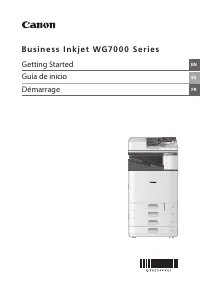 Canon 250
User Manual
Canon 250
User Manual
 Canon 251
User Manual
Canon 251
User Manual
 Canon 6710C002
User Manual
Canon 6710C002
User Manual
 Canon K10605
User Manual
Canon K10605
User Manual
 Canon K10613
User Manual
Canon K10613
User Manual
 Canon K10608
User Manual
Canon K10608
User Manual
 Canon K10609
User Manual
Canon K10609
User Manual
 Canon imageRUNNER C3326i
User Manual
Canon imageRUNNER C3326i
User Manual
 Canon imageCLASS MF465dw
User Manual
Canon imageCLASS MF465dw
User Manual
 Canon K10617
User Manual
Canon K10617
User Manual