Page 4 - Quick Start Guide
Quick Start Guide ^ Install the batteries. As shown in the figure, open the battery compartment cover and insert two DL123A (or CR123A) lithium batteries. 2 Attach a lens. Align the red dots on the lens and camera and turn the lens clockwise until it snaps in place. 3 On the lens, set the focus mode...
Page 5 - Unloading the film.
Quick Start Guide 0 Load the film. Align the edge of the film leader with the orange mark on the camera and dose the camera back until it snaps shut. The film will then advance to frame 1 automatically. Focus the subject. Aim the focusing point (□ □ □) on the subject and press the shutter button lig...
Page 6 - Nomenclature
Nomenclature 2W8®SSWHS(W«!S9SS»K(»S®»^K^9»*>ia6S^i3»»Si!j»$!?te«^ Self-timer button (page 25} Film rewind button (page 51) Function button (page 44) Focusing point selector (page 28) — LCD pane! (page 8) Hot shoe (page 61) ■ For dedicated Canon Speedlites (sold separately), etc. Built-in flash (p...
Page 8 - LCD Panel; The LCD panel is shown with ail the information displayed.; Viewfinder Information; The viewfinder is shown with all the information displayed.
Nomenclature LCD Panel The LCD panel is shown with ail the information displayed. Shutter speed / ISO film speed — -— Self-timer symbol ISO symbol Battery symbol Battery level indicator Focusing point indicator Film status Film loaded Film rewind completed Manual-focus symbol Exposure display • Expo...
Page 9 - Command Dial
Command Dial The Command Dial cannot be rotated to where there is no symbol on the dial. Function Set Zone Full AutO (page 16 ) The camera takes care of everything. Just aim and press the shutter button. Programmed Image Control Zone Fully automatic operation can be set to suit the type of subject. ...
Page 11 - Checking the Battery Level; • DL123A (or CR123A) Lithium Battery Service Life
I. Before You Start Checking the Battery Level -I Turn the Command Dial to a * Programmed Image Control mode or Creative Zone mode. p The battery level will be displayed ^ on the LCD panel by one of the following battery level indicator symbols: : Battery level OK. o ; Keep spare battery handy. t=p ...
Page 12 - Mounting and Detaching a Lens; Mounting a Lens; Detaching the Lens
Mounting and Detaching a Lens Mounting a Lens H Remove the rear lens cap and the * camera body cap by turning the cap as shown by the arrow. p Align the red dots on the lens and ^ camera and turn the lens as shown by the arrow until it snaps in place. 3 On the lens, set the focus mode switch to AF. ...
Page 13 - Shutter Button and Autofocusing Operations; The EOS camera’s shutter button can be depressed halfway or all the; When it is pressed
Shutter Button and Autofocusing Operations The EOS camera’s shutter button can be depressed halfway or all the way. It operates as described below (with autofocus enabled). When it is pressed halfway: Autofocusing is activated, and when the subject is focused, the camera beeps and the in-focus indic...
Page 14 - Loading and Unloading Film; Loading Film
Loading and Unloading Film Loading Film When a roll of film is loaded, the camera first winds the whole roll onto the camera’s spool. Then each time a picture is taken and the frame advances, one frame of film is rewound back into the film cartridge. With DX-coded film, the camera automatically sets...
Page 15 - Unloading Film
p __ I. Before You Start A Hold down the film cartridge and ^ pull the edge of the film leader to the orange mark on the camera. • If the edge of the film leader goes beyond the orange mark, rewind some of the film back into the cartridge. C After checking that the film leader ^ edge is correctly al...
Page 16 - □ Full Auto Mode; Turn the Command Dial to O
II. Basic Operation Easy picture-taking with the Command Dial’s Fuil Auto^and Programmed ^ H* Jmage Control modes is described here. With these fully-automatic picture-taking modes, all you do* is press the shatter button and the ■'camera does the rest. ^ The Full Auto mode and Programmed Image Cont...
Page 18 - Automatic Flash Operation; In the Full Auto mode □ or in the ^; Setting Red-Eye Reduction; Press the function button until the
II. Basic Operation — . . . . . . «—■ * — ■ '.tffl&T'- Automatic Flash Operation In the Full Auto mode □ or in the ^ , and 0 Programmed Image Control modes, the built-in flash pops up and fires automatically for dark or backlit (fill-in flash) subjects. 4 * If the built-in flash Is obstructed fr...
Page 20 - This mode blurs the background to
^ Portrait Mode * Holding down the shutter button enables continuous shooting. * For dark or backlit (fill-in flash) subjects, the built-in flash pops up and fires automatically. This mode blurs the background to make the human subject stand out. Set the Command Dial to ^ . • The picture-taking proc...
Page 21 - Landscape Mode; Set the Command Dial to
Landscape Mode Jfflwnniiiwr ■ The built-in flash does not operate in this mode. This is for sweeping scenery, sunsets,etc. Set the Command Dial to * The picture-taking procedure is the same as for the Full Auto mode (page 16). • If a zoom lens is attached, use the shortest focal length. (For example...
Page 22 - Set the Command Dial to ft
Set this mode when using the lens' built-in macro feature for taking close- up shots of flowers, insects, etc, ■ For dark or backlit (fill-in flash) subjects, the built-in flash pops up and fires automatically. Set the Command Dial to ft . • The picture-taking procedure is the same as for the Full A...
Page 24 - Pi Night Scene Mode; Flash is used to illuminate the subject
Pi Night Scene Mode Flash is used to illuminate the subject and a slow shutter speed is used to expose the background, resulting in a natural-looking exposure. Use this mode when taking a photo ofa human subject at sunset or at night. Set the Command Dial to R . 0 • Using ISO 400 or faster film is r...
Page 26 - Imprinting the Date or Time (QD model only); j n; Disabling Date or Time
Imprinting the Date or Time (QD model only) QD models have a quartz date feature which maintains an automatic calendar to the year 2019. It can imprint the date or time on the photographs you take. The year, month, and day are initially displayed on the quartz date display panel. If left unchanged, ...
Page 27 - Setting the Date and Time; ’ 0 c i n; COo ®; i u; C u; Replacing the Quartz Date Battery
II!. Self-Timer and Quartz Date (QD model only) Setting the Date and Time To set or change the date and time, follow the procedure below: MODE OE>o o SELECT SET rvi ’ 0 c i n j u r u MODE CD)® O SELECT SET (VI ’on * C_ JU ! MODE COo ® ’DC i h — D n . D 0 I U C L L ^|V SELECT SET MODE CD)® O SELEC...
Page 28 - Automatic selection:; Selecting the focusing
I IV. Advanced Operations The Creative Zone modes make picture-taking more flexible with shutter £?: speed-priority and aperture-priority modes, user-selected focusing points, f and options for changing the exposure settings. The Creative Zone modes are described here along with other advanced opera...
Page 29 - viewfinder and turn the Main Dial; Press the shutter button halfway to
(V. Advanced Operations O Look at the focusing point indicator ^ on the LCD panel or in the viewfinder and turn the Main Dial until the desired focusing point indicator is displayed. ■ ■] :Sets the focusing point selection to automatic. [■ ] :Selects the left focusing point. £ ■ rSelectsthe center f...
Page 30 - Focusing an Off-Center Subject
IV. Advanced Operations Focusing an Off-Center Subject If you want to focus an off-center subject not covered by any of the focusing points, following the procedure below. ■I Aim the manually-selected focusing point on the subject, then press the shutter button halfway to focus. O Keep pressing the ...
Page 31 - O Check the shutter speed and
P Program AE_ Like the Full Auto mode (CD), this is a general-purpose picture-taking mode. The camera automatically sets the shutter speed and aperture to suit the scene’s brightness. Press the shutter button halfway to focus the subject. * The shutter speed and aperture will be displayed in the vie...
Page 33 - Tv Shutter-Speed Priority AE
Tv Shutter-Speed Priority AE Taken at a fast shutter speed In this mode, you set the shutter speed and the camera sets the aperture automatically to suit the brightness of the scene. (Tv stands for Time value.) By setting a fast shutter speed t you can freeze the motion of a fast-moving subject. And...
Page 34 - Check the aperture and take the
IV . A d va n ce d O p e ratio n s * The shutter speed and aperture will be displayed in the viewfinder and on the LCD panel. Q Press the shutter button halfway to^ focus the subject. r n r c r ■ n " 2 . 1 . * » 1 * 2 + i Qu j. C' L 1 J | ' Check the aperture and take the picture. * If the maxim...
Page 35 - Av Aperture-Priority AE
Av Aperture-Priority AE Taken with a large aperture In this mode, you set the aperture and the camera sets the shutter speed automatically to suit the brightness of the scene- (Av stands for aperture value.) By setting a larger aperture (smaller f- number), you can blur the background and make the s...
Page 36 - IV. Advanced Operations; Q Press the shutter button halfway to
IV. Advanced Operations • The shutter speed and aperture will be displayed in the viewfinder and on the LCD panel. Q Press the shutter button halfway to focus the subject. I "7 I" ■L 0 A Check the shutter speed and take ** the picture. ■ If the 30" shutter speed blinks, the scene is too ...
Page 38 - Q Check the shutter speed and
This mode is for obtaining a wide depth of field automatically between a near subject and far subject. It is effective for large-group photos and landscapes. The camera uses the three focusing points to detect the nearest subject and the farthest subject. A'DEP Automatic Depth-of-Field AE ■1 Set the...
Page 39 - Using the Built-in Flash
r----- i Using the Built-in Flash In Creative Zone modes, flash photography is possible at any time regardless of the ambient light level. Whether the built-in flash or an external EOS-dedicated Speedlite is used, the basic operation is the same as with an AE mode. When flash is used in a Creative Z...
Page 40 - Press the flash button to pop up; When flash is used in a low-light environment, the subject's eyes may
IV . A d va n ce d O p e ratio n s ■ To retract the flash head after use, push it down, Press the flash button to pop up the flash, O Press the shutter button halfway and focus the subject. O Check that the lightning symbol in ^ the viewfinder lights, then take the picture. Setting Red-Eye Reduction...
Page 41 - Effective Flash Range cwsth; ef; mm; Flash Exposure Indications
Effective Flash Range cwsth ef 28 - 80 mm 1 / 35 - 5.6 lens) IV . A d va n ce d O p e ratio n s —------ ■ ■ ------- ---------- ---------- 28 mm 80 mm ISO Negative Film Reversal Film Negative Film Reversal Film 100 1 - 4.8 m 1 - 3.4 m 1 -3m 1 -2.1 m 400 1.2-9.6 m 1.5 -6.8 m 1 - 6m 1.5 - 4.3 m Flash E...
Page 42 - Partial Metering and AE Lock; Partial metering circle; ■I Set the Command Dial to a
Partial Metering and AE Lock > ; : V • V ' V • ■ • ’ - ■ . . . . - . v . v - -^ =vr.v-. v>V-0 • • ' • * : - ~ : ■. LV ‘-' ‘'--VV'.: In high-contrast situations such as a person spotlighted against a dark background, the exposure may turn out too bright or too dark in certain areas of the photo...
Page 43 - Exposure Compensation; O Press and hold down the exposure
Exposure Compensation Changing the exposure level set by the camera is called exposure compensation. Exposure compensation can be used to make the picture darker or brighter intentionally. Exposure compensation can be set up to 2 stops in half steps. Set the Command Dial to a Creative Zone mode exce...
Page 44 - narrow exposure latitude.; Dial to a
Autoexposure Bracketing (AEB) With autoexposure bracketing, the camera automatically changes the exposure level within the set range for three successive frames. The bracketing amount centers on the correct exposure (or the exposure compensation setting), and the exposure can be varied up to 2 stops...
Page 45 - If the set bracketing amount exceeds 2
IV . A d va n ce d O p e ratio n s -4$ “2,1.0.1.2 + * Bracketing amount of 1 1 1 1 stop “2.1.G.1*2* * Bracketing amount of 1 • * -1 stop "2.1.GM.2+ ■l l Bracketing amount of -1.5 stop -2.1.0.1.2+ ■ ■ Bracketing amount of -2 stops If the set bracketing amount exceeds 2 stops, the display will be ...
Page 46 - Bulb Exposure; When bulb is set, you can expose the film for as long as you press the
Bulb Exposure t i i r r r r - — i — r f m " — — f - j Tt ■** When bulb is set, you can expose the film for as long as you press the shutter button completely. Bulb exposures are useful when long exposures are required for night scenes, fireworks, etc. Use a tripod when making a bulb exposure. Re...
Page 47 - Multiple Exposures; to obtain a special effect.
Multiple Exposures By not advancing the film, a single frame can be exposed multiple times to obtain a special effect. O Press the function button until the ^ function pointer points to the multiple-exposure symbol (0) on the LCD panel. * "1” will be displayed on the film counter on the LCD pane...
Page 48 - Compose the shot and press the
IV . A d va n ce d O p e ratio n s A Compose the shot and press the ^ shutter button completely to expose the same frame each time. ■ While multiple exposures are taker, the multiple-exposure symbol’s function pointer ^ blinks on the LCD panel during the 4 seconds while the exposure information is d...
Page 49 - Setting the ISO Film Speed; Turn the Command Dial to ISO.; p Turn the Main Dial until the desired
Setting the ISO Film Speed If the film is not DX-coded or if you want to set a different ISO film speed, you can set the ISO film speed manually* The ISO film speed can be set from 6 to 6400. Turn the Command Dial to ISO. * The ISO symbol and the current ISO film speed will be displayed on the LCD p...
Page 50 - Silencing the In-Focus Beeper
Silencing the In-Focus Beeper 7 ^.V . .J&: «■ - -- ** The in-focus beeper can be silenced for all picture-taking modes. 3 Press the function button until the function pointer points to the beeper symbol (■»])) on the LCD panel. • The film counter on the LCD panel will show “1”. Turn the Main Dia...
Page 51 - Midroli Film Rewind
Midroli Film Rewind To rewind and unload the film before reaching the last frame, follow the steps below. Press and hold down the film rewind button (self-timer button) for at least 1 second. • The film will start rewinding. When the film rewind ends, there will be a shutter- release sound and the f...
Page 52 - E-TTL Autoflash System; any part of the picture.
V. E-TTL Autoflash with an EX-Series Speed!ite With an EX-series Speedlite like the 380EX or 220EX, flash photography is easy with the E-TTL (Evaluative-Through-The-Lens) autoflash system which is linked to the active focusing point. It is as easy as using the built-in flash. An external Speedlite i...
Page 53 - Normal Flash Operation
V . E -T T L A u to fla s h w ith an E X -S e rie s S p e ed lite Normal Flash Operation H Set the Command Dial to any * picture-taking mode except A-DEP. * If A-DEP is set and flash is used, it will be the same as using flash in the P (Program AE) mode. O Turn on Speedlite 220EX’s power ^ switch. •...
Page 54 - FE Lock
V. E-TTL Autoflash with an EX-Series Speedlite - -up*: :ate—** “ ---- 1 — ■ ' High-Speed Sync (FP Flash) With the Speedlite’s high-speed sync switch set to V h , high-speed sync (focal-plane flash) is set automatically when the shutter speed is set faster than 1/90 sec. The Speedlite can then synchr...
Page 56 - Basic Terminology; Shutter speed; The
VI. Reference ■m This Reference section is provided to enable you to better understand your camera and take full advantage of its capabilitiesr^g^^ Basic terminology, a troubleshooting guide, accessories guide, and other information are covered. Basic Terminology Shutter speed The shutter speed is t...
Page 58 - Troubleshooting Guide
Troubleshooting Guide — _ _ _■ 11 »' iwwf 1 ■ ' ■ m >i i If there is a problem, first refer to this Troubleshooting Guide. If the problem still persists, take your camera to your nearest Canon Service Center. Canon Service Centers are listed on the back of this booklet. Problem Probable Cause Sol...
Page 59 - Exposure Warnings; Tv
Exposure Warnings l Command Dial Mode T— V- -------- ------------ - ------ Blinking Display (Warning) Description Countermeasures D -^SO^iS — ^ i ^ i v - 30" shutter speed andlens’ maximum aperture The subject is too dark. Use flash. X- , -^ | v. 1/2000 shutter speed and lens' minimum aperture T...
Page 60 - Feature Availability Table; Pi; Av; AF Modes and Film Advance Modes
Feature Availability Table Autofocus Focusing Point Selection Film Advance Metering Mode Flash_____ Command Dial Mode One- Shot AF Al Servo AF Auto Manual Single Continuous Evaluative Center- weightedaveraged Partial Automatic Firing Manual a • • * • • 9 • • • • • • • • • :-i- A • • • • • • • • • Pi...
Page 61 - Major Accessories
Major Accessories (Sold separately) Grip GR-80TP comes with a hand strap and serves as a camera grip for holding ease, It can also unfolds as a mini-tripod. Remote Switch RS-60E3 Dedicated cable release for use with a tripod-mo unted camera to prevent camera shake during close-ups and bulb exposures...
Page 62 - Handling Precautions; Camera Care
Handling Precautions ..............• ~ ~ r ~ mi ' " ~ w.^ 1 , _ . j jm -i.&mfwmwm. —f-k_ - , «- Camera Care 1. This camera is not waterproof and cannot be used in rain or underwater. If the camera gets really wet, consult your nearest Canon Service Center. Wipe off any water droplets with a ...
Page 63 - Lithium Batteries; The camera is being used in a low-temperature environment.; Low Battery Power
VI. Reference Lithium Batteries The camera operates on two DL123A (or CR123A) lithium batteries. Check the battery level in the following cases: 1. After replacing the batteries. 2. After not using the camera for an extended period.3. The shutter does not work. 4. The camera is being used in a low-t...
Page 64 - Major Specifications
Major Specifications Type 35 mm autofocus/autoexposure single-lens reflex camera with focal- plane shutter, built-in motor drive, built-in flash, and quartz date back." Picture size 24 mm x 36 mm Compatible lenses Canon EF lenses Lens mount Canon EF mount (Fully electronic control) - Picture cov...
Page 68 - Canon
Canon CANON INC. 30-2, Shimomaruko 3-chome, Ohta-ku, Tokyo 146-8501, Japan U.S.A.---------------- CANON U.S.A. INC. For all inquiries concerning this camera, call toll free in the U.S. 1-B00-B2B-4040 or write to: Customer Relations,Canon U.S.A., Inc.One Canon Plaza, Lake Success, N.Y, 11042-1198 CAN...


 Canon 6130280
User Manual
Canon 6130280
User Manual
 Canon imageCLASS MF284dw
User Manual
Canon imageCLASS MF284dw
User Manual
 Canon imageCLASS LBP172dw
User Manual
Canon imageCLASS LBP172dw
User Manual
 Canon 248
User Manual
Canon 248
User Manual
 Canon 323
User Manual
Canon 323
User Manual
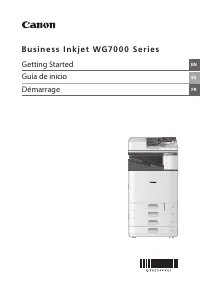 Canon 250
User Manual
Canon 250
User Manual
 Canon 251
User Manual
Canon 251
User Manual
 Canon 6710C002
User Manual
Canon 6710C002
User Manual
 Canon K10605
User Manual
Canon K10605
User Manual
 Canon K10613
User Manual
Canon K10613
User Manual
 Canon K10608
User Manual
Canon K10608
User Manual
 Canon K10609
User Manual
Canon K10609
User Manual
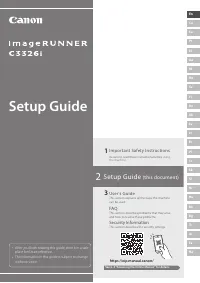 Canon imageRUNNER C3326i
User Manual
Canon imageRUNNER C3326i
User Manual
 Canon imageCLASS MF465dw
User Manual
Canon imageCLASS MF465dw
User Manual
 Canon K10617
User Manual
Canon K10617
User Manual