Page 2 - II; Safety Information
II Safety Information Safety Information ∙ The components included in this package are prone to damage from electrostatic discharge (ESD). Please adhere to the following instructions to ensure successful computer assembly. ∙ Ensure that all components are securely connected. Loose connections may ca...
Page 3 - III; Installing a Processor
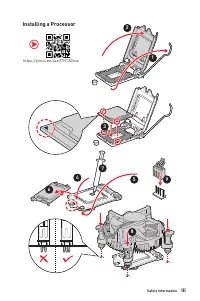
III Safety Information Installing a Processor ⚽ https://youtu.be/4ce91YC3Oww 1 2 3 6 4 5 7 8 9
Page 4 - IV; Installing DDR4 memory
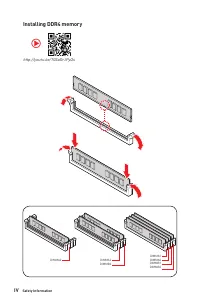
IV Safety Information Installing DDR4 memory http://youtu.be/T03aDrJPyQs ⚽ DIMMA2 DIMMA2 DIMMB2 DIMMA1 DIMMA2 DIMMB1 DIMMB2
Page 5 - HDD LED; Connecting the Front Panel Header
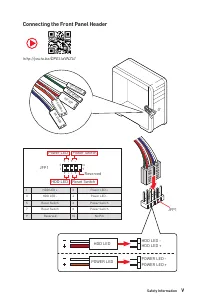
V Safety Information HDD LED RESET SW Connecting the Front Panel Header http://youtu.be/DPELIdVNZUI JFP1 HDD LED HDD LED - HDD LED + POWER LED -POWER LED + POWER LED 1 2 10 9 + + + - - - - + Power LED HDD LED Reset Switch Reserved Power Switch JFP1 1 HDD LED + 2 Power LED + 3 HDD LED - 4 Power LED -...
Page 6 - Installing the Motherboard
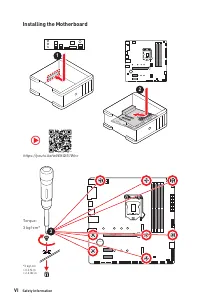
VI Safety Information BAT1 Installing the Motherboard 3 https://youtu.be/wWI6Qt51Wnc ⚽ Torque:3 kgf·cm* *3 kgf·cm = 0.3 N·m = 2.6 lbf·in 2 1 BAT1
Page 7 - VII; Connecting the Power Connectors
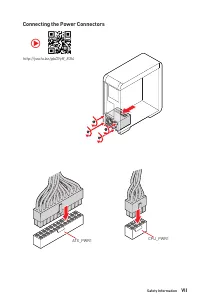
VII Safety Information Connecting the Power Connectors http://youtu.be/gkDYyR_83I4 ⚽ ATX_PWR1 CPU_PWR1
Page 8 - VIII; Installing SATA Drives
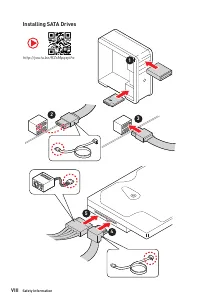
VIII Safety Information Installing SATA Drives http://youtu.be/RZsMpqxythc 1 2 3 4 5
Page 9 - IX; Installing a Graphics Card
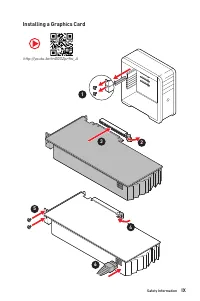
IX Safety Information 1 Installing a Graphics Card http://youtu.be/mG0GZpr9w_A 2 3 4 5 6
Page 10 - Connecting Peripheral Devices
Page 11 - XI; Power On
Page 12 - Contents
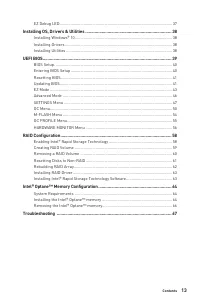
12 Contents Contents Quick Start ............................................................................................................. 1 Preparing Tools and Components.......................................................................... 1 Safety Information ................................
Page 14 - Specifications
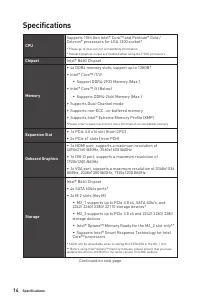
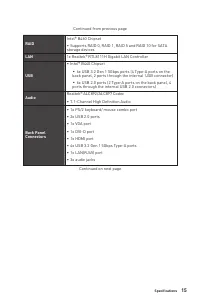
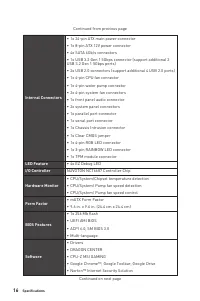
14 Specifications Specifications CPU Supports 10th Gen Intel® Core™ and Pentium® Gold / Celeron® processors for LGA 1200 socket* * Please go to intel.com for compatibility information.* Onboard graphics output are disabled when using the F SKU processors. Chipset Intel® B460 Chipset Memory ∙ 4x DDR4...
Page 17 - Dragon Center; Special Features
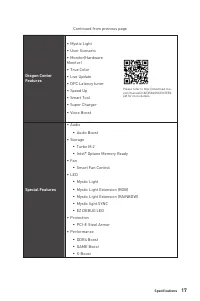
17 Specifications Continued from previous page Dragon Center Features ∙ Mystic Light ∙ User Scenario ∙ Monitor(Hardware Monitor) ∙ True Color ∙ Live Update ∙ DPC Latency tuner ∙ Speed Up ∙ Smart Tool ∙ Super Charger ∙ Voice Boost Please refer to http://download.msi. com/manual/mb/DRAGONCENTER2. pdf ...
Page 18 - Package contents; Motherboard; Application; Cables; Important
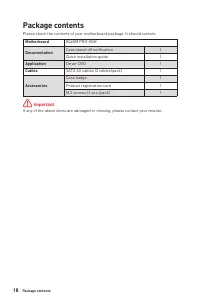
18 Package contents Package contents Please check the contents of your motherboard package. It should contain: Motherboard B460M PRO-VDH Documentation Case stand-off notification 1 Quick installation guide 1 Application Driver DVD 1 Cables SATA 6G cables (2 cables/pack) 1 Accessories Case badge 1 Pr...
Page 19 - Block Diagram
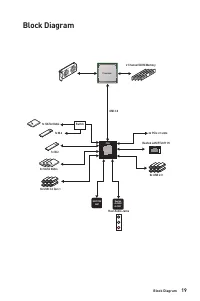
19 Block Diagram Block Diagram 6x USB 2.0 2 Channel DDR4 Memory DMI 3.0 PCH Processor NUVOTON 6687 6x USB 3.2 Gen 1 2x PCIe x1 slots Realtek LAN RTL8111H Rear Audio Jacks 1x M.2 1x M.2 1x SATA 6Gb/s Switch 3x SATA 6Gb/s Realtek ALC892/ ALC897
Page 20 - Speed LED; LAN Port LED Status Table
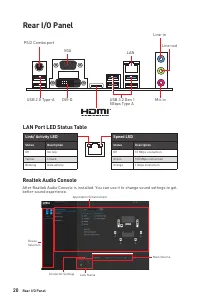
20 Rear I/O Panel Rear I/O Panel PS/2 Combo port LAN Line-in Line-out Mic in USB 2.0 Type-A DVI-D VGA USB 3.2 Gen 1 5Gbps Type A Link/ Activity LED Status Description Off No link Yellow Linked Blinking Data activity Speed LED Status Description Off 10 Mbps connection Green 100 Mbps connection Orange...
Page 22 - Overview of Components
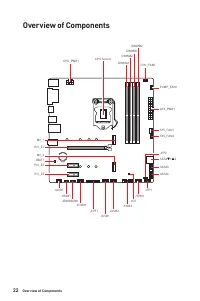
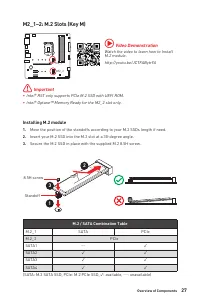
22 Overview of Components BAT1 Overview of Components DIMMA1 CPU_FAN1 DIMMA2 DIMMB1 DIMMB2 PUMP_FAN1 JFP1 JFP2 JTPM1 JUSB3 JUSB2 JUSB1 JLPT1 JCOM1 JRAINBOW1 ATX_PWR1 CPU_PWR1 CPU Socket SATA▼1▲2 SATA3 SATA4 SYS_FAN2 SYS_FAN1 JRGB1 JAUD1 PCI_E3 PCI_E2 PCI_E1 M2_1 M2_2 JBAT1 JCI1
Page 23 - Component Contents; Port Name
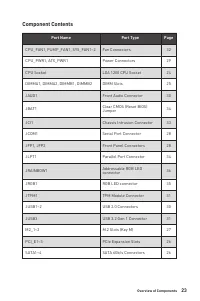
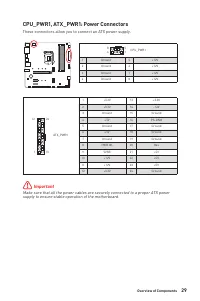
23 Overview of Components Component Contents Port Name Port Type Page CPU_FAN1, PUMP_FAN1, SYS_FAN1~2 Fan Connectors 32 CPU_PWR1, ATX_PWR1 Power Connectors 29 CPU Socket LGA 1200 CPU Socket 24 DIMMA1, DIMMA2, DIMMB1, DIMMB2 DIMM Slots 25 JAUD1 Front Audio Connector 30 JBAT1 Clear CMOS (Reset BIOS) J...
Page 24 - CPU Socket; Introduction to the LGA 1200 CPU; notches
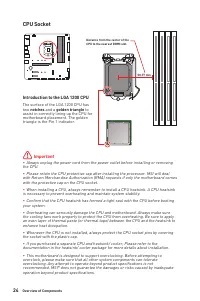
24 Overview of Components ⚠ Important ∙ Always unplug the power cord from the power outlet before installing or removing the CPU. ∙ Please retain the CPU protective cap after installing the processor. MSI will deal with Return Merchandise Authorization (RMA) requests if only the motherboard comes wi...
Page 25 - DIMM Slots; Memory module installation recommendation; DRAM Frequency
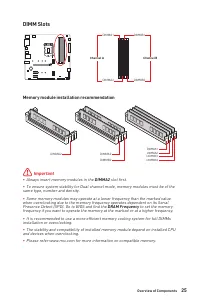
25 Overview of Components BAT1 DIMM Slots DIMMA1 DIMMB1 Channel A Channel B DIMMA2 DIMMB2 Memory module installation recommendation ⚠ Important ∙ Always insert memory modules in the DIMMA2 slot first. ∙ To ensure system stability for Dual channel mode, memory modules must be of the same type, number...
Page 26 - MSI
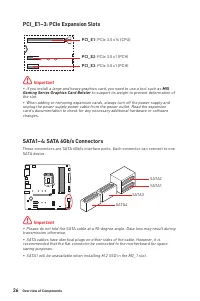
26 Overview of Components BAT1 PCI_E1~3: PCIe Expansion Slots ⚠ Important ∙ If you install a large and heavy graphics card, you need to use a tool such as MSI Gaming Series Graphics Card Bolster to support its weight to prevent deformation of the slot. ∙ When adding or removing expansion cards, alwa...
Page 28 - JCOM1: Serial Port Connector
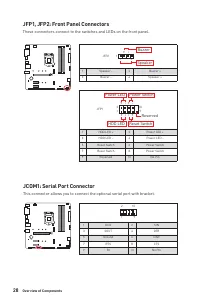
28 Overview of Components JFP1, JFP2: Front Panel Connectors These connectors connect to the switches and LEDs on the front panel. BAT1 BAT1 1 2 10 9 + + + - - - - + Power LED HDD LED Reset Switch Reserved Power Switch JFP1 1 HDD LED + 2 Power LED + 3 HDD LED - 4 Power LED - 5 Reset Switch 6 Power S...
Page 30 - JAUD1: Front Audio Connector
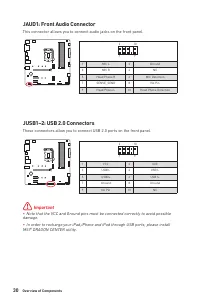
30 Overview of Components BAT1 JAUD1: Front Audio Connector This connector allows you to connect audio jacks on the front panel. 1 2 10 9 1 MIC L 2 Ground 3 MIC R 4 NC 5 Head Phone R 6 MIC Detection 7 SENSE_SEND 8 No Pin 9 Head Phone L 10 Head Phone Detection JUSB1~2: USB 2.0 Connectors These connec...
Page 31 - JTPM1: TPM Module Connector
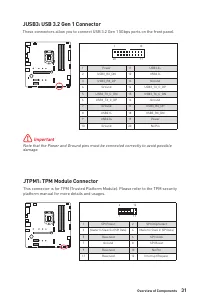
31 Overview of Components JUSB3: USB 3.2 Gen 1 Connector These connectors allow you to connect USB 3.2 Gen 1 5Gbps ports on the front panel. ⚠ Important Note that the Power and Ground pins must be connected correctly to avoid possible damage. BAT1 1 10 11 20 1 Power 11 USB2.0+ 2 USB3_RX_DN 12 USB2.0...
Page 32 - Switching fan mode and adjusting fan speed; HARDWARE MONITOR; Pin definition of fan connectors; Connector
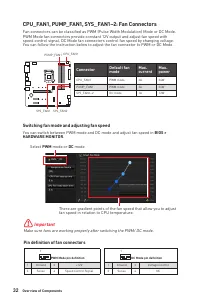
32 Overview of Components BAT1 CPU_FAN1, PUMP_FAN1, SYS_FAN1~2: Fan Connectors Fan connectors can be classified as PWM (Pulse Width Modulation) Mode or DC Mode. PWM Mode fan connectors provide constant 12V output and adjust fan speed with speed control signal. DC Mode fan connectors control fan spee...
Page 33 - JCI1: Chassis Intrusion Connector; Using chassis intrusion detector
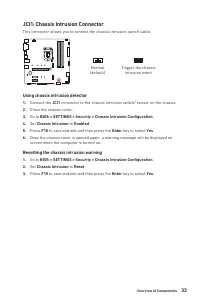
33 Overview of Components JCI1: Chassis Intrusion Connector This connector allows you to connect the chassis intrusion switch cable. BAT1 Normal (default) Trigger the chassis intrusion event Using chassis intrusion detector 1. Connect the JCI1 connector to the chassis intrusion switch/ sensor on the...
Page 34 - Resetting BIOS to default values; JLPT1: Parallel Port Connector
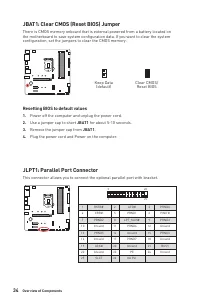
34 Overview of Components JBAT1: Clear CMOS (Reset BIOS) Jumper There is CMOS memory onboard that is external powered from a battery located on the motherboard to save system configuration data. If you want to clear the system configuration, set the jumpers to clear the CMOS memory. Keep Data (defau...
Page 35 - JRGB1: RGB LED connector; RGB LED Strip Connection
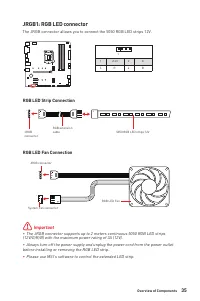
35 Overview of Components BAT1 ⚠ Important ∙ The JRGB connector supports up to 2 meters continuous 5050 RGB LED strips (12V/G/R/B) with the maximum power rating of 3A (12V). ∙ Always turn off the power supply and unplug the power cord from the power outlet before installing or removing the RGB LED s...
Page 36 - CAUTION; JRAINBOW1: Addressable RGB LED connector; Addressable RGB LED Strip Connection
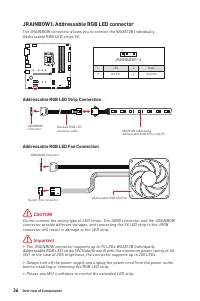
36 Overview of Components 1 1 1 D +5V BAT1 ⚠ CAUTION Do not connect the wrong type of LED strips. The JRGB connector and the JRAINBOW connector provide different voltages, and connecting the 5V LED strip to the JRGB connector will result in damage to the LED strip. ⚠ Important ∙ The JRAINBOW connect...
Page 37 - EZ Debug LED; CPU; DRAM; VGA; BOOT
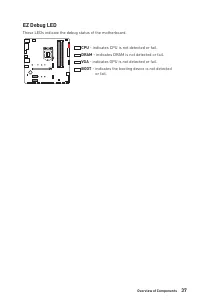
37 Overview of Components BAT1 EZ Debug LED These LEDs indicate the debug status of the motherboard. CPU - indicates CPU is not detected or fail. DRAM - indicates DRAM is not detected or fail. VGA - indicates GPU is not detected or fail. BOOT - indicates the booting device is not detected or fail.
Page 39 - UEFI BIOS
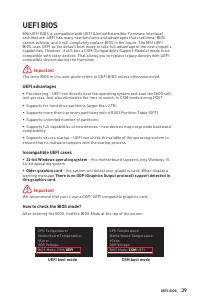
39 UEFI BIOS UEFI BIOS MSI UEFI BIOS is compatible with UEFI (Unified Extensible Firmware Interface) architecture. UEFI has many new functions and advantages that traditional BIOS cannot achieve, and it will completely replace BIOS in the future. The MSI UEFI BIOS uses UEFI as the default boot mode ...
Page 40 - BIOS Setup; always keep the default settings; HELP; Entering BIOS Setup; Delete; Function key
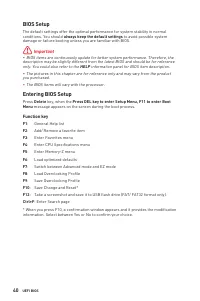
40 UEFI BIOS BIOS Setup The default settings offer the optimal performance for system stability in normal conditions. You should always keep the default settings to avoid possible system damage or failure booting unless you are familiar with BIOS. ⚠ Important ∙ BIOS items are continuously update for...
Page 41 - Resetting BIOS; Updating BIOS; Updating BIOS with M-FLASH
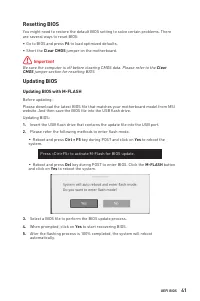
41 UEFI BIOS Resetting BIOS You might need to restore the default BIOS setting to solve certain problems. There are several ways to reset BIOS: ∙ Go to BIOS and press F6 to load optimized defaults. ∙ Short the Clear CMOS jumper on the motherboard. ⚠ Important Be sure the computer is off before clear...
Page 42 - Updating the BIOS with MSI DRAGON CENTER
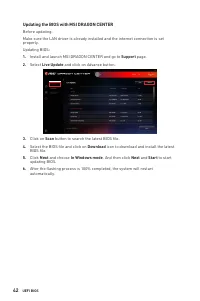
42 UEFI BIOS Updating the BIOS with MSI DRAGON CENTER Before updating:Make sure the LAN driver is already installed and the internet connection is set properly. Updating BIOS: 1. Install and launch MSI DRAGON CENTER and go to Support page. 2. Select Live Update and click on Advance button. 3. Click ...
Page 43 - EZ Mode
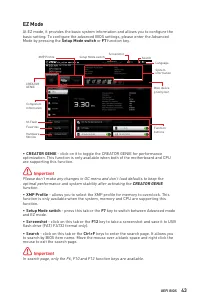
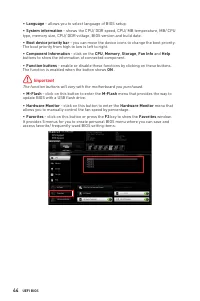
43 UEFI BIOS EZ Mode At EZ mode, it provides the basic system information and allows you to configure the basic setting. To configure the advanced BIOS settings, please enter the Advanced Mode by pressing the Setup Mode switch or F7 function key. XMP Profile Component Information System information ...
Page 45 - To add a BIOS item to a favorite menu
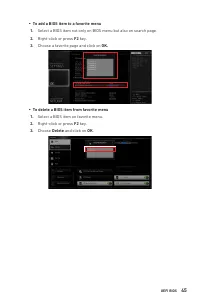
45 UEFI BIOS ▪ To add a BIOS item to a favorite menu 1. Select a BIOS item not only on BIOS menu but also on search page. 2. Right-click or press F2 key. 3. Choose a favorite page and click on OK. ▪ To delete a BIOS item from favorite menu 1. Select a BIOS item on favorite menu. 2. Right-click or pr...
Page 46 - Advanced Mode
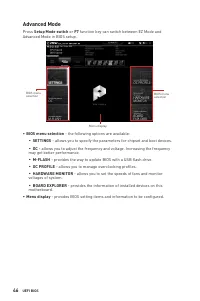
46 UEFI BIOS Advanced Mode Press Setup Mode switch or F7 function key can switch between EZ Mode and Advanced Mode in BIOS setup. BIOS menu selection Menu display BIOS menu selection ∙ BIOS menu selection - the following options are available: ▪ SETTINGS - allows you to specify the parameters for ch...
Page 47 - SETTINGS Menu
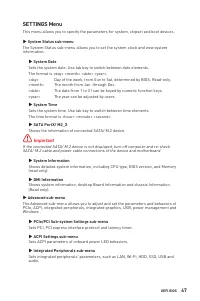
47 UEFI BIOS SETTINGS Menu This menu allows you to specify the parameters for system, chipset and boot devices. ▶ System Status sub-menu The System Status sub-menu allows you to set the system clock and view system information. ▶ System Date Sets the system date. Use tab key to switch between date e...
Page 50 - OC Menu
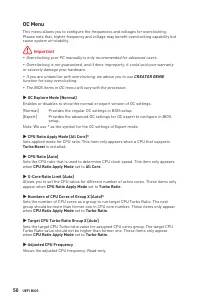
50 UEFI BIOS OC Menu This menu allows you to configure the frequencies and voltages for overclocking. Please note that, higher frequency and voltage may benefit overclocking capability but cause system un-stability. ⚠ Important ∙ Overclocking your PC manually is only recommended for advanced users. ...
Page 51 - ▶ CPU Ratio Offset When Running AVX [Auto]
51 UEFI BIOS ▶ Core X X of X xxxx MHz [Auto] Allows you to set the CPU ratios for different number of active cores. These items only appear when CPU Ratio Apply Mode set to Per Core . ▶ Turbo Ratio Offset Value [Auto] Sets the CPU Turbo ratio offset value. This item only appears when CPU Ratio Apply...
Page 52 - ▶ Advanced DRAM Configuration
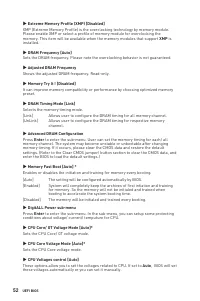
52 UEFI BIOS ▶ Extreme Memory Profile (XMP) [Disabled] XMP (Extreme Memory Profile) is the overclocking technology by memory module. Please enable XMP or select a profile of memory module for overclocking the memory. This item will be available when the memory modules that support XMP is installed. ...
Page 53 - Auto
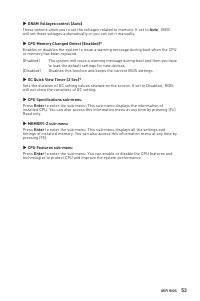
53 UEFI BIOS ▶ DRAM Voltages control [Auto] These options allow you to set the voltages related to memory. If set to Auto , BIOS will set these voltages automatically or you can set it manually. ▶ CPU Memory Changed Detect [Enabled]* Enables or disables the system to issue a warning message during b...
Page 54 - Yes
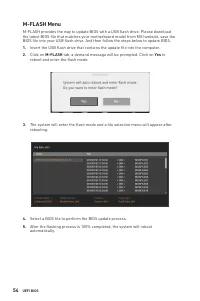
54 UEFI BIOS M-FLASH Menu M-FLASH provides the way to update BIOS with a USB flash drive. Please download the latest BIOS file that matches your motherboard model from MSI website, save the BIOS file into your USB flash drive. And then follow the steps below to update BIOS. 1. Insert the USB flash d...
Page 55 - OC PROFILE Menu; Enter; ▶ OC Profile Load from ROM; ▶ OC Profile Save to USB
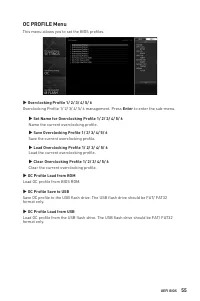
55 UEFI BIOS OC PROFILE Menu This menu allows you to set the BIOS profiles. ▶ Overclocking Profile 1/ 2/ 3/ 4/ 5/ 6 Overclocking Profile 1/ 2/ 3/ 4/ 5/ 6 management. Press Enter to enter the sub-menu. ▶ Set Name for Overclocking Profile 1/ 2/ 3/ 4/ 5/ 6 Name the current overclocking profile. ▶ Save ...
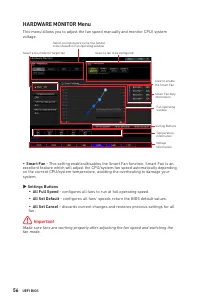
Page 56 - HARDWARE MONITOR Menu; Smart Fan; All Set Default; All Set Cancel
56 UEFI BIOS HARDWARE MONITOR Menu This menu allows you to adjust the fan speed manually and monitor CPU/ system voltage. Fan operating window Smart Fan duty information Click to enable the Smart Fan Temperature information Setting Buttons Select a fan to be configured Select a temperature curve lin...
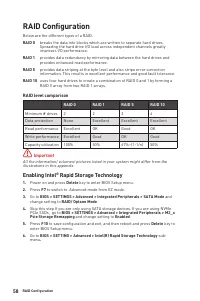
Page 58 - RAID level comparison; Enabling Intel® Rapid Storage Technology
RAID Configuration Below are the different types of a RAID. RAID 0 breaks the data into blocks which are written to separate hard drives. Spreading the hard drive I/O load across independent channels greatly improves I/O performance. RAID 1 provides data redundancy by mirroring data between the hard...
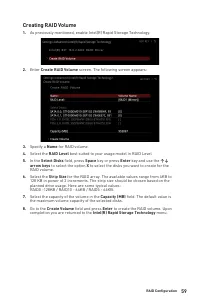
Page 59 - Creating RAID Volume
Creating RAID Volume 1. As previously mentioned, enable Intel(R) Rapid Storage Technology. 2. Enter Create RAID Volume screen. The following screen appears: 3. Specify a Name for RAID volume. 4. Select the RAID Level best suited to your usage model in RAID Level. 5. In the Select Disks field, press ...
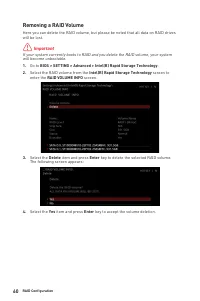
Page 60 - Removing a RAID Volume; RAID VOLUME INFO
Removing a RAID Volume Here you can delete the RAID volume, but please be noted that all data on RAID drives will be lost. ⚠ Important If your system currently boots to RAID and you delete the RAID volume, your system will become unbootable. 1. Go to BIOS > SETTING > Advanced > Intel(R) Rap...
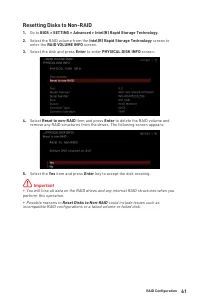
Page 61 - Resetting Disks to Non-RAID
Resetting Disks to Non-RAID 1. Go to BIOS > SETTING > Advanced > Intel(R) Rapid Storage Technology . 2. Select the RAID volume from the Intel(R) Rapid Storage Technology screen to enter the RAID VOLUME INFO screen. 3. Select the disk and press Enter to enter PHYSICAL DISK INFO screen. 4. Se...
Page 62 - Rebuilding RAID Array
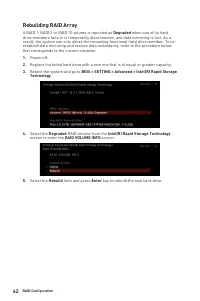
Rebuilding RAID Array A RAID 1, RAID 5 or RAID 10 volume is reported as Degraded when one of its hard drive members fails or is temporarily disconnected, and data mirroring is lost. As a result, the system can only utilize the remaining functional hard drive member. To re- establish data mirroring a...
Page 63 - Installing RAID Driver; New Operating System Installation; Installing Intel® Rapid Storage Technology Software
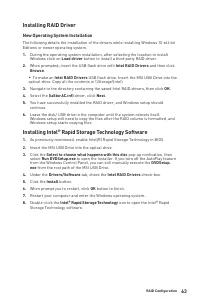
Installing RAID Driver New Operating System Installation The following details the installation of the drivers while installing Windows 10 x64 bit Editions or newer operating system. 1. During the operating system installation, after selecting the location to install Windows click on Load driver but...
Page 64 - System Requirements
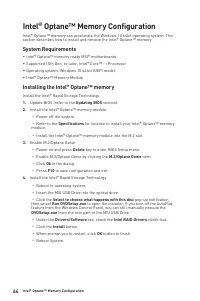
Intel® Optane™ Memory Configuration Intel® Optane™ memory can accelerate the Windows 10 64bit operating system. This section describes how to install and remove the Intel® Optane™ memory. System Requirements ∙ Intel® Optane™ memory ready MSI® motherboards ∙ Supported 10th Gen, or later, Intel® Core™...
Page 65 - WARNING
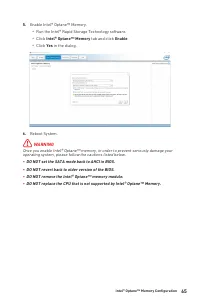
5. Enable Intel® Optane™ Memory. ▫ Run the Intel® Rapid Storage Technology software. ▫ Click Intel® Optane™ Memory tab and click Enable . ▫ Click Yes in the dialog. 6. Reboot System. ⚠ WARNING Once you enable Intel® Optane™ memory, in order to prevent seriously damage your operating system, please f...
Page 66 - Removing the Intel® OptaneTM memory
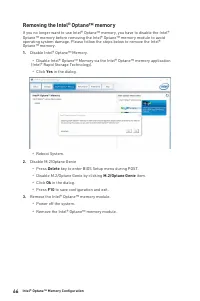
Removing the Intel® Optane™ memory If you no longer want to use Intel® Optane™ memory, you have to disable the Intel® Optane™ memory before removing the Intel® Optane™ memory module to avoid operating system damage. Please follow the steps below to remove the Intel® Optane™ memory. 1. Disable Intel®...
Page 67 - Clear CMOS
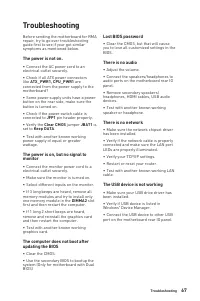
Troubleshooting Before sending the motherboard for RMA repair, try to go over troubleshooting guide first to see if your got similar symptoms as mentioned below. The power is not on. ∙ Connect the AC power cord to an electrical outlet securely. ∙ Check if all ATX power connectors like ATX_PWR1, CPU_...
Page 68 - Regulatory Notices; KC인증서
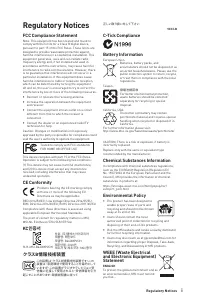
i Regulatory Notices Regulatory Notices FCC Compliance Statement Note: This equipment has been tested and found to comply with the limits for a Class B digital device, pursuant to part 15 of the FCC Rules. These limits are designed to provide reasonable protection against harmful interference in a r...
Page 69 - ii
ii Regulatory Notices Under the European Union (“EU”) Directive on Waste Electrical and Electronic Equipment, Directive 2002/96/ EC, which takes effect on August 13, 2005, products of “electrical and electronic equipment” cannot be discarded as municipal wastes anymore, and manufacturers of covered ...
Page 70 - iii; India RoHS
iii Regulatory Notices süreleri bittiğinde MSI ürünlerin geri alınması isteği ile işbirliği içerisinde olacaktır. Ürünlerinizi yerel toplama noktalarına bırakabilirsiniz. ČESKY Záleží nám na ochraně životního prostředí - společnost MSI upozorňuje...Podle směrnice Evropské unie (“EU”) o likvidaci ele...
Page 71 - iv; MS-7C83主板产品中有害物质的名称及含量
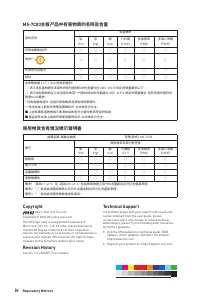
iv Regulatory Notices MS-7C83主板产品中有害物质的名称及含量 部件名称 有害物质 铅 (Pb) 汞 (Hg) 镉 (Cd) 六价铬 (Cr(VI)) 多溴联苯 (PBB) 多溴二苯醚 (PBDE) 印刷电路板组件* ╳ ○ ○ ○ ○ ○ 电池** ╳ ○ ○ ○ ○ ○ 外部信号连接头 ╳ ○ ○ ○ ○ ○ 线材 ╳ ○ ○ ○ ○ ○ 本表格依据 SJ/T 11364 的规定编制。○: 表示该有害物质在该部件所有均质材料中的含量均在 GB/T 26572 规定的限量要求以下。╳: 表示该有害物质至少在该部件的某一均质材料中的含量超出 GB/T 26572 规定...




 MSI Z590-A PRO User Manual
 MSI Z690 User Manual
 MSI A520 User Manual
 MSI B560 User Manual
 MSI B560M BOMBER User Manual
 MSI B560M PRO-E User Manual
 MSI B660 User Manual
 MSI B660M User Manual
 MSI H510 User Manual
 MSI H510M-A PRO User Manual
 MSI H610 User Manual
 MSI MAG B550 User Manual
 MSI MAG B550M User Manual
 MSI MAG B650M User Manual