Page 2 - IMPORTANT SAFETY INSTRUCTIONS
IMPORTANT SAFETY INSTRUCTIONS i • Explanation of Graphical Symbols The lightning flash with arrowhead symbol, within an equilateral triangle, is intended to alert you to the presence of uninsulated “dangerous voltage” within the product’s enclosure that may be of sufficient magnitude to constitute a...
Page 3 - ii; Note to CATV system installer:
IMPORTANT SAFETY INSTRUCTIONS ii EXAMPLE OF ANTENNA GROUNDING MAST GROUNDCLAMP ANTENNALEAD INWIRE ANTENNADISCHARGE UNIT(NEC SECTION 810–20) GROUNDING CONDUCTORS(NEC SECTION 810–21) GROUND CLAMPS POWER SERVICE GROUNDINGELECTRODE SYSTEM(NEC ART 250. PART H) ELECTRICSERVICEEQUIPMENT NEC – NATIONAL ELEC...
Page 4 - iii; CAUTION: READ THIS BEFORE OPERATING YOUR UNIT.; WARNING
CAUTION: READ THIS BEFORE OPERATING YOUR UNIT. iii 1 To assure the finest performance, please read this manual carefully. Keep it in a safe place for future reference. 2 Install this sound system in a well ventilated, cool, dry, clean place – away from direct sunlight, heat sources, vibration, dust,...
Page 5 - XM; CONTENTS
1 PREP ARA TION INTR ODUCTION BA S IC OPE R A T IO N SOUND FIELD PROGRAMS AD V AN CED OPERA T ION ADDITIONA L INF O RMA T ION FEATURES ............................................................. 2GETTING STARTED............................................ 3 Supplied accessories ......................
Page 6 - Sound field programs; FEATURES; Notes; iPod
FEATURES 2 Built-in 6-channel power amplifier ◆ Minimum RMS output power (0.06% THD, 20 Hz to 20 kHz, 8 Ω ) Front: 95 W + 95 WCenter: 95 WSurround: 95 W + 95 WSurround back: 95 W Sound field programs ◆ Proprietary YAMAHA technology for the creation of sound fields ◆ Dolby Digital/Dolby Digital EX de...
Page 7 - INTR; Check that you received all of the following parts.; Take off the battery compartment cover.; GETTING STARTED; Supplied accessories; Remote control
GETTING STARTED 3 INTR ODUCTION Check that you received all of the following parts. 1 Take off the battery compartment cover. 2 Insert the two supplied batteries (AA, R6, UM-3) according to the polarity markings (+ and –) on the inside of the battery compartment. 3 Snap the battery compartment cover...
Page 8 - Remote control sensor; • Selects one of the 5 preset station groups (A to E) when; CONTROLS AND FUNCTIONS; Front panel; Note; B C
CONTROLS AND FUNCTIONS 4 The XM Satellite Radio controlling functions in the following buttons (SEARCH MODE, CATEGORY, PRESET/TUNING/CH l / h , MEMORY, and DISPLAY) are only applicable to the U.S.A. model and are operational only when “XM” is selected as the input source. For details, see “XM Satell...
Page 9 - Controls the output level of all audio channels.
CONTROLS AND FUNCTIONS 5 INTR ODUCTION 8 TUNING MODE (AUTO/MAN’L) Switches between automatic tuning (the AUTO indicator is turned on) and manual tuning (the AUTO indicator is turned off) (see page 45). 9 ZONE 2 ON/OFF Turns on Zone 2 or sets it to the standby mode (see page 96). This button is opera...
Page 10 - Controlling this unit; Select the input source you want to control.; A on
CONTROLS AND FUNCTIONS 6 This section describes the function of each control on the remote control used to control this unit. To operate other components, see “REMOTE CONTROL FEATURES” on page 90. • The XM Satellite Radio controlling functions in the following buttons (XM, XM MEMORY, SRCH MODE, DISP...
Page 11 - Increases or decreases the volume level.
CONTROLS AND FUNCTIONS 7 INTR ODUCTION 8 Cursor buttons u / d / j / i , ENTER Select and adjust the sound field program parameters or the “SET MENU” parameters. 9 RETURN Returns to the previous menu level when adjusting the “SET MENU” parameters. 0 TRANSMIT indicator Flashes while the remote control...
Page 12 - Controlling the TUNER functions; Numeric buttons; Use numbers 1 through 8 to select preset stations.; BAND; Press; Using the remote control
CONTROLS AND FUNCTIONS 8 ■ Controlling the TUNER functions Set the component selector switch to SOURCE and then press TUNER to select “TUNER” as the input source. 4 Numeric buttons Use numbers 1 through 8 to select preset stations. 7 BAND Switches the reception band between FM and AM (see page 45). ...
Page 13 - Light up to indicate the active DSP sound fields.; Front panel display; DVR; HiFi DSP
CONTROLS AND FUNCTIONS 9 INTR ODUCTION The XM indicator is only applicable to the U.S.A. model and the cursor on the left of the XM indicator lights up only when “XM” is selected as the input source. For details, see “Basic XM Satellite Radio operations” on page 55. 1 Decoder indicators The respecti...
Page 14 - Indicates the current volume level.
CONTROLS AND FUNCTIONS 10 C VOLUME level indicator Indicates the current volume level. D PCM indicator Lights up when this unit is reproducing PCM (Pulse Code Modulation) digital audio signals. E STANDARD indicator Lights up when the “SUR. STANDARD” or “SUR. ENHANCED” program is selected (see page 4...
Page 15 - Rear panel; A B C
CONTROLS AND FUNCTIONS 11 INTR ODUCTION 1 Video component jacks See pages 18 and 19 for connection information. 2 Audio component jacks See page 21 for connection information. 3 MULTI CH INPUT jacks See page 23 for connection information. 4 ZONE 2 OUTPUT jacks See page 95 for connection information....
Page 16 - The speaker layout below shows the standard ITU-R; Front left and right speakers (FL and FR); CONNECTIONS; Placing speakers; SW
CONNECTIONS 12 The speaker layout below shows the standard ITU-R * speaker setting. You can use it to enjoy CINEMA DSP and multi-channel audio sources. * ITU-R is the radio communication sector of the ITU (International Telecommunication Union). Front left and right speakers (FL and FR) The front sp...
Page 17 - PREP; Connecting speakers
13 CONNECTIONS PREP ARA TION Be sure to connect the left channel (L), right channel (R), “+” (red) and “–” (black) properly. If the connections are faulty, no sound will be heard from the speakers, and if the polarity of the speaker connections is incorrect, the sound will be unnatural and lack bass...
Page 18 - FRONT terminals; Speaker layout
14 CONNECTIONS FRONT terminals Connect one or two front speaker systems (1, 2) to these terminals. If you use only one front speaker system, connect it to the FRONT A or B terminal. CENTER terminals Connect a center speaker (3) to these terminals. SURROUND terminals Connect surround speakers (4, 5) ...
Page 19 - Connecting the speaker cable; Tighten the knob to secure the wire.; Banana plug
15 CONNECTIONS PREP ARA TION ■ Connecting the speaker cable 1 Remove approximately 10 mm (0.4 in) of insulation from the end of each speaker cable and then twist the exposed wires of the cable together to prevent short circuits. 2 Loosen the knob. 3 Insert one bare wire into the hole on the side of ...
Page 20 - Audio jacks; transmitted on separate wires of component video cables.; Information on jacks and cable plugs
16 CONNECTIONS You can use the digital jacks to input PCM, Dolby Digital and DTS bitstreams. When you connect components to both the COAXIAL and OPTICAL jacks, priority is given to the signals input at the COAXIAL jack. All digital input jacks are compatible with 96-kHz sampling digital signals. ■ A...
Page 21 - Video signal flow for MONITOR OUT; Audio and video signal flow; PORTABLE
17 CONNECTIONS PREP ARA TION ■ Audio signal flow for AUDIO OUT (REC) This unit handles digital and analog signals independently. Thus, audio signals input at the analog jacks are output only at the analog AUDIO OUT (REC) jacks. Likewise, audio signals input at the DIGITAL INPUT (OPTICAL or COAXIAL) ...
Page 22 - Connecting a TV; TV
18 CONNECTIONS Connect your TV to the VIDEO MONITOR OUT jack, the S VIDEO MONITOR OUT jack or the COMPONENT VIDEO MONITOR OUT jacks of this unit. Do not connect this unit or other components to the AC power supply until all connections between components are complete. Connecting a TV CAUTION MONITOR...
Page 23 - Connecting a DVD player; Connecting a DVD player, a DVD recorder, a VCR or an STB; DVD player
19 CONNECTIONS PREP ARA TION Connect your DVD player, DVD recorder, VCR or STB (set-top box) using the same type of video connections as those made for your TV (see page 18). The cable TV receiver and the satellite receiver are examples of the STB. Do not connect this unit or other components to the...
Page 24 - Connecting a DVD recorder or a VCR; DVD recorder or; Cable TV receiver or
20 CONNECTIONS ■ Connecting a DVD recorder or a VCR ■ Connecting an STB AUDIO DVR COMPONENT VIDEO IN OUT DVR IN OUT DVR VIDEO S VIDEO P R P B Y V S V L R L R P R P B Y S DVD recorder or VCR A u di o in A u di o ou t V ide o in V ide o out Component video out S- vi de o i n S- vi de o o ut (U.S.A. mo...
Page 25 - Connecting a CD player, an MD player or a tape deck; CD player
21 CONNECTIONS PREP ARA TION Connect your CD player, MD player or tape deck via analog and/or digital connections. Do not connect this unit or other components to the AC power supply until all connections between components are complete. To make a digital connection to a component other than the def...
Page 26 - Connecting a YAMAHA iPod universal dock; YAMAHA iPod universal dock
22 CONNECTIONS This unit is equipped with the DOCK terminal on the rear panel that allows you to connect a YAMAHA iPod universal dock (such as YDS-10 sold separately) where you can station your iPod and control playback of your iPod using the supplied remote control. Connect a YAMAHA iPod universal ...
Page 28 - Connecting the AM loop antenna; Set up the AM loop antenna.; Connecting the FM and AM antennas; Outdoor AM antenna
24 CONNECTIONS Both FM and AM indoor antennas are supplied with this unit. In general, these antennas should provide sufficient signal strength. Connect each antenna correctly to the designated terminals. • Be sure to set the tuner frequency step (Asia and General models only) according to the frequ...
Page 29 - Connecting the power cable; To the AC wall outlet; Voltage indication
25 CONNECTIONS PREP ARA TION Once all connections are complete, plug the power cable into the AC wall outlet. ■ VOLTAGE SELECTOR(Asia and General models only) The VOLTAGE SELECTOR on the rear panel of this unit must be set for your local voltage BEFORE plugging the power cable into the AC wall outle...
Page 30 - MIN” as follows BEFORE using this; Setting the speaker impedance; While holding; S P; S P
26 CONNECTIONS If you are to use 4 or 6 ohm speakers, set “SP IMP.” to “6 Ω MIN” as follows BEFORE using this unit. 1 Make sure this unit is turned off. See page 27 for details about turning on or off this unit. 2 Press and hold STRAIGHT (EFFECT) on the front panel and then press MASTER ON/OFF inwar...
Page 31 - When all connections are complete, turn on this unit.; Turning on this unit; • Press MAIN ZONE ON/OFF on the front panel (or; Turning off this unit; Turning on and off the power
27 CONNECTIONS PREP ARA TION When all connections are complete, turn on this unit. ■ Turning on this unit Press MASTER ON/OFF on the front panel inward to the ON position to turn on this unit. • Press MAIN ZONE ON/OFF on the front panel (or STANDBY on the remote control) to set the main zone to the ...
Page 32 - The top “SET MENU” display appears in the OSD.; BASIC SETUP; SET MENU; BASIC SETUP
BASIC SETUP 28 The “BASIC SETUP” feature is a useful way to set up your system quickly and with minimal effort. • Make sure you disconnect your headphones from this unit.• If you wish to configure this unit manually using more precise adjustments, use the detailed parameters in “SOUND MENU” (see pag...
Page 33 - • Select “YES” if you have a subwoofer in your; Choice
29 BASIC SETUP PREP ARA TION 6 Press d to select “SUBWOOFER” and then j / i to select the desired setting. Choices: YES , NONE • Select “YES” if you have a subwoofer in your system. • Select “NONE” if you do not have a subwoofer in your system. 7 Press d to select “SPEAKERS” and then j / i to select...
Page 35 - BA; PLAYBACK; D V D
PLAYBACK 31 BA S IC OPE R A T IO N Extreme caution should be exercised when you play back CDs encoded in DTS. If you play back a CD encoded in DTS on a DTS-incompatible CD player, you will only hear some unwanted noise that may damage your speakers. Check whether your CD player supports CDs encoded ...
Page 36 - • Select “TREBLE” to adjust the high-frequency; T R E B L E; T V S p o r t s
32 PLAYBACK 5 Rotate VOLUME on the front panel (or press VOLUME +/– on the remote control) to adjust the volume to the desired output level. 6 Press TONE CONTROL on the front panel repeatedly to select “TREBLE” or “BASS” and then rotate the PROGRAM selector to adjust the corresponding frequency resp...
Page 37 - • Select “NIGHT:MUSIC” when listening to music; USING AUDIO FEATURES; Using SILENT CINEMA; Muting the audio output; Selecting the night listening mode
USING AUDIO FEATURES 33 BA S IC OPE R A T IO N SILENT CINEMA allows you to enjoy multi-channel music or movie sound, including Dolby Digital and DTS sources, through ordinary headphones. SILENT CINEMA activates automatically whenever you connect headphones to the PHONES jack while listening to CINEM...
Page 38 - AUTO; Selecting the input mode; Currently selected; Using the sleep timer
34 USING AUDIO FEATURES y “NIGHT:CINEMA” and “NIGHT:MUSIC” adjustments are stored independently. • You cannot use the night listening modes in the following cases:– when the “DIRECT STEREO” mode (see page 38) is selected. – when the component connected to the MULTI CH INPUT jacks is selected as the ...
Page 39 - SLEEP OFF; S L E E P 1 2 0 m i n; Flashes; S T R A I G H T; Lights up; S L E E P O F F; Adjusting the speaker level
35 USING AUDIO FEATURES BA S IC OPE R A T IO N 3 Press SLEEP on the remote control repeatedly to set the amount of time. Each time you press SLEEP, the front panel display changes as shown below. The SLEEP indicator flashes while you are switching the amount of time for the sleep timer. Once the sle...
Page 40 - • Press
36 USING AUDIO FEATURES 2 Press j / i on the remote control to adjust the speaker output level. • Press i to increase the value. • Press j to decrease the value. Control range: –10 dB to +10 dB 3 Press ENTER on the remote control when you have completed your adjustment. Compression artifacts (such a...
Page 41 - • Select “2ch Stereo” to play back compression; MUSIC ENHANCER
37 USING AUDIO FEATURES BA S IC OPE R A T IO N 1 Set the component selector switch to AMP and then press ENHANCER on the remote control repeatedly to select the desired Compressed Music Enhancer mode. The following display is shown in the OSD and the ENHANCER indicator lights up in the front panel d...
Page 42 - The sound effect is turned back on.; Enjoying pure hi-fi stereo sound; DIRECT STEREO
38 USING AUDIO FEATURES You can mix down multi-channel sources to 2 channels and enjoy playback in 2-channel stereo. Set the component selector switch to AMP and then press STEREO on the remote control repeatedly to select “2ch Stereo”. y • You can use a subwoofer with this program when “LFE/BASS OU...
Page 43 - USING VIDEO FEATURES; SIGNAL INFO
USING VIDEO FEATURES 39 BA S IC OPE R A T IO N You can display the format, sampling frequency, channel, bit rate and flag data of the current input signal. 1 Set the component selector switch to AMP and then press SET MENU on the remote control. The top “SET MENU” display appears in the OSD. 2 Press...
Page 44 - The OSD mode changes in the following order.; Full display; Selecting the OSD mode; MUSIC
40 USING VIDEO FEATURES You can display the operating information of this unit on a video monitor. If you display the “SET MENU” and sound field program parameter settings on a video monitor, it is much easier to see the available options and parameters than it is to read the information in the fron...
Page 45 - Decoders; OFF; ENJOYING SURROUND SOUND; Decoder; PLIIxMusic
ENJOYING SURROUND SOUND 41 BA S IC OPE R A T IO N If you connected a surround back speaker, use this feature to enjoy 6.1-channel playback for multi-channel sources using the Dolby Pro Logic IIx, Dolby Digital EX or DTS-ES decoders. 1 Set the component selector switch to AMP and then press EXTD SUR....
Page 46 - or; Functions
42 ENJOYING SURROUND SOUND Signals input from 2-channel sources can also be played back on multi-channels. 1 Set the component selector switch to AMP and then press STANDARD on the remote control repeatedly to switch between the “SUR. STANDARD” and “SUR. ENHANCED” programs or press MOVIE to select t...
Page 47 - Using Virtual CINEMA DSP
43 ENJOYING SURROUND SOUND BA S IC OPE R A T IO N Virtual CINEMA DSP allows you to enjoy the CINEMA DSP programs without surround speakers. It creates virtual speakers to reproduce the natural sound field.If you set “SUR. L/R SP” to “ NONE” (see page 79), Virtual CINEMA DSP activates automatically w...
Page 48 - Turn on all the connected components.; RECORDING
RECORDING 44 Recording adjustments and other operations are performed from the recording components. Refer to the operating instructions for those components. The DTS signal is a digital bitstream. Attempting to digitally record the DTS bitstream will result in noise being recorded. Therefore, if yo...
Page 49 - Press FM/AM to select the reception band.; “FM” or “AM” appears in the front panel display.; once to; to tune into a higher frequency.; Automatic tuning; AM
FM/AM TUNING 45 BA S IC OPE R A T IO N There are 2 tuning methods: automatic and manual. Automatic tuning is effective when station signals are strong and there is no interference. If the signal from the station you want to select is weak, tune into it manually. You can also use the automatic and ma...
Page 50 - to tune; Hold down the button to continue searching.; Manual tuning
46 FM/AM TUNING If the signal received from the station you want to select is weak, tune into it manually. Manually tuning into an FM station automatically switches the tuner to monaural reception to increase the signal quality. 1 Rotate the INPUT selector to select “TUNER” as the input source. 2 Pr...
Page 51 - “FM” appears in the front panel display.; Automatic preset tuning; FM
47 FM/AM TUNING BA S IC OPE R A T IO N You can use the automatic preset tuning feature to store FM stations with strong signals up to 40 (A1 to E8: 8 preset station numbers in each of the 5 preset station groups) of those stations in order. You can then recall any preset station easily by selecting ...
Page 52 - Automatic preset tuning options; See pages 45 and 46 for tuning instructions.; Manual preset tuning; A M; Preset station
48 FM/AM TUNING ■ Automatic preset tuning options You can specify the preset number from which this unit stores FM stations and/or begins tuning toward lower frequencies. First carry out steps 1 through 3 in “Automatic preset tuning” on page 47. • Press A/B/C/D/E and then PRESET/TUNING/ CH l / h to ...
Page 53 - on the remote control) to select the; Selecting preset stations
49 FM/AM TUNING BA S IC OPE R A T IO N 4 Press PRESET/TUNING/CH l / h to select a preset station number (1 to 8) while the MEMORY indicator is flashing. • Press h to select a higher preset station number. • Press l to select a lower preset station number. 5 Press MEMORY (MAN’L/AUTO FM) while the MEM...
Page 54 - See “Selecting preset stations” on page 49.; Exchanging preset stations
50 FM/AM TUNING 2 Press PRESET/TUNING/CH l / h on the front panel (or PRESET/CH u / d on the remote control) to select the desired preset station number (1 to 8). The preset station group and number appear in the front panel display along with the station band and frequency. You can exchange the ass...
Page 55 - E D I T
51 FM/AM TUNING BA S IC OPE R A T IO N 3 Select preset station “A5” using A/B/C/D/E and PRESET/TUNING/CH l / h . “A5” and the MEMORY indicator flash in the front panel display.See “Selecting preset stations” on page 49. 4 Press EDIT again. “EDIT E1–A5” appears in the front panel display and the assi...
Page 56 - Information from XM Satellite Radio Inc.; Connecting the XM Connect-and-Play digital antenna accessory; digital antenna accessory
XM® SATELLITE RADIO TUNING 52 XM Satellite Radio is the satellite radio service with millions of listeners across the United States, broadcasting live daily. The XM Satellite Radio channel lineup includes more than 150 digital channels of choice from coast to coast: 67 commercial-free music channels...
Page 57 - Front panel functions; XM Satellite Radio controls and functions
53 XM® SATELLITE RADIO TUNING BA S IC OPE R A T IO N The following controls are available only when “XM” is selected as the input source. Rotate the INPUT selector on the front panel (or set the component selector switch to SOURCE and then press XM on the remote control) to select “XM” as the input ...
Page 58 - on the; Activating XM Satellite Radio; X M R A D I O
54 XM® SATELLITE RADIO TUNING To sign up for an account with the XM Satellite Radio service, an XM Satellite Radio ID number is required. Follow the procedure below to check your ID number, and then visit the website at “http://activate.xmradio.com/” or call “1-800-XM-RADIO (1-800-967-2346)” with a ...
Page 60 - All Channel Search mode; on the remote control); A L L C H S E A R C H
56 XM® SATELLITE RADIO TUNING You can search for the desired channel using one of the three search modes (All Channel Search, Category Search, and Preset Search modes). You can also enter the channel number directly to select the desired channel by using the Direct Number Access mode (see page 59). ...
Page 61 - Category Search mode; C A T S E A R C H
57 XM® SATELLITE RADIO TUNING BA S IC OPE R A T IO N ■ Category Search mode 1 Rotate the INPUT selector on the front panel (or set the component selector switch to SOURCE and then press XM on the remote control) to select “XM” as the input source. 2 Press SEARCH MODE on the front panel (or SRCH MODE...
Page 62 - Preset Search mode; P R E S E T S E A R C H
58 XM® SATELLITE RADIO TUNING ■ Preset Search mode Prior to selecting a preset channel in the Preset Search mode, you must preset XM Satellite Radio channels. For details, see “Setting the XM Satellite Radio preset channels” on page 60. y All preset channels (A1 to E8) recalls “001 Preview” by the i...
Page 63 - Direct Number Access mode; The display changes as follows.
59 XM® SATELLITE RADIO TUNING BA S IC OPE R A T IO N ■ Direct Number Access mode 1 Set the component selector switch to SOURCE and then press XM on the remote control to select “XM” as the input source. 2 Press SRCH MODE on the remote control repeatedly to select “ALL CH SEARCH” or “CAT SEARCH”. 3 P...
Page 66 - When the channel number / name is displayed:; The following screen is displayed in the OSD.; C o l d p l a y / C l o; XM INFORMATION
62 XM® SATELLITE RADIO TUNING When the channel number / name is displayed: When the channel category is displayed: When the artist name / song title is displayed: y • The front panel display can indicate up to 14 alphanumeric characters at once. You can set whether to display the XM Satellite Radio ...
Page 67 - SOUND; Elements of a sound field; Early reflections; Front panel operations; Rotate the PROGRAM selector on the front panel.; Remote control operations; SOUND FIELD PROGRAMS; Selecting sound field programs; PROGRAM selector
SOUND FIELD PROGRAMS 63 SOUND FIELD PROGRAMS What really creates the rich, full tones of a live instrument are the multiple reflections from the walls of the room. In addition to making the sound live, these reflections enable us to tell where the player is situated as well as the size and shape of ...
Page 68 - For movie/video sources; Sound field program descriptions
64 SOUND FIELD PROGRAMS This unit is equipped with a variety of precise digital decoders that allow you to enjoy multi-channel playback from almost any stereo or multi-channel sound source. This unit is also equipped with a YAMAHA digital sound field processing (DSP) chip containing several sound fi...
Page 69 - For music sources
65 SOUND FIELD PROGRAMS SOUND FIELD PROGRAMS ■ For music sources You can select from the following sound fields when playing music sources, like CD, FM/AM broadcasting, tapes, etc. y Rotate the PROGRAM selector on the front panel (or set the component selector switch to AMP and then press one of the...
Page 70 - The following display is shown in the OSD.; Sound field program category
66 SOUND FIELD PROGRAMS You can enjoy good quality sound with the initial factory settings. Although you do not have to change the initial factory settings, you can change some of the parameters to better suit the input source or your listening room. • Use the “PARAM. INI” feature in “OPTION MENU” t...
Page 71 - Sound field parameter descriptions; Sound field parameter
67 SOUND FIELD PROGRAMS SOUND FIELD PROGRAMS ■ Sound field parameter descriptions You can adjust the values of certain digital sound field parameters so that the sound fields are recreated accurately in your listening room. Not all of the following parameters are found in every program. y To change ...
Page 74 - ch Stereo
70 SOUND FIELD PROGRAMS REV.LEVEL Reverberation level. Adjusts the volume of the reverberation sound. The larger the value, the stronger the reverberation becomes. Control range: 0 to 100% 2ch Stereo DIRECT 2-channel stereo direct. Bypasses the decoders and DSP processors of this unit for pure hi-fi...
Page 75 - PANORAMA; DIMENSION
71 SOUND FIELD PROGRAMS SOUND FIELD PROGRAMS y The “PRO LOGIC IIx Music”, “PRO LOGIC II Music”, and “DTS Neo:6 Music” parameters can be set only when “SUR. STANDARD” is selected. Set the component selector switch to AMP and then press STANDARD on the remote control repeatedly to select “SUR. STANDAR...
Page 76 - The abbreviations and symbols used in each diagram are as follows:; Sound field program speaker layouts; Sound field program
72 SOUND FIELD PROGRAMS Sound output from each speaker depends on the type of audio signals being input. Refer to the diagrams in the table below to understand the speaker layout for each sound field program. Be advised that there may be no or not enough sound output from speakers depending on the t...
Page 77 - MOVIE THEATER
73 SOUND FIELD PROGRAMS SOUND FIELD PROGRAMS MOVIE THEATER SpectacleSci-FiAdventureGeneral SUR. STANDARD DOLBY DIGITALPRO LOGICDTS Pro Logic Pro Logic SUR. STANDARD PLII MoviePLII MusicPLII GamePLIIx MoviePLIIx MusicPLIIx Game Pro Logic II/Pro Logic IIx Pro Logic II Pro Logic IIx SUR. STANDARD Neo:6...
Page 79 - AD; Basic setup; Manual setup; MANUAL SETUP; Sound menu; SOUND MENU; Input menu; INPUT MENU
SET MENU 75 AD V AN CED OPERA T ION You can use the following parameters in “SET MENU” to adjust a variety of system settings and customize the way this unit operates. Change the initial settings (indicated in bold under each parameter) to reflect the needs of your listening environment. ■ Basic set...
Page 80 - Option menu; OPTION MENU; Signal information; Parameter
76 SET MENU Option menu 3 OPTION MENU Use this menu to manually adjust the optional system parameters. The “XM RADIO SET” parameter is only applicable to the U.S.A. model. ■ Signal information SIGNAL INFO Use this feature to check audio signal information (see page 39). Parameter Features Page A)DIS...
Page 81 - Using SET MENU
77 SET MENU AD V AN CED OPERA T ION Use the remote control to access and adjust each parameter. y • You can change the “SET MENU” parameters while this unit is reproducing sound. • If you press one of the sound field program selector buttons during the “SET MENU” operation, the “SET MENU” operation ...
Page 82 - Speaker settings; FRONT SP
78 SET MENU 5 Press u / d repeatedly and then press ENTER to select and enter the desired submenu. The following display is an example where “SPEAKER LEVEL” is selected. 6 Press u / d to select the desired parameter and then j / i to change the parameter settings. • Press i to increase the value. • ...
Page 83 - CENTER SP
79 SET MENU AD V AN CED OPERA T ION Center speaker CENTER SP Choices: NONE, SML , LRG • Select “NONE” (none) if you did not connect a center speaker. The low-frequency signals of the center channel are directed to the speakers selected in “LFE/BASS OUT”, and the rest of the center channel signals ar...
Page 84 - Crossover; Subwoofer phase; SUBWOOFER PHASE; NORMAL; Speaker level; CROSS OVER
80 SET MENU Crossover CROSS OVER Use this feature to select a crossover frequency of all the speakers set to “SML” (or “SMALL”) or to “NONE” in “SPEAKER SET” (see pages 78 and 79). All frequencies below the selected frequency will be sent to the subwoofer or to the speakers set to “LRG” (or “LARGE”)...
Page 85 - Speaker distance; UNIT; Center graphic equalizer; TEST; Low-frequency effect level; SPEAKER
81 SET MENU AD V AN CED OPERA T ION ■ Speaker distance C)SP DISTANCE Use this feature to manually adjust the distance of each speaker and the delay applied to the respective channel. Ideally, each speaker should be the same distance from the main listening position. However, this is not possible in ...
Page 86 - Dynamic range; Audio settings
82 SET MENU ■ Dynamic range F)DYNAMIC RANGE Use this feature to select the amount of dynamic range compression to be applied to your speakers or headphones. This setting is effective only when this unit is decoding Dolby Digital and DTS signals. Speaker SP Adjusts the speaker compression. Headphone ...
Page 87 - Input/output assignment
83 SET MENU AD V AN CED OPERA T ION Use this menu to reassign the input/output jacks, select the input mode or rename the input source. ■ Input/output assignment A)I/O ASSIGNMENT Use this feature to assign the input/output jacks according to the component to be used if the initial settings of this u...
Page 88 - Input mode; • Select “AUTO” to reset “INPUT MODE” back to; Input rename; MODE
84 SET MENU ■ Input mode B)INPUT MODE Use this feature to set this unit to reset “INPUT MODE” back to “AUTO” (see page 34) regardless of the previous setting or to recall the last input mode (“AUTO”, “DTS”, or “ANALOG”) used for that source whenever you turn on this unit.Choices: AUTO , LAST • Selec...
Page 89 - Volume Trim; Dimmer; DIMMER; Video conversion; OPTION
85 SET MENU AD V AN CED OPERA T ION ■ Volume Trim D)VOLUME TRIM Use this feature to adjust the level of the signal input at each jack. This is useful if you want to balance the level of each input source to avoid sudden changes in volume when switching between input sources.Choices: CD, MD/CD-R, TUN...
Page 90 - OSD shift; OSD SHIFT; Gray back; GRAY BACK; Memory guard; Parameter initialization; GUARD; INI
86 SET MENU OSD shift OSD SHIFT Use this feature to adjust the vertical position of the OSD.Control range: –5 (upward) to +5 (downward)Control step: 1Initial setting: 0• Press j to raise the position of the OSD. • Press i to lower the position of the OSD. Gray back GRAY BACK Use this feature to disp...
Page 91 - Zone set; SP B; XM Radio setting; XM DISPLAY; SCROLL; SET
87 SET MENU AD V AN CED OPERA T ION ■ Zone set D)MULTI ZONE SET Use this feature to specify the location of speakers connected to the SPEAKERS B terminals of this unit. Speaker B setting SP B Use this feature to select the location of the front speakers connected to the SPEAKERS B terminals.Choices:...
Page 92 - ADVANCED SETUP
ADVANCED SETUP 88 This unit has additional menus that are displayed in the front panel display. The advanced setup menu offers additional operations to adjust and customize the way this unit operates. Change the initial settings (indicated in bold under each parameter) to reflect the needs of your l...
Page 93 - PRESET; CANCEL; REMOTE AMP; Speaker
89 ADVANCED SETUP AD V AN CED OPERA T ION ■ Speaker impedance SP IMP. Use this feature to set the speaker impedance of this unit so that it matches that of your speakers.Choices: 8 Ω MIN , 6 Ω MIN • Select “8 Ω MIN” to set the speaker impedance to 8 Ω . • Select “6 Ω MIN” to set the speaker impedanc...
Page 94 - , priority is given to the one set for DTV/; REMOTE CONTROL FEATURES; Controlling this unit, a TV, or other components
REMOTE CONTROL FEATURES 90 In addition to controlling this unit, the remote control can also operate other audiovisual components made by YAMAHA and other manufacturers. To control your TV or other components, you must set the appropriate remote control code for each input source (see page 92). ■ Co...
Page 95 - Controlling other components; . You must set the appropriate remote control
91 REMOTE CONTROL FEATURES AD V AN CED OPERA T ION ■ Controlling other components Set the component selector switch to SOURCE to control other components selected with the input selector buttons, , or . You must set the appropriate remote control code for each input source (see page 92). The followi...
Page 96 - Remote Control Code Default Settings; Setting the remote control code
92 REMOTE CONTROL FEATURES You can control your TV and other components by setting the appropriate remote control code for each input source. For a complete list of available remote control codes, refer to “LIST OF REMOTE CONTROL CODES” at the end of this manual. The following table shows the defaul...
Page 97 - Setting library codes
93 REMOTE CONTROL FEATURES AD V AN CED OPERA T ION You can operate multiple YAMAHA receivers or amplifiers in the same room with the supplied remote control simultaneously. Set the appropriate library code to select and operate the desired component with the supplied remote control. ■ Setting remote...
Page 98 - Press XM to select “XM” as the input source.; Resetting all remote control codes
94 REMOTE CONTROL FEATURES ■ Setting remote control XM ID library codes (U.S.A. model only) Select one of the following codes to set the remote control XM ID library code for the component you want to use. 1 Press XM to select “XM” as the input source. 2 Press CODE SET using a ballpoint pen or a sim...
Page 99 - • An amplifier and speakers in the second zone.; Multi-zone configuration and Zone 2 connections; USING MULTI-ZONE CONFIGURATION; Connecting Zone 2
USING MULTI-ZONE CONFIGURATION 95 AD V AN CED OPERA T ION This unit allows you to configure a multi-zone audio system. The Zone 2 feature allows you to set this unit to reproduce separate input sources in the main zone and the second zone (Zone 2). You can control this unit from the second zone usin...
Page 100 - • Tuning into XM Satellite Radio when “XM” is selected; Controlling Zone 2 with the front panel; Press ZONE CONTROL to control Zone 2.; • Select “TUNER” as the input source to use the; Controlling Zone 2
96 USING MULTI-ZONE CONFIGURATION You can select and control Zone 2 by using the control buttons on the front panel or on the remote control. The available operations are listed as follows:• Selecting the input source of Zone 2• Tuning into FM or AM when “TUNER” is selected as the input source of Zo...
Page 101 - to set the remote control to
97 USING MULTI-ZONE CONFIGURATION AD V AN CED OPERA T ION ■ Setting the remote control to the Zone 2 mode The remote control is originally set to the main mode to control the main zone. To control Zone 2 with the remote control, you must first set the remote control to the Zone 2 mode. 1 Press CODE ...
Page 102 - Controlling iPod without using the OSD; USING iPod; Controlling iPod
USING IPOD® 98 Once you have stationed your iPod in a YAMAHA iPod universal dock (such as YDS-10 sold separately) connected to the DOCK terminal of this unit (see page 22), you can enjoy playback of your iPod using the supplied remote control. You can also use the Compressed Music Enhancer mode of t...
Page 103 - Controlling iPod using the OSD; Shuffle
99 USING iPod® AD V AN CED OPERA T ION ■ Controlling iPod using the OSD Once “V-AUX” is selected as the input source, you can perform the advanced operations of your iPod using the supplied remote control with the aid of the OSD of this unit. You can also browse the songs stored on your iPod in the ...
Page 104 - RESETTING THE SYSTEM; P R E S E T - C A N C E L; P R E S E T - R E S E T
RESETTING THE SYSTEM 100 Use this feature to reset all the parameters of this unit to the initial factory settings. • This procedure completely resets all the parameters of this unit including the “SET MENU” parameters. However, the advanced setup menu parameters will not be initialized. • The initi...
Page 105 - ADDITIONA; General; TROUBLESHOOTING
TROUBLESHOOTING 101 ADDITIONA L INF O RMA T ION Refer to the table below when this unit does not function properly. If the problem you are experiencing is not listed below or if the instruction below does not help, turn off this unit, disconnect the power cable, and contact the nearest authorized YA...
Page 106 - Problem
102 TROUBLESHOOTING Problem Cause Remedy See page The sound suddenly goes off. The protection circuitry has been activated because of a short circuit, etc. Check that the speaker impedance setting is correct. 26, 89 Check that the speaker wires are not touching each other and then turn this unit bac...
Page 108 - Tuner; CHECK ANTENNA
104 TROUBLESHOOTING ■ Tuner ■ XM Satellite Radio (U.S.A. model only) If an operation takes longer than usual or an error occurs, one of the following messages may appear in the front panel display. In this case, read the cause and follow the corresponding remedies. Problem Cause Remedy See page FM F...
Page 110 - Dolby Digital; GLOSSARY; Audio information
GLOSSARY 106 ■ Dolby Digital Dolby Digital is a digital surround sound system that gives you completely independent multi-channel audio. With 3 front channels (front L/R and center), and 2 surround stereo channels, Dolby Digital provides 5 full-range audio channels. With an additional channel especi...
Page 111 - Neural Surround; Component video signal; and P; Composite video signal; Video information
107 GLOSSARY ADDITIONA L INF O RMA T ION ■ LFE 0.1 channel This channel reproduces low-frequency signals. The frequency range of this channel is from 20 Hz to 120 Hz. This channel is counted as 0.1 because it only enforces a low-frequency range compared to the full-range reproduced by the other 5/6 ...
Page 112 - CINEMA DSP; Sound field program information
108 GLOSSARY ■ CINEMA DSP Since the Dolby Surround and DTS systems were originally designed for use in movie theaters, their effect is best felt in a theater having many speakers designed for acoustic effects. Since home conditions, such as room size, wall material, number of speakers, and so on, ca...
Page 113 - SPECIFICATIONS
SPECIFICATIONS 109 ADDITIONA L INF O RMA T ION AUDIO SECTION • Minimum RMS Output Power for Front, Center, Surround, Surround back 20 Hz to 20 kHz, 0.06% THD, 8 Ω ....................................... 95 W • Maximum Power (EIAJ) [Asia, China, Korea and General models] 1 kHz, 10% THD, 8 Ω ............
Page 114 - LIST OF REMOTE CONTROL CODES; CABLE TV RECEIVER
APPENDIX-i LIST OF REMOTE CONTROL CODES CABLE TV RECEIVER ABC 10003, 10008, 10014, 10017, 10033 AMERICAST 10899 BELL & HOWELL 10014 BELL SOUTH 10899CLEARMASTER 10883 CLEARMAX 10883 COOLMAX 10883 DIGEO 11187 DIGI 10637 DIRECTOR 10476 DUMONT 10637 GENERAL INSTRUMENT 10003, 10276, 10476, 10810 GOLD...
Page 120 - AV Receiver; OWNER’S MANUAL
YAMAHA ELECTRONICS CORPORATION, USA 6660 ORANGETHORPE AVE., BUENA PARK, CALIF. 90620, U.S.A. YAMAHA CANADA MUSIC LTD. 135 MILNER AVE., SCARBOROUGH, ONTARIO M1S 3R1, CANADA YAMAHA ELECTRONIK EUROPA G.m.b.H. SIEMENSSTR. 22-34, 25462 RELLINGEN BEI HAMBURG, GERMANY YAMAHA ELECTRONIQUE FRANCE S.A. RUE AM...


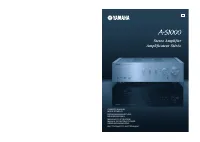 Yamaha A-S1000
User Manual
Yamaha A-S1000
User Manual
 Yamaha A-S1200BL
User Manual
Yamaha A-S1200BL
User Manual
 Yamaha A-S2200BL
User Manual
Yamaha A-S2200BL
User Manual
 Yamaha AS-301BL
User Manual
Yamaha AS-301BL
User Manual
 Yamaha A-S3200BL
User Manual
Yamaha A-S3200BL
User Manual
 Yamaha AS-501BL
User Manual
Yamaha AS-501BL
User Manual
 Yamaha A-S700
User Manual
Yamaha A-S700
User Manual
 Yamaha AS-801BL
User Manual
Yamaha AS-801BL
User Manual
 Yamaha AX-397
User Manual
Yamaha AX-397
User Manual