MartinLogan CLA9DCD - Manuals
MartinLogan CLA9DCD Speaker – User Manual in PDF format online.
Manuals:
User Manual MartinLogan CLA9DCD
Summary
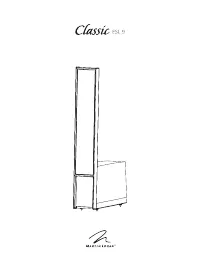
u s e r ’ s m a n u a l | m a n u e l d e l ’ u t i l i s a t e u r ®
Thank you—to you the MartinLogan owner, for loving what we do, and making it possible for us to do what we love. ________________________________________ Merci à vous, propriétaire d’un produit MartinLogan, d’aimer ce que nous faisons, et de faire en sorte que nous puissions faire ce que nous aimons...
I N T R O D U C T I O N | I N T R O D U C T I O N Congratulations! You have invested in one of the world’s pre-mier loudspeaker systems. MartinLogan electrostatic speakers represent an advanced combination of sonic technologies establish-ing an unprecedented direction for audiophile design. The resu...
C O N T E N T S | T A B L E D E S M A T I È R E S Controls and Connections . . . . . . . . . . . . . . . . . . . . . . . . . . . . . . . . 1 Low-Voltage (DC) Power Connection. . . . . . . . . . . . . . . . . . . . . . . . 1 Signal Input Connection . . . . . . . . . . . . . . . . . . . . . . . . . . ...
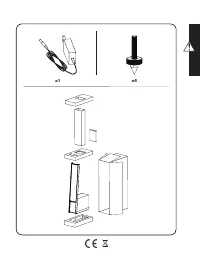
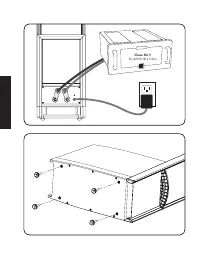
1 English C O N T R O L S A N D C O N N E C T I O N S Low-Voltage (DC) Power Connection Your speakers use external low-voltage power supplies to energize their electrostatic panels. For this reason the proper low-voltage power supplies are provided. A power supply should be firmly inserted into the ...
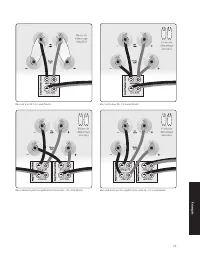
2 English Bi-Wire Connection This connection method replaces the jumper clips installed under the binding posts with individual runs of speaker wire from your amplifier. This doubles the signal carrying conductors from the amplifier to the speaker, thus direct-coupling each por-tion of the crossover...
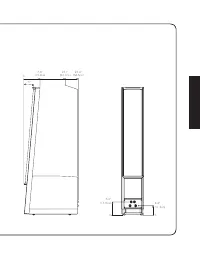
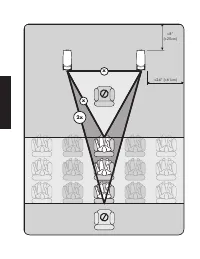
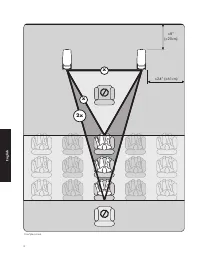
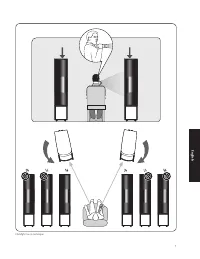
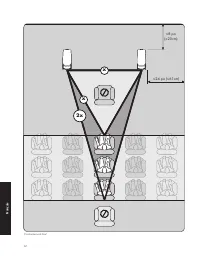
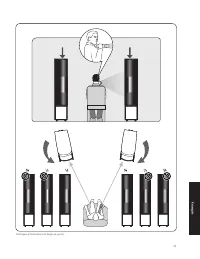
4 English P L A C E M E N T Listening Position Star t with the rear of your speakers placed approximately eight inches from the front wall (the wall in front of the listen-ing position) and the edge of the electrostatic stat panel about two feet from the side walls. Your sitting distance should be f...
8 R O O M A C O U S T I C S Your Room This is one of those areas that requires both a little background to understand and some time and experimentation to obtain the best performance from your system. Your room is actually a component and an important part of your system. This com-ponent is a very l...
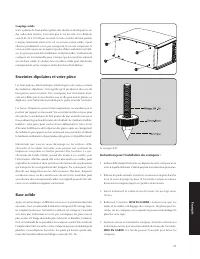
9 English Solid Coupling Your loudspeaker system generates frequency vibrations or waves into the room. This is how it creates sound. These vibra-tions vary from 20 per second to 20,000 per second. If your speaker system is not securely planted on the floor or solid surface, it can shake as it produ...
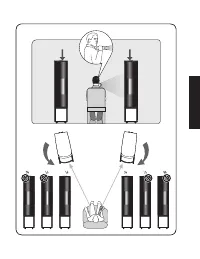
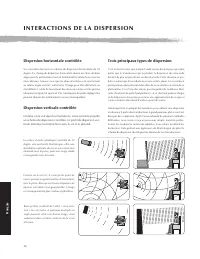
10 English D I S P E R S I O N I N T E R A C T I O N S Controlled Horizontal Dispersion Your speakers launch a 30 degree horizontal dispersion pat-tern. This horizontal dispersion field gives a choice of good seats for the performance while minimizing interactions with side walls. Make sure both spe...
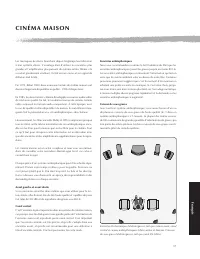
11 English It had long been the practice of stereo buffs to connect their television to a stereo system. The advantage was the use of the larger speakers and more powerful amplifier of the stereo sys-tem. Even though the sound was greatly improved, it was still mono and limited by the broadcast sign...
12 E L E C T R O S T A T I C A D V A N T A G E S How can sound be reproduced by something that you are able to see through? Electrostatic energy makes this possible. Where the world of traditional loudspeaker technology deals with cones, domes, diaphragms and ribbons that are moved with magnetism, t...
13 English Full Range Operation Another significant advantage of MartinLogan’s exclusive trans-ducer technology reveals itself when you look at examples of other loudspeaker products on the market today. MartinLogan electrostats uses no crossover networks in critical frequency ranges because they ar...
14 M A R T I N L O G A N E X C L U S I V E S XStat Transducer XStat transducers incorporate a myriad of technology and design innovations including CLS, MicroPerf, Generation 2 Diaphragms, ClearSpars™, and Vacuum Bonding. CLS (Curvilinear Line Source) Since the beginning of audio, achieving smooth d...
15 English In the late 1800’s, any loudspeaker was considered exotic. Today, we take the wonders of sound reproduction for granted. I t w a s 18 8 0 b e fo r e T h o m a s Edi s o n h a d inv e n t e d t h e f ir s t p h o n o g r a p h. T hi s w a s a h o r n - l o a d e d dia p h r a g m that was ...
16 In 1947, Arthur Janszen, a young Naval engineer, took part in a research project for the Navy. The Navy was interested in developing a better instrument for testing microphone arrays. The test instrument needed an extremely accurate speaker, but Janszen found that the cone speakers of the period ...
17 English How do I clean my speakers? Use a dust free cloth or a soft brush to remove the dust from your speakers. For the wood surfaces it is accept-able to slightly dampen the cloth. Do not spray any kind of cleaning agent on or in close proximity to the electro-static element. Avoid the use of a...
19 English No Output • Check that all your system components are turned on.• Check the status LED. It should be green. Please see the Controls section of manual. • Check your speaker wires and connections.• Check all interconnecting cables.• Try hooking up a different set of speakers. The lack of ou...
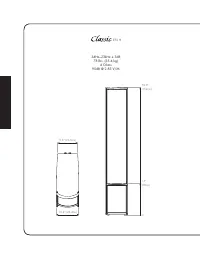
20 System Frequency Response: 34–23,000 Hz ± 3db Recommended Amplifier Power: 50–400 watts per channel at 4 Ohms Dispersion: Horizontal: 30 Degrees Vertical: 44” (112 cm) line source Sensitivity: 90 dB/2.83 volts/meter Impedance: Nominal: 4 ohms, 0.8 ohms @ 20 kHz Crossover Frequency: 380 Hz High/Mi...
21 English Warranty and Registration Your speakers are provided with an automatic Limited 90 Day Warranty coverage. You have the option, at no additional charge, to receive a Limited 5 Year Warranty coverage. To obtain the Limited 5 Year Warranty coverage you need to complete the warranty registrati...
22 English AC. Abbreviation for alternating current. Active crossover. Uses active devices (transistors, IC’s, tubes) and some form of power supply to operate. Amplitude. The extreme range of a signal. Usually measured from the average to the extreme. Arc. The visible sparks generated by an electric...
® m a n u e l d e l ’ u t i l i s a t e u r Français
27 Français R A C C O R D S E T C O M M A N D E S Raccord de l’alimentation (CC) à faible tension Vos enceintes utilisent une alimentation externe à faible tension pour alimenter leurs cellules électrostatiques. Par conséquent, les sources d’alimentation à faible tension appro-priées sont fournies. ...
28 Français tions de haute et de basse fréquence du répartiteur. En les laissant en place, branchez le câble (+) de votre amplificateur à la borne de rac-cordement rouge et le câble (-) de votre amplificateur à la borne de raccordement noire. Raccord à deux fils Cette méthode de raccordement remplac...
30 Français P O S I T I O N N E M E N T Position d’écoute À présent, vos enceintes doivent être placées à environ huit pouces du mur avant, le mur devant la position d’écoute, et à environ deux pieds des murs latéraux. Votre distance en position assise doit être plus longue que la distance entre les...
31 enceinte. La réflexion de la lampe de poche doit être à l’intérieur du tiers interne du panneau. Inclinaison des enceintes vers l’avant et vers l’arrière — Comme les diagrammes l’indiquent à la section Interactions de la dispersion de ce manuel , la dispersion verticale est directionnelle au-dess...
34 A C O U S T I Q U E D E L A P I È C E La pièce C’est l’un des domaines qui requièrent un certain bagage pour com-prendre, et un peu de temps et d’expérimentation pour obtenir le meilleur rendement possible de votre système. La pièce est une composante et une partie intégrale de votre système. Cet...
35 Français Couplage solide Votre système de haut-parleur génère des vibrations de fréquences ou des ondes dans la pièce. C’est ainsi que le son est créé. Ces vibrations varient de 20 à 20 000 par seconde. Si votre système de haut-parleur n’est pas fermement ancré sur le sol ou sur une surface solid...
36 Français I N T E R A C T I O N S D E L A D I S P E R S I O N Dispersion horizontale contrôlée Vos enceintes lancent un schéma de dispersion horizontale de 30 degrés. Ce champ de dispersion horizontale donne un choix de bons sièges pour la performance tout en minimisant les interactions avec les m...
37 Français Les maniaques de stéréo branchent depuis longtemps leur télévision à leur système stéréo. L’avantage était d’utiliser les enceintes plus grandes et l’amplificateur plus puissant du système stéréo. Même si le son était grandement amélioré, il était encore mono et son signal de diffusion é...
38 A V A N T A G E S É L E C T R O S T A T I Q U E S Comment le son peut-il être reproduit par une chose à travers laquelle on peut voir? C’est l’énergie électrostatique qui rend cela possible. Tandis que le monde de la technologie traditionnelle des haut-parleurs fait appel à des cônes, des dômes, ...
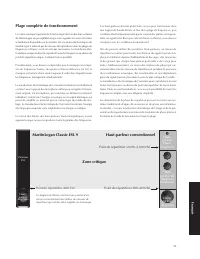
39 Zone critique Haut-parleur conventionnel Point de répartition (100–400 Hz) Point de répartition (2,000–5,000 Hz) MartinLogan Classic ESL 9 Point de répartition (400 Hz) Haut- parleur Paute Fréquence Haut- parleur de Moyenne Fréquence Haut- parleur de graves Panneau ESL Haut- parleur de graves Fra...
40 E X C L U S I V I T É S M A R T I N L O G A N Transducteur XStat Les transducteurs XStat incluent une multitude d’innovations en matière de conception et de technologie, notamment le CLS, le MicroPerf, les diaphragmes Generation 2, le ClearSpars™, et le collage sous vide. CLS (Source linéaire cur...
41 Français À la fin des années 1800, les haut-parleurs étaient considérés comme exotiques. Aujourd’hui, nous sommes nombreux à tenir les miracles de la reproduction sonore pour acquis. C’est en 1880 que Thomas Edison a inventé le premier phonographe. Il s’agissait d’un diaphragme doté d’une corne q...
42 Français test avait besoin d’une enceinte très précise, mais Janszen a relevé que les enceintes à cône de l’époque n’étaient pas assez linéaires en ce qui concerne la réponse de phase et d’amplitude pour répondre à ses critères. Janszen croyait que les électrostatiques étaient de nature plus liné...
43 Français Comment puis-je nettoyer mes enceintes? Utilisez un linge exempt de poussière ou une brosse molle pour enlever la poussière des enceintes. Pour les surfaces en bois, vous pouvez utiliser un linge légèrement humide. Ne vaporisez pas d’agent nettoyant sur ou à proximité de l’élément électr...
45 Français Pas de son • Vérifiez que toutes les composantes du système sont allumées. • Vérifiez la DEL de statut. Elle doit être verte. Veuillez consulter la section Commandes du panneau supérieur du manuel. • Vérifiez les câbles de l’enceinte et les raccords. • Vérifiez tous les câbles interconne...
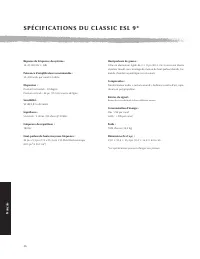
46 Réponse de fréquence du système : 34–23 000 Hz ± 3db Puissance d’amplificateur recommandée : 50–400 watts par canal à 4 ohms Dispersion : Position horizontale : 30 degrés Position verticale : 44 po (112 cm) source de ligne Sensibilité : 90 dB/2,83 volts/mètre Impédance : Nominale : 4 ohms, 0,8 oh...
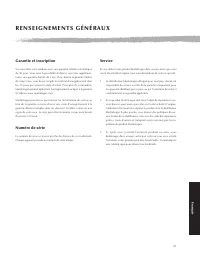
47 Français Garantie et inscription Vos enceintes sont vendues avec une garantie limitée automatique de 90 jours. Vous avez la possibilité d’obtenir, sans frais supplémen-taires, une garantie limitée de 5 ans. Pour obtenir la garantie limitée de cinq (5) ans, vous devez remplir le certificat d’enreg...
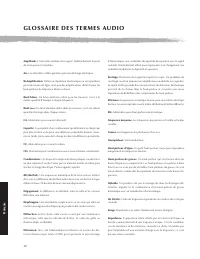
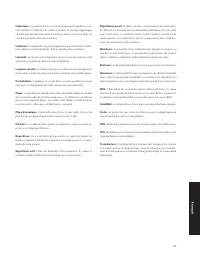
48 Français Amplitude. L’intervalle extrême d’un signal. Habituellement mesuré de la moyenne à l’extrême. Arc. Les étincelles visibles générées par une décharge électrique. Bi-Amplification. Utilise un répartiteur électronique ou un répartiteur passif de niveau de ligne, ainsi que des amplificateurs...
MartinLogan Speakers Manuals
-
MartinLogan CLA9GBD
User Manual
-
MartinLogan CLA9WAD
User Manual
-
MartinLogan EFXBLD
User Manual
-
MartinLogan EMESLCSBD
User Manual
-
MartinLogan EMESLD
User Manual
-
MartinLogan EMESLXGBD
User Manual
-
MartinLogan EMESLXSBD
User Manual
-

MartinLogan EMFX2
User Manual
-
MartinLogan EXP13DCD
User Manual
-
MartinLogan EXP13GBD
User Manual
-
MartinLogan EXP13GWD
User Manual
-
MartinLogan FB1B
User Manual
-
MartinLogan FB1SW
User Manual
-
MartinLogan FB1WNT
User Manual
-
MartinLogan FB2B
User Manual
-
MartinLogan FB2SW
User Manual
-
MartinLogan FB2WNT
User Manual
-
MartinLogan FC1B
User Manual
-
MartinLogan FC1SW
User Manual
-
MartinLogan FC1WNT
User Manual