Page 2 - en Table of Contents
en Table of Contents Safety and warning information ........... 3Information concerning disposal ......... 5Scope of delivery ................................... 6Ambient temperature and ventilation ................................................. 6Installation location ...............................
Page 3 - Safety and warning; Before you switch ON the
en 3 enTable of Contents enInstruction for Use Safety and warning information Before you switch ON the appliance Please read the operating and installation instructions carefully! They contain important information on how to install, use and maintain the appliance.The manufacturer is not liable if y...
Page 5 - Information concerning; Disposal of packaging
en 5 ■ Do not store bottled or canned drinks (especially carbonated drinks) in the freezer compartment. Bottles and cans may burst! ■ Never put frozen food straight from the freezer compartment into your mouth. Risk of low-temperature burns! ■ Avoid prolonged touching of frozen food, ice or the evap...
Page 6 - Scope of delivery; Ambient temperature
en 6 * Disposal of your old appliance Old appliances are not worthless rubbish! Valuable raw materials can be reclaimed by recycling old appliances. m Warning Redundant appliances1. Pull out the mains plug.2. Cut off the power cord and discard with the mains plug. 3. Do not take out the trays and re...
Page 7 - Ventilation; Installation location; Electrical connection
en 7 Note The appliance is fully functional within the room temperature limits of the indicated climatic class. If an appliance of climatic class SN is operated at colder room temperatures, the appliance will not be damaged up to a temperature of +5 °C. Ventilation Fig. ! /24 The refrigeration unit ...
Page 8 - Controls
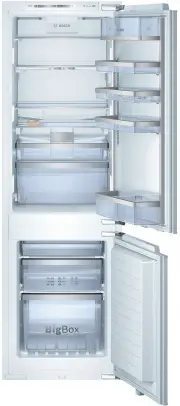
en 8 Getting to know your appliance Please fold out the illustrated last page. These operating instructions refer to several models.The features of the models may vary.The diagrams may differ.Fig. ! * Not all models. Controls Fig. " A Refrigerator compartment B Freezer compartment 1-7 Controls 8...
Page 9 - Operating tips; Setting; Refrigerator compartment
en 9 Switching the appliance on 1. Switch on the appliance with the On/Off button, Fig. ! /8. A warning signal sounds, the temperature displays, Figs. " /4 and 7, flash, the alarm button, Fig. " /1, is lit. 2. Press the alarm button Fig. " /1. The warning signal is switched off, the appl...
Page 10 - Alarm functions; Door alarm; Switching off the alarm; Usable capacity; Fully utilising the freezer
en 10 Alarm functions Fig. " Door alarm The door alarm (continuous sound) switches on if the appliance door is open for longer than one minute. Close the door to switch off the warning signal. Temperature alarm The temperature alarm switches on if the freezer compartment is too warm: ■ Alarm but...
Page 11 - Storing food; Note the chill zones; Super cooling
en 11 Refrigerator compartment The refrigerator compartment is the ideal storage location for meat, sausage, fish, dairy products, eggs, ready meals and pastries. Storing food ■ Store fresh, undamaged food. The quality and freshness will then be retained for longer. ■ In the case of ready-made produ...
Page 12 - Switching on and off; Freezer compartment; Use the freezer compartment; Max. freezing capacity; Prerequisites for max. freezing
en 12 Switching on and off Fig. " Press super button 5 refrigerator compartment.The button is lit when super cooling is switched on. Note When super cooling is switched on, increased operating noises may occur. Freezer compartment Use the freezer compartment ■ To store deep-frozen food. ■ To mak...
Page 13 - Purchasing frozen food; Storing frozen food; Freezing fresh food
en 13 Freezing and storing food Purchasing frozen food ■ Packaging must not be damaged. ■ Use by the “use by” date. ■ Temperature in the supermarket freezer must be -18 °C or lower. ■ If possible, transport deep-frozen food in an insulated bag and place quickly in the freezer compartment. Note when ...
Page 14 - Packing frozen food; Shelf life of frozen food; Super freezing
en 14 Packing frozen food To prevent food from losing its flavour or drying out, place in airtight containers.1. Place food in packaging.2. Remove air.3. Seal the wrapping.4. Label packaging with contents and date of freezing. Suitable packaging: Plastic film, tubular film made of polyethylene, alum...
Page 15 - Thawing frozen food; Interior fittings; Glass shelf “EasyLift”; Door shelf “EasyLift”
en 15 Thawing frozen food Depending on the type and application, select one of the following options: ■ at room temperature ■ in the refrigerator ■ in an electric oven, with/without fan assisted hot-air ■ in the microwave m Caution Do not refreeze thawing or thawed food. Only ready meals (boiled or ...
Page 16 - Ice block; Sticker “OK”; Switching off and; Switching off the appliance; Defrosting
en 16 Ice block If a power failure or malfunction occurs, the ice blocks can be used to slow down the thawing process. The longest storage time is obtained by placing the ice pack on the food in the top compartment.The ice blocks can also be used to cool food temporarily , e. g. in a cold bag. Stick...
Page 17 - Cleaning the appliance
en 17 Freezer compartment The fully automatic NoFrost system ensures that the freezer compartment remains free of ice. Defrosting is no longer required. Cleaning the appliance m Caution ■ Do not use abrasive, chloride or acidic cleaning agents or solvents. ■ Do not use scouring or abrasive sponges. ...
Page 18 - Odours
en 18 Removing the container Fig. * Tilt container forwards and take out.To insert the container, place the front of the container on the telescopic rails and push into the appliance. The container is engaged by pushing it into the appliance. Remove telescopic rails Fig. , 1. Pull out the telescopic...
Page 19 - Quite normal noises
en 19 Tips for saving energy ■ Install the appliance in a dry, well ventilated room! The appliance should not be installed in direct sunlight or near a heat source (e.g. radiator, cooker).If required, use an insulating plate. ■ Allow warm food and drinks to cool down before placing in the appliance....
Page 20 - Eliminating minor faults yourself
en 20 Eliminating minor faults yourself Before you call customer service:Please check whether you can eliminate the fault yourself based on the following information.Customer service will charge you for advice – even if the appliance is still under guarantee! Fault Possible cause Remedial action Tem...
Page 21 - Customer service; Repair order and advice
en 21 Customer service Your local customer service can be found in the telephone directory or in the customer-service index. Please provide customer service with the appliance product number (E-Nr.) and production number (FD).These specifications can be found on the rating plate. Fig. + To prevent u...