Page 2 - ELECTRO
Page 3 - Operating modes; When the extractor hood is operated; which will be needed by the; Instructions for use:; The complete installation set and; from; If no activated carbon filter is installed,
3 Operating modes Exhaust-air mode: ❑ The extractor-hood fan extracts the kitchen vapours and conveys themthrough the grease filter into the atmosphere. ❑ The grease filter absorbs the solid particles in the kitchen vapours. ❑ The kitchen is kept almost free of greaseand odours. D When the extractor...
Page 4 - Before using for the first time; Repairs; should be carried out by; Gas hobs / gas cookers; Do not operate more than 2 gas; If you encounter a problem; If you have any questions or if a fault; The manufacturer of the extractor
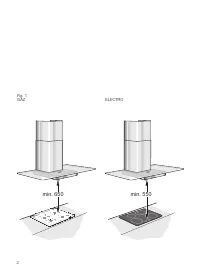
4 Before using for the first time Important notes: ❑ The Instructions for Use apply to severalversions of this appliance. Accordingly,you may find descriptions of individualfeatures that do not apply to your specific appliance. ❑ This extractor hood complies with all relevant safety regulations. Rep...
Page 5 - Safety instructions
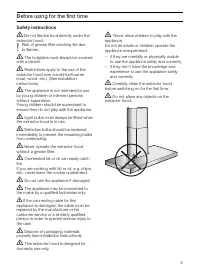
5 Before using for the first time Safety instructions Do not flambé food directly under the extractor hood. Risk of grease filter catching fire due ! to flames. The hotplates must always be covered with a utensil. Restrictions apply to the use of the extractor hood over a solid-fuel burner(coal, woo...
Page 6 - Operating procedure; Switch the ventilator ON
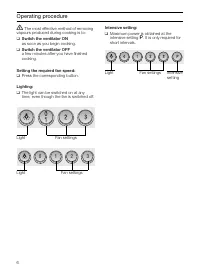
6 Operating procedure The most effective method of removing vapours produced during cooking is to: ❑ Switch the ventilator ON as soon as you begin cooking. ❑ Switch the ventilator OFF a few minutes after you have finishedcooking. Setting the required fan speed: ❑ Press the corresponding button. Ligh...
Page 7 - Filters and maintenance; Cleaning the metal grease filters:; The halogen bulbs must be
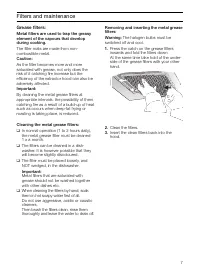
7 Filters and maintenance Grease filters: Metal filters are used to trap the greasyelement of the vapours that developduring cooking. The filter mats are made from non-combustible metal. Caution: As the filter becomes more and more saturated with grease, not only does therisk of it catching fire inc...
Page 8 - Activated carbon filter:; Replacing the activated carbon filter:
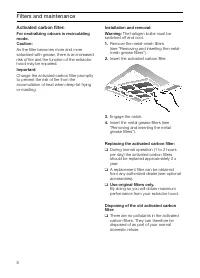
8 Filters and maintenance Activated carbon filter: For neutralizing odours in recirculatingmode. Caution: As the filter becomes more and more saturated with grease, there is an increasedrisk of fire and the function of the extractorhood may be impaired. Important: Change the activated carbon filter ...
Page 9 - Cleaning and care; Do not clean the extractor hood with; Stainless steel surfaces:; Do not use dry cloths.
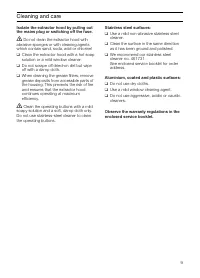
9 Cleaning and care Isolate the extractor hood by pulling outthe mains plug or switching off the fuse. Do not clean the extractor hood with abrasive sponges or with cleaning agentswhich contain sand, soda, acid or chlorine! ❑ Clean the extractor hood with a hot soapsolution or a mild window cleaner....
Page 10 - Replacing the light bulbs
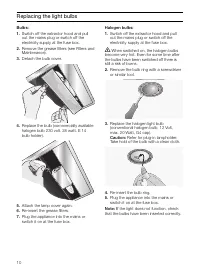
10 Replacing the light bulbs Bulbs: 1. Switch off the extractor hood and pullout the mains plug or switch off the electricity supply at the fuse box. 2. Remove the grease filters (see Filters andMaintenance). 3. Detach the bulb cover. 4. Replace the bulb (commercially availablehalogen bulb 230 volt,...
Page 12 - Prior to installation; Exhaust air should neither be directed
12 Prior to installation Exhaust-air mode The exhaust air is discharged upwardsthrough a ventilation shaft or directlythrough the outside wall into the open. D Exhaust air should neither be directed into a smoke or exhaust flue that iscurrently used for other purposes, nor intoa shaft that is used f...
Page 13 - Connecting a
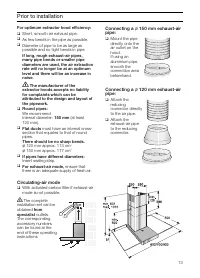
13 For optimum extractor hood efficiency: ❑ Short, smooth air exhaust pipe. ❑ As few bends in the pipe as possible. ❑ Diameter of pipe to be as large aspossible and no tight bends in pipe. If long, rough exhaust-air pipes,many pipe bends or smaller pipe diameters are used, the air extractionrate wil...
Page 14 - Preparing t h e w a l l; Electrical connection; The extractor hood
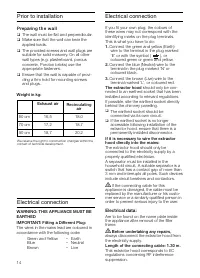
14 Prior to installation Preparing t h e w a l l ❑ The wall must be flat and perpendicular. ❑ Make sure that the wall can bear theapplied loads. ❑ The provided screws and wall plugs aresuitable for solid masonry. On all otherwall types (e.g. plasterboard, porousconcrete, Poroton bricks) use theappro...
Page 15 - Installation preparations; This extractor hood
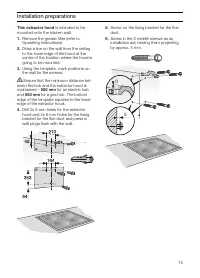
15 Installation preparations 5. Screw on the fixing bracket for the flueduct. 6. Screw in the 2 middle screws as aninstallation aid, leaving them projectingby approx. 5 mm. 5 0 This extractor hood is intended to be mounted onto the kitchen wall. 1. Remove the grease filter (refer to Operating Instru...
Page 16 - Installation; Connect up the air outlet pipe.
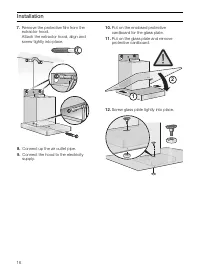
16 Installation 7. Remove the protective film from theextractor hood. Attach the extractor hood, align andscrew tightly into place. 8. Connect up the air outlet pipe. 9. Connect the hood to the electricitysupply. 10. Put on the enclosed protective cardboard for the glass plate. 11. Put on the glass ...
Page 17 - Installing the flue ducts
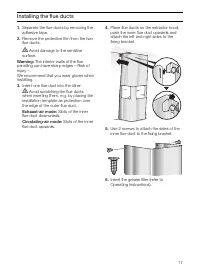
17 Installing the flue ducts 4. Place flue ducts on the extractor hood,push the inner flue duct upwards andattach the left and right sides to thefixing bracket. 1. Separate the flue ducts by removing theadhesive tape. 2. Remove the protective film from the twoflue ducts. Avoid damage to the sensitiv...
Page 18 - Notes