Page 2 - Congratulations; Getting Started; Table of Contents
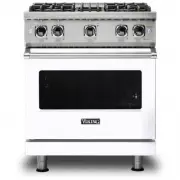
Congratulations We hope you will enjoy and appreciate the care and attention we have put into every detail of your new, state-of-the-artrange. Your appliance is designed to offer years of reliable service. This Use and Care Manual will provide you with the informationyou need to become familiar with...
Page 3 - Warnings
3 Warnings Warning and Important Safety Instructions appearing in this manualare not meant to cover all possible conditions andsituations that may occur. Common sense, caution, and care must be exercised when installing, maintaining, or operatingthe appliance. ALWAYS contact the manufacturer about p...
Page 5 - CAUTION
5 Getting Started • NEVER use aluminum foil to cover oven racks or oven bottom. This could result in risk of electric shock, fire, or damage to the appliance. Use foil only as directed in this guide. • DO NOT cook directly on the oven bottom. This could result in damage to your appliance. Always use...
Page 6 - WARNING; WARNING; ELECTRICAL SHOCK HAZARD
Warnings 6 Self-Clean Oven • Clean only parts listed in this guide. DO NOT clean door gasket. The door gasket is essential for a good seal. Care should be taken not to rub, damage, or move the gasket. DO NOT use oven cleaners of any kind in or around any part of the self-clean oven. • Before self-cl...
Page 7 - BURN HAZARD
7 Getting Started WARNING ELECTRICAL SHOCK HAZARD Disconnect the electric power at the main fuse orcircuit breaker before replacing bulb. WARNING CAUTION To avoid sickness and food waste, DO NOT allow defrosted food to remain in the oven for more than two hours. BURN OR ELECTRICAL SHOCK HAZARD Make ...
Page 8 - Before Using Range; Glass Rangetop; Range Features
8 Getting Started Before Using Range All products are wiped clean with solvents at the factory to remove any visible signs of dirt, oil, and grease which may haveremained from the manufacturing process. Before starting to cook, clean the range thoroughly with hot, soapy water. There maybe some burn ...
Page 9 - Oven Functions and Settings; HI BROIL
9 Oven Functions and Settings BAKE (Two-Element Bake) Use this setting for baking, roasting, and casseroles. CONV BAKE (Convection Bake) Use this setting to bake and roast foods at the same time with minimal taste transfer. TRU CONV (TruConvec™) Use this bake setting for multi-rack baking for breads...
Page 10 - Surface Operation
10 Surface Operation Operation Cooking Utensils Each cook has his or her own preference for theparticular cooking utensils that are most appropriate forthe type of cooking being done. Any and all cookingutensils are suitable for use in the range and it is notnecessary to replace your present domesti...
Page 11 - Broil element; Rack Positions; Using the Oven; Preheat; Oven Features
11 Operation Broil element Oven light 6 5 4 3 2 1 TruConvec™ element(behind baffle) (3) Oven racks Concealed bake element Rack Positions Each oven is equipped with three oven racks (somemodels include 1 or more TruGlide racks). All ovenshave six rack positions. Position 6 is the farthestfrom the ove...
Page 12 - Conventional and Convection Cooking; Pan Placement Tips
12 Operation Using the Oven Conventional and Convection Cooking Because of variations in food density, surface texture and consistency, some foods may be prepared more successfully using theconventional bake setting. For this reason, conventional baking is recommended when preparing baked goods such...
Page 13 - Baking; Baking Tips
13 Operation BAKE (Two-Element Bake) Full power heat is radiated from the bake element in the bottom of the oven cavity andsupplemental heat is radiated from the broil element. This function is recommended forsingle rack baking. Many cookbooks contain recipes to be cooked in the conventionalmanner. ...
Page 14 - Conventional Baking Chart
14 Operation Conventional Baking Chart Single Rack Time Food Pan Size Position Temp (min) BREADS Biscuits Cookie sheet 3 or 4 400˚F (204˚C) 10 - 12 Yeast loaf Loaf pan 3 or 4 375˚F (191˚C) 30 - 35 Yeast rolls Cookie sheet 3 or 4 400˚F (204˚C) 12 - 15 Nut bread Loaf pan 3 or 4 375˚F (191˚C) 30 - 35 C...
Page 15 - Convection Baking Chart
15 Operation *Note: The above information is given as a guide only. Single Rack Time Food Pan Size Position Temp (min) BREADS Frozen Biscuits Cookie sheet 3 or 4 375˚F (191˚C) 7 - 9 Yeast loaf Loaf pan 3 or 4 375˚F (191˚C) 25 - 30 Yeast rolls Cookie sheet 3 or 4 375˚F (191˚C) 11 - 13 Nut bread Loaf ...
Page 16 - Common Baking Problems/Remedies; Solving Baking Problems
16 Operation Problems Cause Remedy Cakes burned on the 1. Oven was too hot 1. Reduce temperature sides or not done 2. Wrong pan size 2. Use recom. pan size in center 3. Too many pans 3. Reduce no. of pans Cakes crack on top 1. Batter too thick 1. Follow recipe 2. Oven too hot Add liquid 3. Wrong pan...
Page 17 - Roasting; Roasting Tips
17 Operation Roasting CONV ROAST* (Convection Roast) The convection element runs in conjunction with the inner and outer broil elements.The reversible convection fan runs at a higher speed in each direction. This transferof heat (mainly from the convection element) seals moisture inside of large roa...
Page 18 - Conventional Roasting Chart
18 Operation Conventional Roasting Chart (when using the Bake or Convection Bake setting) Time Internal Food Weight Temp (min/lb) Temp BEEF Rib roast Rare 4 - 6 lbs 325˚F (162.8˚C) 25 140˚F (60.0˚C) Medium 4 - 6 lbs 325˚F (162.8˚C) 30 155˚F (68.3˚C) Well done 4 - 6 lbs 325˚F (162.8˚C) 40 170˚F (76.7...
Page 19 - Convection Roasting Chart
Operation 19 Convection Roasting Chart Time Internal Food Weight Temp (min/lb) Temp BEEF Rib roast Rare 4 - 6 lbs 325˚F (162.8˚C) 25 140˚F (60.0˚C) Medium 4 - 6 lbs 325˚F (162.8˚C) 24 155˚F (68.3˚C) Well done 4 - 6 lbs 325˚F (162.8˚C) 30 170˚F (76.7˚C) Rump roast Medium 4 - 6 lbs 325˚F (162.8˚C) 20 ...
Page 20 - Broiling
20 Operation Broiling convection broil high broil medium broil CONV BROIL*(Convection Broil) The top element operates at full power. This function is exactly the same as regularbroiling with the additional benefit of air circulation by the motorized fan in the rear ofthe oven. Smoke is reduced since...
Page 21 - Broiling Instructions; Broiling Tips; Rack Positions for Broiling
21 Operation Broiling Instructions Broiling is a dry-heat cooking method using direct or radiant heat. It is used for small, individualized cuts such as steaks, chops, and patties. Broiling speed is determined by the distancebetween the food and the broil element. Choose the rack position based on d...
Page 22 - Broiling Chart
22 Operation Broiling Broiling Chart Type and Time Cut of Meat Weight Setting Rack (min) BEEF Sirloin, 1 " Rare 12 oz Broil 3 4 Medium 12 oz Broil 3 5 Well done 12 oz Broil 3 6 T-Bone, 3/4 " Rare 10 oz Broil 3 4 Medium 10 oz Broil 3 6 Well done 10 oz Broil 3 8 Hamburger, 1/2 " Medium 1/4...
Page 23 - Convection Defrost; Convection Dehydrate
Operation 23 Convection Dehydrate CAUTION You must carefully check the food during the dehydration process toensure that it does not catch fire. Convection Defrost WARNING To avoid sickness and food waste, DO NOT allow defrosted food to remain in the oven for more than two hours. Convection Dehydrat...
Page 24 - Cleaning and Maintenance; Glass Ceramic Top; Cleaning Problems on Glass Ceramic Top
24 Cleaning and Maintenance Any piece of equipment works better and lasts longer when maintained properly and kept clean. Cooking equipment is noexception. Your range must be kept clean and maintained properly. Before cleaning, make sure all controls are in the “OFF”position. Disconnect power if you...
Page 26 - Replacing Oven Lights
26 Pr oduct Car e Replacing Oven Lights 1. Unsnap glass light cover using a screwdriver in the access groove. 2. Firmly grasp light bulb and pull out. 3. Replace with halogen bulb using volt and wattage requirements listed on glass cover. 4. Replace the light cover by snapping glass cover onto metal...
Page 27 - BURN OR ELECTRICAL SHOCK HAZARD
27 Product Car e Self-Clean Cycle WARNING BURN OR ELECTRICAL SHOCK HAZARD Make sure all controls are OFF and oven is COOLbefore cleaning. Failure to do so can result in burnsor electrical shock. This oven features an automatic pyrolytic self-cleaning cycle. During this cycle, the oven reaches elevat...
Page 28 - Door Removal
28 Pr oduct Car e Door Removal 1 2 3 Open door completely. Fold latches back until locked in place Gently close until latches stop door. Lift door up and out. Door Replacement 1 Carefully realign door on hinges. Slide in and down Open door completely. Fold latches forward until locked in place. 2 3 ...
Page 29 - Troubleshooting
29 Product Car e Troubleshooting Problem Possible Cause and/or Remedy Range will not function. Range is not connected to electrical power:Have electrician check power circuit breaker,wiring, and fuses. Oven does not operate in self-clean. Door is not shut tight enough for automaticdoor latch to lock...
Page 30 - Service Information
30 Pr oduct Car e Service Information If service is required, call your dealer or authorized service agency. The name of the authorized service agency can be obtained from the dealer or distributor in your area. Have the following information readily available. • Model number• Serial number• Date pu...
Page 31 - Warranty
31 Product Car e Warranty FREESTANDING ELECTRIC SELF-CLEAN RANGES WARRANTY ONE YEAR FULL WARRANTY Freestanding electric ranges and all of their component parts, except as detailed below*† , are warranted to be free from defective materials or workmanship in normal residential use for a period of one...
Page 32 - UL
F21192B EN (070115) Viking Range, LLC 111 Front Street Greenwood, Mississippi 38930 USA (662) 455-1200 For product information, call 1-888-845-4641 or visit the our web site at vikingrange.com in the US or brigade.ca in Canada UL C UL