Page 2 - Introduction; INSTRUCTIONS FOR SAFE AND PROPER USE
Introduction 1. INSTRUCTIONS FOR SAFE AND PROPER USE THIS MANUAL IS AN INTEGRAL PART OF THE APPLIANCE AND THEREFORE MUST BE KEPT IN ITS ENTIRETY AND IN AN ACCESSIBLE PLACE FOR THE WHOLE WORKING LIFE OF THE COOKING HOB. WE ADVISE READING THIS MANUAL AND ALL THE INSTRUCTIONS THEREIN BEFORE USING THE C...
Page 4 - Instructions for the installer; POSITIONING OF HOB; be carried out by a competent tradesman.; Attachment to support structure
Instructions for the installer 24 2. POSITIONING OF HOB The following operation requires building and/or carpentry work so must be carried out by a competent tradesman. Installation can be carried out on various materials such as masonry, metal, solid wood or plastic laminated wood as long as they a...
Page 6 - ELECTRICAL CONNECTION; Do not use reducers, adapters or shunts.; The manufacturer will not be liable; for any damage to persons or
Instructions for the installer 26 3. ELECTRICAL CONNECTION Make sure that the voltage and capacity of the power line conform to the data shown on the plate located under the casing. Do not remove this plate for any reason. The plug on the end of the supply cable and the wall socket must be the same ...
Page 7 - GAS CONNECTION; Connection to LPG
Instructions for the installer 27 4. GAS CONNECTION Connection to the gas mains may be made with a rigid copper pipe or with a flexible pipe and conforming to the provisions defined by standard regulations in force. To facilitate connection, fitting A on the rear of the appliance may be adjusted lat...
Page 8 - Ventilation of rooms
Instructions for the installer 28 Use a pressure regulator and make the connection to the tank according to the provisions of standards regulations in force. Make sure that feed pressure conforms to the levels shown in the table in paragraph “5.2 Regulation for LPG”. 4.2 Ventilation of rooms The hob...
Page 9 - ADAPTATION TO DIFFERENT TYPES OF GAS; Before performing any cleaning or maintenance work, detach the; Removing the hob; remove the screws and the nuts A that secure the burner supports; lift the hob from its seat
Instructions for the installer 29 5. ADAPTATION TO DIFFERENT TYPES OF GAS Before performing any cleaning or maintenance work, detach the appliance from the electrical socket. The hob has been inspected for G20 (2H) natural gas at a pressure of 20 mbar. For functioning with other types of gas the noz...
Page 10 - Regulation for LPG
Instructions for the installer 30 5.2 Regulation for LPG Loosen screw A and push support B all the way. Use a double head wrench to remove nozzle C and assemble the suitable one, following the instructions indicated in the reference charts, with respect to the type of gas to use. The screwing torque...
Page 11 - Regulation for natural gas; Regulation of primary air; Referred to distance “X” in mm.
Instructions for the installer 31 5.3 Regulation for natural gas The hob has been inspected for G20 (2H) natural gas at a pressure of 20 mbar. To allow the unit to work with this type of gas, perform the same operations described in paragraph “5.2 Regulation for LPG”, but choose the nozzles and regu...
Page 12 - FINAL OPERATIONS; Regulation of minimum for natural gas
Instructions for the installer 32 6. FINAL OPERATIONS Having carried out the above adjustments, reassemble the appliance following, backwards, the instructions in paragraph “5.1 Removing the hob”. 6.1 Regulation of minimum for natural gas Replace the components on the burner and slide the knobs on t...
Page 13 - Arrangement of burners on hob; Lubrication of gas taps
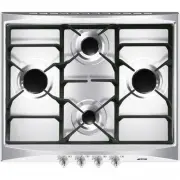
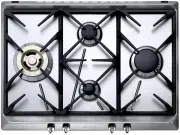
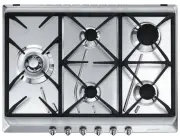
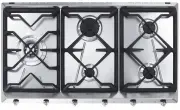
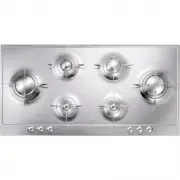
Instructions for the installer 33 6.3 Arrangement of burners on hob BURNERS 1 Auxiliary 2 Semi-rapid 3 Rapid 4 Rapid 5 Ultra rapid 6.4 Lubrication of gas taps After a while, the gas tap may become hard to turn or lock. If this happens, it has to be cleaned inside and re-greased. This must be done by...
Page 14 - Instructions for the user; USING THE HOB; Ignition of the burners
Instructions for the user 34 7. USING THE HOB Before turning on the burners, make sure that the burner rings, caps and grids have been fitted correctly. In the ultrarapid burner, notch A must be aligned with pin B . Grid C provided is intended for use with woks (Chinese pans). Adapter D comes only w...
Page 15 - Practical advice for using the burners; Using a griddle plate; A few precautions are necessary if you wish to use a griddle plate:; Electric elements; Turning on electric elements
Instructions for the user 7.2 Practical advice for using the burners For better burner performance and minimum gas consumption, flat bottomed, even recipients must be used, with covers and proportional in size to the burners (see paragraph “7.3 Diameter of containers”). To avoid overcooking or damag...
Page 16 - Using the electric elements; WARNING; To use correctly remember to:
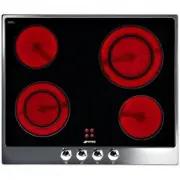
Instructions for the user 36 7.5.2 Using the electric elements The electric elements are ideal for ultrarapid cooking. The settings shown in the table are merely indicative. POSITION HEAT INTENSITY POSSIBLE COOKING - 0 Off To melt butter, chocolate, etc. 1 Weak To heat small amounts of liquid. 2 Sof...
Page 17 - CLEANING AND MAINTENANCE; Cleaning; Never use a steam jet to clean the appliance.; Regular daily cleaning of the hob; Rinse thoroughly and dry with a soft cloth or deerskin.
Instructions for the user 8. CLEANING AND MAINTENANCE Before any intervention, disconnect the power supply of the device. 8.1 Cleaning Clean the cooking top regularly every time you use it, obviously after it has cooled. Never use a steam jet to clean the appliance. 8.1.1 Regular daily cleaning of t...
Page 18 - Cleaning of cooking hob components; CAUTION: do not wash these components in a dishwasher.; Ignition plugs and safety devices
Instructions for the user 38 8.2 Cleaning of cooking hob components CAUTION: do not wash these components in a dishwasher. In normal use of the hob, the stainless steel burner caps and pan-stands tend to be burnished by the high temperature. Clean these parts using very fine abrasive sponges or simi...