Page 2 - Instructions; General safety instructions
Instructions 4 1 Instructions 1.1 General safety instructions Risk of personal injury • During use the appliance becomes hot. Care should be taken to avoid touching heating elements inside the oven. • WARNING - Accessible parts will become hot when in use. To avoid burns young children should be kep...
Page 3 - Risk of damaging the appliance
Instructions 5 EN • DO NOT USE OR STORE FLAMMABLE MATERIALS NEAR THE APPLIANCE. • NEVER USE AEROSOL CANS NEAR THE APPLIANCE WHILE IT IS IN OPERATION. • Switch the appliance off immediately after use. • DO NOT MODIFY THIS APPLIANCE. • Before carrying out any work on the appliance (installation, maint...
Page 4 - Installation
Instructions 6 • All cookware must have smooth, flat bottoms. • If any liquid does boil over or spill, remove the excess from the cooktop. • Take care not to spill acidic substances such as lemon juice or vinegar onto the cooktop. • Do not put empty pans or frying pans on switched on cooking zones. ...
Page 5 - For this appliance
Instructions 7 EN gas connections is between 10 Nm and 15 Nm. • At the end of the installation, check for any leaks with a soapy solution, never with a flame. • Have the electrical connection performed by authorised persons. • The appliance must be connected to earth in compliance with electrical sy...
Page 6 - Power voltage
Instructions 8 1.5 Disposal This appliance must be disposed of separately from other waste (Directives 2002/95/EC, 2002/96/EC, 2003/108/EC). The appliance does not contain substances in quantities sufficient to be considered hazardous to health and the environment, in accordance with current Europea...
Page 7 - How to read the user manual
Instructions 9 EN 1.7 How to read the user manual This user manual uses the following reading conventions: 1. Use instruction sequence.• Single use instruction. Instructions General information on this user manual, on safety and final disposal. Description Description of the appliance and its access...
Page 8 - Description; General Description; AUX
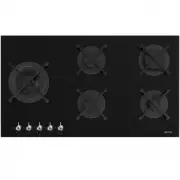
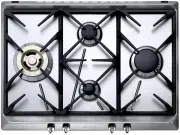
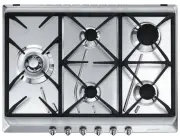
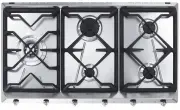
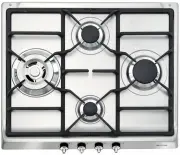
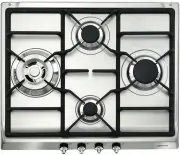
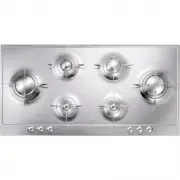
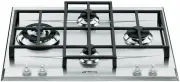
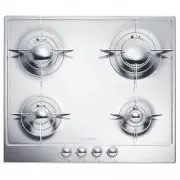
Description 10 2 Description 2.1 General Description 65 cm 75 cm 90 cm AUX = Auxiliary SR = Semi-rapid RR = Reduced rapid R = Rapid UR = Ultra rapid UR* = Ultra rapid
Page 9 - Cooking zones; Available accessories; WOK ring
Description 11 EN 2.2 Symbols Cooking zones Front left Centre left Rear left Central Rear right Central right Front right Burner knobs Useful for lighting and adjusting the hob burners. Press and turn the knobs anti- clockwise to the value to light the relative burners. Turn the knobs to the zone be...
Page 10 - Use; Improper use
Use 12 3 Use 3.1 Instructions 3.2 First use 1. Remove any protective film from the outside or inside of the appliance, including accessories. 2. Remove any labels (apart from the technical data plate) from accessories. 3. Remove and wash all the appliance accessories (see 4 Cleaning and maintenance)...
Page 11 - Correct positioning of the grids
Use 13 EN Correct positioning of the flame-spreader crowns and burner caps Before lighting the hob burners, make sure that the flame-spreader crowns are correctly positioned in their seats with their respective burner caps. Make sure that the holes in the burners are aligned with the igniters and th...
Page 12 - Using a griddle
Use 14 To prevent burns or damage to the hob or the counter top during cooking, all pans or griddles (not supplied) must be placed inside the perimeter of the hob. Using a griddle A few precautions are necessary if you wish to use a griddle:• The griddle can be pre-heated with the burner on maximum ...
Page 13 - Cleaning and maintenance; Cleaning the appliance; Ordinary daily cleaning
Cleaning and maintenance 15 EN 4 Cleaning and maintenance 4.1 Instructions 4.2 Cleaning the appliance To keep the surfaces in good condition, they should be cleaned regularly after use. Let them cool first. Ordinary daily cleaning Always use only specific products that do not contain abrasives or ch...
Page 14 - Cooking hob grids
Cleaning and maintenance 16 Cooking hob grids Remove the grids and clean them with lukewarm water and non-abrasive detergent. Make sure to remove any encrustations. Dry them thoroughly and return them to the hob. Flame-spreader crowns and burner caps For easier cleaning, the flame-spreader crowns an...
Page 15 - Installation; Minimum clearance to combustible surfaces; Cooktop
Installation 17 EN 5 Installation 5.1 Minimum clearance to combustible surfaces Cooktop A : 200 mm (Vertical combustible surface) measured from the edge of the nearest burner. B : 460 mm minimum. C : 600 mm (Overhead) measured from the highest part of the highest burner and 750 mm from an exhaust fa...
Page 16 - the pressure regulator must; Section cut from the countertop; Over built-in oven unit
Installation 18 This appliance is suitable for connection with rigid pipe or flexible hose. The isolating manual shut-off valve connection point must be accessible when the appliance is installed.Flexible hose assembly must be certified to AS/NZS 1869 class B or D, be of appropriate internal diamete...
Page 17 - Over empty kitchen unit or drawers
Installation 19 EN If installed above an oven, a space must be left between the bottom of the hob and the top of the appliance installed below. opens on bottom opens on bottom and on rear Over empty kitchen unit or drawers If there are other pieces of furniture (lateral walls, drawers, etc.), dishwa...
Page 18 - Fixing brackets
Installation 20 Fixing brackets Screw the fixing brackets ( A ) into the holes on the sides of the bottom casing to properly fasten the hob to the structure. Hob seal With glass hob To prevent leakage of liquid between the frame of the hob and the countertop, place the adhesive seal provided along t...
Page 19 - Room ventilation
Installation 21 EN Room ventilation The room containing the appliance should have a permanent air supply in accordance with the standards in force. The room where the appliance is installed must have enough air flow needed for the regular combustion of gas and the necessary air change in the room it...
Page 20 - Adaptation to different types of gas; Removing the hob top
Installation 22 5.5 Adaptation to different types of gas If other types of gas are to be used, the nozzles must be replaced and the primary air must be adjusted. In order to replace the nozzles and adjust the burners, the hob top must be removed. Removing the hob top 1. Remove the grids from the hob...
Page 21 - Replacing nozzles
Installation 23 EN 5. Remove the fastening plates and the hob top. Replacing nozzles 1. Unscrew screw A and push air regulator B as far as it will go. 2. Use a spanner to remove the nozzles C and install the new ones for the required gas supply, following the indications given in the relevant table....
Page 22 - Adjusting the minimum setting for LPG
Installation 24 Adjusting the minimum setting for LPG Tighten the screw located at the side of the tap rod clockwise all the way. Lubricating the gas cocks Over time the gas taps may become difficult to turn and get blocked. Clean them internally and replace the lubrication grease. Following adjustm...
Page 23 - Burner and nozzle specifications tables; Electrical connection; General information
Installation 25 EN Burner and nozzle specifications tables 5.6 Electrical connection General information Check the grid characteristics against the data indicated on the plate.The identification plate bearing the technical data, serial number and brand name is visibly positioned on the appliance.Do ...
Page 24 - Connection with plug and socket; For the installer; DO NOT
Installation 26 Connection with plug and socket Make sure that the plug and socket are of the same type. Avoid using adapters and shunts as these could cause overheating and a risk of burns. Testing At the end of installation, carry out a brief inspection test. If the hob fails to operate, after che...