Page 2 - Instructions; General safety instructions
Instructions 4 1 Instructions 1.1 General safety instructions Risk of personal injury • During use the appliance and its accessible parts become very hot. Never touch the heating elements during use. • Never try to put out a fire or flames with water: turn off the appliance and smother the flames wi...
Page 3 - Risk of damaging the appliance
Instructions 5 EN • DO NOT SPRAY AEROSOLS IN THE VICINITY OF THIS APPLIANCE WHILE IT IS IN OPERATION. • DO NOT USE FLAMMABLE MATERIALS NEAR THIS APPLIANCE. • Switch the appliance off immediately after use. • DO NOT MODIFY THIS APPLIANCE. • Before carrying out any work on the appliance (installation,...
Page 4 - Installation
Instructions 6 • Do not put empty pans or frying pans on switched on cooking zones. • Do not use steam jets to clean the appliance. • Do not use rough or abrasive materials or sharp metal scrapers. • Do not use cleaning products containing chlorine, ammonia or bleach on steel parts or parts with met...
Page 5 - For this appliance; Manufacturer liability; Appliance purpose
Instructions 7 EN • In case of service, contact your nearest service agent distributor listed in the warranty card or www.smeg.au | 02 8667 4888 | Annual service is recommended. For this appliance • Do not obstruct ventilation openings and heat dispersal slots. • Do not insert pointed metal objects ...
Page 6 - Power voltage
Instructions 8 1.6 Disposal This appliance must be disposed of separately from other waste (Directives 2002/95/EC, 2002/96/EC, 2003/108/EC). The appliance does not contain substances in quantities sufficient to be considered hazardous to health and the environment, in accordance with current Europea...
Page 7 - How to read the user manual
Instructions 9 EN 1.7 How to read the user manual This user manual uses the following reading conventions: 1. Sequence of instructions for use.• Standalone instruction. Instructions General information on this user manual, on safety and final disposal. Description Description of the appliance and it...
Page 8 - Description; General Description; Cooking zones
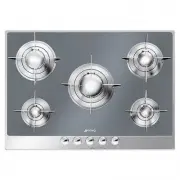
Description 10 2 Description 2.1 General Description 1. Control panel2. Auxiliary Burner (AUX)3. Reduced Rapid Burner (RR)4. Ultra-rapid burner, internal crown (UR2 int.)5. Ultra-rapid burner, external crown (UR2 ext.)8. Right side trivet 7. Left side trivet8. Central trivet 2.2 Symbols Cooking zone...
Page 9 - Burner knobs; Available accessories; Raised trivet
Description 11 EN Burner knobs Useful for lighting and adjusting the cooktop burners. Press and turn the knobs anti- clockwise to the value to light the relative burners. Turn the knobs to the zone between the maximum and minimum setting to adjust the flame. Return the knobs to the position to turn ...
Page 10 - Use; Using the cooktop; Improper use
Use 12 3 Use 3.1 Instructions 3.2 First use 1. Remove any protective film from the outside or inside of the appliance, including accessories. 2. Remove any labels (apart from the technical data plate) from accessories. 3. Remove and wash all the appliance accessories (see 4 Cleaning and maintenance)...
Page 11 - Positioning the trivets
Use 13 EN Positioning the trivets The trivets are provided unassembled on the cooktop. Follow the instructions as shown in the figure for correct trivet positioning. Correct positioning of the flame-spreader crowns and burner caps Before lighting the cooktop burners, check that the flame-spreader cr...
Page 12 - Limitations on griddle use
Use 14 Limitations on griddle use A few precautions are necessary if you wish to use a griddle:• Griddles must not protrude beyond the perimeter of the cooktop • Aluminium griddles with Teflon anti-stick coating should be pre-heated for a maximum of 5 minutes in order to avoid damage to the applianc...
Page 13 - Cleaning and maintenance; Cleaning the appliance; Ordinary daily cleaning
Cleaning and maintenance 15 EN 4 Cleaning and maintenance 4.1 Instructions 4.2 Cleaning the appliance To keep the surfaces in good condition, they should be cleaned regularly after use. Let them cool first. Ordinary daily cleaning Always use only specific products that do not contain abrasives or ch...
Page 14 - Flame-spreader crowns and burner caps
Cleaning and maintenance 16 Flame-spreader crowns and burner caps For easier cleaning, the flame-spreader crowns and the burner caps can be removed. Wash them in hot water and non-abrasive detergent. Carefully remove any encrustation, then wait until they are perfectly dry. Refit the flame-spreader ...
Page 15 - Installation; Clearances above and around domestic appliances; Requirements
Installation 17 EN 5 Installation 5.1 Clearances above and around domestic appliances This appliance must be installed by an authorised person in accordance with this instruction manual, AS/NZS 5601.1 – Gas installations (installation and pipe sizing), local gas fitting regulations, local electrical...
Page 16 - Additional requirements for; Safety instructions; Risk of fire
Installation 18 3. Additional requirements for Freestanding and Elevated Cooking Appliances – (Measurements D & E) Where D, the distance from the periphery of the nearest burner to a horizontal combustible surface is less than 200, then E shall be 10 or more, or the horizontal surface shall be a...
Page 17 - Positioning in the counter top; Use light pressure to make the seal stick
Installation 19 EN 5.3 Positioning in the counter top Fixing to the traditional built-in model support structure Create an opening in the unit worktop with the dimensions shown in the figure. To prevent leakage of liquid between the frame of the cooktop and the worktop, carefully position the insula...
Page 18 - Place the cooktop on the insulating seal
Installation 20 2. Place the cooktop on the insulating seal and fix it to the supporting structure using the supplied screws and fastening brackets ( A ) so that the cooktop is perfectly flat. 3. Carefully trim the surplus seal ( B ). Fixing to the flush built-in model support structure Create an op...
Page 19 - ) in order to achieve a
Installation 21 EN This built-in model requires a 3 mm deep section to be routed out of the worktop (detail “ B ” in the figure above). Before positioning the appliance, the insulating seal provided must be placed on the routed section ( E ). After performing these operations, fasten the appliance i...
Page 20 - View from right
Installation 22 This appliance can also be installed in a 90 cm base . To fit the brackets the appliance must be inserted into the opening made in the counter top, with the edge resting on the actual top. To bracket the cooktop laterally, just fix the two “L” brackets to the sides of the unit (2) us...
Page 21 - opens on bottom; Over empty kitchen unit or drawers; Opens on rear
Installation 23 EN 5.4 Mounting Over built-in oven The distance between the cooktop and the kitchen furniture or other installed appliances must be enough to ensure sufficient ventilation and air discharge.If installed above an oven, a space must be left between the bottom of the cooktop and the top...
Page 22 - General information
Installation 24 5.5 Gas connection General information This appliance is suitable for installation with Natural Gas or ULPG (propane/butane). Refer to “Burner and injector characteristics tables” paragraph for the relevant burner pressure and appropriate injector sizes. When the appliance is to be c...
Page 23 - not; Gas Approval Consulting Pty Ltd Smeg
Installation 25 EN To check the operating pressure of the appliance it is recommended at least 2 large size burners are used. Ensure appliance is secured to wall when installation is completed. N.G. The regulator must be fitted to the appliance inlet connection. Gas pressure must be adjusted to 1.0 ...
Page 24 - Connection to LPG
Installation 26 Connection to LPG Use a pressure regulator and make the connection on the gas cylinder following the guidelines set out in the regulations in force. The supply pressure must comply with the values indicated in the “Gas types and Countries” table. Room ventilation The appliance should...
Page 25 - Adaptation to different types of; Changing the injectors
Installation 27 EN 5.6 Adaptation to different types of gas In case of operation with other types of gas, the burner injectors must be changed and the minimum flame adjusted on the gas taps. Changing the injectors 1. Remove the trivets from the cooktop. 2. Remove the flame-spreader crowns and relati...
Page 26 - Light the burner and turn it to the minimum
Installation 28 Adjusting the minimum setting for natural or city gas 1. Light the burner and turn it to the minimum position. 2. Remove the knobs by pulling them upwards. 3. Turn the regulating screw on the side of the valve spindle until a steady minimum flame is achieved. 4. Refit the knob and ve...
Page 27 - Burner and injector characteristics tables; Electrical connection
Installation 29 EN Burner and injector characteristics tables 5.7 Electrical connection General information Check the grid characteristics against the data indicated on the plate.The identification plate bearing the technical data, serial number and brand name is visibly positioned on the appliance....
Page 28 - Fixed connection; Instructions for the installer; DO NOT
Installation 30 The appliance can work in the following modes:• 220-240 V 1N ~ Use a 3 x 0.75 mm² three-core cable. Fixed connection Fit the power line with an omnipolar circuit breaker, with contact separation of at least 3 mm, in compliance with installation regulations.The circuit breaker should ...