Whirlpool WCI55US4JB - Manual
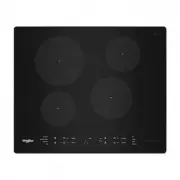
This quick reference guide covers the essentials of using an induction cooktop safely and effectively. The document highlights key operational principles, including which materials–such as ferromagnetic cookware (e.g., enamel-coated cast iron or induction-compatible stainless steel)–are compatible with induction heating versus non-ferromagnetic ones (like regular stainless steel, glass, or copper). It also emphasizes proper techniques like centering pans flat-bottomed and avoiding warped or improperly aligned cookware. Additionally, it clarifies that common sounds–such as cracking, humming, clicking, hissing, or whistling–are normal and indicate routine function rather than defects.

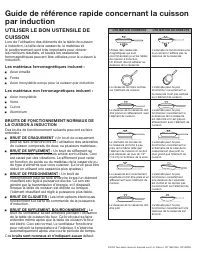

Table of Contents:
- Page 1 – Induction Cooktop Cookware Usage Guidelines
- Page 2 – Ferromagnetic and Non-ferromagnetic Cookware Materials
- Page 3 – Cookware Placement and Operating Noise Information
Induction Quick Reference Guide
USE THE CORRECT COOKWARE
When using induction cooktop elements, pan size,
material, and positioning are very important to achieve
the best results, and only ferromagnetic pans can be
used for induction cooking.
Ferromagnetic materials include:
Ƀ
Enameled steel
Ƀ
Cast Iron
Ƀ
Stainless steel designed for induction cooking
Non-Ferromagnetic materials include:
Ƀ
Stainless Steel
Ƀ
Glass
Ƀ
Copper
Ƀ
Aluminum
NORMAL INDUCTION OPERATING NOISES
You may hear the following operational noises:
Ƀ
CRACKING NOISES:
You may hear a cracking
noise when you are using cookware made of two or
more materials.
Ƀ
WHISTLING:
A whirling noise occurs when
both back burners are in use. This is caused by
vibrations. Whistling can vary depending on the
weight or material of the cookware or the type of
food you are cooking. (Noise can be reduced by
using thicker cookware.)
Ƀ
HUMMING:
You may hear a low humming when you
set an element to a high power setting. This sound
is generated by energy transmission, and it will
disappear when cooktop is turned off, or at lower
power settings.
Ƀ
CLICKING:
Electric switches are operating on
induction control board.
Ƀ
HISSING, BUZZING:
You may hear a fan noise
during cooktop/oven operation. You may continue
to hear it even after the cooktop/oven is turned
off. This is normal. The fan runs to cool down the
temperature inside. It will automatically shut off after
a short period of time.
These
noises are normal and do not
indicate
any defects.
CORRECT USAGE
INCORRECT USAGE
Use magnetic pans that are
recommended for induction
cooktops. A magnet should
stick to the bottom of the pan.
The cookware will not
work if a magnet does not
stick to the bottom of the
pan.
The cookware bottom should
be centered on the cooking
element area.
The cookware may not
work properly if the
bottom of the pan is not
centered on the cooking
element area.
The bottom of the pan should
be flat and flush with the
cooking element.
The cookware may not
work properly if the
bottom of the pan is
warped and not flush with
the cooking element.
The diameter of the pan’s
base should be about the
same size as the cooking
element, and should not
extend more than 1/2"
(1.3 cm) outside the area.
The cookware may not
work properly if the
diameter of the pan’s base
is too small or too large to
fit on the cooking element.
The pan is properly balanced
and should be flat and flush
with the cooking element
.
The cookware may not
work properly if the
bottom of the pan is tilted
and not resting properly
on the cooking element.
The pan should have a flat
bottom.
The cookware may not
work properly if the
bottom of the pan is
rounded.
©2020 All rights reserved. Printed in the U.S.A. Part No. W11363125A. HC180095.
"Loading the manual" means you need to wait until the file loads and becomes available for online reading. Some manuals are very large, and the time they take to appear depends on your internet speed.
Was this manual helpful?
About this manual
- Brand
- Whirlpool
- Model
- WCI55US4JB
- Document type
- Manual
- Category
- Hob
- Language(s)
- English, Spanish, French
- Pages
- 3
- File size
- 1.1 MB
- Format
Summary
Reference guide detailing correct and incorrect usage of cookware, including proper centering and base alignment for induction stoves.
Details on materials compatible with induction cooking, listing ferromagnetic items like enamel and cast iron, and non-ferromagnetic items such as stainless steel, glass, copper, and aluminum.
Visual comparisons for proper cookware placement and base alignment, along with descriptions of normal operating sounds like cracking, hissing, buzzing, clicking, and whistling that do not indicate a malfunction.
Ask a question
Related manuals
Popular Whirlpool Hobs


More Whirlpool Hobs models
 Whirlpool WCGK7030PS Manual
 Whirlpool WCGK7036PS Manual
- Whirlpool WCGK7530PS User Manual
- Whirlpool WCGK7536PS Manual
 Whirlpool WCI55US0JB Manual
 Whirlpool ACM795BA User Manual
 Whirlpool ACM804BA User Manual
 Whirlpool SMP658CNEIXL User Manual
 Whirlpool W5CE1522FB User Manual
 Whirlpool WCC31430AB User Manual
 Whirlpool WCC31430AW User Manual
 Whirlpool WCE55US0HB User Manual
 Whirlpool WCE55US0HS Manual
 Whirlpool WCE55US0HW User Manual