Singer S0100 - User Manual
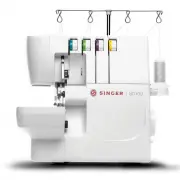
Singer S0100 Sewing Machine – User Manual, read for free online in PDF format. We hope this helps you resolve any issues you may have. If you have further questions, please contact us through the contact form.


Table of Contents:
- Page 2 – IMPORTANT SAFETY INSTRUCTIONS; shall not be made by children without supervision.; TO REDUCE THE RISK OF ELECTRIC SHOCK:; used by or near children.
- Page 3 – agent or a similarly qualified person, in order to avoid a hazard.; SAVE THESE INSTRUCTIONS
- Page 4 – Table of contents
- Page 5 – Parts of the machine
- Page 7 – Open the front cover; Removing and replacing the flat bed; Free arm sewing; To remove the flat bed extension; To replace the flat bed extension
- Page 8 – Presser foot lift; Changing the needles; Changing the presser foot
- Page 9 – Disengage the movable upper cutter; Place the movable upper cutter in nonworking; Attaching the 2-thread overlock; Removing the 2-thread overlock converter
- Page 10 – Threading the machine
- Page 14 – Changing thread; Start sewing
- Page 15 – Thread tension settings; When the upper looper thread is too loose
- Page 16 – Differential feed adjustment; Fabric
- Page 17 – Presser foot pressure adjustment; Stitch width settings; Width adjustment by changing needle position; Width adjustment with the width adjustment knob; Stitch length settings
- Page 18 – Stitch finger lever setting; Rolled edge sewing
- Page 19 – Flatlock sewing; Standard Flatlock Stitch
- Page 20 – Securing the thread chain
- Page 21 – Machine maintenance; Cleaning; Oiling
- Page 22 – Replacing the stationary cutter; Storage; Servicing
- Page 23 – Trouble shooting; Problem
- Page 24 – Stitch table; Explanation of the fabric symbols
- Page 28 – Specifications
- Page 29 – INTELLECTUAL PROPERTY
S0100 / S0105
INSTRUCTION MANUAL
"Loading the manual" means you need to wait until the file loads and becomes available for online reading. Some manuals are very large, and the time they take to appear depends on your internet speed.
Was this manual helpful?
About this manual
- Brand
- Singer
- Model
- S0100
- Document type
- User Manual
- Category
- Sewing Machine
- Language(s)
- English
- Pages
- 32
- File size
- 3.4 MB
- Format
Summary
IMPORTANT SAFETY INSTRUCTIONS When using an electrical appliance, basic safety precautions should always be followed, including the following:Read all instructions before using this household sewing machine. Keep the instructions at a suitable place close to the machine. Make sure to hand them over ...
3 • Switch the sewing machine off (“0”) when making any adjustment in the needle area, such as threading needle, changing needle, threading bobbin, or changing presser foot, etc. • Never drop or insert any object into any opening.• Do not use outdoors. • Do not operate where aerosol (spray) products...
4 Table of contents Parts of the machine........................................................5 Accessories .....................................................................6 Connecting the foot control and the power supply ..........6 Setting up the telescopic thread stand ......................
Ask a question
Related manuals
More Singer Sewing Machines models


Other Singer appliances
 Singer 12K User Manual
 Singer 14CG754 User Manual
 Singer 14HD854 User Manual
 Singer 14J334 User Manual
- Singer 14SH744 User Manual
- Singer 14SH754 User Manual
 Singer 14T970C User Manual
 Singer 37-10 User Manual
 Singer 118 User Manual
 Singer 120U User Manual
 Singer 160 User Manual
-User-Manual/webp/1.webp) Singer 384.13012 (Sold at Sears) User Manual
Singer 384.13012 (Sold at Sears) User Manual Singer 401 User Manual
 Singer 401A User Manual
 Singer 413 User Manual
 Singer 1108 User Manual
 Singer 1120 User Manual