Page 2 - After you have finished reading the instructions, keep this man-; Contents
Thank you for buying this Pioneer product. Please read through these operating instructions so you will know how to operate your model properly. After you have finished reading the instructions, keep this man- ual in a safe place for future reference. Before You Start Information to User 6 For Canad...
Page 3 - English
Pausing MP3/WMA/WAV playback 28 Using compression and BMX 28 Selecting the search method 28 Searching every 10 tracks in the current folder 29 Switching the tag display 29 Displaying text information on MP3/WMA/ WAV disc 29 When playing back an MP3/WMAdisc 29 When playing back a WAV disc 30 Scrollin...
Page 5 - We Want You Listening For A Lifetime; Example
Selecting fine audio equipment such as the unit you’ve just purchased is only the start of your musical enjoyment. Now it’s time to consider how you can maximize the fun and excitement your equipment offers. This manufacturer and the Electronic Industries Association’s Consumer Electronics Group wan...
Page 7 - Precautions; Features; About WMA
2 Receive updates on the latest products and technologies. 3 Download owner s manuals, order product catalogues, research new products, andmuch more. Precautions WARNING: Handling the cord on this product or cords asso-ciated with accessories sold with the product willexpose you to lead, a chemical ...
Page 8 - About the XM READY mark; Protecting your unit from
WMA is short for Windows Media Audio and refers to an audio compression technology that is developed by Microsoft Corporation. WMA data can be encoded by using Windows Media Player version 7 or later. Microsoft, Windows Media, and the Windows logo are trademarks, or registered trademarks of Microsof...
Page 9 - Removing the front panel; Attaching the front panel; Resetting the microprocessor; Use and care of the remote; Installing the battery; WARNING
Removing the front panel 1 Press OPEN to open the front panel. 2 Slide and remove the front panel to- ward you. Take care not to grip it too tightly or to drop it. Release button 3 Put the front panel into the protective case provided for safe keeping. Attaching the front panel 1 Make sure the inner...
Page 10 - Using the remote control; Display indication; About the demo mode; Reverse mode
! Do not store the battery with metallic materi-als. ! In the event of battery leakage, wipe the re-mote control completely clean and install anew battery. ! When disposing of used batteries, pleasecomply with governmental regulations or en-vironmental public institutions rules that apply in your co...
Page 11 - Feature demo; About basic displays
Feature demo Pressing button 6 when power to this unit is turned off while the ignition switch is set to ACC or ON starts the feature demo. Pressing button 6 during feature demo operation can- cels the feature demo mode. Remember that if the feature demo continues operating when the car engine is tu...
Page 13 - What
Head unit (front panel open) These buttons listed below can be operated only when the front panel opened. b ENTERTAINMENT button Press to change to the entertainment dis- play. Press and hold to change the display form. c AUDIO button Press to select various sound quality con- trols. d DISPLAY butto...
Page 14 - Remote control; c e
Remote control Operation is the same as when using the but- tons on the head unit. f VOLUME buttons Press to increase or decrease the volume. g PGMbutton Press to operate the preprogrammed func- tions for each source. (Refer to Using the PGM button on page 54.) h CD button Press to select the built-...
Page 15 - Turning the unit off
Turning the unit on % Press SOURCE to turn the unit on. When you select a source the unit is turned on. Selecting a source You can select a source you want to listen to. To switch to the built-in CD player, load a disc in the unit (refer to page 19). % Press SOURCE to select a source. Press SOURCE r...
Page 16 - Listening to the radio; Tuner
Listening to the radio 1 2 3 4 5 These are the basic steps necessary to operate the radio. More advanced tuner operation is explained starting on the next page. 1 Frequency indicator Shows to which frequency the tuner is tuned. 2 Stereo ( 5 ) indicator Shows that the frequency selected is being broa...
Page 18 - Selecting stations from the
4 When you want to return to normal seek tuning, press b to turn local seek tun- ing off. Local OFF appears in the display. Storing the strongest broadcast frequencies BSM(best stations memory) lets you automa- tically store the six strongest broadcast fre- quencies under preset tuning buttons 1 6 a...
Page 19 - Playing a CD
Playing a CD 1 2 These are the basic steps necessary to play a CD with your built-in CD player. More ad- vanced CD operation is explained starting on the next page. 1 Track number indicator Shows the track currently playing. 2 Play time indicator Shows the elapsed playing time of the cur- rent track...
Page 20 - Selecting a trackdirectly; Introduction of advanced; Repeating play
Selecting a trackdirectly When using the remote control, you can select a track directly by entering the desired track number. 1 Press DIRECT. Track number input display appears. 2 Press NUMBER buttons to enter the de- sired track number. # You can cancel the input number by pressing CLEAR . 3 Press...
Page 21 - Playing tracks in a random; Pausing CD playback
1 Press FUNCTION to select Repeat mode. Press FUNCTION until Repeat mode appears in the display. 2 Press a to turn repeat play on. The light comes on. The track currently playing will play to the end and then repeat. # To turn repeat play off, press b . Note If you perform track search or fast forwa...
Page 22 - Searching every 10 tracks in; Using disc title functions; Entering disc titles
Using compression and BMX Using the COMP (compression) and BMX functions let you adjust the sound playback quality of the CD player. Each of the functions have a two-step adjustment. The COMP func- tion balances the output of louder and softer sounds at higher volumes. BMX controls sound reverberati...
Page 23 - Displaying disc titles; Using CD TEXT functions
2 Press OPEN to open the front panel. 3 Press FUNCTION and hold until Title input appears in the display. # When playing a CD TEXT disc, you cannot switch to Title input . The disc title will have al- ready been recorded on a CD TEXT disc. 4 Press button 1 to select the desired character type. Press...
Page 24 - Displaying titles on CD TEXT discs; Scrolling titles in the display; Selecting tracks from the
Displaying titles on CD TEXT discs 1 Press OPEN to open the front panel. 2 Press DISPLAY. Press DISPLAY repeatedly to switch between the following settings: Form 1 Play time : disc title : disc artist name : track title : track artist name Form 2 Play time and : disc title Play time and : disc artis...
Page 26 - Selecting a trackdirectly in
Notes ! When playing discs with MP3/WMA/WAV filesand audio data (CD-DA) such as CD-EXTRAand MIXED-MODE CDs, both types can beplayed only by switching mode between MP3/WMA/WAV and CD-DA with BAND . ! If you have switched between playback ofMP3/WMA/WAV files and audio data (CD-DA),playback starts at t...
Page 28 - Scanning folders and tracks; playback; Using compression and BMX
Scanning folders and tracks While you are using Folder repeat , the begin- ning of each track in the selected folder plays for about 10 seconds. When you are using Disc repeat , the beginning of the first track of each folder is played for about 10 seconds. 1 Select the repeat range. Refer to Repeat...
Page 29 - Switching the tag display; Displaying text information; When playing backan MP3/
2 Press c or d to select the search meth- od. Press c or d until the desired search method appears in the display. ! FF / REV Fast forward and reverse ! Rough search Searching every 10 tracks Searching every 10 tracks in the current folder If the current folder contains over 10 tracks, you can searc...
Page 30 - When playing backa WAV disc; Scrolling text information
Play time and : folder name Play time and : file name Play time and :track title Play time and :artist name Play time and : album title Play time and :comment : folder name and : file name : album title and :track title :artist name and :track title # When playing back MP3 files recorded as VBR (var...
Page 34 - Scanning CDs and tracks
2 Press c or d to select the repeat range. Press c or d until the desired repeat range ap- pears in the display. ! Magazine repeat Repeat all discs in the multi-CD player ! Track repeat Repeat just the current track ! Disc repeat Repeat the current disc Notes ! If you select other discs during repea...
Page 35 - Using compression and; Using ITS playlists; Creating a playlist with ITS
2 Press a to turn pause on. The light comes on. Play of the current track pauses. # To turn pause off, press b . Using compression and bass emphasis You can use these functions only with a multi- CD player that supports them. Using COMP (compression) and DBE (dy- namic bass emphasis) functions lets ...
Page 36 - Playbackfrom your ITS playlist; Erasing a trackfrom your ITS; Erasing a CD from your ITS playlist
Playbackfrom your ITS playlist ITS play lets you listen to the tracks that you have entered into your ITS playlist. When you turn on ITS play, tracks from your ITS playlist in the multi-CD player will begin to play. 1 Select the repeat range. Refer to Repeating play on page 33. 2 Press FUNCTION to s...
Page 38 - Selecting discs or tracks
Some discs have certain information encoded on the disc during manufacture. These discs may contain such information as the CD title, track title, artist s name and playback time and are called CD TEXT discs. Only these spe- cially encoded CD TEXT discs support the functions listed below. Displaying...
Page 40 - Using the position selector; Using balance adjustment; Audio Adjustments
# You can select SW.2 and SW.3 only when sub- woofer output is turned on in SW.1 . # When selecting the FMtuner as the source, you cannot switch to SLA . Note If you do not operate the function within about 30seconds, the display is automatically returned. Using the position selector One way to assu...
Page 41 - Adjusting the time alignment; Using subwoofer output
(auto-time alignment and auto-equalizing) on page 46.) # Please set Auto TA appears. This indicates that you cannot select Auto TA if auto TA and EQ has not been carried out. Adjusting the time alignment You can adjust the distance between each speaker and the selected position. ! An adjusted time a...
Page 42 - Adjusting subwoofer settings; Adjusting low pass filter; Using the high pass filter
3 Press c or d to select the phase of sub- woofer output. Press c to select reverse phase and Reverse appears in the display. Press d to select nor- mal phase and Normal appears in the display. Adjusting subwoofer settings When the subwoofer output is on, you can ad- just the cut-off frequency and t...
Page 44 - Using the auto-equalizer; Recalling equalizer curves; Adjusting equalizer curves
Using the auto-equalizer The auto-equalizer is the equalizer curve cre- ated by auto TA and EQ (refer to Auto TA and EQ (auto-time alignment and auto-equalizing) on page 46). You can turn the auto-equalizer on or off. 1 Press AUDIO and hold until second audio menu appears in the display, then press ...
Page 45 - Using BBE sound; Adjusting loudness
Adjusting 13-band graphic equalizer For CUSTOM1 and CUSTOM2 equalizer curves, you can adjust the level of each band. ! A separate CUSTOM1 curve can be cre- ated for each source. (The built-in CD player and the multi-CD player are set to the same equalizer adjustment setting automatically.) If you ma...
Page 46 - Adjusting source levels
Using automatic sound levelizer During driving, noise in the car changes ac- cording to the driving speed and road condi- tions. The automatic sound levelizer (ASL) monitors such varying noise and automati- cally increases the volume level, if this noise becomes greater. The sensitivity (variation o...
Page 47 - CAUTION; Before operating the auto TA
CAUTION ! Carrying out auto TA and EQ under the follow-ing conditions may damage the speakers. Besure to check the conditions thoroughly be-fore carrying out auto TA and EQ. When speakers are incorrectly connected.(e.g., When a rear speaker is connected toa subwoofer output.) When a speaker is conne...
Page 48 - Carrying out auto TA and EQ
Carrying out auto TA and EQ 1 Stop the car in a place that is as quiet as possible, close all doors, windows and the sun roof, and then turn the engine off. If the engine is left running, engine noise may prevent correct auto TA and EQ. 2 Fix the supplied microphone in the cen- ter of the headrest o...
Page 50 - Adjusting initial settings; Setting the clock
Adjusting initial settings 1 Initial settings lets you perform initial setup of different settings for this unit. 1 Function display Shows the function status. 1 Press SOURCE and hold until the unit turns off. 2 Press OPEN to open the front panel. 3 Press FUNCTION and hold until function name appear...
Page 52 - Using reverse mode
2 Press a or b to turn Warning tone on or off. Pressing a or b will turn Warning tone on or off and that status will be displayed (e.g., Warning tone ON ). Switching the flap auto open For theft protection, the front panel opens automatically and easily detaches. Flap auto open is on as a default. 1...
Page 53 - Using the AUX source; Selecting AUX as the source; Setting the AUX title; Other Functions
Turning the clockdisplay on or off You can turn the clock display on or off. % Press CLOCK to turn the clock display on or off. Each press of CLOCK turns the clock display on or off. Clock display appears on LCD display. # The clock display disappears temporarily when you perform other operations, b...
Page 55 - Introduction of XM operation; XM operation
# If a disc is loaded in the unit, it is ejected auto- matically. 4 Insert the disc containing the rewritten data into the CD loading slot. Data rewriting will start automatically. Now loading is displayed during rewriting. 5 After Finished is displayed, press EJECT to eject the disc. Download mode ...
Page 56 - Switching the XM display; Introduction of DVD operation; Operation
XMoperation of the following functions with this unit differs. ! Switching the XM display (Refer to this page.) ! Swiching the XM channel select setting (Refer to this page.) This unit does not have the following function. ! Scrolling the text in the display Selecting the XM channel directly When us...
Page 57 - Function menu switching; Selecting discs from the disc list
Function menu switching % During DVD playback, press FUNCTION to display the function names. Press FUNCTION repeatedly to switch be- tween the following functions: Disc list Play mode (repeat play) Pause (pause) % During Video CD playback, press FUNCTION to display the function names. Press FUNCTION...
Page 59 - CD player and care
Message Cause Action Disc ERROR The disc does not contain the ne- cessary data Press EJECT and replace the disc. Download ERROR, Trans- mit ERROR Writing error Press EJECT and retry the rewriting. CD player and care ! Use only CDs that have either of the two Compact Disc Digital Audio marks as shown...
Page 60 - MP3, WMA and WAV files; MP3 additional information; Additional Information
! This unit conforms to the track skip func- tion of the CD-R/CD-RW disc. The tracks containing the track skip information are skipped automatically (in case of audio data (CD-DA)). ! If you insert a CD-RW disc into this unit, time to playback will be longer than when you insert a conventional CD or...
Page 61 - About folders and MP3/
44.1, 48 kHz sampling frequencies can be played back.) ! There is no m3u playlist compatibility. ! There is no compatibility with the MP3i (MP3 interactive) or mp3 PRO formats. ! The sound quality of MP3 files generally be- comes better with an increased bit rate. This unit can play recordings with ...
Page 63 - Terms
Terms Bit rate This expresses data volume per second, or bps units (bits per second). The higher the rate, the more information is available to reproduce the sound. Using the same encoding method (such as MP3), the higher the rate, the better the sound. ID3 tag This is a method of embedding track-re...
Page 65 - Specifications
Specifications General Power source ............................. 14.4 V DC (10.8 15.1 V al- lowable) Grounding system ................... Negative type Max. current consumption ..................................................... 10.0 A Dimensions (W × H × D): DIN Chassis ..................... 178...
Page 66 - Nous vous prions de lire ces instructions d; Table des matières
Nous vous remercions d avoir acquis cet appareil Pioneer. Nous vous prions de lire ces instructions d utilisation afin que vous sachiez utiliser votre appareil correctement. Quand vous aurez fini la lecture de ces instructions, rangez ce mode d emploi dans un endroit sûr pour référence ultérieure. A...
Page 67 - Français
Répétition de la lecture 93 Écoute des plages musicales dans un ordre quelconque 93 Examen du contenu des dossiers et des plages 93 Pause en lecture MP3/WMA/WAV 94 Utilisation de la compression et de la fonction BMX 94 Sélection de la méthode de recherche 94 Recherche toutes les 10 plages dans le do...
Page 69 - Nous voulons que vous écoutiez pendant toute votre vie
La sélection d’un équipement audio de qualité comme l’unité que vous venez d’acheter n’est que le début de votre plaisir musical. Maintenant, il est temps de penser à la manière de profiter au maximum des plaisirs que vous offre votre équipement. Ce fabricant et le Groupe “Consumer Electronics Group...
Page 71 - Précautions; Quelques mots sur WMA
3 Téléchargez les modes d emploi, commandez les catalogues des produits, recherchez denouveaux produits, et bien plus. Précautions ! Conservez ce mode d emploi à portée de main afin de vous y référer pour les modes opératoires et les précautions. ! Maintenez le niveau d écoute à une valeur telle que...
Page 73 - Détache de la face avant; Pose de la face avant; Réinitialisation du; Utilisation et soin du; Installation de la pile; ATTENTION; Avant de commencer
Détache de la face avant 1 Appuyez sur OPEN pour ouvrir la face avant. 2 Faites glisser la face avant et retirez-la en la tirant vers vous. Prenez garde de ne pas la serrer trop fort ni de la laisser tomber. Touche de libération 3 Rangez la face avant dans le boîtier de protection fourni à cet effet...
Page 74 - PRÉCAUTION; Utilisation de la télécommande; Indications affichées; Quelques mots sur le mode
PRÉCAUTION ! Utilisez seulement une pile CR2025 (3 V) au lithium. ! Retirez la pile si la télécommande ne doit pasêtre utilisé pendant un mois ou plus. ! Ne rechargez pas la pile, ne la démontez pas,ne la chauffez pas et ne la jetez pas dans lefeu. ! Ne manipulez pas la pile avec un outil métal-liqu...
Page 75 - Quelques mots sur les
mage. Ne pas respecter cette condition peutconduire au déchargement de la batterie. Mode inverse Si vous n effectuez pas une opération dans un délai d environ 30 secondes, les indications de l écran commencent à s inverser, puis conti- nuent à s inverser toutes les 10 secondes. Ap- puyer sur la touc...
Page 77 - Appareil central (face avant; Description de l
Appareil central (face avant ouverte) Les touches indiquées ci-dessous peuvent être utilisées seulement quand la face avant est ouverte. b Touche ENTERTAINMENT Appuyez sur cette touche pour modifier l af- fichage divertissant. Maintenez la touche enfoncée pour modifier la forme de l affichage. c Tou...
Page 78 - Boîtier de télécommande
Boîtier de télécommande Le fonctionnement est le même qu avec l utili- sation des touches de l appareil principal. f Touches VOLUME Appuyez sur cette touche pour augmenter ou diminuer le niveau sonore. g Touche PGM Appuyez sur cette touche pour exécuter les fonctions préprogrammées pour chaque touch...
Page 83 - Lecteur de CD intégré
Écoute d un CD 1 2 Voici les étapes élémentaires pour lire un CD avec votre lecteur de CD intégré. Une utilisa- tion plus élaborée du CD est expliquée à partir de la page suivante. 1 Indicateur de numéro de plage Il indique la plage en cours de lecture. 2 Indicateur de temps de lecture Il indique le...
Page 87 - Saisie des titres de disque; Affichage du titre d
Utilisation des fonctions de titre de disque Vous pouvez saisir les titres des CDs et les affi- cher. La prochaine fois que vous insérez un CD pour lequel vous avez saisi un titre, le titre de ce CD sera affiché. Saisie des titres de disque Utilisez la fonction saisie de titre de disque pour enregis...
Page 88 - Utilisation des fonctions CD; Affichage des titres sur les; Défilement des titres sur
1 Appuyez sur OPEN pour ouvrir la face avant. 2 Appuyez sur DISPLAY. Appuyez de manière répétée sur DISPLAY pour passer d un des paramètres suivants à l autre: Forme 1 Temps de lecture : titre du disque Lorsque vous choisissez titre du disque, le titre du disque en cours de lecture s affiche. # Si l...
Page 90 - Lecture de fichiers MP3/
Lecture de fichiers MP3/ WMA/WAV 1 2 3 4 5 Voici les étapes élémentaires pour lire un fi- chier MP3/WMA/WAV avec votre lecteur de CD intégré. Une utilisation plus élaborée des fichiers MP3/WMA/WAV est expliquée à partir de la page 92. 1 Indicateur MP3/WMA/WAV Indique quand le fichier MP3/WMA/WAV est...
Page 91 - Sélection directe d
tuer une recherche par sauts de dix plages dansle dossier en cours. (Reportez-vous à la page 94, Sélection de la méthode de recherche .) 6 Pour atteindre une plage précédente ou suivante, appuyez sur c ou d . Appuyer sur d fait passer au début de la plage suivante. Appuyer sur c fait passer au début...
Page 92 - Introduction au
3 Appuyez sur DIRECT. La plage du numéro saisi est jouée. Remarque Après être passé en mode saisie de numéro, cemode est automatiquement annulé si vous n ef- fectuez aucune opération dans les huit secondesenviron. Introduction au fonctionnement détaillé du lecteur de CD (MP3/WMA/ WAV) intégré 1 1 Af...
Page 93 - Répétition de la lecture; Écoute des plages musicales; Examen du contenu des
Répétition de la lecture Pour la lecture MP3/WMA/WAV, il existe trois modes de répétition de la lecture : Folder repeat (répétition du dossier), Track repeat (répétition d une plage) et Disc repeat (répétition de toutes les plages). 1 Appuyez sur FUNCTION pour choisir Play mode. Appuyez sur FUNCTION...
Page 94 - WAV
2 Appuyez sur FUNCTION pour choisir Scan mode. Appuyez sur FUNCTION jusqu à ce que Scan mode apparaisse sur l afficheur. 3 Appuyez sur a pour activer l examen du contenu. Le voyant s allume. Les 10 premières secondes de chaque plage musicale du dossier en cours (ou de la première plage de chaque dos...
Page 96 - Si vous lisez un disque MP3/WMA; Si vous lisez un disque WAV; Défilement des informations
Si vous lisez un disque MP3/WMA 1 Appuyez sur OPEN pour ouvrir la face avant. 2 Appuyez sur DISPLAY. Appuyez de manière répétée sur DISPLAY pour passer d un des paramètres suivants à l autre: Forme 1 Temps de lecture : nom du dossier : nom du fichier : titre de la plage :nom de l interprète : titre ...
Page 97 - Choix des plages musicales
Remarques ! Contrairement aux formats de fichier MP3 etWMA, les fichiers WAV affichent seulement lenom du dossier et le nom du fichier. ! Quand la fonction Ever Scroll est mise en ser-vice lors du réglage initial, les informationstextuelles du CD défilent en permanence. Sivous voulez afficher tempor...
Page 100 - Lecteur de CD à chargeur
1 Appuyez sur FUNCTION pour choisir Play mode. Appuyez sur FUNCTION jusqu à ce que Play mode apparaisse sur l afficheur. 2 Appuyez sur c ou d pour choisir l éten- due de répétition. Appuyez sur c ou d jusqu à ce que l étendue de répétition désirée apparaisse sur l affi- cheur. ! Magazine repeat Répé...
Page 103 - Suppression d; Utilisation des fonctions de
Si ITS est déjà en service, passez à l opération 2. Si ITS n est pas en service, appuyez sur FUNCTION . 1 Jouez le CD qui contient la plage que vous voulez supprimer de votre liste ITS, et activez la lecture ITS. Reportez-vous à la page précédente, Lecture à partir de votre liste de lecture ITS . 2 ...
Page 108 - Utilisation du sélecteur de; Réglages sonores
Introduction aux réglages sonores 1 1 Affichage des réglages sonores Indique l état des réglages sonores. 1 Appuyez sur OPEN pour ouvrir la face avant. 2 Appuyez sur AUDIO pour afficher les premiers noms de fonction audio. Appuyez de manière répétée sur AUDIO pour choisir une des fonctions suivantes...
Page 109 - Réglage de l
Touche Afficheur Position a Front Seat Sièges avant b All Seat Tous les sièges # Pour annuler la position d écoute sélection- née, appuyez à nouveau sur la même touche. Réglage de l équilibre sonore Vous pouvez régler l équilibre avant-arrière et droite-gauche de manière que l écoute soit op- timale...
Page 110 - Utilisation de la sortie pour
2 Appuyez sur a ou b pour sélectionner une unité de distance. Appuyez sur a pour choisir le centimètre et cm apparaît sur l afficheur. Appuyez sur b pour choisir le pouce et inch apparaît sur l affi- cheur. 3 Appuyez sur AUDIO pour choisir TA.2. Appuyez sur AUDIO jusqu à ce que TA.2 ap- paraisse sur...
Page 112 - Utilisation du filtre passe-haut; Réglage du filtre passe-haut
Utilisation du filtre passe-haut Quand vous ne voulez pas que les sons graves de la gamme de fréquence de la sortie haut- parleur d extrêmes graves soient émis par les haut-parleurs avant ou arrière, mettez le filtre passe-haut (HPF) en service. Seules les fré- quences supérieures à celles de la pla...
Page 115 - Utilisation du son BBE; Réglage de la correction
3 Appuyez sur c ou d pour choisir la bande de l égaliseur à régler. Chaque pression sur c ou d provoque la sé- lection d une bande, dans l ordre suivant : 50 80 125 200 315 500 800 1.25k 2k 3.15k 5k 8k 12.5k (Hz) 4 Appuyez sur a ou b pour régler l am- plitude de la bande d égalisation. Chaque appui ...
Page 117 - Avant d
ATTENTION Pour éviter les accidents, n effectuez jamais de réglage TA et EQ auto pendant que vous condui-sez. Quand cette fonction mesure les caractéristi-ques acoustiques de la voiture pour créer unecourbe d égalisation automatique, une tonalité (bruit) de mesure forte peut être émise par leshaut-p...
Page 118 - Exécution du réglage TA et EQ auto
Quand le son réfléchi à l intérieur du vé- hicule est fort et que des retards se pro- duisent. Quand des retards se produisent pour des sons graves en raison de l influence du filtre passe bas sur les haut-parleurs d extrêmes graves actifs ou les amplis externes. ! Le réglage TA et EQ auto modifie l...
Page 124 - Choix de l; Définition du titre de l
Mise en service ou hors service de l affichage de l horloge Vous pouvez mettre l affichage de l horloge en service ou hors service. % Appuyez sur CLOCK pour mettre l affi- chage de l horloge en service ou hors ser- vice. Chaque pression sur CLOCK provoque l affi- chage de l horloge ou son extinction...
Page 125 - Utilisation de la touche PGM; Autres fonctions
6 Après avoir frappé le titre, placez le cur- seur sur la dernière position en appuyant sur d . Lorsque vous appuyez une nouvelle fois sur d , le titre saisi est mis en mémoire. 7 Appuyez sur BAND pour revenir à l affi- chage des conditions de lecture. Utilisation des divers affichages divertissants...
Page 126 - Utilisation
Réécriture des affichages divertissants Vous pouvez réécrire l affichage divertissant. Créez ou téléchargez les données avec votre PC, puis enregistrez-les sur CD-R. Pour les dé- tails, veuillez visiter http://www.pioneer.co.jp/car/pclink3a/. Important Une fois que le processus de réécriture acommen...
Page 131 - Informations MP3 additionnelles; Informations
! Le nombre maximum de caractères qui peuvent être affichés pour un nom de fi- chier, incluant l extension (.mp3, .wma ou .wav) est 64 caractères à partir du premier. ! Le nombre maximum de caractères qui peut être affiché pour un nom de dossier est 64 caractères. ! Dans le cas de fichiers enregistr...
Page 132 - Informations WAV additionnelles; Quelques mots sur les dossiers
Windows Media Audio 9 Voice Informations WAV additionnelles ! Cet appareil lit des fichiers WAV codés en format Linear PCM (LPCM) ou MS ADPCM. ! Vous pouvez seulement lire des fichiers WAV aux fréquences 16, 22,05, 24, 32, 44,1 et 48 kHz (LPCM) ou 22,05 et 44,1 kHz (MS ADPCM). La fréquence d échanti...
Page 134 - Termes utilisés
Termes utilisés Débit binaire Ce chiffre exprime le volume de données par secondes, ou unités bit/s (bits par seconde). Plus le débit est élevé, plus il existe d informa- tion disponible pour reproduire le son. Dans le cadre d une même méthode de codage (par exemple MP3), plus le débit est élevé, me...
Page 136 - Caractéristiques techniques
Caractéristiques techniques Généralités Alimentation .............................. 14,4 V DC (10,8 à 15,1 V ac- ceptable) Mise à la masse ....................... Pôle négatif Consommation maximale ... 10,0 A Dimensions (L × H × P) : DIN Châssis ..................... 178 × 50 × 157 mm Panneau avant ...
Page 137 - PIONEER CORPORATION
PIONEER CORPORATION 4-1, MEGURO 1-CHOME, MEGURO-KU, TOKYO 153-8654, JAPAN PIONEER ELECTRONICS (USA) INC. P.O. Box 1540, Long Beach, California 90801-1540, U.S.A. TEL: (800) 421-1404 PIONEER EUROPE NV Haven 1087, Keetberglaan 1, B-9120 Melsele, Belgium TEL: (0) 3/570.05.11 PIONEER ELECTRONICS ASIACEN...


 Pioneer DEH-P7700MP Manual
 Pioneer DEH-P7750MP Manual
 Pioneer DEH-P7900UB Manual
 Pioneer DEH-P8400MP Manual
 Pioneer DEH-P8600MP Manual
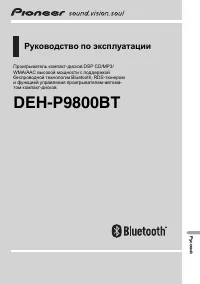 Pioneer DEH-P9800BT Manual
 Pioneer DEH-S100UB Manual
 Pioneer DEH-S3000BT Manual
 Pioneer DEH-S5000BT Manual
 Pioneer DEH-S6220BS User Manual
 Pioneer DEH-X2900UI Manual
 Pioneer DEH-X3500UI Manual