Page 2 - ELECTRO
Page 3 - Table of contents
3 Table of contents General Information ............................................................................................ 4 Information on protection of the environment ............................................................................... 4 Before using the appliance for the fir...
Page 4 - FD; These operating instructions apply to; Disposal of transport packaging; Faults
4 E-no. FD B EFORE USING THE APPLIANCE FOR THE FIRST TIME NOTE: These operating instructions apply to several appliance models It is possible thatindividual features are described which do notapply to your appliance. Before switching on your new appliance, plea-se read the operating instructions car...
Page 5 - Intended use; RISK OF INJURY; Technical safety; Safety instructions; RISK OF POISONING
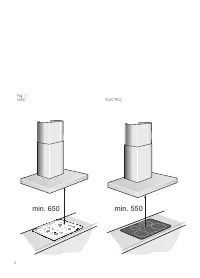
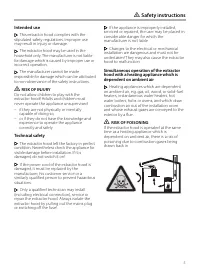
5 Intended use This extractor hood complies with the stipulated safety regulations. Improper usemay result in injury or damage. The extractor hood may be used in the household only. The manufacturer is not liablefor damage which is caused by improper use orincorrect operation. The manufacturer canno...
Page 6 - Special information for gas cookers; RISK OF BURNS
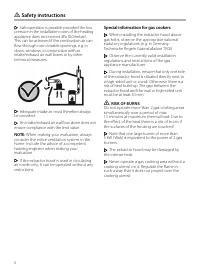
6 Safe operation is possible provided the low pressure in the installation room of the heatingappliance does not exceed 4Pa (0.04mbar).This can be achieved if the combustion air canflow through non-closable openings, e.g. indoors, windows, in conjunction with airintake/exhaust air wall boxes or by o...
Page 7 - Proper use; RISK OF FIRE; Correct installation
7 Proper use Clean the extractor hood thoroughly before using for the first time. Before cleaning and servicing the extractor hood, isolate it from the power supply bypulling out the mains plug or switching off thefuse. Bulbs (especially halogen bulbs) become very hot during operation. Even some tim...
Page 8 - Operating modes; Appliance dimensions Exhaust air; The extractor hood can be used in exhaust; and; an activated carbon filter and
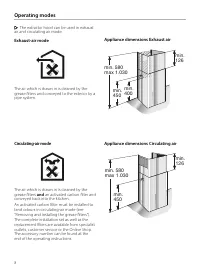
8 Operating modes Appliance dimensions Exhaust air Appliance dimensions Circulating air min. 126 min. 450 min. 400 min. 580 max 1.030 min. 126 min. 450 min. 580 max 1.030 The extractor hood can be used in exhaust air and circulating air mode. Exhaust-air mode The air which is drawn in is cleaned by ...
Page 9 - Operation; Switching off the fan; or; Light
9 Operation NOTE: It is recommended to switch on theblower when you start cooking and not toswitch it off again until several minutes after youhave finished cooking. In this way the kitchenfumes are removed most effectively. Switching on the fan and selecting thefan settings Press button + . If kitc...
Page 10 - Cleaning and care; Appliance surfaces
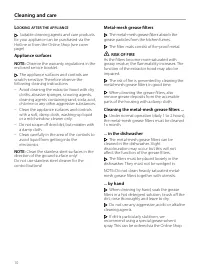
10 Cleaning and care L OOKING AFTER THE APPLIANCE Suitable cleaning agents and care products for your appliance can be purchased via theHotline or from the Online Shop (see coverpage). Appliance surfaces NOTE: Observe the warranty regulations in the enclosed service booklet. The appliance surfaces a...
Page 11 - Removing and installing the grease filters; Changing the activated carbon filter
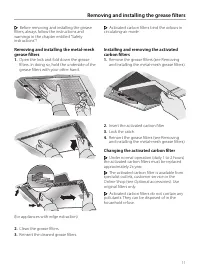
11 Removing and installing the grease filters Activated carbon filters bind the odours in circulating-air mode. Installing and removing the activatedcarbon filters 1. Remove the grease filters (see Removingand installing the metal-mesh grease filters). 2. Insert the activated carbon filter. 3. Lock ...
Page 12 - Changing the bulbs; Changing the halogen bulbs
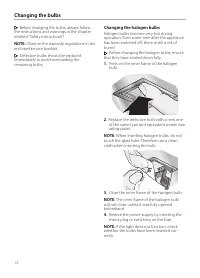
12 Changing the bulbs Changing the halogen bulbs Halogen bulbs become very hot duringoperation. Even some time after the appliancehas been switched off, there is still a risk ofburns! Before changing the halogen bulbs, ensure that they have cooled down fully. 1. Press on the inner frame of the halog...
Page 13 - Connecting pipes; Flat ducts; Connection of 120 mm ø exhaust air pipe; Installation instructions
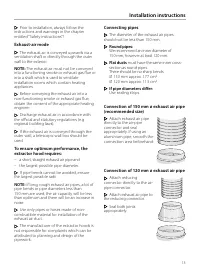
13 Prior to installation, always follow the instructions and warnings in the chapterentitled ”Safety instructions”! Exhaust-air mode The exhaust air is conveyed upwards via a ventilation shaft or directly through the outerwall to the exterior. NOTE: The exhaust air must not be conveyed into a functi...
Page 15 - Installation; The extractor hood; Preparing the wall
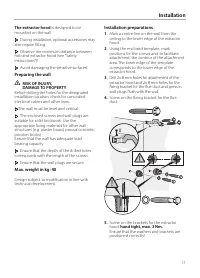
15 Installation The extractor hood is designed to be mounted on the wall. During installation, optional accessories may also require fitting. Observe the minimum distance between hob and extractor hood (see ”Safetyinstructions”)! Avoid damaging the sensitive surfaces! Preparing the wall RISK OF INJU...
Page 16 - Attachment and alignment; Removing the safety caps; Remove the locking caps from the brackets
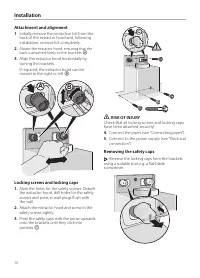
16 Installation Attachment and alignment 1. Initially remove the protective foil from theback of the extractor hood and, followinginstallation, remove foil completely. 2. Mount the extractor hood, ensuring that theback is attached firmly to the brackets Ⓐ . 3. Align the extractor hood horizontally b...
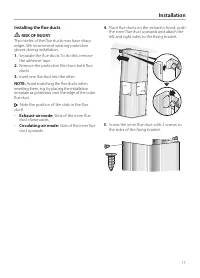
Page 17 - Installing the flue ducts; Insert one flue duct into the other.
17 4. Place flue ducts on the extractor hood, pushthe inner flue duct upwards and attach theleft and right sides to the fixing bracket. 5. Screw the inner flue duct with 2 screws tothe sides of the fixing bracket. Installing the flue ducts RISK OF INJURY The insides of the flue ducts may have sharpe...
Page 18 - Notes
Page 23 - Optional accessory
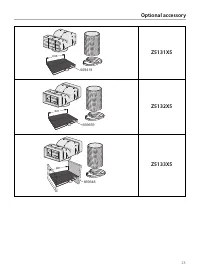
23 Optional accessory Z5131X5 Z5132X5 Z5133X5 669419 236 669659 321 669648 281