Page 2 - Contents; Settings mode
Contents 2 Warning and Safety instructions ............................................................................... 4 Caring for the environment ......................................................................................... 12 Installation .............................................
Page 4 - Warning and Safety instructions; Correct application; It must only be used as a domestic appliance to store deep frozen
Warning and Safety instructions 4 This refrigeration appliance complies with current safetyrequirements. Inappropriate use can, however, lead to personalinjury and material damage. Please read the operating and installation instructions carefullybefore using the refrigeration appliance for the first...
Page 5 - Safety with children
Warning and Safety instructions 5 This refrigeration appliance is not suitable for storing and keeping cool medicines, blood plasma, laboratory preparations or similarsubstances or products that are subject to the Medical DeviceDirective. Incorrect use of the refrigeration appliance for suchpurpos...
Page 6 - Technical safety; The coolant circuit has been checked for leaks. The refrigeration
Warning and Safety instructions 6 Technical safety The coolant circuit has been checked for leaks. The refrigeration appliance complies with statutory safety requirements and theappropriate EU directives. Warning: fire hazard/flammable materials. This symbol is on the compressor and indicates fl...
Page 8 - Proper installation
Warning and Safety instructions 8 Faulty components must only be replaced with genuine Miele original spare parts. Miele can only guarantee the safety standards ofthe appliance when Miele replacement parts are used. Proper installation Change the door hinging (if necessary) as described in the i...
Page 9 - Accessories and spare parts
Warning and Safety instructions 9 Danger of injury. Never handle frozen food or the metal parts of the appliance with wet hands. Your hands may freeze to the frozen foodor to the metal. Danger of injury. Do not take ice cubes out with your bare hands and never place ice cubes or ice lollies in y...
Page 10 - Transport
Warning and Safety instructions 10 Do not place electric heaters or candles in the appliance to defrost it. These can damage the plastic parts. Do not use defrosting sprays or de-icers, as they could contain substances which could damage the plastic parts or which mightcause the build-up of gase...
Page 11 - Splashes of coolant can damage the eyes. Be careful not to; Symbol on the compressor (depending on model); The oil in the compressor can be fatal if swallowed or if it
Warning and Safety instructions 11 Splashes of coolant can damage the eyes. Be careful not to damage any part of the pipework whilst awaiting disposal, e.g. by - puncturing the coolant channels in the condenser,- bending any pipework, or- scratching the surface coating. Symbol on the compressor (d...
Page 12 - Caring for the environment; Disposing of your old appliance
Caring for the environment 12 Disposing of the packagingmaterial The packaging material is used forhandling and protects the appliancefrom transport damage. The packagingmaterial used is selected from materialswhich are environmentally friendly fordisposal and can generally be recycled.Recycling the...
Page 13 - Installation; Installation site; Climate range
Installation *INSTALLATION* 13 Installation site Risk of damage due to high humidity.In environments with high humidity,condensation can build up onexternal refrigeration appliancepanels. This condensate can cause corrosionon external appliance panels.Install the refrigeration appliance in adry an...
Page 14 - Ventilation requirements; not
Installation *INSTALLATION* 14 which it is not designed.A lower room temperature leads to thecompressor switching off for longerperiods. This can cause the internaltemperature in the refrigerationappliance to rise with the risk of fooddeteriorating and going off.The climate range is stated on the da...
Page 15 - Changing the door hinging; Danger of injury and damage to; Fitting supplied wall spacers; Risk of injury and damage due to
Installation *INSTALLATION* 15 Changing the door hinging Danger of injury and damage to the appliance due to heavy door.There is an increased risk of injuryand damage if the door hinging isinstalled by a single person.Always change the door hinging withthe help of a second person. The refrigeratio...
Page 16 - Risk of damage to the appliance; Aligning the refrigeration appliance; Risk of damage and injury caused
Installation *INSTALLATION* 16 Risk of damage to the appliance door caused by impact.The appliance door could hit the wallof the room resulting in damage tothe door.Fit the door opening angle limitersupplied before the refrigerationappliance is installed.Protect the appliance door by fitting afelt...
Page 19 - Appliance dimensions; Installation dimensions/View from above; All dimensions are given in mm.
Installation *INSTALLATION* 19 Appliance dimensions Installation dimensions/View from above FN 4312 ..., FN 4322 ..., FN 4342 ..., FN 4372 ... All dimensions are given in mm. The refrigeration appliance will function correctly if the specified ventilation cross-sections are kept clear. * Dimensions ...
Page 20 - Connections
Installation *INSTALLATION* 20 Connections FN 4312 ..., FN 4322 ..., FN 4342 ..., FN 4372 ... All dimensions are given in mm. a View from the front b Mains connection cable, length = 2100 mm A longer mains connection cable is available to order from the Miele CustomerService Department.
Page 21 - Electrical connection; Risk of fire from overheating.; Connecting the refrigeration appliance
Installation *INSTALLATION* 21 Electrical connection The refrigeration appliance must only beconnected to an earthed socket usingthe mains connection cable supplied.The socket must be easily accessibleafter the refrigeration appliance hasbeen installed. If the socket is not easilyaccessible, ensure ...
Page 22 - Saving energy
Saving energy 22 How to save energy: Installation site The refrigeration appliance has to cool more often at higherambient temperatures and consumes more energy in theprocess. Therefore, you should: - Install the refrigeration appliance in a well-ventilated room. - Do not install the refrigeration a...
Page 23 - Guide to the appliance; Appliance overview
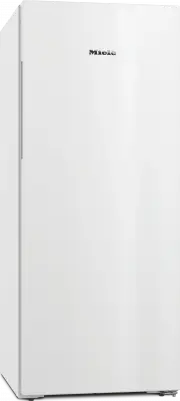
Guide to the appliance 23 Appliance overview This drawing is for illustration purposes only. a Display b Tiltable freezer drawer (depending on model) c Freezer drawers d Freezer drawer XXLBox e NoFrost module f Ventilation gap
Page 24 - Control panel with start display; OK
Guide to the appliance 24 Control panel with start display -18 °C OK < > 1 2 3 4 a Temperature display for freezer section b Sensor controls for selecting a setting c OK sensor control for confirming a selection and entering Settings mode d Display for Miele@home connection status (only ...
Page 25 - Switch the keypad tone on or off
Guide to the appliance 25 / Switch the keypad tone on or off On / Change the volume of the alarms and buzzers or switchthem off entirely (see “Selecting further settings”) On/level 5 Change the display brightness (see “Selecting further settings”) Level 4 °C / °F Change the temperature...
Page 26 - Selecting the desired function in Settings mode
Guide to the appliance 26 Selecting the desired function in Settings mode Touch the OK sensor control on the control panel. will appear in the display. Use the or sensor control to scroll to the symbol. Touch OK . Select the function you want using the or sensor control....
Page 27 - Adjusting the interior fittings
Guide to the appliance 27 Adjusting the interior fittings Tilting the top drawer (from an appliance height of 1650 mm)The drawer can be tilted to make iteasier to remove frozen food. Pull the drawer out. The drawer is secured with pull-outstops and cannot fall out. XXL box freezer drawer The extra...
Page 28 - Switching on and off; Before using for the first time
Switching on and off 28 Before using for the first time Remove all packaging material andprotective film. Clean the inside of the appliance andthe accessories (see “Cleaning andcare”). Connecting the refrigeration appliance Connect the refrigeration appliance tothe electricity supply as descri...
Page 29 - The correct temperature; Temperature display; maximum; Setting the temperature; Possible temperature settings
The correct temperature 29 It is very important to set the correcttemperature to ensure the shelf life offood. Reducing the temperature reducesthe growth rate of microorganisms.Food does not spoil as quickly.To freeze fresh food, a temperature of -18 °C is required. This will prolong the shelf life ...
Page 30 - Using Super freeze; SuperFreeze
Using Super freeze 30 SuperFreeze When switched on, the SuperFreezefunction can be used to rapidly reduce the temperature in the freezer section to its lowest setting (depending on the ambienttemperature). The refrigerationappliance will work at full power andlower the temperature. Select this...
Page 31 - Selecting further settings; Party mode
Selecting further settings 31 Explanation of the differentsettings Only the settings that require furtherexplanation are described below. The door alarm and other warnings areautomatically suppressed when youare in Settings mode . Party mode The Party mode function is recommended if you wis...
Page 33 - Adjusting the display brightness
Selecting further settings 33 Use the and sensor controls to set the time you want between30 seconds and 3 minutes:30 seconds. Touch OK . Adjusting the volume of alarms andbuzzers / You can adjust the volume of alarms andbuzzers (e.g. in the event of a door alarmor fault message). Yo...
Page 34 - Information; Keep this appliance data to hand:
Selecting further settings 34 Information Appliance data (model identifier andserial number) is shown on the display. Keep this appliance data to hand: - For integrating the refrigeration appliance into your WiFi network (see“Selecting further settings –Miele@home”) (depending on themodel). - Whe...
Page 35 - Temperature and door alarm; Temperature alarm
Temperature and door alarm 35 Health risk caused by decomposing food.If the temperature in the freezerremains above -18 °C for a long time,the frozen food can start to defrost.This will reduce the storage life of thefood.Check whether the frozen food hasstarted to defrost. If it has, check thatthe...
Page 36 - Door alarm; will appear in; Switching the door alarm off early; Touch
Temperature and door alarm 36 Door alarm The refrigeration appliance is fittedwith a door alarm to avoid increasedenergy consumption and foodbecoming warm if the door is leftopen. If the appliance door is left open for alonger period of time, will appear in the temperature display. An alarm wil...
Page 37 - Freezing and storing food; Freezing fresh food; Maximum freezing capacity; Storing frozen food; Before placing food in the freezer
Freezing and storing food 37 Freezing fresh food Health risk caused by decomposing food.If the temperature in the freezerremains above -18 °C for a long time,the frozen food can start to defrost.This will reduce the storage life of thefood.Check whether the frozen food hasstarted to defrost. If it...
Page 38 - Placing food in the freezer; Risk of damage caused by; – Freezing small amounts of food; Freeze food in the top freezer drawer.; apart from; the lowest freezer drawer.
Freezing and storing food 38 Expel as much air as possible fromthe packaging and close it tightly. Make a note of the contents and thedate of freezing on the packaging. Placing food in the freezer Risk of damage caused by loading too much food.Loading food which is too heavy cancause damage to...
Page 39 - Storage time for frozen food; Food group; Ice cream; Cooling drinks quickly; not left in; Using accessories; Making ice cubes; Ice cubes can be removed easily
Freezing and storing food 39 Storage time for frozen food Food group Storage time(Months) Ice cream 2 to 6 Bread, baked goods 2 to 6 Cheese 2 to 4 Fish, oily 1 to 2 Fish, lean 1 to 5 Sausage, ham 1 to 3 Game, pork 1 to 12 Poultry, beef 2 to 10 Vegetables, fruit 6 to 18 Herbs 6 to 10 The storage time...
Page 40 - Defrosting
Defrosting 40 The appliance is equipped with aNoFrost system. The refrigerationappliance defrosts automatically.The moisture generated in the appliancecollects on the condenser and isautomatically defrosted and dissipatedfrom time to time.This automatic defrosting systemenables the refrigeration app...
Page 41 - Cleaning and care; Cleaning agents; do not use the following:
Cleaning and care 41 The data plate located inside theinterior cabinet of the refrigerationappliance must not be removed. Itcontains information which is requiredin the event of a fault. Do not let water get into theelectronic module. Risk of damage due to moisture ingress.The steam from a steam c...
Page 42 - by hand; The following components are; Removing the drawers; Pull the drawer out as far as it will go.; Replacing the drawers; Push in and lower the drawer.; Cleaning the door seal; Risk of damage as a result of
Cleaning and care 42 Cleaning accessories by handor in the dishwasher The following components must becleaned by hand only: - All drawers The following components are dishwasher-safe : Risk of damage due to high dishwasher temperatures.Parts of the refrigeration appliancemay become unusable, e.g. ...
Page 43 - Cleaning the ventilation gaps; Switch the SuperFreeze function
Cleaning and care 43 The door seal should be cleanedregularly with clean water, and thenwiped dry with a soft cloth. Cleaning the ventilation gaps A build-up of dust will increase theenergy consumption of the appliance. The ventilation gaps should becleaned on a regular basis with abrush or vacu...
Page 44 - Problem solving guide; Problem
Problem solving guide 44 Many malfunctions and faults that can occur in daily operation can be easilyremedied. You can save time and money in many cases, as you do not need to callthe Miele Customer Service Department.Information to help you rectify faults yourself can be found at www.miele.com/serv...
Page 46 - Other problems
Problem solving guide 46 Problem Cause and remedy Ice or condensation hasbuilt up inside the refri-geration appliance. Theappliance door may notclose correctly. The door seal has come out of its groove. Check that the door seal is correctly positioned inthe groove. The door seal is damaged. Chec...
Page 47 - Display warnings; Message; is lit up on the display
Problem solving guide 47 Display warnings Message Cause and remedy lights up in thedisplay. The refri-geration appli-ance does not getcold, although theappliance con-trols are working. Demo mode has been activated. Touch OK . Miele will appear initially in the display, followed by the start scre...
Page 49 - Tap
Problem solving guide 49 Message Cause and remedy lights up red in the display and an alarmalso sounds. Indication of an interruption to the power supply: thetemperature in the refrigeration appliance over the lastfew days or hours has risen too high because of apower cut or interruption to the...
Page 51 - Noises
Noises 51 The refrigeration appliance is producing various noises during operation. If the cooling performance is low, the refrigeration appliance will conserve energybut operate for longer. The volume will be lower. Food will be chilled faster if the cooling performance is high. The volume will be ...
Page 53 - Service; Contact in the event of a fault; Warranty
Service 53 Information to help you rectify faultsyourself and about Miele spare partscan be found at www.miele.com/service. Contact in the event of a fault In the event of a fault which you cannotremedy yourself, please contact yourMiele dealer or Miele Customer Service. You can book a Miele Custome...
Page 55 - United Kingdom
United Kingdom Miele Co. Ltd., Fairacres, Marcham Road, Abingdon, Oxon, OX14 1TWTel: 0330 160 6600, Internet: www.miele.co.uk, E-mail: [email protected] Australia Miele Australia Pty. Ltd.ACN 005 635 398ABN 96 005 635 398Level 4, 141 Camberwell RoadHawthorn East, VIC 3123Tel: 1300 464 353E-mail: [em...


 Miele WWD380 WCS PWash&Steam&9kg User Manual
 Miele W 1614 Manual
 Miele G 5266 SCVi SFP Active Plus User Manual
 Miele Classic C1 Turbo Team PowerLine - SBAN0 User Manual
![Miele PDR 307 [EL]](https://manualsarea.com/img/product/thumbs/48/ba/fd/bafde84806e8abc8b420f34eaf8fcd6e.webp) Miele PDR 307 [EL] User Manual
Miele PDR 307 [EL] User Manual Miele F 1911 Vi Manual
![Miele PDR 908 [EL MAR 3N AC 400V 50-60Hz]](https://manualsarea.com/img/product/thumbs/48/05/b7/05b705998b251f92b271e908423e1ecb.webp) Miele PDR 908 [EL MAR 3N AC 400V 50-60Hz] Installation Manual
Miele PDR 908 [EL MAR 3N AC 400V 50-60Hz] Installation Manual Miele K 9757 iD Manual
 Miele F 2672 Vi User Manual
 Miele F 2812 Vi User Manual
 Miele F 2813 Vi User Manual
 Miele F 2912 Vi User Manual
 Miele F 4001 D User Manual
 Miele F 12020 S Manual
 Miele FN 12420 S Manual
 Miele FN 12827 S Manual
 Miele FN 14827 S ed Manual
 Miele FNS 4382 D User Manual
 Miele FNS 7140 C User Manual
 Miele FNS 7710 E User Manual