Page 3 - Contents; SAVE THESE INSTRUCTIONS; Water supply
1 Contents Important! SAVE THESE INSTRUCTIONS The models shown in this User Guide may not be available in all markets and are subject to change at any time. For current details about model and specification availability in your country, please visit our local website listed on the back cover or cont...
Page 4 - Introduction; Welcome to; WashSmart
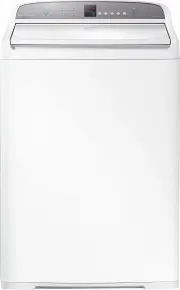
2 Introduction Welcome to WashSmart ™ Thank you for buying a Fisher & Paykel WashSmart™ clothes washer. We are proud of this washer and trust it will serve you well for many years. At Fisher & Paykel we aim to provide innovative products that are simple to use, ergonomic and kind to the envi...
Page 5 - Installation instructions; Unpacking; Removing the packaging; Location
3 Installation instructions Unpacking To ensure the best performance from your new washer please follow the instructions below. Removing the packaging 1 Remove the outer packaging. 2 Tilt the machine backwards and walk it off the bottom packer one foot at a time (ensure lid is still taped down). 3 R...
Page 6 - Hot ‘N’ Safe Valves available are:; Inlet hose replacement; Draining
4 Installation instructions Hot ‘N’ Safe Valves available are: RMC TVA 50HFRMC TVA 75HFS Adjustable between 35°C – 55°C RMC TVA 50HP For instantaneous gas hot water supply Water supply Your cold water should not exceed 35°C and your hot water should not exceed 65°C. Temperatures above these may caus...
Page 7 - Levelling instructions
5 Installation instructions Levelling instructions It is IMPORTANT to level the machine to ensure good spin performance and effective detergent and fabric softener dispensing. A spirit level is provided with your machine. Use this to level your machine, always placing it on a clean, flat surface. Th...
Page 8 - Completing your installation; Installation test cycle; Clothes washer safety; Electrical Shock Hazard; Accessories and spare parts
6 Completing your installation Turn on the water and check all hose connections for leaks. Make sure there are no kinks in the hoses. Check the hose connections for leaks again after 24 hours. Uncoil power cord, remove and discard the plastic pin cover, and plug into wall socket. Installation test c...
Page 9 - Before you do your first wash
7 Before you do your first wash You owe it to yourself and your washer to have your machine installed correctly. Before you start, it is a good idea to go through the following checklist: 1 Has the basepacker been removed? Refer to page 3. 2 Is the drain hose threaded through the ‘U bend‘ (with no m...
Page 10 - Getting started quickly; Fabric softener
8 Getting started quickly Fabric softener If you wish to use fabric softener, place it in the fabric softener dispenser cup on the top of the agitator (refer to page 15). Important! Fabric softener must not be used if you have selected the QUICK cycle or the ECO option (refer to page 19). Place the ...
Page 11 - If you wish to stop your; WashSmartTM; washer
9 Getting started quickly If you wish to stop your WashSmart™ washer Press START / PAUSE. During a spray rinse or spin, there will be a slight delay while the bowl slows to a stop and the lid is unlocked. Important! Failure to follow the advice in this guide may result in damage to your garments, an...
Page 12 - Easy touch buttons; Keylock mode
10 WashSmart ™ controls Easy touch buttons The smooth easy clean buttons require only a gentle touch to activate. Digital display screen The digital display screen provides feedback on how long the wash cycle has to go, to keep you informed throughout the cycle. The screen also displays your DELAY S...
Page 13 - Lid lock; To unlock the lid at any time press START / PAUSE.; Auto drain
11 WashSmart ™ safety features Lid lock The lid of your WashSmart™ washer is locked during the wash cycle, ensuring safety for you and your family while it is operating. The “Lid locked” light (above the START / PAUSE button) is illuminated when the lid lock is activated, letting you know at a glanc...
Page 15 - Sorting and loading; Sorting; Lint givers
13 Sorting and loading Sorting To get the best wash results it pays to sort your clothes before washing. Care labels The care label will tell you about the fabric of the garment and how it should be washed. Soil Sort clothes according to the type and amount of soil. Some soils suit warmer washes, eg...
Page 16 - Detergent; Choosing the right detergent; Liquid or powdered detergents
14 Detergent Choosing the right detergent We recommend using domestic laundry detergent. Use powder or liquid detergent for “Top Loader” machines. When washing wool items, remember to use a detergent specifically recommended for woollens. Soap flakes or granulated soap powders should not be used in ...
Page 17 - How the fabric softener is dispensed
15 Fabric softener How the fabric softener is dispensed The fabric softener goes into the dispenser cup on the top of the agitator. During the rinse the machine spins to release the fabric softener, delivering it down the agitator stem as the machine fills for the final deep rinse. If fabric softene...
Page 18 - Wash cycles; Wash cycles – default settings; Basic cycle descriptions
16 Wash cycles Wash cycles – default settings REGULAR HEAVY HANDWASH EASY IRON ALLERGY QUICK Wash time* 13 – 15 min 15 – 17 min 5 min 9 min 13 – 15 min 3 min Wash action REGULAR HEAVY HANDWASH REGULAR REGULAR REGULAR Wash temp WARM / COLD WARM WARM / COLD WARM / COLD HOT WARM / COLD Rinse Sprays / D...
Page 19 - Wash options; Water level; Auto water level
17 Wash options Water level Auto water level Your washer has the ability to automatically select the most efficient water level for the load. 1 Place your clothes in the machine. 2 Select the wash cycle (and select AUTO water level if not automatically selected). 3 Touch START / PAUSE. The machine w...
Page 20 - Wash temp; COLD; Spin speed
18 Wash options Wash temp WashSmart ™ offers 5 wash temperatures, and an additional setting, CONTROLLED COLD. COLD CONTROLLED COLD WARM / COLD WARM WARM / HOT HOT Incoming from tap 20°C 35°C 40°C 50°C Incoming from tap Note: these temperatures are approximate. Touch the WASH TEMP button to increase ...
Page 21 - Options; Eco; Clothes care safeguards
19 Wash options Options Eco Use the ECO option to save water. The ECO option uses a spray rinse which has been specially designed to use at least 25% less water than a traditional rinse. Use this option when you want to use less detergent and less water. However, if you have low water pressure or se...
Page 22 - Washing bulky items
20 Wash options Washing bulky items Forcing large items into the machine may result in them being damaged during washing. Make sure there is enough room in the machine for items to move when being washed. Some items float up during the wash (eg duvets / doonas, water-proof and water-resistant items ...
Page 23 - Customising wash cycles; To customise a cycle
21 Customising wash cycles To customise a cycle You can program your WashSmart ™ washer to remember the wash options you prefer for each wash cycle. For instance, you may want to set the REGULAR cycle to default to a WARM wash or set HEAVY cycle to include a SOAK. 1 Touch POWER. 2 Touch and hold the...
Page 24 - Changing pre-set options; Option Adjustment mode; The diagram on page 23 shows how the wash cycle
22 Changing pre-set options Option Adjustment mode After using your washer a number of times you may want to fine tune some of the options to suit your wash needs. There are a number of pre-set options, which can be altered: 1 The wash temperatures, including changing the COLD wash temperature to CO...
Page 25 - Adjusting your options
23 Changing pre-set options Adjusting your options 1 Enter Option Adjustment mode (refer to page 22). 2 The diagram below shows how the wash cycle buttons relate to the options you can change. It also shows what will be displayed when you first enter Option Adjustment mode. Options you can change ar...
Page 26 - Wash temperatures; Controlled Cold
24 Changing pre-set options Wash temperatures All wash temperatures can be individually adjusted if you think they are too hot or too cold. Note: the hot temperature will be the same as the hot water supply temperature. 1 Enter Option Adjustment mode (refer to page 22). 2 Select the REGULAR cycle. 3...
Page 27 - Out of balance recovery routine; Automatic recovery OFF (the default setting); End of cycle beeps
25 Changing pre-set options Out of balance recovery routine When your washer is spinning it can sense if the wash load is out of balance. If an out of balance load is detected, the machine will stop and re-try spinning one more time. If it still senses an unbalanced load there are two options the ma...
Page 28 - Factory reset
26 Changing pre-set options Factory reset You can reset your washer to the settings it left the factory with: 1 Enter Option Adjustment mode (refer to page 22). 2 Select the ALLERGY cycle. 3 The display will show “rSt”. Touch and hold START / PAUSE for 3 seconds to reset your washer to its factory s...
Page 29 - Machine information; Specifications; Model
27 Machine information Specifications Model Capacity Depth Width Height* Height (lid open) WA1068G 10.0 kg 700 mm 685 mm 1020 – 1050 mm 1410 – 1440 mm * Height is measured to the highest point on the console. Note: The exact height of your washer is dependent on how far the feet are extended from th...
Page 30 - Caring for your washer; When you have finished using your washer; Cold water washing
28 Caring for your washer When you have finished using your washer Turn off the taps to prevent the chance of flooding should a hose burst. Turn off the power at the wall. Cold water washing If you always wash with cold water, we recommend that a WARM or HOT wash be used at regular intervals, eg eve...
Page 31 - Products that might damage your washer; Washer sounds and beeps; Automatic lint system
29 Caring for your washer Products that might damage your washer Concentrated bleaches, nappy sanitisers and hydrocarbon solvents (eg petrol and paint thinners) can cause damage to the paintwork and components of your washer. Be careful when washing garments stained with solvents as they are flammab...
Page 32 - Saving water; Water saving tips
30 Saving water Water saving tips Bigger loads are more efficient than small loads. Use the ECO option (refer to page 19). Recycling the wash water Your washer also offers several ways of reusing the wash and rinse water. 1 Select SOAK on the first wash cycle. 2 Remove the clothes at the end of the ...
Page 33 - Before you call for service; “no hot” (I am not getting any hot water)
31 Before you call for service Please read the following pages before you call for service. Your washer is capable of diagnosing its own problems. If your washer gives a musical series of beeps every 5 seconds it is telling you that it has a problem which you can solve using the checklist below. You...
Page 34 - “Sud LoC” (suds lock – I have too many suds)
32 Before you call for service “Sud LoC” (suds lock – I have too many suds) The machine has a suds build-up (too much detergent may have been used for the amount of soil in the load). Wait for suds to dissolve (about 20 min). Rinse clothes using a deep rinse.Check the standpipe height does not excee...
Page 35 - Solving operating problems
33 Solving operating problems Pressing POWER does not turn the machine on Is the power switched on at the wall?Switch the power off at the wall and wait 60 seconds before turning the power on again.Could your household power supply be at fault? Try plugging in another electrical appliance. Pressing ...
Page 36 - Solving wash problems; Creasing
34 Solving wash problems Listed below are possible causes and solutions to some common wash problems. Creasing Overloading the washer or dryer.Choose the EASY IRON or HANDWASH cycle, as these cycles have been designed to minimise creasing. Try selecting a slower spin speed.Do not leave wet clothes t...
Page 37 - Dye transfer
35 Solving wash problems Dye transfer Wash and dry non-colourfast clothes separately.Non-colourfast clothes left sitting in a washer or laundry basket can transfer dye onto other clothes. Tangling Washing with too much water (ie underloading) can cause the clothes to tangle around one another.Do not...
Page 38 - Manufacturer’s Warranty; Note; These warranties DO NOT cover
36 Manufacturer’s Warranty You automatically receive a 2 year Manufacturer’s Warranty with the purchase of this Product covering parts and labour for servicing within the country of purchase. Fisher & Paykel undertakes to: Repair or, at its option, replace without cost to the owner either for ma...
Page 39 - For Australian Customers
37 Manufacturer’s Warranty E Normal recommended maintenance as set out in the product’s user guide. F Repairs when the appliance has been dismantled, repaired or serviced by other than a Fisher & Paykel authorised repairer or the selling dealer. G Pick-up and delivery. H Transportation or travel...
Page 40 - Customer Care; Before you call for service or assistance...; Product details
38 Customer Care Before you call for service or assistance… Check the things you can do yourself.Refer to your User Guide and check: 1 Your appliance is correctly installed. 2 You are familiar with its normal operation. 3 You have read the problem solving at the back of the book. If after checking t...


 Fisher & Paykel WL1068P1 User Manual
 Fisher & Paykel WL1264P1 User Manual
 Fisher & Paykel MW513 User Manual
 Fisher & Paykel WA70T60GW1 User Manual
 Fisher & Paykel WA80T65GW1 User Manual
 Fisher & Paykel WA1068G2 User Manual
 Fisher & Paykel WA7060G2 User Manual
 Fisher & Paykel WA8560G1 User Manual
 Fisher & Paykel WA8560P1 User Manual
 Fisher & Paykel WD8560F1 User Manual
 Fisher & Paykel WH1060P4 User Manual
 Fisher & Paykel WH7560J3 User Manual
 Fisher & Paykel WH7560P2 User Manual
 Fisher & Paykel WH8060J3 User Manual
 Fisher & Paykel WH8560P2 User Manual
 Fisher & Paykel WH8560P3 User Manual
 Fisher & Paykel WH9060J3 User Manual
 Fisher & Paykel WH9060P3 User Manual