DeLonghi DEM 8.5 - User Manual

DeLonghi DEM 8.5 – User Manual, read for free online in PDF format. We hope this helps you resolve any issues you may have. If you have further questions, please contact us through the contact form.


Table of Contents:
- Page 2 – D e s c r i p t i o n / A c c e s s o r i e s
- Page 3 – ENGLISH; mportant safeguards; ssistance; W a r n i n g s
- Page 4 – I n s t a l l a t i o n; YES
- Page 5 – H o w t o d e h u m i d i f y; ow to dehumidify
- Page 6 – ank control system light; ON; I n d i c a t o r l i g h t s
- Page 7 – i m p o r t a n t s a f e g u a r d s; aintenance; f the appliance is not used for long periods
- Page 8 – T r o u b l e s h o o t i n g
- Page 9 – Te c h n i c a l s p e c i f i c a t i o n s
11
ENGLISH
A
ir always contains a certain amount of water in the form of vapour. This is commonly
known as humidity. This determines the level of humidity in an atmosphere.
The capacity of the air to hold water vapour increases with temperature.
This is why in our homes, as soon as the temperature decreases, the vapour contained in the
air condenses, as is evident on the colder sur faces in the room, such as the windows, walls
etc.
The purpose of a dehumidifier is to remove the excess moisture from the air, avoiding the
damage caused by condensation. Experts have established that the optimum environmental
conditions for our well being and for the home are obtained between 40% and 60% relative
humidity. Below these levels tha air can feel too dry an may cause skin complaints and even
static electric shocks
With temperatures lower than 5°C, you are recommended to heat the room even minimally.
With heating, the condensation formed by the water vapour on windows and other cold sur-
faces evaporates into the air to be collected by the dehumidifier.
Air leaving the dehumidifier is usually about 1°C warmer than room temperature.
B r i e f n o t e s o n h u m i d i t y
IMPORTANT INFORMATION FOR CORRECT DISPOSAL OF THE PRODUCT IN ACCORDANCE WITH
EC DIRECTIVE 2002/96/EC.
At the end of its working life, the product must not be disposed of as urban waste.
It must be taken to a special local authority differentiated waste collection centre or to a dea-
ler providing this service.
Disposing of a household appliance separately avoids possible negative consequences for
the environment and health deriving from inappropriate disposal and enables the consti-
tuent materials to be recovered to obtain significant savings in energy and resources.As a
reminder of the need to dispose of household appliances separately, the product is marked
with a crossed-out wheeled dustbin.
"Loading the manual" means you need to wait until the file loads and becomes available for online reading. Some manuals are very large, and the time they take to appear depends on your internet speed.
Was this manual helpful?
Helpful for 3 of 3 readers
About this manual
- Brand
- DeLonghi
- Model
- DEM 8.5
- Document type
- User Manual
- Language(s)
- English
- Pages
- 9
- File size
- 80.4 KB
- Format
Summary
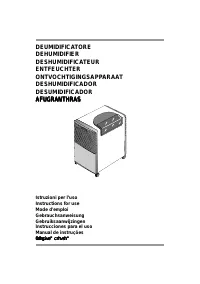
12 D e s c r i p t i o n / A c c e s s o r i e s 1. Lifting handle 2. Dust filter (internal) 3. Air intake grille 4. Condensate collection tank 5. Power cable 6. Control panel 7. Air outlet grille 8. Continuous drain cap Accessories Description condensate drain hose rubber bung 2 1 4 3 6 5 7 8
13 ENGLISH I mportant safeguards • Use this appliance only as described in this instruction manual. As with all electrical equipment, whilst the instructions aim to cover as many eventualities as possible, Caution and common sense should be applied when operating and installing this appliance. • Thi...
14 P osition the appliance in the room to be dehumidified: A free space of at least 50 cm must be left at the front and back of the dehumidifier, so as notto block the air intake or outlet. Do not place the dehumidifier next to a radiator or other heat source as this will reduce itsper formance.For ...
Ask a question
Related manuals
Popular DeLonghi Other


More DeLonghi Other models
 DeLonghi DEC 21 User Manual
 DeLonghi Dedica EC680 User Manual
 DeLonghi DEFSGG 36 Manual
 DeLonghi DEGLSC 24 SS Manual
 DeLonghi Dehumidifier User Manual
 DeLonghi DEM10 User Manual
 DeLonghi DFG440 Series Manual
 DeLonghi Dishwasher User Manual
 DeLonghi Dishwasher DEDW645S User Manual
 DeLonghi DL 48 P6G Manual
- DeLonghi DL48P6G-E Manual
 DeLonghi DMFPSII Manual