Page 5 - Safety information
Safety information Connect the power cord to a properly grounded electrical outlet that is near the product and easily accessible. Do not place or use this product near water or wet locations. Use only the power supply and power cord provided with this product or the manufacturer's authorizedreplace...
Page 6 - Thank you for choosing this printer!; Minimizing your printer's environmental impact; Conserving energy; Conserving paper
About your printer Thank you for choosing this printer! We've worked hard to make sure it will meet your needs. To start using your new printer right away, use the setup materials that came with the printer, and then skim the User’s Guide to learn how to perform basic tasks. To get the most out of y...
Page 7 - Conserving ink; Recycling; Finding information about the printer; Publications
Conserving ink • Use Quick Print or Draft Mode. These modes can be used to print documents using less ink than normal and are ideal for printing documents that are mostly text. • Use High Yield cartridges. Inks in High-Yield cartridges allow you to print more pages with fewer cartridges. • Clean the...
Page 9 - Understanding the parts of the printer
Understanding the parts of the printer 1 2 3 4 5 6 7 8 9 10 11 12 Use the To 1 Scanner lid Access the scanner glass. 2 Scanner glass Scan, copy, or fax photos and documents. 3 Automatic Document Feeder (ADF) Scan, copy, or fax multiple-page letter-, legal-, and A4-size documents. 4 ADF tray Load ori...
Page 11 - Ordering and replacing supplies; Ordering ink cartridges; Replacing ink cartridges
Ordering and replacing supplies Ordering ink cartridges Page yields available at www.dell.com/supplies . For best results, use only Dell ink cartridges. Item Licensed cartridge 1 Regular cartridge Black cartridge Series 21 Series 21R Black cartridge, high yield 2 Series 24 Series 24R Color cartridge...
Page 12 - Recycling Dell products
3 Press the release tab, and then remove the used ink cartridge or cartridges. 1 2 4 Use two hands to install each cartridge. 1 2 Note: Install the new ink cartridges immediately after removing the protective cap to avoid exposing the ink to air. 5 Close the printer. Recycling Dell products To retur...
Page 13 - Using the printer control panel
Using the printer control panel buttons and menus Using the printer control panel The following diagrams explain the sections of the printer control panel: 1 2 3 4 5 6 7 8 9 10 Use To 1 Power • Turn the printer on and off. • Switch to Power Saver mode. Note: When the printer is on, press to switch t...
Page 15 - Changing the Power Saver timeout; Saving paper and energy with Eco-Mode
Use To 6 2-Sided/Eco Mode Activate 2-Sided to: • Print on both sides of the paper (duplex). Activate Eco-Mode to: • Print on both sides of the paper (duplex). • Change to Power Saver mode after the printer is left idle for ten minutes. • Set screen brightness to low. 7 Cancel • Cancel a print, copy,...
Page 16 - To change the temporary settings into new default settings
To enable Eco-Mode, press the 2-Sided/Eco-Mode button until the light near “Eco-Mode” comes on. Changing temporary settings into new default settings The following menus revert to default settings after two minutes of inactivity or after the printer is turned off: Copy menu • Copies • Quality • Resi...
Page 17 - To disable the settings timeout feature; Resetting to factory settings; Using the printer control panel menus
To disable the settings timeout feature You can disable the settings timeout feature if you do not want the printer to revert to the default settings after twominutes of inactivity or after the printer is turned off. 1 From the printer control panel, press . 2 Press the up or down arrow button to sc...
Page 18 - Using the printer software; Minimum system requirements; Supported operating systems; Using the Windows printer software; Software installed during printer installation; Printer software
Using the printer software Minimum system requirements The printer software requires up to 500 MB of free disk space. Supported operating systems • Microsoft Windows 7 (Web only) 1 • Microsoft Windows Vista (SP1) • Microsoft Windows XP (SP3) • Microsoft Windows 2000 (SP4 or greater) • Linux Ubuntu 8...
Page 20 - Updating the printer software (Windows only); Checking for software updates; Reinstalling the printer software; Uninstalling the printer software; Using the World Wide Web
Updating the printer software (Windows only) Checking for software updates 1 Click or Start . 2 Click All Programs or Programs , and then select the printer program folder from the list. 3 Select Printer Home . 4 Choose your printer from the printer drop-down list. 5 From the Support tab, select Che...
Page 21 - Loading paper and original documents; Loading the paper tray
Loading paper and original documents Loading the paper tray Make sure: • You use paper designed for inkjet printers. • The paper is not used or damaged. • If you are using specialty paper, you follow the instructions that came with it. Note: To avoid jams, make sure the paper does not buckle when yo...
Page 24 - Loading envelopes or photo paper
Loading envelopes or photo paper 1 Pull tray completely out of the printer. 2 Move the paper guides to the sides of tray. Loading paper and original documents 24
Page 27 - Loading various paper types
Loading various paper types Load up to Make sure 150 sheets of plain paper • The paper is designed for use with inkjet printers. • The paper guides rest against the left, right, and bottom edges of thepaper. 100 sheets of coated paper 25 sheets of photo paper 25 sheets of glossy paper • The glossy o...
Page 29 - Saving paper default settings
Load up to Make sure 20 sheets of banner paper • The print side of the banner faces down. • The leading edge of the banner paper feeds into the printer first. • If your printer has more than one paper tray, then load banner paper inTray 1. To load banner paper: 1 Pull the tray completely out of the ...
Page 30 - Loading original documents on the scanner glass; Loading original documents into the ADF
c Press the up or down arrow button to select the default photo print size for the printer, and then press . Loading original documents on the scanner glass 1 Open the scanner lid and place the document facedown on the scanner glass. 2 Close the scanner lid. Loading original documents into the ADF Y...
Page 31 - Printing; Tips for printing; Printing a document
Printing Tips for printing • Use the appropriate paper for your print job. • Select a higher print quality for better prints. • Make sure there is enough ink in the ink cartridges. • Remove each sheet as it is printed when printing photos or when working with specialty media. • Select the borderless...
Page 33 - If the printer is using a USB connection; Printing specialty documents; Printing envelopes
1 Insert a memory card or flash drive. When the printer detects the memory device, Memory Card Detected or Storage Device Detected appears on the display. 2 If only document files are stored on the memory device, then the printer automatically switches to File Print mode. If document files and image...
Page 34 - Printing labels; Tips on loading label sheets; Printing on custom-size paper
Notes: • Most envelopes use landscape orientation. • Make sure the same orientation is also selected in the software application. Printing labels 1 Load the label sheets in the printer. 2 Send the print job: a With a document open, click File Print . b Click Properties , Preferences , Options , or...
Page 35 - Working with photos; Using a memory card or flash drive with the printer
Working with photos Using a memory card or flash drive with the printer Memory cards and flash drives are storage devices frequently used with cameras and computers. You can removethe memory card from the camera or the flash drive from the computer and insert it directly into the printer. 1 Insert a...
Page 36 - Supported memory cards and file types; Printing photos using the printer control panel
Notes: • If the printer does not recognize the memory device, then remove and reinsert it. • If a flash drive or a digital camera set to mass storage mode is inserted into the USB port while a memory card isin the card slot, then a message appears on the display prompting you to choose which memory ...
Page 37 - Editing photos using the printer control panel
8 Press the Color/Black button to set a color or black-and-white print. When you select color or black-only printing, the light near your choice comes on. 9 Press . Note: For best results, allow the prints to dry at least 24 hours before stacking, displaying, or storing. Editing photos using the pri...
Page 38 - Printing photos from a memory device using the printer software; Printing photos from a PictBridge-enabled digital camera
Printing photos from a memory device using the printer software 1 Load photo paper. 2 From the printer control panel, press . 3 Insert a memory card or flash drive. 4 Transfer or print the photos: If the printer is using a USB connection • Fast Pics launches automatically when you insert the memory ...
Page 39 - Printing photos from a memory device using the proof sheet
Notes: • Make sure that the digital camera is set to the correct USB mode. If the camera USB selection is incorrect,then the camera is detected as a flash drive, or an error message is displayed on the printer control panel.For more information, see the camera documentation. • The printer reads only...
Page 40 - Printing photos from a digital camera using DPOF
7 Follow the instructions on the proof sheet to select which photos to print, the number of copies per photo, red-eyereduction, page layout, print options, and paper size. Note: When making selections, make sure to fill in the circles completely. 8 Load the proof sheet facedown on the scanner glass....
Page 41 - Printing from a Bluetooth-enabled device; Setting up a connection between your printer and a
Printing from a Bluetooth-enabled device • This printer is compliant with Bluetooth Specification 2.0. It supports the following profiles: Object Push Profile(OPP) and Serial Port Profile (SPP). Check with your Bluetooth-enabled device manufacturers (cellular phone orPDA) to determine their hardware...
Page 42 - Setting the Bluetooth security level
5 Make sure Discovery is set to On. If necessary, press the up or down arrow button to scroll to On , and then press . The printer is now ready to accept a connection from a Bluetooth-enabled device. 6 Configure the Bluetooth-enabled device to set up a connection to the printer. For more information...
Page 43 - Printing on both sides of the paper (duplexing); Printing on both sides of the paper (duplexing) automatically
1 Insert a USB Bluetooth adapter into the USB port. Bluetooth Dongle Connected appears on the display. Warning—Potential Damage: Do not touch any cables, any network adapter, any connector, the USB Bluetooth adapter, or the printer in the areas shownwhile actively printing, reading, or writing from ...
Page 44 - Printing on both sides of the paper (duplexing) manually; Managing print jobs; Setting your printer as the default printer
4 From the 2-Sided Printing section, select On from the drop-down menu. Note: To use the settings defined in the printer, select Use Printer Settings . 5 Select either the Sideflip or Topflip option. Sideflip is the setting most often used. 6 Select Extend Dry Time , and then select a setting. In re...
Page 45 - Changing the printing mode; Changing the printing mode for a single print job; Pausing print jobs; Resuming print jobs
3 Press Enter , or click OK . The printer folder opens. 4 Right-click the printer, and then select Set as Default Printer . Changing the printing mode To conserve ink, you can change the default printing mode for all print jobs to Quick Print. It uses less ink and is idealfor printing text-only docu...
Page 46 - Canceling print jobs
5 Resume the print job: • If you want to resume a particular print job, then right-click the document name, and then select Resume . • If you want to resume all print jobs in the queue, then click Printer , and then clear the selection for Pause Printing. Canceling print jobs To cancel a print job f...
Page 47 - Tips for copying; Making copies
Copying ADF Scanner glass Use the ADF for multiple-page documents. Note: The ADF is available only on selected models. If you purchased a printer without an ADF, then load originaldocuments or photos on the scanner glass. Use the scanner glass for single pages, small items (such aspostcards or photo...
Page 48 - Copying an ID card; Copying a two-sided document
3 From the printer control panel, press . 4 Press the up or down arrow button to scroll to Photo Reprint . 5 Press the left or right arrow button to select the desired photo size. 6 Press . Note: For best results, allow the prints to dry at least 24 hours before stacking, displaying, or storing. Cop...
Page 49 - Adjusting copy quality; Making a copy lighter or darker
5 Press the left or right arrow button to select the setting that you want. Notes: • If you select Custom %, then press , and then press the left or right arrow button to select the desired custom percent value. Press to save the setting. • If you select Borderless, then the printer will reduce or e...
Page 50 - Collating copies using the printer control panel; Repeating an image on one page; Copying multiple pages on one sheet
Collating copies using the printer control panel If you print multiple copies of a document, then you can choose to print each copy as a set (collated) or to print thecopies as groups of pages (not collated). Collated Not collated 1 Load paper. 2 Load an original document faceup into the ADF or face...
Page 51 - Making a duplex copy; Making a duplex copy automatically
5 Press the left or right arrow button to select the number of pages that you want to copy on a sheet of paper. Youmay choose to copy one, two, or four page images on a sheet. Note: If you are copying four pages in landscape format, scan pages 3 and 4 first, and then scan pages 1 and 2. 6 Press . Ma...
Page 52 - Canceling copy jobs
7 Remove the paper from the paper exit tray, and then reload the paper to print the other side of the document. 8 Press . Canceling copy jobs To cancel a copy job, press . Scanning stops and the printer returns to the previous menu. Copying 52
Page 53 - Scanning; Tips for scanning; Scanning to a local or network computer
Scanning ADF Scanner glass Use the ADF for multiple-page documents. Note: The ADF is available only on selected models. If you purchased a printer without an ADF, then load originaldocuments or photos on the scanner glass. Use the scanner glass for single pages, small items (such aspostcards or phot...
Page 54 - Scanning to a flash drive or memory card; Scanning photos into an editing application
6 Press the arrow buttons to select the resolution quality and the original image size. Press each time you make a selection. 7 Press to start scanning. The scan is complete when the application you selected in step 5 opens on the destination computer, and the scanappears within the application as a...
Page 55 - Scanning documents into an editing application
The scan is complete when the photo editing application you selected in step 5 opens on the destination computer,and the scan appears within the application as a new file. Using the printer software 1 Load a photo or photos facedown on the scanner glass. 2 Click or Start . 3 Click All Programs or Pr...
Page 56 - How can I improve the quality of a scan?
Scanning directly to e-mail using the printer software 1 Load an original document faceup into the ADF or facedown on the scanner glass. 2 Click or Start . 3 Click All Programs or Programs , and then select the printer program folder from the list. 4 Select Printer Home . 5 Choose your printer from ...
Page 57 - Updating the application list; Canceling scan jobs
How do I scan in black and white? Color is the default for all scans. To scan in black and white, press the Color/Black button on the printer control panel to switch from color to black and white. Why am I being asked for a PIN? PINs are a security measure used to restrict the scanned information fr...
Page 58 - Faxing; Setting up the printer to fax; Scenario 1: Standard telephone line; Setup 1: Printer is connected to a dedicated fax line
Faxing CAUTION—SHOCK HAZARD: Do not use the fax feature during a lightning storm. Do not set up this product or make any electrical or cabling connections, such as the power supply cord or telephone, during a lightningstorm. Setting up the printer to fax Scenario 1: Standard telephone line Setup 1: ...
Page 59 - Setup 2: Printer is sharing the line with an answering machine
Setup 2: Printer is sharing the line with an answering machine Connected to the same telephone wall jack EXT LINE PHONE LINE To connect: 1 Connect the cable from the wall jack to the port of the printer. 2 Remove the protective plug from the port of the printer, and then connect the answering machin...
Page 60 - service
To connect: Connect the cable from the wall jack to the port of the printer. Tips for this setup: • If you have only one telephone number on your line, then you need to set the printer to receive faxes automatically(Auto Answer On). • Set the printer to pick up calls two rings after the answering ma...
Page 62 - Scenario 3: VoIP telephone service
3 To continue using a computer for Internet access, connect the computer to the DSL HPN port on the DSL filter. 4 To connect a telephone to the printer, remove the protective plug from the port of the printer and then connect the telephone to the port. Scenario 3: VoIP telephone service To connect: ...
Page 63 - Scenario 4: Digital telephone service through a cable provider; Setup 1: Printer is connected directly to a cable modem
Scenario 4: Digital telephone service through a cable provider Setup 1: Printer is connected directly to a cable modem Follow this setup if you normally connect your telephone to a cable modem. To connect: 1 Connect one end of a telephone cable to the port of the printer. 2 Connect the other end of ...
Page 64 - in the house
Setup 2: Printer is connected to a wall jack; cable modem is installed elsewhere in the house Follow this setup if your cable provider activated the wall jacks in your house so that you do not have to plug yourdevices into the cable modem. Your cable telephone service comes from the wall jacks. To c...
Page 65 - Connecting the printer to a non-RJ-11 wall jack
Connecting the printer to a non-RJ-11 wall jack EXT LINE To connect: 1 Connect one end of a telephone cable to the port of the printer. 2 Connect the other end of the cable to the RJ-11 adapter, and then connect the adapter to the wall jack. 3 If you want to connect another device (telephone or answ...
Page 66 - Connecting the printer in countries that use serial connection
If the additional device (telephone or answering machine) has an RJ-11 connector, then you can remove the wrapplug and connect the device to the port of the printer. EXT LINE Connecting the printer in countries that use serial connection In some countries or regions, you need to plug all devices int...
Page 67 - Connecting the printer to a wall jack in Germany; N F N
EXT LINE To connect: Connect the cable from the wall jack to the port of the printer. Connecting the printer to a wall jack in Germany The German wall jack has two kinds of ports. The N ports are for fax machines, modems, and answering machines.The F port is for telephones. N F N Faxing 67
Page 68 - Entering your user information; Setting the fax header
Connect the printer to any of the N ports. PHONE LINE N F N EXT LINE To connect: 1 Connect one end of a telephone cable to the port of the printer. 2 Connect the other end of the cable to the RJ-11 adapter, and then connect the adapter to an N port. 3 If you want to connect a telephone and answering...
Page 69 - Setting the fax footer; Configuring the fax settings; Configuring fax settings using the fax software
6 Press the arrow buttons to scroll to Your Fax Number , and then press . 7 Enter your fax number or your telephone number, and then press . Setting the fax footer 1 From the printer control panel, press . 2 Press the arrow buttons to scroll to Fax Printing , and then press . 3 Press the arrow butto...
Page 70 - Configuring fax settings using the printer control panel
Configuring fax settings using the printer control panel 1 From the printer control panel, press . 2 Press the arrow buttons to scroll to Fax Setup , and then press . 3 Configure the fax settings using the selections in the menu: From here You can Address Book Set up, view, or print the Address Book...
Page 71 - Creating a contact list; Creating a contact list using the fax software
Creating a contact list You can create a contact list using the Address Book in the printer control panel or the phone book in the fax software.If you create a contact list in the printer control panel, then the fax software automatically saves those contacts asPhonebook entries. Likewise, when you ...
Page 72 - Sending faxes; Tips for sending faxes
c Press the arrow buttons to select whether you want to add a contact manually or import a contact. Press when you make a selection. • If you want to add a contact manually, then use the keypad to enter the fax number, and then press . • If you want to import a contact, then press the arrow buttons ...
Page 73 - Sending faxes using the computer; Receiving faxes; Tips for receiving faxes
If you want to send a fax to a group of numbers (broadcast fax): a Press the right arrow button. b Enter another number, and then press . Repeat steps a through b to add more numbers. 4 Press the Color/Black button to select a color or black-and-white fax. 5 Press to start the fax job. Warning—Poten...
Page 74 - Receiving a fax manually; Faxing FAQ
When the number of rings you set is detected, the printer automatically receives the incoming fax. Warning—Potential Damage: Do not touch the cables or the and ports while actively receiving a fax. Tips: • If the printer is sharing the line with other analog devices (telephone, answering machine), t...
Page 75 - What is a splitter and what type of splitter should I use?; What is my fax number?
To set up the fax: 1 Connect the printer to the telephone line. For more information, see “Setting up the printer to fax” on page 58. 2 Configure the fax settings using the fax software. To access the fax software: a Click or Start . b Click All Programs or Programs , and then select the printer pro...
Page 76 - How can I check the dial tone?; Make sure the telephone line and the wall jack are working
If the printer is connected to the same telephone line with an answering machine, then you must set Auto Answerto On so that you can receive both your voice calls and your faxes. Make sure that the answering machine is set topick up on fewer rings than the rings set in the printer. This lets the oth...
Page 77 - Make sure the printer is connected properly to the telephone line; How do I adjust the speaker volume on the printer?; Adjusting the dialing volume; Adjusting the ringer volume; How can I make sure that the fax answers the call before the
Make sure the printer is connected properly to the telephone line 1 While the printer is connected to a telephone line through the port on the back of the printer, plug an analogtelephone into the port of the printer. 2 Listen for a dial tone. If you hear a dial tone, then the telephone line is work...
Page 78 - How do I change the resolution of the documents that I fax?; How do I send a fax at a scheduled time?; How do I send a fax using a phone calling card?
If you do not have distinctive ring service, then set the printer to receive faxes manually (Auto Answer Off). This settinglets you receive both voice calls and fax calls, but works best if you use voice mail more often. You need to turn offvoice mail whenever you are expecting a fax. How do I chang...
Page 79 - How do I know that the fax was sent successfully?; How do I view the fax history of the printer?
3 When prompted, enter the fax number of the recipient, and then press . How do I know that the fax was sent successfully? You can set the printer to print a confirmation page, or transmission report, every time you send a fax. This reportincludes the date and time that the fax was sent. If the fax ...
Page 80 - How do I forward a fax?; Can I retrieve failed faxes?
How do I forward a fax? 1 From the printer control panel, press . 2 Press the arrow buttons to scroll to Fax Setup , and then press . 3 Press the arrow buttons to scroll to Ringing and Answering , and then press . 4 Press the arrow buttons to scroll to Fax Forward , and then press . 5 Press the arro...
Page 82 - Networking; Installing the printer on a wireless network; Wireless network compatibility; No Security
Networking Installing the printer on a wireless network Wireless network compatibility Your printer contains an IEEE 802.11n wireless print server. Your printer is compatible with IEEE 802.11 b/g/n routersthat are Wi-Fi certified. Supported network security options The printer supports three wireles...
Page 83 - Printing a network setup page; Information you will need to set up the printer on a wireless
Every device on the wireless network must use the same WPA passphrase. WPA security is an option only oninfrastructure networks with wireless access points and network cards that support WPA. Most newer wirelessnetwork equipment also offers WPA2 security as an option. Note: If your network uses WPA ...
Page 85 - Special wireless installation instructions; Before you begin; Assigning a static IP address
Special wireless installation instructions The following instructions apply to customers outside of North America who are using a wireless broadband box.Some examples of these boxes include LiveBox, AliceBox, N9UF Box, FreeBox, and Club Internet. Before you begin • Make sure your box is wireless-ena...
Page 86 - Changing wireless settings after installation; Advanced wireless setup; Creating an ad hoc wireless network; In Windows Vista
7 Type the IP address you want to assign to the printer in the IP Address field. 8 Click the Submit button. The Submitting Selection message appears. To confirm that the address was successfully assigned, type the static IP address in the Web browser address fieldand then press Enter . The printer W...
Page 87 - In Windows XP
6 Click Set up a wireless ad-hoc (computer-to-computer) network , when you are prompted to choose a connection option, and then click Next . 7 Follow the instructions in the “Set up a wireless ad hoc network” wizard. As part of the setup: a Create a network name or SSID for the network between the c...
Page 88 - Adding a printer to an existing ad hoc wireless network
11 Under Preferred Networks, delete any existing networks. a Select the network to be removed. b Click Remove to delete the network from the list. 12 Click Add to create an ad hoc network. 13 In the Network Name (SSID) box, type the name you want to give your wireless network. 14 Write down the netw...
Page 89 - Configuring the printer wirelessly using WPS (Wi-Fi Protected; Switching between USB, Ethernet, and wireless connections; Using the printer wirelessly; If the printer is currently set up locally (using USB connection)
3 Select Printer Home . 4 Click the Settings tab. 5 Click Wireless setup utility link. 6 Follow the instructions on the computer screen. Note: Windows Vista computers may need to be reconnected to the ad hoc network after restarting. Configuring the printer wirelessly using WPS (Wi-Fi Protected Setu...
Page 90 - Using the printer over an Ethernet network; If the printer is currently set up for wireless
5 Click the Wireless setup utility link. 6 Follow the instructions on the computer screen to set up the printer wirelessly. Note: There is no need to remove the USB cable connecting the printer to the computer during wireless configuration. If the printer is currently set up for Ethernet 1 Unplug th...
Page 91 - Selecting the printer; Sharing a printer in a Windows environment
If the printer is currently set up locally (using USB connection) 1 Plug an Ethernet cable into the printer and into an available port on a switch or wall jack. 2 Insert the software and installation CD into the computer you want to use to configure the printer. 3 Follow the instructions on the comp...
Page 92 - Installing the printer on an Ethernet network; Information you will need to set up the printer on an Ethernet
b Right-click the name of your printer. c Click Properties . d Click the Ports tab, and then click Add Port . e Select Local Port , and then click New Port . f Type the Universal Naming Convention (UNC) Port name , which consists of the server name and the distinctive printer name that was specified...
Page 93 - Networking FAQ; Where do I find my WEP key or WPA passphrase?
If the Welcome screen does not appear after a minute, do one of the following: a Click , or click Start and then click Run . b In the Start Search or Run box, type D:\setup.exe , where D is the letter of your CD or DVD drive. 3 Follow the instructions on the computer screen to set up the printer, se...
Page 94 - Where do I find my SSID?
An SSID can contain up to 32 alphanumeric characters. Where do I find my SSID? You can find the SSID for the wireless network by viewing the settings on the access point or wireless router. Mostaccess points have a built-in Web server that can be accessed using a Web browser. Many network adapters p...
Page 95 - Wired network example; Wireless network examples
Wired network example • A desktop computer, a laptop, and a printer are connected by Ethernet cables to a hub, router, or switch. • The network is connected to the Internet through a DSL or cable modem. Internet Wireless network examples Scenario 1: Mixed wired and wireless connections on a network ...
Page 96 - Scenario 2: Wireless network with Internet access; Scenario 3: Wireless network with no Internet access; Why do I need an installation cable?
Scenario 2: Wireless network with Internet access • All computers and printers connect to the network using a wireless access point or wireless router. • The wireless access point connects the network to the Internet through a DSL or cable modem. Internet Scenario 3: Wireless network with no Interne...
Page 97 - How do I attach the installation cable?; How are infrastructure and ad hoc networks different?
The installation cable connects to a rectangular USB port on the installing computer and the square USB port on theprinter. How do I attach the installation cable? The installation cable attaches to a USB port on the computer and to the square connector on the back of the printer.This connection all...
Page 98 - Finding the signal strength
The following table compares the characteristics and requirements of the two types of wireless networks. Infrastructure Ad hoc Characteristics Communication Through wireless access point Directly between devices Security More security options WEP or no security Range Determined by range and number o...
Page 99 - How can I improve wireless signal strength?
How can I improve wireless signal strength? A common reason wireless printers fail to communicate over a network is poor wireless signal quality. If the signalis too weak, too distorted, or blocked by an object, it cannot carry information between the access point and theprinter. To determine if the...
Page 100 - Can I use my printer on a USB and a network connection at the same
How can I make sure my computer and printer are connected to the same wireless network? If the printer is not on the same wireless network as the computer, you will not be able to print wirelessly. The SSIDof the printer must match the SSID of the computer, if the computer is already connected to th...
Page 101 - How do I find the MAC address?
Every device capable of communicating on a network has a MAC address. Network printers, computers, and routers,whether Ethernet or wireless, all have MAC addresses. While it is possible to change the MAC address of a network device, it is not common practice to do so. For this reason,MAC addresses a...
Page 102 - What is an IP address?; How do I locate IP addresses?; How to locate a printer IP address; How are IP addresses assigned?
What is an IP address? An IP address is a unique number used by devices (such as a wireless printer, computer, or wireless access point) onan IP network to locate and communicate with each other. Devices on an IP network can communicate with eachother only if they have unique and valid IP addresses....
Page 104 - Maintaining ink cartridges; Checking ink levels
Maintaining the printer Maintaining ink cartridges In addition to the following tasks that you can perform, your printer performs an automatic maintenance cycle everyweek if it is plugged into an electrical outlet. It will briefly come out of Power Saver mode or will temporarily poweron if it is tur...
Page 105 - Cleaning the printhead nozzles; Cleaning the exterior of the printer
4 Select Printer Home . 5 Choose your printer from the printer drop-down list. 6 From the Maintenance tab, click Align cartridges . 7 Follow the instructions on the computer screen. If you aligned the cartridges to improve print quality, then print your document again. If print quality has notimprov...
Page 106 - Cleaning the scanner glass
3 Dampen a clean, lint-free cloth with water. Warning—Potential Damage: Do not use household cleaners or detergents, as they may damage the finish of the printer. 4 Wipe only the outside of the printer, making sure to remove any ink residue that has accumulated on the paperexit tray. Warning—Potenti...
Page 107 - Before you troubleshoot; If Troubleshooting does not solve your problem
Troubleshooting Before you troubleshoot Use this checklist to solve most printer problems: • Make sure the power cord is plugged into the printer and into a properly grounded electrical outlet. • Make sure the printer is not plugged into any surge protectors, uninterrupted power supplies, or extensi...
Page 108 - Incorrect language appears on the display; Printhead errors
• “Printer is printing blank pages” on page 112 • “Printer is busy or does not respond” on page 112 • “Cannot delete documents from the print queue” on page 112 • “Cannot print through USB” on page 113 Incorrect language appears on the display If the "Before you troubleshoot" checklist does ...
Page 110 - Software did not install
4 Reinsert the printhead, and then close the latch until it clicks. 5 Close the printer. Note: If removing and reinserting the printhead does not resolve the error, then contact technical support. Software did not install If you encountered problems while installing, or if your printer does not appe...
Page 111 - Print job does not print or is missing pages
Print job does not print or is missing pages If the "Before you troubleshoot" checklist does not solve the problem, then try one or more of the following: M AKE SURE THE INK CARTRIDGES ARE INSERTED CORRECTLY 1 Turn the printer on, and then open the printer. 2 Make sure the cartridges are ins...
Page 112 - Printer is printing blank pages; Printer is busy or does not respond
Printer is printing blank pages Blank pages may be caused by improperly installed ink cartridges. R EINSTALL THE INK CARTRIDGES AND DEEP CLEAN AND ALIGN THE PRINTHEAD 1 Reinstall the ink cartridges, see “Replacing ink cartridges” on page 11 for more information. If the cartridges do not seem to fit,...
Page 113 - Jams and misfeeds troubleshooting; Paper jam in the printer
Cannot print through USB If the "Before you troubleshoot" checklist does not solve the problem, then try one or more of the following: C HECK THE USB CONNECTION 1 Check the USB cable for any obvious damage. If the cable is damaged, then use a new one. 2 Firmly plug the square end of the USB ...
Page 114 - Paper jam in the duplex unit
1 Press to turn off the printer. 2 Check the paper tray or lift the scanner unit to check for jammed paper. 3 Firmly grasp the paper, and then gently pull it out. Note: Be careful not to tear the paper while removing it. 4 Press to turn the printer back on. Paper jam in the duplex unit Note: The par...
Page 115 - Paper jam in the ADF (selected models only)
2 Firmly grasp the paper, and then gently pull it out. Note: Be careful not to tear the paper while removing it. 3 Reinsert the duplex unit. 4 Touch DONE or press , depending on your printer model. 5 From your computer, resume the print job. Paper jam in the ADF (selected models only) Note: The part...
Page 116 - Paper or specialty media misfeeds; Print troubleshooting
1 Open the ADF door, and then gently pull out the jammed paper. Note: Be careful not to tear the paper while removing it. 2 Close the ADF door. 3 Touch DONE or press , depending on your printer model. 4 From your computer, resume the print job. Paper or specialty media misfeeds These are possible so...
Page 118 - Copy and scan troubleshooting
Print speed is slow If the "Before you troubleshoot" checklist does not solve the problem, then try one or more of the following: M AXIMIZE COMPUTER PROCESSING SPEED • Close all applications not in use. • Minimize the number and size of graphics and images in the document. • Remove as many u...
Page 119 - Poor copy or scanned image quality
Copier or scanner does not respond If the "Before you troubleshoot" checklist does not solve the problem, then try one or more of the following: S ET YOUR PRINTER AS THE DEFAULT PRINTER R EMOVE AND REINSTALL THE PRINTER SOFTWARE Scanner unit does not close 1 Lift the scanner unit. 2 Remove a...
Page 120 - Fax troubleshooting
Scan was not successful If the "Before you troubleshoot" checklist does not solve the problem, then try one or more of the following: C HECK THE USB CONNECTION 1 Check the USB cable for any obvious damage. If the cable is damaged, then use a new one. 2 Firmly plug the square end of the USB c...
Page 121 - Fax troubleshooting checklist; Connection checklist; Cannot send faxes
Fax troubleshooting checklist If you encounter problems sending and receiving faxes, then check the connection first: 1 Check for a dial tone on the telephone line by plugging an analog telephone into the wall jack, DSL filter, VoIPdevice, or cable modem where you connected the printer. Make sure yo...
Page 123 - Cannot receive faxes
4 Press the arrow buttons to scroll to Auto Fax Convert , and then press . 5 Check to see if automatic fax conversion is set to On. If it is not set to On, press the arrow buttons to select On , and then press . M AKE SURE THAT THE D IAL P REFIX SETTING IS CORRECT The dialing prefix is the number or...
Page 124 - Cannot run the fax software
M AKE SURE THAT THE PRINTER MEMORY IS NOT FULL The printer saves an incoming fax to the printer memory before it prints the fax. If the printer runs out of ink orruns out of paper while receiving the fax, then the printer saves the fax so you can print it later. However, if theprinter memory is full...
Page 125 - Fax error messages on the printer control panel
Fax error messages on the printer control panel Error Message: What it indicates: Possible solutions: Remote Fax Error The receiving fax machine cannotreceive the fax. The error on thereceiving end could be due to severalfactors. • Resend the fax. There may havebeen a problem with the quality ofthe ...
Page 126 - Memory card troubleshooting
Error Message: What it indicates: Possible solutions: Failed to Connect Phone Line Error Phone Line Not Connected The printer cannot detect a dial tone. See the “Fax troubleshooting checklist.” Phone Line Busy Your telephone line or the telephoneline of the receiving fax machine isbusy. This happens...
Page 127 - Memory card troubleshooting checklist; Nothing happens when a memory card is inserted; Cannot print documents from a memory card or flash drive
Memory card troubleshooting checklist Before you troubleshoot, use the following checklist to solve most memory card problems: • Make sure that the memory card you are using can be used in the printer. • Make sure the memory card is not damaged. • Make sure memory card contains supported file types....
Page 128 - Network troubleshooting; Network troubleshooting checklist; General Networking
Photos do not transfer from a memory card across a wireless network If the "Memory card troubleshooting checklist" does not solve the problem, then try one or more of the following: M AKE SURE THAT BOTH THE PRINTER AND THE DESTINATION COMPUTER ARE TURNED ON AND READY S ELECT THE CORRECT COMP...
Page 129 - Wireless Networking; The Continue button is unavailable
Wireless Networking Make sure: • The SSID is correct. Print a network setup page from the printer to check the network settings. • Your WEP key or WPA passphrase is correct (if your network is secure). Log in to the wireless access point (wireless router) and check the security settings. If you are ...
Page 131 - Cannot print and there is a firewall on the computer; Wireless troubleshooting; Resetting the wireless settings to factory defaults
Cannot print and there is a firewall on the computer Third-party (non-Microsoft) firewalls can interfere with wireless printing. If the printer and computer are configuredcorrectly, and the wireless network is working, but the printer will not print wirelessly, then a firewall could be theproblem. I...
Page 132 - WEP
Cannot print over wireless network If you encountered problems while installing, or if your printer does not appear in the printers folder or as a printeroption when sending a print job, then you can try uninstalling and reinstalling the software. Before you reinstall the software, check the trouble...
Page 135 - Wi-Fi indicator light is not lit
S ELECT THE WIRELESS PORT If you have previously set up your printer as a locally attached printer, then you may need to select the wirelessprinter to use the printer wirelessly. 1 Click , or click Start and then click Run . 2 In the Start Search or Run box, type control printers . 3 Press Enter , o...
Page 136 - MAC
C HECK SECURITY KEYS If you are using WEP security A valid WEP key is: • Exactly 10 or 26 hexadecimal characters. Hexadecimal characters are A–F, a–f, and 0–9. or • Exactly 5 or 13 ASCII characters. ASCII characters are letters, numbers, and symbols found on a keyboard. If you are using WPA security...
Page 141 - Resolving intermittent wireless communications issues
M AKE SURE BIDIRECTIONAL COMMUNICATION IS ENABLED 1 Click , or click Start and then click Run . 2 In the Start Search or Run box, type control printers . 3 Press Enter , or click OK . The printer folder opens. 4 Right-click the printer, and then select Properties from the menu. 5 Click the Ports tab...


 Dell V305 Manual
 Dell V310 Manual
 Dell V313w Manual
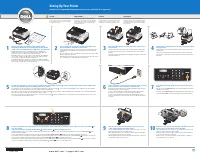 Dell V505 Manual
 Dell V515w Manual
 Dell v525w Manual
 Dell Venue 7 User Manual
-User-Manual/webp/1.webp) Dell Venue 7 (3741, Late 2014) User Manual
Dell Venue 7 (3741, Late 2014) User Manual-User-Manual/webp/1.webp) Dell Venue 8 (7840, Early 2015) User Manual
Dell Venue 8 (7840, Early 2015) User Manual-User-Manual/webp/1.webp) Dell Venue 8 Pro (3845, Late 2014) User Manual
Dell Venue 8 Pro (3845, Late 2014) User Manual Dell Venue 10 Pro 5056 User Manual
-User-Manual/webp/1.webp) Dell Venue 11 Pro (7140, Late 2014) User Manual
Dell Venue 11 Pro (7140, Late 2014) User Manual