Broan BBN3306SS - User Manual
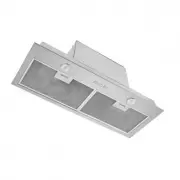
A user manual for ventilation systems–such as range hoods, ductless exhaust units, or heat recovery ventilators–covers essential topics like installation methods (including cabinet mounting, ductwork setup, and electrical wiring), safety precautions (fire hazards, electrical risks, and proper tool use), filter maintenance (ducted vs. non-ducted types), operational controls (fan speed, light settings, airflow adjustments via thermostats or control panels), and troubleshooting common issues like airflow regulation or system activation protocols. The manual emphasizes compliance with ventilation standards while guiding users through setup, operation, and periodic upkeep to ensure efficiency and safety.


Table of Contents:
- Page 1 – PowerPack Insert Installation Procedures and Safety
- Page 2 – Unit Mounting and Ductwork Assembly
- Page 3 – Ventilation System Operation and Maintenance
- Page 4 – Range Hood Installation Safety and Setup
- Page 5 – Cabinet and Equipment Assembly Procedures
- Page 6 – Heat Recovery Ventilation System Control
- Page 7 – Portable Range Hood Installation Guide
- Page 8 – Cabinet Mounting Specifications and Hardware
- Page 9 – Control Panel Features and Surface Maintenance
In the United States
In Canada
For complete warranty statement and service parts, or to learn more about the instructions below,
please type your model number in on our website or scan the QR code.
broan-nutone.com
broan-nutone.ca
To obtain a paper copy of the detailed instructions, please call us.
1-800-558-1711
1-800-567-3855
EN
INSTALLATION, USE, AND CARE QUICK START MANUAL
POWERPACK INSERT MODELS BBN3306SS AND BBN3306SSC
READ AND SAVE THESE INSTRUCTIONS
Intended for domestic cooking only
!
!
WARNING
WARNING
CAUTION
TO REDUCE THE RISK OF FIRE, ELECTRIC SHOCK, OR
INJURY TO PERSONS, OBSERVE THE FOLLOWING:
• Use this unit only in the manner intended by the manufacturer. If you have
questions, contact the manufacturer at the address or telephone number
listed in the warranty.
• Before servicing or cleaning unit, switch power off at service panel and lock the
service disconnecting means to prevent power from being switched on
accidentally. When the service disconnecting means cannot be locked,
securely fasten a prominent warning device, such as a tag, to the service panel.
• Installation work and electrical wiring must be done by a qualified person(s)
in accordance with all applicable codes and standards, including fire-rated
construction codes and standards.
• Sufficient air is needed for proper combustion and exhausting of gases
through the flue (chimney) of fuel burning equipment to prevent backdrafting.
Follow the heating equipment manufacturer’s guideline and safety standards
such as those published by the National Fire Protection Association (NFPA),
and the American Society for Heating, Refrigeration and Air Conditioning
Engineers (ASHRAE), and the local code authorities.
• When cutting or drilling into wall or ceiling, do not damage electrical wiring
and other hidden utilities.
• Ducted fans must always be vented to the outdoors.
• Do not use this unit with any separate solid-state speed control device.
• To reduce the risk of fire, use only metal ductwork.
• This unit must be grounded.
• When installing, servicing or cleaning the unit, it is recommended to wear
safety glasses and gloves.
• When applicable local regulations comprise more restrictive installation and/or
certification requirements, the aforementioned requirements prevail on those
of this document and the installer agrees to conform to these at his own expense.
TO REDUCE THE RISK OF A RANGE TOP GREASE FIRE:
A. Never leave surface units unattended at high settings. Boilovers cause smoking
and greasy spillovers that may ignite. Heat oils slowly on low or medium settings.
B. Always turn hood ON when cooking at high heat or when flambeing food
(i.e. Crepes Suzette, Cherries Jubilee, Peppercorn Beef Flambé).
C. Clean ventilating fans frequently. Grease should not be allowed to accumulate
on fan or filter.
D. Use proper pan size. Always use cookware appropriate for the size of the
surface element.
TO REDUCE THE RISK OF INJURY TO PERSONS IN THE
EVENT OF A RANGE TOP GREASE FIRE, OBSERVE THE
FOLLOWING:*
1.
SMOTHER FLAMES with a close-fitting lid, cookie sheet, or metal tray, then
turn off the burner. BE CAREFUL TO PREVENT BURNS. If the flames do not
go out immediately, EVACUATE AND CALL THE FIRE DEPARTMENT.
2.
NEVER PICK UP A FLAMING PAN - You may be burned.
3.
DO NOT USE WATER, including wet dishcloths or towels - violent steam
explosion will result.
4. Use an extinguisher ONLY if:
A. You know you have a Class ABC extinguisher and you already know how to
operate it.
B. The fire is small and contained in the area where it started.
C. The fire department is being called.
D. You can fight the fire with your back to an exit.
* Based on “Kitchen Fire Safety Tips” published by NFPA.
• For indoor residential use only.
• To reduce risk of fire and to properly exhaust air, be sure to duct air
outside. Do not vent exhaust air into spaces within walls or ceilings
or into attics, crawl spaces, or garages.
• Take care when using cleaning agents or detergents.
• Avoid using food products that produce flames under the Range
Hood.
• For general ventilating use only. Do not use to exhaust hazardous
or explosive materials and vapors.
• To avoid motor bearing damage and noisy and/or unbalanced
impellers, keep drywall spray, construction dust, etc. off power
unit.
• Your hood motor has a thermal overload which will automatically
shut off the motor if it becomes overheated. The motor will restart
when it cools down. If the motor continues to shut off and restart,
have the hood serviced.
• The bottom of the hood MUST NOT BE LESS than 24” and
recommended at a maximum of 30” above the cooktop for best
capture of cooking impurities.
• Use only with range hood cord connection kits that have been
investigated and found acceptable for use with this model range
hood.
• Please read specification label on product for further information
and requirements.
!
!
!
1. INSTALL THE DUCTWORK (DUCTED
INSTALLATION
ONLY)
NOTE: To reduce the risk of fire, use only metal ductwork.
1. D e c i d e w h e r e
t h e d u c t w o r k
will run between
the powerpack
insert and the
outside. (FIG. 1)
2. A straight, short
d u c t r u n w i l l
allow the hood
to perform most
efficiently.
3. Long duct runs,
e l b o w s , a n d
transitions will
reduce the performance of the hood. Use as few of them as possible.
Larger ducting may be required for best performance with longer duct runs.
4. Install wall cap or roof cap (sold separately). Connect metal ductwork to
cap and work back towards the hood location. Use 2” metal foil duct tape
to seal the joints between ductwork sections.
24"
MIN
- 30"
MAX
ABOVE
COOKING
SURFACE
P
OWERPACK
INSERT
W
ALL
CAP
R
OOF
CAP
8"
OR
6"
ROUND
DUCT
OR
3¼"
X
10"
DUCT
H
OUSE
WIRING
3¼"
X
10"
DUCT
FIG. 1
Detach and set aside the 3¼” x 10” adapter/damper and the 6-in.-round
damper (grey parts in FIG. 2) from back and side of the powerpack insert by
removing their 2 retaining screws. Discard the screws.
Detach the cabinet brackets (grey part in FIG. 3) from the back of the
powerpack insert by removing its 3 retaining screws.
Discard the screws.
Fold up and down the bracket until it is split in two separate parts (FIG. 4).
Keep the brackets for possible further use.
NOTE: Both cabinet brackets have one wide edge and one narrow edge
(FIG. 5), to cover all installation configurations depending on cabinet widths.
2. REMOVE THE ADAPTER/DAMPER AND
6-IN. ROUND DAMPER
3. REMOVE THE CABINET BRACKETS
FIG. 4
FIG. 2
SCREWS
FIG. 3
Wide edge
Narrow edge
FIG. 5
4. PREPARE THE CABINET
NOTES: A. The unit has to be installed inside the cabinet.
B. The unit should be mounted centered laterally over the cooktop burners.
C. For back to front position, the unit must be mounted according to local building codes.
1. Cut a hole in the bottom of the cabinet, using the dimensions shown (FIG. 6).
2. Measure the remaining material of the cabinet bottom sides (
C
in FIG. 7), if it is 1/4” or more, there is no need to use the cabinet brackets. Go to step 7.
3. When there is less than 1/4” remaining material (
C
), carefully remove those strips. Measure the cabinet inner width (
D
in FIG. 7). Refer to the table below
to see which cabinet bracket edge configuration must be used.
WARNING
The cabinet must be secured to wall studs or other wooden framework behind the drywall to support the weight of this
unit. Failure to do so may cause personal injury or damage to countertop or cooktop.
!
N
ARROW
EDGE
W
IDE
EDGE
D
From 28-1/16”
to < 28-1/2”
D
From 28-1/2” to 29”
FIG. 7
A = 10¼”
B = 28 ¹/
16
”
CUT A HOLE IN THE BOTTOM
OF THE CABINET
FIG. 6
4. Pay attention to the Ease of Install hooks location on the unit (distance given from unit front flange, FIG. 8). Measure and mark the position of the Ease
of Install hooks (shown as
E
in FIG.9) on both cabinet side walls. Remove the unit.
8¼
”
4½
”
FIG. 8
FRONT
UNIT TOP VIEW
5. Install the cabinet brackets as follow (FIG. 9):
Align the bracket flush with the bottom of
the right cabinet side panel, with the
hooks marked position (
E
) between the
bottom embossed holes. For the narrow
edge configuration, trace a line on
the top of the bracket. For wide edge
configuration, trace a line at the bottom
of the central slots.
Lift the bracket flush with the marked
lined. Assemble the bracket to the
cabinet side panel using 2 no. 8 x 5/8”
wood screws (included in parts bag)
through the upper holes.
NOTE: Do not use the embossed holes to
attach the bracket to the cabinet.
Repeat steps
to
for the left
cabinet side panel.
FIG. 9
Wide edge
configuration
FLUSH
E
FLUSH
Narrow edge
configuration
E
FLUSH
1105018C
For ADA compliance installation guidelines, please type the model number into our website.
RECOMMENDED TOOLS AND ACCESSORIES
• Measuring tape
• Phillips screwdriver no. 2
• Nut driver or socket 3/8”
• Flat blade screwdriver
(to open knock-out holes)
• Saw (to cut holes in cabinet)
• Sheet metal shears
• Pliers
• Metal foil duct tape
• Scissors (to cut metal foil duct tape)
• Pencil
• Wire stripper
• 2 Appropriate wire nuts
• Strain relief, 7/8” diameter (to secure
house wiring cable to the hood)
"Loading the manual" means you need to wait until the file loads and becomes available for online reading. Some manuals are very large, and the time they take to appear depends on your internet speed.
Was this manual helpful?
Helpful for 3 of 3 readers
About this manual
- Brand
- Broan
- Model
- BBN3306SS
- Document type
- User Manual
- Category
- Range Hood
- Language(s)
- English, Spanish, French
- Pages
- 9
- File size
- 7.6 MB
- Format
Summary
Instructions for installing a PowerPack insert, including ductwork setup, damper/adapter removal, cabinet bracket detachment, and preparation for unit mounting, along with fire and electrical safety warnings.
Detailed installation steps, preparation, and mounting options (horizontal and vertical exhaust) for the unit, including ductwork connection diagrams and securing procedures within a cabinet.
Electrical wiring, filter installation, maintenance guidelines for grease filters and stainless steel surfaces, operational procedures for the control panel (fan speed, light settings, delay functions), and Heat Sentry™ thermostat operation.
Ask a question
Related manuals
Popular Broan Range Hoods


More Broan Range Hoods models
 Broan ALT330SS User Manual
 Broan ALT430SS User Manual
 Broan BBN1243SS User Manual
 Broan BBN1303SS User Manual
 Broan BBN2243SS User Manual
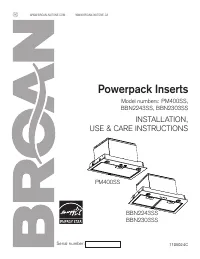 Broan BBN2303SS User Manual
 Broan BCDF130BLS User Manual
 Broan BCDF130SS User Manual
 Broan BCDF136SS User Manual
 Broan BCDJ130SS User Manual
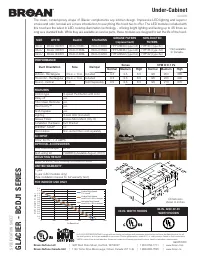 Broan BCDJ136SS User Manual
 Broan BCSD130BL User Manual
 Broan BCSD130SS User Manual
 Broan BCSD130WW User Manual
 Broan BCSD136SS User Manual
 Broan BCSEK130SS User Manual