Page 2 - Instructions; General safety instructions
Instructions 48 1 Instructions 1.1 General safety instructions Risk of personal injury • During use the appliance and its accessible parts become very hot. Never touch the heating elements during use. • Protect your hands by wearing oven gloves when moving food inside the oven. • Never try to put ou...
Page 4 - Risk of damaging the appliance
Instructions 50 Risk of damaging the appliance • Do not use abrasive or corrosive detergents (e.g. scouring powders, stain removers and metallic sponges) on glass parts. • Use wooden or plastic utensils.• Racks and trays should be inserted as far as they will go into the side guides. The mechanical ...
Page 5 - Installation
Instructions 51 EN • All pans must have smooth, flat bottoms. • If any liquid does boil over or spill, remove the excess from the hob. • Take care not to spill acid substances such as lemon juice or vinegar on the hob. • Do not put empty pans or frying pans on switched on cooking zones. • Do not use...
Page 6 - For this appliance
Instructions 52 • Installation using a hose must be carried out so that the length of the hose does not exceed 2 metres when fully extended for steel hoses and 1.5 metres for rubber hoses. • The hoses should not come into contact with moving parts and should not be crushed in any way. • If required,...
Page 7 - Appliance purpose
Instructions 53 EN 1.3 Appliance purpose • This appliance is intended for cooking food in the home environment. Every other use is considered inappropriate. • The appliance is not designed to operate with external timers or with remote-control systems. 1.4 Identification plate The identification pla...
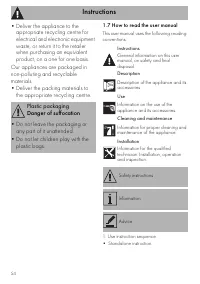
Page 8 - • Deliver the appliance to the; How to read the user manual; Plastic packaging
Instructions 54 • Deliver the appliance to the appropriate recycling centre for electrical and electronic equipment waste, or return it to the retailer when purchasing an equivalent product, on a one for one basis. Our appliances are packaged in non-polluting and recyclable materials.• Deliver the p...
Page 9 - Description; General Description; Cooking hob
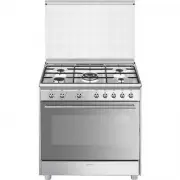
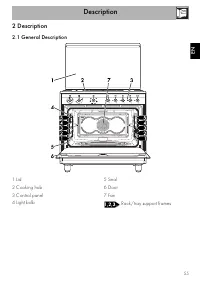
Description 55 EN 2 Description 2.1 General Description 1 Lid 2 Cooking hob 3 Control panel 4 Light bulb 5 Seal 6 Door 7 Fan Rack/tray support frames
Page 10 - AUX
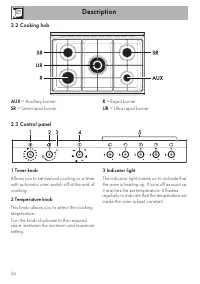
Description 56 2.2 Cooking hob AUX = Auxiliary burner SR = Semi-rapid burner R = Rapid burner UR = Ultra rapid burner 2.3 Control panel 1 Timer knob Allows you to set manual cooking or a timer with automatic oven switch off at the end of cooking. 2 Temperature knob This knob allows you to select the...
Page 11 - Function knob
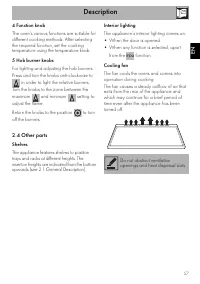
Description 57 EN 4 Function knob The oven's various functions are suitable for different cooking methods. After selecting the required function, set the cooking temperature using the temperature knob. 5 Hob burner knobs For lighting and adjusting the hob burners.Press and turn the knobs anti-clockw...
Page 12 - Available accessories; Rack
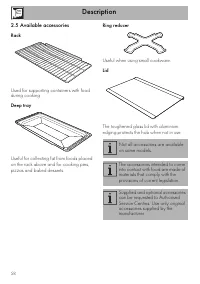
Description 58 2.5 Available accessories Rack Used for supporting containers with food during cooking. Deep tray Useful for collecting fat from foods placed on the rack above and for cooking pies, pizzas and baked desserts. Ring reducer Useful when using small cookware. Lid The toughened glass lid w...
Page 13 - Use
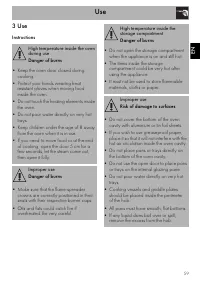
Use 59 EN 3 Use Instructions High temperature inside the oven during use Danger of burns • Keep the oven door closed during cooking. • Protect your hands wearing heat resistant gloves when moving food inside the oven. • Do not touch the heating elements inside the oven. • Do not pour water directly ...
Page 14 - Precautions
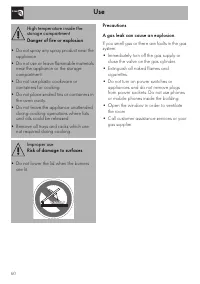
Use 60 Precautions A gas leak can cause an explosion. If you smell gas or there are faults in the gas system:• Immediately turn off the gas supply or close the valve on the gas cylinder. • Extinguish all naked flames and cigarettes. • Do not turn on power switches or appliances and do not remove plu...
Page 15 - Malfunctions
Use 61 EN Malfunctions Any of the following indicate a malfunction and you should contact a service centre.• Yellowing of the burner plate.• Damage to kitchen utensils.• The burners do not ignite properly.• It is difficult to keep the burners lit.• The burners go out when the appliance is in use. • ...
Page 16 - Using the accessories; Ring reducers
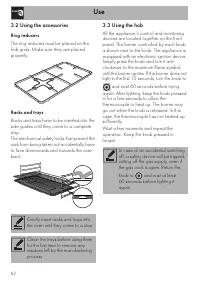
Use 62 3.2 Using the accessories Ring reducers The ring reducers must be placed on the hob grids. Make sure they are placed properly. Racks and trays Racks and trays have to be inserted into the side guides until they come to a complete stop.The mechanical safety locks that prevent the rack from bei...
Page 17 - Practical tips for using the hob
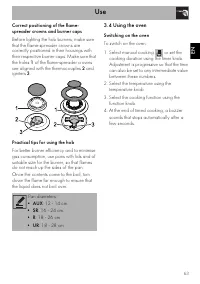
Use 63 EN Correct positioning of the flame-spreader crowns and burner caps Before lighting the hob burners, make sure that the flame-spreader crowns are correctly positioned in their housings with their respective burner caps. Make sure that the holes 1 of the flame-spreader crowns are aligned with ...
Page 18 - Functions list
Use 64 Functions list Static As the heat comes from above and below at the same time, this system is particularly suitable for certain types of food. Traditional cooking, also known as static cooking, is suitable for cooking just one dish at a time. Perfect for all types of roasts, bread and cakes, ...
Page 19 - General advice
Use 65 EN 3.5 Cooking advice General advice • Use a fan assisted function to achieve consistent cooking at several levels. • It is not possible to shorten cooking times by increasing the temperature (the food could be overcooked on the outside and undercooked on the inside). Advice for cooking meat ...
Page 20 - Advice for defrosting and proving
Use 66 • With the Grill function, we recommend that you turn the temperature knob to the maximum value near the symbol to optimise cooking. • Foods should be seasoned before cooking. Foods should also be coated with oil or melted butter before cooking. • Use the oven tray on the first bottom shelf t...
Page 21 - Cooking information table
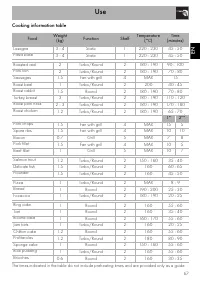
Use 67 EN Cooking information table Food Weight (kg) Function Shelf Temperature (°C) Time (minutes) Lasagne 3 - 4 Static 1 220 - 230 45 - 50 Pasta bake 3 - 4 Static 1 220 - 230 45 - 50 Roasted veal 2 Turbo/Round 2 180 - 190 90 - 100 Pork loin 2 Turbo/Round 2 180 - 190 70 - 80 Sausages 1.5 Fan with g...
Page 22 - Cleaning and maintenance
Cleaning and maintenance 68 4 Cleaning and maintenance Instructions Cleaning the surfaces To keep the surfaces in good condition, they should be cleaned regularly after use. Let them cool first. Ordinary daily cleaning Always use specific products only that do not contain abrasives or chlorine-based...
Page 23 - Cooking hob grids
Cleaning and maintenance 69 EN 4.1 Cleaning the hob Cooking hob grids Remove the grids and clean them in lukewarm water and non-abrasive detergent. Make sure to remove any encrustations. Dry them thoroughly and return them to the hob. Flame-spreader crowns and burner caps For easier cleaning, the fl...
Page 24 - Cleaning the glass lid; Cleaning the door; Removing the door
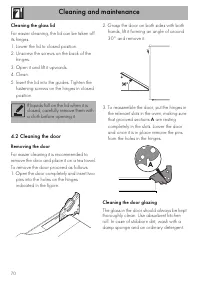
Cleaning and maintenance 70 Cleaning the glass lid For easier cleaning, the lid can be taken off its hinges.1. Lower the lid to closed position.2. Unscrew the screws on the back of the hinges. 3. Open it and lift it upwards. 4. Clean. 5. Insert the lid into the guides. Tighten the fastening screws o...
Page 25 - Removing the internal glass panes
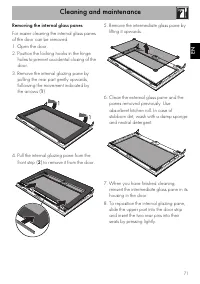
Cleaning and maintenance 71 EN Removing the internal glass panes For easier cleaning the internal glass panes of the door can be removed.1. Open the door.2. Position the locking hooks in the hinge holes to prevent accidental closing of the door. 3. Remove the internal glazing pane by pulling the rea...
Page 26 - Cleaning the oven cavity; Removing racks/trays support frames
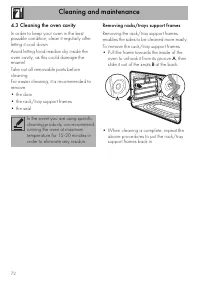
Cleaning and maintenance 72 4.3 Cleaning the oven cavity In order to keep your oven in the best possible condition, clean it regularly after letting it cool down.Avoid letting food residue dry inside the oven cavity, as this could damage the enamel.Take out all removable parts before cleaning.For ea...
Page 27 - Preliminary operations
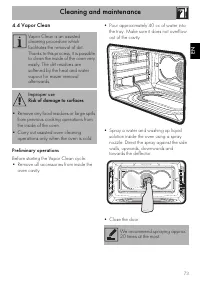
Cleaning and maintenance 73 EN 4.4 Vapor Clean Preliminary operations Before starting the Vapor Clean cycle:• Remove all accessories from inside the oven cavity. • Pour approximately 40 cc of water into the tray. Make sure it does not overflow out of the cavity. • Spray a water and washing up liquid...
Page 28 - Vapor Clean cycle setting
Cleaning and maintenance 74 Vapor Clean cycle setting 1. Turn the function knob to the symbol and the temperature knob to the symbol . 2. Set a cooking time of 18 minutes using the programmer clock. The Vapor Clean cycle starts a few seconds after the last press on the programmer clock keys.3. At th...
Page 29 - Extraordinary maintenance; Replacing the internal light bulb
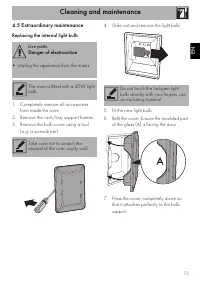
Cleaning and maintenance 75 EN 4.5 Extraordinary maintenance Replacing the internal light bulb 1. Completely remove all accessories from inside the oven. 2. Remove the rack/tray support frames. 3. Remove the bulb cover using a tool (e.g. a screwdriver). 4. Slide out and remove the light bulb. 5. Fit...
Page 30 - Installing and removing the seal
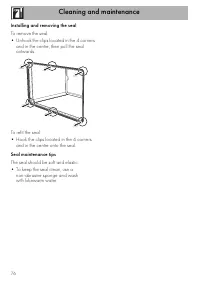
Cleaning and maintenance 76 Installing and removing the seal To remove the seal:• Unhook the clips located in the 4 corners and in the centre, then pull the seal outwards. To refit the seal:• Hook the clips located in the 4 corners and in the centre onto the seal. Seal maintenance tips The seal shou...
Page 31 - Installation; General information
Installation 77 EN 5 Installation 5.1 Gas connection General information Connection to the gas mains can be made using a continuous wall steel hose in compliance with the guidelines established by the standards in force. The appliance is preset for natural gas G20 (2H) at a pressure of 20 mbar. For ...
Page 32 - Connection with a steel hose
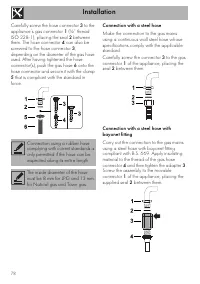
Installation 78 Carefully screw the hose connector 3 to the appliance’s gas connector 1 (½” thread ISO 228-1), placing the seal 2 between them. The hose connector 4 can also be screwed to the hose connector 3 , depending on the diameter of the gas hose used. After having tightened the hose connector...
Page 33 - Connection to LPG
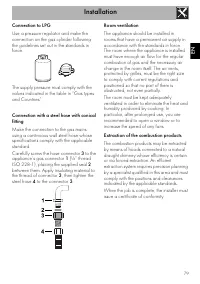
Installation 79 EN Connection to LPG Use a pressure regulator and make the connection on the gas cylinder following the guidelines set out in the standards in force. The supply pressure must comply with the values indicated in the table in “Gas types and Countries”. Connection with a steel hose with...
Page 34 - Adaptation to different types of gas; Replacing nozzles
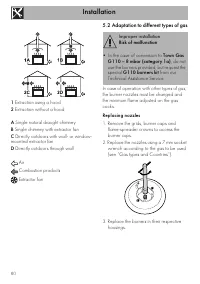
Installation 80 1 Extraction using a hood 2 Extraction without a hood A Single natural draught chimney B Single chimney with extractor fan C Directly outdoors with wall- or window- mounted extractor fan D Directly outdoors through wall Air Combustion products Extractor fan 5.2 Adaptation to differen...
Page 35 - Adjusting the minimum setting for LPG
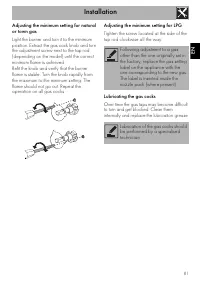
Installation 81 EN Adjusting the minimum setting for natural or town gas Light the burner and turn it to the minimum position. Extract the gas cock knob and turn the adjustment screw next to the tap rod (depending on the model) until the correct minimum flame is achieved.Refit the knob and verify th...
Page 36 - Gas types and Countries; SE RU DK PL HU
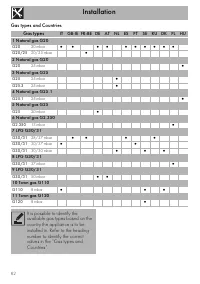
Installation 82 Gas types and Countries Gas types IT GB-IE FR-BE DE AT NL ES PT SE RU DK PL HU 1 Natural gas G20 G20 20 mbar • • • • • • • • • • G20/25 20/25 mbar • 2 Natural gas G20 G20 25 mbar • 3 Natural gas G25 G25 25 mbar • G25.3 25 mbar • 4 Natural gas G25.1 G25.1 25 mbar • 5 Natural gas G25 G...
Page 37 - Burner and nozzle characteristics tables
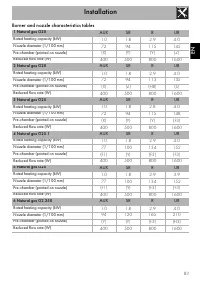
Installation 83 EN Burner and nozzle characteristics tables 1 Natural gas G20 AUX SR R UR Rated heating capacity (kW) 1.0 1.8 2.9 4.0 Nozzle diameter (1/100 mm) 72 94 115 145 Pre-chamber (printed on nozzle) (X) (Y) (Y) (Z) Reduced flow rate (W) 400 500 800 1600 2 Natural gas G20 AUX SR R UR Rated he...
Page 38 - In the case of conversion to
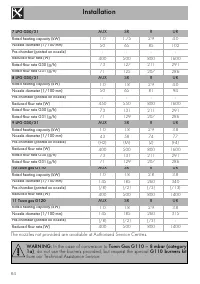
Installation 84 The nozzles not provided are available at Authorised Service Centres. 7 LPG G30/31 AUX SR R UR Rated heating capacity (kW) 1.0 1.75 2.9 4.0 Nozzle diameter (1/100 mm) 50 65 85 102 Pre-chamber (printed on nozzle) - - - - Reduced flow rate (W) 400 500 800 1600 Rated flow rate G30 (g/h)...
Page 39 - Heavy appliance
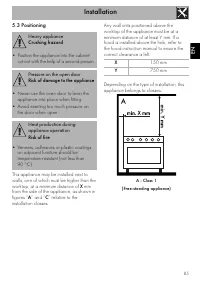
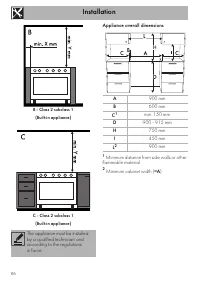
Installation 85 EN 5.3 Positioning This appliance may be installed next to walls, one of which must be higher than the worktop, at a minimum distance of X mm from the side of the appliance, as shown in figures “ A ” and “ C ” relative to the installation classes. Any wall units positioned above the ...
Page 40 - B - Class 2 subclass 1; Appliance overall dimensions
Installation 86 B - Class 2 subclass 1 (Built-in appliance) C - Class 2 subclass 1 (Built-in appliance) Appliance overall dimensions 1 Minimum distance from side walls or other flammable material. 2 Minimum cabinet width ( =A ). The appliance must be installed by a qualified technician and according...
Page 41 - Electrical connection
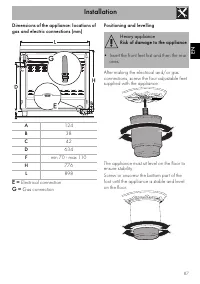
Installation 87 EN Dimensions of the appliance: locations of gas and electric connections (mm) E = Electrical connection G = Gas connection Positioning and levelling After making the electrical and/or gas connections, screw the four adjustable feet supplied with the appliance. The appliance must sit...
Page 42 - Fastening to the wall
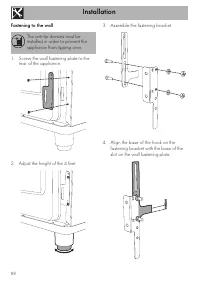
Installation 88 Fastening to the wall 1. Screw the wall fastening plate to the rear of the appliance. 2. Adjust the height of the 4 feet. 3. Assemble the fastening bracket. 4. Align the base of the hook on the fastening bracket with the base of the slot on the wall fastening plate. The anti-tip devi...
Page 43 - Align the base of the fastening bracket
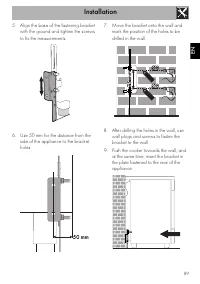
Installation 89 EN 5. Align the base of the fastening bracket with the ground and tighten the screws to fix the measurements. 6. Use 50 mm for the distance from the side of the appliance to the bracket holes. 7. Move the bracket onto the wall and mark the position of the holes to be drilled in the w...
Page 44 - Fitting the lid
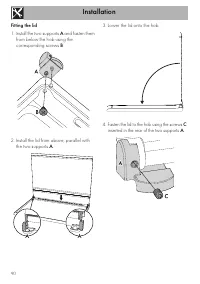
Installation 90 Fitting the lid 1. Install the two supports A and fasten them from below the hob using the corresponding screws B . 2. Install the lid from above, parallel with the two supports A . 3. Lower the lid onto the hob. 4. Fasten the lid to the hob using the screws C inserted in the rear of...
Page 45 - Electrical connection
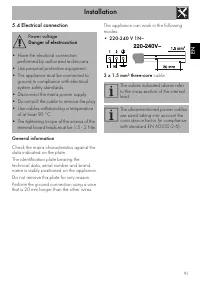
Installation 91 EN 5.4 Electrical connection General information Check the mains characteristics against the data indicated on the plate.The identification plate bearing the technical data, serial number and brand name is visibly positioned on the appliance.Do not remove this plate for any reason.Pe...
Page 46 - Fixed connection; Instructions for the installer
Installation 92 Fixed connection Fit the power line with an all-pole disconnection switch, with at least 3 mm between its contacts, in compliance with installation regulations.The circuit breaker should be located near the appliance and in an easily reachable position. Connection with plug and socke...