Page 2 - Instructions; General safety instructions
Instructions 4 1 Instructions 1.1 General safety instructions Risk of personal injury • Never touch the heating elemen- ts during use. • Keep children under the age of eight at a safe distance unless they are constantly supervised and make sure that they do not play with the appliance. • In accordan...
Page 3 - Risk of damaging the appliance
5 EN • Opening the door for long pe- riods can cause a significant in- crease of the temperature in the compartments of the appliance. • Clean regularly surfaces that can come in contact with food and accessible drainage sy- stems. • Store raw meat and fish in suitable containers in the refrige- rat...
Page 4 - For this appliance
Instructions 6 • If installed near another refri- gerator or freezer, keep it at a minimum distance of 2 cm. • Do not install/use the applian- ce outdoors. For this appliance • WARNING: risk of fire / flam- mable materials. • The appliance may only be used by children aged 8 years and over, and by p...
Page 5 - Manufacturer liability; Danger of electrocution
7 EN Instructions 1.2 Manufacturer liability The manufacturer declines all liability for damage to persons or property caused by: • use of the appliance other than that specified; • failure to comply with the in- structions in the user manual; • tampering with any part of the appliance; • use of non...
Page 6 - Danger of suffocation; Technical support
Instructions 8 • If the appliance is replaced, remove the door and leave the shelves in their positions, in order to prevent children from being trapped inside. Our appliances are packaged in non-polluting and recyclable mate- rials. • Deliver the packing materials to the appropriate recycling centr...
Page 7 - Contents; How to read the user; This user manual uses the following
Contents 9 EN 1.8 How to read the user manual This user manual uses the following reading conventions: Warning Serious injury or death risk Risk of electric shock Dangerous voltage risk Fire Warning; risk of fire / flam- mable materials Warning Injury or property damage risk Important Operating the ...
Page 8 - Description of the appliance; General Description; This presentation is only for
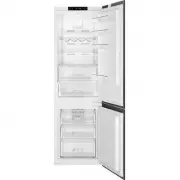
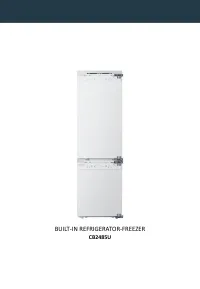
Instructions 10 Description 2 Description of the appliance 2.1 General Description This presentation is only for information about the parts of the appliance. Parts may vary according to the ap- pliance model. A) Refrigerator compartment B) Freezer compartment 1) Display and control panel 2) Cooling...
Page 9 - Using the appliance; Information about New; Using the control panel
Contents 11 EN Use 3 Using the appliance 3.1 Information about New Generation Cooling Technology Fridges with new-ge- neration cooling tech- nology have a diffe- rent operating system to static fridges. Other (static) fridges may experience a build up of ice in the freezer compartment due to door op...
Page 10 - Operating your Fridge; NOTE; Use
Instructions 12 3.3 Operating your Fridge Freezer Once you have plugged in the pro- duct, all symbols will be displayed for 2 seconds and the initial values will be shown as -18 °C on the freezer adjustment indicator, and +4 °C on the refrigerator adjustment indicator. 3.3.1 Freezer temperature sett...
Page 12 - Temperature Adjustment; Do not fill the icebox with wa-
Instructions 14 3.4 Temperature Adjustment Warnings • It is not recommended that you operate your appliance in environ- ments colder than 10°C in terms of its efficiency. • Do not start another adjustment while you are already making an adjust- ment. • Temperature adjustments should be made accordin...
Page 13 - Removing the container with; Do not put food you want to
Contents 15 EN 3.5.2 Container with drawers The freezer drawers allow food to be accessed more easily. Freezer boxes Removing the container with drawer: • Pull the container with drawer out as far as possible • Pull the front of the container with drawer up and out Carry out the opposite of this ope...
Page 14 - fruit and vegetable drawer
Instructions 16 To remove the shelf of the super cold drawer proceed as follows: • Pull the drawer towards you by sliding it on the rails. • Pull the drawer up from the rail and remove it from the refrigerator. 3.5.4 Adjusting humidity in the fruit and vegetable drawer (In some models) Fresh dial If...
Page 15 - Visual and text descriptions in the ac-
Contents 17 EN 3.5.6 Maxi-fresh preserver (If available) Maxi Fresh Preserver te- chnology helps to remove ethylene gas (a bioproduct released naturally from fre- sh foods) and unpleasant odors from the fruit and vegetable drawer. In this way, food stays fresh for a longer time. • Maxi Fresh Preserv...
Page 16 - Food storage; Refrigerator compartment
Instructions 18 4 Food storage 4.1 Refrigerator compartment For normal operating conditions, set the temperature of the refrigerator com- partment to +4 or +6 °C. • To reduce humidity and avoid the consequent formation of frost, always store liquids in sealed containers in the refrigerator. Frost te...
Page 17 - Freezer compartment
Contents 19 EN Note: Potatoes, onions and garlic should not be stored in the refrige- rator. The table below is a quick guide to show you the most efficient way to store the major food groups in your refrigerator compartment. Food Maximum storage time How and where to store Vege- tables and fruits 1...
Page 19 - The table below is a quick guide
Contents 21 EN The table below is a quick guide to show you the most efficient way to store the major food groups in your freezer compartment. Meat and fish Preparation Maximum storage time (months) Steak Wrap in foil 6 - 8 Lamb meat Wrap in foil 6 - 8 Veal roast Wrap in foil 6 - 8 Veal cubes In sma...
Page 22 - Cleaning and Maintenance; Defrosting the refrigerator/freezer; Cleaning and maintenance
Instructions 24 5 Cleaning and Maintenance 5.1 Defrosting Occasional presence of frost inside the freezer compartment is normal. Do not use electrical applian- ces (e.g. hair dryers) or sprays for defrosting, the plastic parts could be damaged. Defrosting the refrigerator/freezer compartments The re...
Page 23 - Cleaning the appliance; Cleaning the outside of the appliance; Replacing LED Lighting
Contents 25 EN Cleaning and maintenance 5.3 Cleaning the appliance A special antibacterial protection on the appliance's interior walls prevents bacterial growth and keeps them cle- an. They must nevertheless be cleaned regularly in order to keep them in good condition. Do not wash your appliance by...
Page 25 - Excessive ice has built up inside the; • If you attempt to open the door again; The doors are misaligned:
Contents 27 EN Excessive ice has built up inside the freezer compartment: • The thermostat is set at too low a temperature. • The room temperature is too high. • The door is being opened too often or for too long. • The door is not closing/sealing properly. • The door seal is damaged or dirty. Clean...
Page 26 - Electrical connection; Installation
Instructions 28 6 Installation 6.1 Electrical connection Power voltage Danger of electrocution • The appliance must be connected to ground in compliance with electrical system safety standards. • Do not pull the cable to remove the plug. General information • Check the mains characteristics against ...
Page 27 - Important installation instructions; Installation warnings
Contents 29 EN Installation • Your appliance is designed to operate in the ambient temperature (T/SN = 10°C - 43°C) intervals stated in the standards, according to the climate class displayed on the information label. We do not re- commend operating your appliance out of the stated temperature limit...
Page 29 - CE Declaration of conformity
Contents 31 EN Installation Old and Out-of-order Fridges • If your old fridge or freezer has a lock, break or remove the lock before discarding it, because chil- dren may get trapped inside it and accidents may occur. • Old fridges and freezers contain isolation material and refrigerant with CFC. Th...
Page 30 - Positioning
Instructions 32 Positioning Position the appliance on a firm, level surface. The appliance has two small wheels on the back to allow it to be moved and positioned more easily. In any case, we recommend moving the appliance very carefully in order to avoid damaging the floor (especially in the case o...
Page 31 - Risk of damages to the ap-
Contents 33 EN In order for the freezer to be installed correctly, the door must be able to close properly. Ensure that the door seals close hermetically, especially at the corners. Pressure on the seal Risk of damages to the ap- pliance • Do not press, do not tear or detach the seal from the door. ...
Page 32 - Transportation and; Shipment and repositioning
34 7 Shipment and repositio- ning 7.1 Transportation and Changing Positioning • The original packaging and foam may be kept for re-transportation (optional). • Fasten your appliance with thick packaging, bands or strong cords and follow the instructions for tran- sportation on the packaging. • Remov...
Page 33 - Errors; Before calling after-sales service
35 EN 8 Before calling after-sales service Errors Your appliance will warn you if the tem- peratures for the appliance and freezer are at improper levels or if a problem occurs with the appliance. Warning codes are displayed in the freezer and refrigerator indicators. Before calling after-sales serv...
Page 34 - Your refrigerator does not operate
36 ERROR TYPE MEANING WHY WHAT TO DO E10 Refrigera- tor com- partment is not cold enough Likely to occur after: 1. Set the refrigerator temperature to a colder value or set Super Cool. This should remove the error code once the required temperature has been reached. Keep doors closed to impro...
Page 36 - Practical energy saving advice
38 • If the problem persists after you have followed all the instructions above, please consult the nearest Authorised Service Centre. • This appliance is designed for dome- stic use and for the stated purposes only. It is not suitable for commercial or common use. If the consumer uses the appliance...