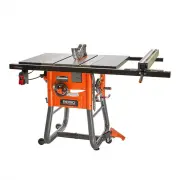
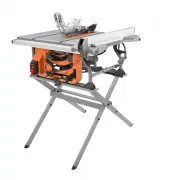
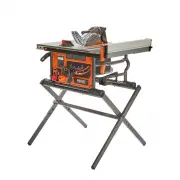
Page 2 - SPECIFICATIONS; MOTOR SPECIFICATIONS:
2 TABLE OF CONTENTS FUNCTIONAL DESCRIPTION FUNCTIONAL DESCRIPTION ............................................ 2 Specifications .................................................................... 2 FEATURES .......................................................................... 3 IMPORTANT SAFET...
Page 3 - FEATURES
3 FEATURES Back View F5 F6 F7 F8 F9 F10 F11 F12 F13 F14 F15 F16 F17 F18 F19 F20 F9 F10 F11 F12 F13 F14 F15 F16 Push Stick Pivoting Pedal and Caster Wheel Adjustable Feet Fixed Wheels Hand Wheel Handle Tubular Stand Power Switch Saw Body F21 F22 F23 F17 F18 F19 F20 F21 F22 F23 Extension Wing Miter Ga...
Page 4 - IMPORTANT SAFETY INSTRUCTIONS; SAFETY SYMBOLS- DEFINITIONS
4 IMPORTANT SAFETY INSTRUCTIONS If you have any questions or concerns regarding the use of your tool or the contents of this manual, please stop using the tool and contact Customer Service, at RIDGID ® Portable and Fixed Power Tool Technical Service at (toll free) 1-888-359-4778 . SAFETY SYMBOLS- DE...
Page 5 - GENERAL POWER TOOL SAFETY WARNINGS
5 The term “power tool” in the warnings refers to your mains-operated (corded) power tool or BATTERY-operated (cordless) power tool. 1. Work area safety a. Keep work area clean and well lit. Cluttered or dark areas invite accidents b. Do not operate power tools in explosive atmospheres, such as in t...
Page 6 - TABLE SAW SPECIFIC SAFETY RULES; TERMINOLOGY; TABLE SAW SAFETY RULES
6 • Through-cut – Any cut that completely cuts through the workpiece. • Non-through cut – Any cut that does not completely cut through the workpiece. • Push stick – A wooden or plastic stick, usually homemade, that is used to push a small workpiece through the saw and keeps the operator’s hands clea...
Page 8 - KICKBACKS; PROPOSITION 65 WARNING:; SAVE THESE INSTRUCTIONS.; SAW BLADE GUARD, ANTI-KICKBACK PAWLS AND RIVING KNIFE
8 KICKBACKS Kickbacks can cause serious injury. A kickback occurs when a part of the workpiece binds between the saw blade and the rip fence, or other fixed object, and rises from the table and is thrown toward the operator. Kickbacks can be avoided by attention to the following conditions. HOW TO R...
Page 9 - POWER CONNECTIONS; POWER SOURCE; EXTENSION CORDS; UNPACKING
** Ampere rating (on tool data label) 12A- 16A Cord Length Wire Size 25' 14 AWG 50' 12 AWG ** Used on 12 gauge - 20 amp circuit NOTE: AWG = American Wire Gauge 9 POWER CONNECTIONS POWER SOURCE This saw is equipped with a 15-amp motor for use with a 120- volt, 60-HZ alternating current. See instructi...
Page 10 - PACKAGE CONTENTS
10 Saw Body Right Leg (A) Left Leg (B) Rip Fence Blade Guard Miter Gauge Push Stick Throat Plate Arbor Wrench Extension Wings x2 Anti-Kickback Pawls Adjustable Feet x2 Fixed Wheels x2 Hand Wheel Handle x2 Rip Fence Handle Blade Rail Spreader Bar Rear Fence Rails x2 Front Fence Rails x2 Fence Guide R...
Page 11 - HARDWARE PACKAGE
11 HARDWARE PACKAGE UNPACKING HP1 HP1 HP2 HP6 HP2 HP3 HP3 HP2 HP2 HP4 HP5 HP7 HP7 HP8 HP9 HP4 HP5 HP12 HP11 Hardware Bag “A” M8 x 75mm Carriage Bolt (1) M8 Nylock Nut (1) M6 x 72mm Carriage Bolt (4) M6 Nylock Nut (4) M8 Flat Washer (1) Hardware Bag “B” M8 x 53mm Carriage Bolt (2) M8 Nylock Nut (3) H...
Page 12 - ASSEMBLY; STAND; Hardware Bag “A”; FIXED WHEELS AND STATIONARY; Hardware Bag “B”
12 ASSEMBLY • DO NOT lift Saw without help. Hold it close to your body while lifting. Keep knees bent and lift with your legs, not your back. • Fully assemble Saw with Leg assembly prior to use. Leg assembly is an integral and necessary part of the Support Structure for this Saw. • DO NOT modify Saw...
Page 13 - FRONT AND REAR RAILS; Hardware Bag “D”
PC19 PC19 PC18 PC18 13 ASSEMBLY FRONT AND REAR RAILS Hardware Bag “D” 1. Attach the Front Fence Rails PC19 (1&2) to the Table Front using four 5/16-18 x 1-1/8 inch Flat Countersunk Hex Screw HP15 , and 5/16-18 inch Hex Flange Nuts HP13 , as shown in Figure 4 and 5. NOTE: The Front Rails have hol...
Page 14 - EXTENSION WINGS
14 ASSEMBLY 1. Attach the Extension Wings to the Table using three 5/16-18 x 7/8 Hex Screw with Split Lock Washers HP7 for each Wing. The Wings attach from underneath as shown in Figure 9. Be sure to use a Level or Ruler to keep the Extension Wings level with the Table. NOTE: Hole patterns on the tw...
Page 15 - FENCE GUIDE AND; Hardware Bag “E”
PC20 HP18 HP19 HP18 15 ASSEMBLY FENCE GUIDE AND POWER CONTROL BOX Hardware Bag “E” LEFT FENCE LEFT FENCE GUIDE (SHORT) GUIDE (SHORT) RULER RULER BACK BACK 1. Attach the Right Fence Guide PC20 using three 1/4 inch -20 x 1/2 inch Button Head Hex Screw with Split Lock Washers HP18 through the holes on ...
Page 16 - THROAT PLATE; BLADE AND RIVING KNIFE
16 To reduce the risk of serious personal injury, the Riving Knife MUST be installed and properly positioned for every possible through and non-through cut. 1. Your Saw is shipped with the Blade and Riving Knife installed and properly aligned. The Riving Knife comes installed in the low, non-through...
Page 17 - Installing the Handles; Installing the Handle
17 Figure 18 Figure 19 The elevation and bevel handles are packaged together in the box, please install as follows: 1. Insert one handle PC14 to the elevation hand wheel located in the front of the saw, as seen in Figure 18. 2. Insert one handle PC14 to the bevel hand wheel located on the side of th...
Page 18 - BLADE GUARD
18 BLADE GUARD To reduce the risk of serious personal injury, the Blade Guard MUST be in place when making a through cut. 1. While holding the Blade Guard Assembly PC5 in a vertical position, hook the Locating Pin B at the back end of the Blade Guard Assembly into the slot at the back edge of the Ri...
Page 19 - RIP FENCE; MITER GAUGE
19 RIP FENCE Before installing the Rip Fence, make sure you have attached the Rip Fence Handle to the Fence Cam. The Rip Fence slides onto the Rear Fence Rail so that the Hook is under the Rear Rail and rides on the Front Guide Tube. The Fence locks in place by applying pressure in a downward motion...
Page 21 - ALIGNMENT; RIVING KNIFE ALIGNMENT
21 ALIGNMENT RIVING KNIFE ALIGNMENT WITH THE BLADE This procedure requires a 4mm T-handle Allen Wrench and straight edge ruler. See Figure 27. WARNING: Completely disconnect saw from power source before making any adjustments. 1. Carefully remove throat plate. 2. Loosen the two hex-head screws A sho...
Page 22 - Adjusting the Miter Gauge Fitment; Adjusting the Miter Gauge Scale
22 Figure 28 Figure 29 Figure 30 A B C Adjusting the Miter Gauge Fitment To adjust the fitment between the miter gauge bar and the miter slot: 1. Use a 3/32 inch Allen wrench on any of the three set screws located on the side of the bar. See Figure 29, 30. 2. Adjust the three set screws until the mi...
Page 24 - TILTING THE BLADE; PREPARING TO CUT
24 RAISING AND LOWERING THE BLADE For most applications, it is recommended that you raise the blade 1/8 inch (3.2mm) to 1/4 inch (6.4mm) above the top surface of the workpiece. Raise or lower the blade with the hand wheel A located on the front of the saw. See Figure 34. 1. Before raising or lowerin...
Page 25 - CHANGING THE SAW BLADE; SELECTING AND STORING SAW BLADES
25 PREPARING TO CUT CHANGING THE SAW BLADE • Use ONLY 10 inch (254mm) diameter blades with 5/8 inch (16mm) arbor holes, rated at 3,600 rpm or higher, 0.102 inch (2.6mm) minimum kerf width and 0.073 inch (1.8mm) maximum body thickness. Use ONLY a saw blade diameter in accordance with the markings on ...
Page 26 - RIVING KNIFE POSITION; RIVING KNIFE HEIGHT SETTINGS
26 RIVING KNIFE POSITION NOTE: Safety devices, blade guard assembly and anti-kickback assembly have been removed in Figure 37 in order to show the location of specific features. When operating the saw, these safety devices should be in place and working properly. The riving knife is a flat plate tha...
Page 27 - CHECKING RIVING KNIFE; CHECKING BLADE PARALLELISM; ADJUSTING BLADE PARALLELISM
27 TO CHECK ALIGNMENT: 1. Horizontal Alignment : Lay a straight edge on the table against blade face A and make sure it extends out along the riving knife B , as shown in Figure 39. The riving knife should just touch the straight edge. Be sure the straight edge goes between the teeth and rests on th...
Page 28 - USING BLADE GUARD ASSEMBLY; CHECKING FENCE ALIGNMENT; USING THE MITER GAUGE
28 USING BLADE GUARD ASSEMBLY The anti-kickback pawls and blade guard MUST be used for all through-cuts. Keep both guard shields down and arms, hands and fingers away from the blade, blade guard and anti-kickback pawls when power is on to prevent serious injury. See assembly instructions on page 18 ...
Page 29 - OPERATION; STARTING AND STOPPING THE SAW; AVOID KICKBACK
29 OPERATION STARTING AND STOPPING THE SAW The POWER switch in Figure 46, is located underneath the front left extension wing. 1. To turn the saw “ON”, push the green “On” button C . 2. To turn the saw “OFF”, push the red paddle switch in A . When not in use, the saw should be turned off and the pow...
Page 30 - OVERLOAD PROTECTION; MAKING CUTS
30 OVERLOAD PROTECTION Your saw is supplied with overload protection. If the motor shuts off or fails to start due to overloading (cutting stock too fast, using a dull blade, using the saw beyond its capacity, etc.) or low voltage, let the motor cool three to five minutes. Then depress the red reset...
Page 32 - CROSSCUTTING
32 CROSSCUTTING • NEVER use the fence as a guide or length stop when crosscutting. • The cut-off piece must NEVER be confined in any through- sawing (cutting completely through the workpiece) operation to prevent pinching blade which may result in a thrown workpiece and possibly injury. • When using...
Page 33 - COMPOUND MITER CUTS; BEVEL CROSSCUTTING; LARGE PANEL CUTS
33 COMPOUND MITER CUTS This is a combination of bevel crosscutting and mitering. Refer to Figure 51 and follow the instructions for both bevel crosscutting and mitering. Remember to use the right miter slot for all bevel cuts. Figure 51 45º 0º BEVEL CROSSCUTTING Bevel crosscutting is the same as cro...
Page 34 - MAKING A NON-THROUGH CUT
34 NON-THROUGH CUTS The use of a non-through cut is essential to cutting grooves and rabbets. Non-through cuts can be made using a standard blade having a diameter of 10 inches or less. Non-through cuts are the only type of cuts that should be made without the blade guard assembly installed. Make su...
Page 35 - CUTTING AIDS AND ACCESSORIES; PUSH STICK; AUXILIARY MITER GAUGE FACING
35 CUTTING AIDS AND ACCESSORIES PUSH STICK In order to operate your table saw safely, you MUST use a push stick whenever the size or shape of the workpiece would otherwise cause your hands to be within 6 inches (152mm) of the saw blade or other cutter. A push stick is included with this saw. No spec...
Page 36 - PUSH BLOCK; FLIP DOWN FENCE
36 Wooden dowel Sandpaper or old mouse pad material PUSH BLOCK Push blocks are blocks used to securely hold down the workpiece against the table. They include some gripping surface or handle to hold the block. Any screws running through the underside of the block to fasten the handle should be reces...
Page 37 - FEATHERBOARD; To avoid binding between the; GROOVING AND RABBETING
37 3/4 in. 3/4 in. 12 in. 12 in. 70˚ 70˚ 2 1/2 in. 2 1/2 in. 1/4 in. 1/4 in. 1/8 in. 1/8 in. 20° FEATHERBOARD Featherboards are used to keep the work in contact with the fence and table as in Figure 58, and help prevent kickback. Featherboards are especially useful when ripping thin workpieces and f...
Page 38 - CUT OFF GAUGE; JIGS
38 CUT OFF GAUGE When crosscutting a number of pieces to the same length, you can clamp a block of wood A , see Figure 59, to the fence and use it as a cut-off gauge. The block A MUST be at least 3/4 inch (19mm) thick to prevent the cut off piece from binding between the blade and the fence. Once th...
Page 39 - MAINTENANCE; LUBRICATION & RUST PROTECTION; KEEP MACHINE CLEAN; ADJUSTING BELT TENSION
39 MAINTENANCE To reduce the risk of injury, turn unit off and disconnect the tool from power source before cleaning or servicing, before installing and removing accessories, before adjusting and when making repairs. An accidental start-up can cause injury. LUBRICATION & RUST PROTECTION Apply ha...
Page 40 - Dust Chute
40 Figure 61 Figure 62 Dust Chute Clean Out 1. Remove the hex screw located in the back of the dust chute, using the supplied 3/16 inch Two-Way Allen Wrench (L Shape) HP23 . See Figure 61. 2. Rotate the dust port downward, and clear any sawdust or woodchips that may be inside the dust chute. See Fig...
Page 41 - FAILURE TO START
41 ACCESSORIES TROUBLESHOOTING For assistance with your machine, visit our website at www.RIDGID.com for a list of service centers or call RIDGID ® Customer Service at (toll free) 1-888-359-4778 or email at [email protected]. FAILURE TO START If your machine fails to start, check to make sure the pr...
Page 42 - PARTS, SERVICE OR WARRANTY ASSISTANCE; DPEC
42 PARTS, SERVICE OR WARRANTY ASSISTANCE DPEC 2651 New Cut Road Spartanburg, SC 29303 Proof of purchase must be presented when requesting warranty service. Limited to RIDGID ® stationary power tools purchased 2/1/21 and after. This product is manufactured by DPEC. The trademark is licensed from RIDG...
Page 43 - OPERATOR’S MANUAL; 0 in. CONTRACTOR TABLE SAW; Customer Service Information:
OPERATOR’S MANUAL 10 in. CONTRACTOR TABLE SAW R4560 DPEC006456 04-12-21 REV8 DPEC 2651 New Cut Road Spartanburg, SC 29203 ©2021 RIDGID ® is a registered trademark and used under license. Customer Service Information: For parts or service, do not return this product to the store. Contact your nearest...