Page 2 - GENERAL SAFETY RULES; SAVE THESE INSTRUCTIONS; PERSONAL SAFETY; TOOL USE AND CARE; SERVICE
2 – English GENERAL SAFETY RULES DANGER: READ AND UNDERSTAND TOOL LABELS AND MANUAL. Failure to follow warnings could result in DEATH or SERIOUS INJURY. SAVE THESE INSTRUCTIONS WORK AREA Keep your work area clean and well lit. Cluttered benches and dark areas invite accidents. Do not operate pow...
Page 3 - SPECIFIC SAFETY RULES; OPERATION
3 – English Know your pneumatic tool. Read operator’s manual carefully. Learn its applications and limitations, as well as the specific potential hazards related to this tool. Fol-lowing this rule will reduce the risk of electric shock, fire, or serious injury. Always wear eye protection with si...
Page 4 - AIR SUPPLY AND CONNECTIONS; LOADING TOOL
4 – English SPECIFIC SAFETY RULES Keep face and body parts away from back of the tool cap when working in restricted areas. Sudden recoil can result in impact to the body, especially when nailing into hard or dense material. During normal use the tool will recoil immediately after driving a fast...
Page 5 - SYMBOLS; SYMBOL; NOTICE
5 – English SYMBOLS Some of the following symbols may be used on this tool. Please study them and learn their meaning. Proper interpreta-tion of these symbols will allow you to operate the tool better and safer. SYMBOL NAME DESIGNATION/EXPLANATION Safety Alert Indicates a potential personal injury h...
Page 6 - GLOSSARY OF TERMS; FEATURES; PRODUCT SPECIFICATIONS
6 – English GLOSSARY OF TERMS Activate (operating controls) To move an operating control so that it is in a position that allows the tool to be actuated or that satisifes one requirement for the tool to be actuated. Actuate (tool) To cause movement of the tool component(s) intended to drive a fasten...
Page 8 - APPLICATIONS; PREPARING THE TOOL FOR USE; CONNECTING THE TOOL TO AN AIR SUPPLY
8 – English DANGER: Do not use oxygen, combustible gases, or bottled gases as a power source for this tool. The tool will explode and cause death or serious injury. WARNING: Do not allow familiarity with tools to make you careless. Remember that a careless fraction of a second is sufficient to infli...
Page 9 - LOADING THE TOOL WITH NAILS; USING THE SELECTABLE TRIGGER
9 – English OPERATION This tool is designed to operate on clean, dry compressed air at regulated pressures between 70 and 120 psi . The correct air pressure is the lowest pressure that will do the job. NOTE: Air pressure that is higher than 120 psi may damage the tool. The tool and air hose must hav...
Page 10 - SINGLE SEQUENTIAL ACTUATION MODE
10 – English OPERATION SINGLE SEQUENTIAL ACTUATION MODE Single sequential actuation provides the most accurate fastener placement. Disconnect the tool from the air supply and remove nails from the tool. Depress the actuation mode selector. Rotate the selector to Position ( ). Release the act...
Page 11 - DRIVING NAILS AT AN ANGLE
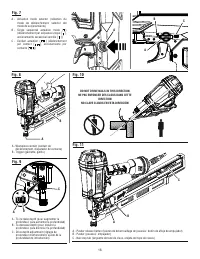
11 – English OPERATION DRIVING NAILS AT AN ANGLE See Figure 10, page 16. When driving nails at an angle, make sure that the tool is pointed away from yourself and others. When driving nails at an angle, make sure that the tool is positioned correctly. Driving at an angle that is too steep may: • cau...
Page 12 - MAINTENANCE; COLD WEATHER OPERATION; AIR SUPPLY PRESSURE AND VOLUME
12 – English MAINTENANCE COLD WEATHER OPERATION For cold weather operation, near and below freezing, the moisture in the air line may freeze and prevent tool operation. We recommend the use of air tool oil or permanent antifreeze (ethylene glycol) as a cold weather oil. NOTICE: Do not store tools in...
Page 13 - ACCESSORIES
13 – English MAINTENANCE Begin inspection: • Without pulling the trigger, press the workpiece con- tact against a workpiece several times. The tool must not actuate. • With the workpiece contact not engaged on the workpiece, point the tool down and away and pull the trigger several times. Hold the...
Page 14 - PROBLEM
14 – English TROUBLESHOOTING ILLUSTRATIONS START ON PAGE 15 AFTER FRENCH AND SPANISH LANGUAGE SECTIONS. PROBLEM POSSIBLE CAUSE SOLUTION Air leak near the top of the tool or in the trigger area Inadequate lubrication Loose screws Worn or damaged O-rings or seals Lubricate tool Tighten screws Install ...
Page 15 - RÈGLES DE SÉCURITÉ GÉNÉRALES; CONSERVER CES INSTRUCTIONS; SÉCURITÉ PERSONNELLE
2 – Français RÈGLES DE SÉCURITÉ GÉNÉRALES DANGER : LIRE ET VEILLER À BIEN COMPRENDRE LES AUTOCOLLANTS APPOSÉS SUR L’OUTIL ET LE MANUEL. Le non respect de cet avertissement pourrait entraîner des BLESSURES GRAVES ou MORTELLES. CONSERVER CES INSTRUCTIONS LIEU DE TRAVAIL Garder le lieu de travail pro...
Page 16 - UTILISATION
3 – Français RÈGLES DE SÉCURITÉ GÉNÉRALES Peut ne pas convenir aux outils pneumatiques. Lire attentivement le manuel d’utilisation. Apprendre les applications et les limites de l’outil, ainsi que les risques spécifiques relatifs à son utilisation. Le respect de cette règle réduira les risques d’in...
Page 17 - RÈGLES DE SÉCURITÉ PARTICULIÈRES; CHARGEMENT DE L’OUTIL; CONSERVER CES INSTRUCTIONS.
4 – Français RÈGLES DE SÉCURITÉ PARTICULIÈRES N’actionner l’outil que pour planter un clou dans la pièce à assujettir. Toujours s’assurer que la surface de contact est exactement positionnée sur la pièce à clouer. Un positionnement seulement partiel de la surface de contact sur la pièce à clouer...
Page 18 - SYMBOLES
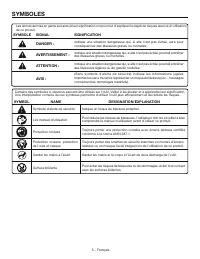
5 – Français SYMBOLES Certains des symboles ci-dessous peuvent être utilisés sur l’outil. Veiller à les étudier et à apprendre leur signification. Une interprétation correcte de ces symboles permettra d’utiliser l’outil plus efficacement et de réduire les risques. SYMBOL NAME DESIGNATION/EXPLANATION...
Page 19 - GLOSSAIRE; CARACTÉRISTIQUES; FICHE TECHNIQUE
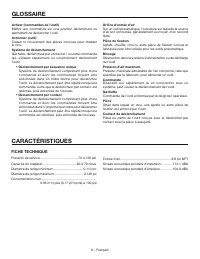
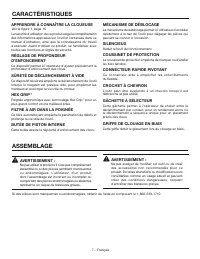
6 – Français GLOSSAIRE Activer (commandes de l’outil) Mettre une commande sur une position déclenchant ou permettant de déclencher l’outil Actionner (outil) Causer le mouvement des pièces conçues pour chasser le clou. Système de déclenchement Gâchette, déclencheur par contact et / ou autre commande ...
Page 21 - COUSSINET DE PROTECTION
8 – Français DANGER : N e p a s u t i l i s e r d e l ’ o x y g è n e o u d e s g a z combustibles ou en bouteille pour alimenter l’outil. L’outil exploserait, causant des blessures graves ou mortelles. AVERTISSEMENT : Ne pas laisser la familiarité avec les outils faire oublier la prudence. Ne pas o...
Page 22 - CHARGEMENT DES CLOUS
9 – Français UTILISATION AVERTISSEMENT : Débrancher l’outil de la source d’air et enlever les clous de l’outil avant de quitter le lieu de travail, de transporter l’outil à un autre endroit ou de le passer à une autre personne. Ne pas prendre cette précaution peut entraîner des blessures graves. Cet...
Page 23 - UTILISATION DE LA GÂCHETTE À SÉLECTEUR; DÉCLENCHEMENT PAR SÉQUENCE UNIQUE
10 – Français UTILISATION AVERTISSEMENT : Ne pas utiliser de clous dont le diamètre est inférieur à 2,87 mm (0,113 po). Ne pas respecter cette directive peut faire en sorte que les clous soient expulsés prématurément de l’outil par la rampe. Ne pas utiliser de clous en acier trempé avec des outils p...
Page 24 - ENFONCER LES CLOUS À ANGLE; DÉBLOCAGE D’UN CLOU
11 – Français UTILISATION Pour le test, utiliser une pression de 90 à 95 psi. Augmenter ou réduire la pression d’air de manière à obtenir le réglage minimum permettant d’exécuter le travail uniformément. Il est possible d’obtenir la profondeur désirée simplement en réglant la pression d’air. Si un r...
Page 25 - ENTRETIEN; PRESSION ET VOLUME D’AIR; ENTRETIEN GÉNÉRAL
12 – Français ENTRETIEN AVIS : Ne pas entreposer les outils dans des endroits froids pour éviter la formation de givre ou de glace sur les soupapes et mécanismes, afin de ne pas risquer une défaillance de l’outil. NOTE : Certains produits d’assèchement de flexibles d’air sont nuisibles aux joints et...
Page 26 - ACCESSOIRES
13 – Français • En tenant la surface de contact enfoncée, relâcher la gâchette. Le poinçon devrait retourner à sa position initiale. Débrancher l’alimentation d’air de l’outil et retirer toutes les agrafes. Choisir le mode de déclenchement par contact ( ). Rebrancher l’outil à la source d’air....
Page 27 - PROBLÈME
14 – Français DÉPANNAGE ILLUSTRATIONS COMMENÇANT SUR 15 DE PAGE APRÈS LA SECTION ESPAGNOL. PROBLÈME CAUSE POSSIBLE SOLUTION Fuite d’air dans le haut de l’outil ou près de la gâchette Lubrification insuffisante Vis desserrées Joints ou joints toriques usés Lubrifier l’outil Serrer les vis Installer l...
Page 28 - REGLAS DE SEGURIDAD GENERALES; GUARDE ESTAS INSTRUCCIONES; SEGURIDAD PERSONAL; EMPLEO Y CUIDADO DE LA HERRAMIENTA
2 – Español REGLAS DE SEGURIDAD GENERALES PELIGRO : LEA Y COMPRENDA LAS ETIQUETAS DE L A S H E R R A M I E N TA S Y E L M A N U A L . L a inobservancia de los avisos de advertencia podría causar la MUERTE o LESIONES SERIAS. GUARDE ESTAS INSTRUCCIONES ÁREA DE TRABAJO Mantenga limpia y bien iluminad...
Page 29 - FUNCIONAMIENTO
3 – Español REGLAS DE SEGURIDAD GENERALES Familiarícese con su herramienta neumáticas. Lea cuidadosamente el manual del operador. Aprenda sus usos y limitaciones, así como los posibles peligros específicos de esta herramienta. Con el cumplimiento de esta regla se reduce el riesgo de una descarga e...
Page 30 - REGLAS DE SEGURIDAD ESPECÍFICAS; SUMINISTRO DE AIRE Y CONEXIONES; CÓMO CARGAR LA HERRAMIENTA; GUARDE ESTAS INSTRUCCIONES.
4 – Español REGLAS DE SEGURIDAD ESPECÍFICAS No utilice una herramienta si alguna parte de los controles de funcionamiento de esta no puede ser utilizada, está desconectada, fue modificada o no funciona correctamente. Las herramientas neumáticas están diseñadas para usarlas con una sola mano. No ...
Page 31 - SÍMBOLOS
5 – Español SÍMBOLOS Es posible que se empleen en esta herramienta algunos de los siguientes símbolos. Le suplicamos estudiarlos y aprender su significado. Una correcta interpretación de estos símbolos le permitirá utilizar mejor y de manera más segura la herramienta. SYMBOL NAME DESIGNATION/EXPLANA...
Page 32 - GLOSARIO DE TÉRMINOS; CARACTERÍSTICAS; ESPECIFICACIONES DEL PRODUCTO
6 – Español GLOSARIO DE TÉRMINOS Activar (los controles de accionamiento) Es mover un control de accionamiento de manera que quede en una posición en la cual se accione la herramienta o cumpla con un requisito necesario para accionar la misma. Accionar (la herramienta) Es producir el movimiento de l...
Page 33 - MECANISMO DE LIBERACIÓN DE ATASCOS; GATILLO DE MODO SELECCIONABLE
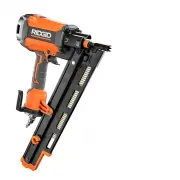
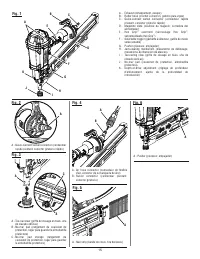
7 – Español FAMILIARÍCESE CON LA CLAVADORA DE ENTRAMAR Vea la figura 1, página 15. Para usar este producto con la debida seguridad se debe comprender la información indicada en la herramienta misma y en este manual, y se debe comprender también el trabajo que intenta realizar. Antes de usar este pro...
Page 34 - USOS; ALMOHADILLA PROTECTORA
8 – Español PELIGRO: No utilice oxígeno, gases combustibles ni gases embotellados como fuente de energía para esta herramienta. La herramienta explotará y causará la muerte o lesiones serias. ADVERTENCIA: N o p e r m i t a q u e s u f a m i l a r i z a c i ó n c o n l a s herramientas lo vuelva desc...
Page 36 - UTILIZACIÓN DEL GATILLO DE MODO; SEGURO DE DISPARO EN SECO
10 – Español FUNCIONAMIENTO ADVERTENCIA: No utilice clavos de un vástago menor de 2,87 mm (0.113 pulg.) de diámetro. Si lo hace, es posible que los clavos salgan de la herramienta antes de tiempo por el riel de la guía. No utilice clavos endurecidos con herramientas neumáticas. Esto puede llevar a u...
Page 37 - AJUSTE DE LA PRESIÓN DE AIRE; CÓMO RETIRAR UN SUJETADOR ATORADO
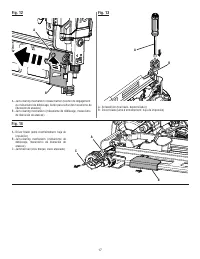
11 – Español FUNCIONAMIENTO AJUSTE DE LA PRESIÓN DE AIRE La cantidad presión de aire requerida depende del tamaño de los clavos y del material de la pieza de trabajo. Comience por probar la profundidad de introducción introduciendo un clavo de prueba en el mismo tipo de material de la pieza de traba...
Page 38 - MANTENIMIENTO; LUBRICACIÓN; AVISO; PRESIÓN Y VOLUMEN DEL SUMINISTRO DE
12 – Español MANTENIMIENTO LUBRICACIÓN Para obtener un desempeño óptimo de la herramienta se requiere una lubricación frecuente, pero no excesiva. El aceite para herramientas neumáticas de clavar vertido por la conexión del conducto de aire lubrica las partes internas. No utilice aceite con deterge...
Page 39 - LISTA DE CONTROL DIARIA OBLIGATORIA; ACCESORIOS
13 – Español agua presentes en el sistema. Toda limitación en el flujo de aire impide a la herramienta recibir un volumen adecuado de aire, incluso si está elevada la lectura de la presión. El resultado de tales circunstancias puede ser funcionamiento lento o potencia de introducción reducida. Antes...
Page 40 - SOLUCIÓN DE PROBLEMAS
14 – Español SOLUCIÓN DE PROBLEMAS PROBLEM POSSIBLE CAUSE SOLUTION Fuga de aire cerca de la parte superior de la herramienta o junto al gatillo Lubricación inadecuada Juntas tóricas o sellos gastados o dañados Lubrique la herramienta Instale el juego de mantenimiento general Fuga de aire cerca de la...
Page 44 - OPERATOR’S MANUAL; FULL ROUND HEAD FRAMING NAILER; CLOUEUSE DE CHARPENTIER À TÊTE RONDE; Información sobre servicio al consumidor:
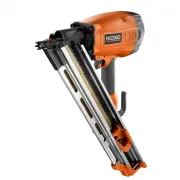
OPERATOR’S MANUAL MANUEL D’UTILISATIONMANUAL DEL OPERADOR FULL ROUND HEAD FRAMING NAILER CLOUEUSE DE CHARPENTIER À TÊTE RONDE CLAVADORA DE ENTRAMAR PARA CLAVOS DE CABEZA REDONDA NORMAL R350RHF 991000781 8-22-18 (REV:03) ONE WORLD TECHNOLOGIES, INC. P.O. Box 1427Anderson, SC 29622 USA 1-866-539-1710 ...