Page 2 - IMPORTANT NOTICE; – THE SERIAL NUMBER FOR THIS EQUIPMENT IS LOCATED IN THE REAR.; Information to User; Responsible Party Name:; CAUTION; The; Operating Environment; STA
IMPORTANT NOTICE – THE SERIAL NUMBER FOR THIS EQUIPMENT IS LOCATED IN THE REAR. PLEASE WRITE THIS SERIAL NUMBER ON YOUR ENCLOSED WARRANTY CARD AND KEEP IN A SECURE AREA. THIS IS FOR YOUR SECURITY. D1-4-2-6-1_En This Class B digital apparatus complies with Canadian ICES-003. Cet appareil numérique de...
Page 3 - RISK OF ELECTRIC SHOCK; IMPORTANT; Before plugging in for the first time, read the following; WARNING
D3-4-2-1-1_En-A The exclamation point within an equilateral triangle is intended to alert the user to the presence of important operating and maintenance (servicing) instructions in the literature accompanying the appliance. The lightning flash with arrowhead symbol, within an equilateral triangle, ...
Page 4 - Handling the cord on this product or; Wash hands after handling
This product contains mercury. Disposal of this material may be regulated due to environmental considerations. For disposal or recycling information, please contact your local authorities or the Electronics Industries Alliance : www.eiae.org. K057_En If the AC plug of this unit does not match the AC...
Page 5 - Contents
5 En Contents 01 Before you start Features . . . . . . . . . . . . . . . . . . . . . . . . . . . . . . . . . . . . . . 7Checking what’s in the box . . . . . . . . . . . . . . . . . . . . . . . 8Installing the receiver . . . . . . . . . . . . . . . . . . . . . . . . . . . 8Loading the batteries . . ....
Page 7 - Before you start; Features
Before you start 01 7 En Chapter 1: Before you start Features • Advanced Direct Energy design This receiver offers a new advancement in discrete design unique to Pioneer for high-power drivability, low distortion and stable imaging. Through a circuit design that minimizes the energy loss of the ampl...
Page 8 - XM and SIRIUS Ready; Checking what’s in the box; Caution
Before you start 01 8 En • XM and SIRIUS Ready With the new XM and SIRIUS Radio terminals, you’ll be up and running in no time. This receiver’s enhanced compatibility makes XM HD Surround playback as well as on-screen control of XM and SIRIUS Radio an added possibility. Checking what’s in the box Pl...
Page 9 - minute guide; Introduction to home theater; Note; SBR; SW
5 minute guide 02 9 En Chapter 2: 5 minute guide Introduction to home theater Home theater refers to the use of multiple audio tracks to create a surround sound effect, making you feel like you’re in the middle of the action or concert. The surround sound you get from a home theater system depends n...
Page 10 - Playing a; Important
5 minute guide 02 10 En Automatically setting up for surround sound (Auto MCACC) The Auto MCACC Setup measures the acoustic characteristics of your listening area, taking into account ambient noise, speaker size and distance, and tests for both channel delay and channel level. After you have set up ...
Page 11 - Problems when; Problems when using the Auto MCACC Setup; Playing a source; Listening to your system
5 minute guide 02 11 En • With error messages (such as Too much ambient noise! or Check Microphone. ) select RETRY after checking for ambient noise (see Problems when using the Auto MCACC Setup below) and verifying the mic connection. If there doesn’t seem to be a problem, you can simply select GO N...
Page 12 - Dolby Digital EX; Better sound using Phase Control; Phase Control OFF; PHASE CONTROL
5 minute guide 02 12 En It is possible to check on the display whether or not multi-channel playback is being performed properly. When using a surround back speaker, Dolby Digital EX is displayed when playing Dolby Digital signals, and DTS+Neo:6 is displayed when playing DTS 5.1-channel signals. Whe...
Page 13 - Connecting your equipment; Rear panel
Connecting your equipment 03 13 En Chapter 3: Connecting your equipment This receiver provides you with many connection possibilities, but it doesn’t have to be difficult. This page explains the kinds of components you can connect to make up your home theater system. Rear panel Caution • Before maki...
Page 14 - 1 SIRIUS Radio input
Connecting your equipment 03 14 En 11 SIRIUS Radio input See Using SIRIUS Radio on page 56. 12 ZONE 2 audio/video outputs Use to connect a second receiver in a separate room. See MULTI-ZONE listening on page 60. 13 Component video connections (x4) Use the inputs to connect any video source that ...
Page 15 - • To avoid hum, do not lay connected cables over the; About the video converter; MONITOR VIDEO OUT; The Input Setup menu
Connecting your equipment 03 15 En When making cable connections • To avoid hum, do not lay connected cables over the top of the receiver. • When connecting optical cables, be careful when inserting the plug not to damage the shutter protecting the optical socket. • When storing optical cable, coil ...
Page 16 - About HDMI
Connecting your equipment 03 16 En Connecting using HDMI If you have an HDMI or DVI (with HDCP) equipped component, you can connect it to this receiver using a commercially available HDMI cable. 1 The HDMI connection transfers uncompressed digital video, as well as almost every kind of digital audio...
Page 18 - Use an optical cable for the connection.
Connecting your equipment 03 18 En Connecting a satellite/cable receiver or other set-top box Satellite and cable receivers, and terrestrial digital TV tuners are all examples of so-called ‘set-top boxes’. 1 Connect the audio/video outputs on the set-top box to the TV SAT AUDIO and VIDEO inputs. Con...
Page 19 - If the device can output digital audio, connect an; Using the component video jacks; Connect the component video outputs of your; Connect using a three-way component video cable.; Connect the COMPONENT VIDEO MONITOR OUT; Connecting digital audio sources; Connecting analog audio sources
Connecting your equipment 03 19 En 3 If the device can output digital audio, connect an optical-type 1 digital audio output from the recorder to the OPTICAL IN 2 (DVR1) input. Use an optical cable for the connection. 2 Using the component video jacks Component video should give superior picture qual...
Page 20 - About the WMA9 Pro decoder
Connecting your equipment 03 20 En 1 Connect a coaxial-type 1 digital audio output on your digital component to the COAXIAL IN 2 (CD) input. Use a coaxial cable for the connection. 2 For recording equipment, connect the optical-type DIGITAL output to a digital input on the recorder. Use an optical c...
Page 21 - Switching the speaker impedance; Connecting the speakers; • These speaker terminals carry; HAZARDOUS LIVE; . To prevent the risk of electric shock when
Connecting your equipment 03 21 En Installing your speaker system To take full advantage of the receiver’s surround sound capabilities connect front, center, surround and surround back speakers, as well as a subwoofer. 1 Although this is ideal, other configurations with fewer speakers—no subwoofer o...
Page 22 - Bare wire connections; Other connections; Placing the speakers
Connecting your equipment 03 22 En Bare wire connections Make sure that the speaker cable you’re going to use is properly prepared with about 10 mm ( 3 / 8 in.) of insulator stripped from each wire, and the exposed wire strands twisted together ( fig. A ). To connect a terminal, unscrew the terminal...
Page 23 - ) shows orientation with one surround back speaker (or; Connecting antennas; Connecting external; Connecting external antennas
Connecting your equipment 03 23 En The diagrams below show suggested surround and surround back speaker orientation. The first diagram ( fig. A ) shows orientation with one surround back speaker (or none) connected. The second ( fig. B ) shows orientation with two surround back speakers connected. C...
Page 24 - • Handle the power cord by the plug part. Do not pull; Plug the power cord into a power outlet.
Connecting your equipment 03 24 En Plugging in the receiver Only plug in after you have connected all your components to this receiver, including the speakers. Caution • Handle the power cord by the plug part. Do not pull out the plug by tugging the cord, and never touch the power cord when your han...
Page 25 - Controls and displays; Front panel; Operating range of remote control unit
Controls and displays 04 25 En Chapter 4: Controls and displays Front panel 1 INPUT SELECTOR dial Use to select an input source. 2 STANDBY/ON Switches the receiver between on and standby. Power indicator lights when the receiver is on. 3 Remote sensor Receives the signals from the remote control (...
Page 26 - Auto playback
Controls and displays 04 26 En 10 PHONES jack Use to connect headphones. When the headphones are connected, there is no sound output from the speakers. 11 Listening mode buttons AUTO SURR/STREAM DIRECT – Switches between Auto surround mode ( Auto playback on page 30) and Stream Direct playback. Stre...
Page 27 - SBL; Listening in surround; eo
Controls and displays 04 27 En Display 1 SIGNAL indicators Light to indicate the currently selected input signal. AUTO lights when the receiver is set to select the input signal automatically (page 33). 2 Program format indicators These change according to which channels are active in digital source...
Page 28 - Controlling the rest of your system
Controls and displays 04 28 En Remote control The remote has been conveniently color-coded according to component control using the following system (press the corresponding input source button to access): • White – Receiver controls (see below) • Blue – Other controls (page 78) 1 RECEIVER This sw...
Page 29 - Selecting preset
Controls and displays 04 29 En RETURN – Press to confirm and exit the current menu screen (also use to return to the previous menu with DVDs or to select closed captioning with DTV). 6 /// (TUNE/ST) /ENTER Use the arrow buttons when setting up your surround sound system (page 38) and the Audio o...
Page 30 - Standard surround sound
Listening to your system 05 30 En Chapter 5: Listening to your system Important • The listening modes and many features described in this section may not be available depending on the current source, settings and status of the receiver. See Listening modes with different input signal formats on page...
Page 31 - Using the Advanced surround effects; Tip; Listening in stereo; Using Front Stage Surround
Listening to your system 05 31 En • 2 Pro Logic IIx MOVIE – See above (only available when you’re using two surround back speakers) • 2 Pro Logic IIx MUSIC – See page 30 • Dolby Digital EX – Creates surround back channel sound for 5.1 channel sources and provides pure decoding for 6.1 channel source...
Page 32 - Using Stream Direct; Stream direct; Selecting MCACC presets; FOCUS
Listening to your system 05 32 En Using Front Stage Surround Advance The Front Stage Surround Advance function allows you to create natural surround sound effects using just the front speakers and the subwoofer. • While listening to a source, press RECEIVER, then press STEREO/A.L.C. to select Front ...
Page 33 - Data Management; Choosing the input signal
Listening to your system 05 33 En • While listening to a source, press RECEIVER, then press MCACC. Press repeatedly to select one of the six MCACC presets 1 or to switch calibration off. See Data Management on page 46 to check and manage your current settings. Choosing the input signal You need to h...
Page 34 - Using the Virtual Surround Back mode; Press SBch repeatedly to cycle the virtual surround
Listening to your system 05 34 En Using the Virtual Surround Back mode When you’re not using surround back speakers, selecting this mode allows you to hear a virtual surround back channel through your surround speakers. You can choose to listen to sources with no surround back channel information, o...
Page 35 - Control connected to this receiver via HDMI.; Press RECEIVER, then press GENRE while the source
Listening to your system 05 35 En Using the genre synchronizing function This feature automatically selects the most appropriate Advanced Surround mode for the source currently being played back on a Pioneer DVD recorder supporting HDMI Control connected to this receiver via HDMI. 1 For details on H...
Page 36 - Using the tuner; Listening to the radio; Improving FM stereo sound; Saving station presets; Listening to the radio
Using the tuner 06 36 En Chapter 6: Using the tuner Listening to the radio The following steps show you how to tune in to FM and AM radio broadcasts using the automatic (search) and manual (step) tuning functions. If you already know the frequency of the station you want, see Tuning directly to a st...
Page 37 - Naming station presets; Listening to station presets
Using the tuner 06 37 En Naming station presets For easier identification, you can name your station presets. 1 Choose the station preset you want to name. See Listening to station presets below for how to do this. 2 Press T.EDIT (Tuner Edit). The display shows STATION NAME , then a blinking cursor ...
Page 38 - The System Setup menu
The System Setup menu 07 38 En Chapter 7: The System Setup menu Making receiver settings from the System Setup menu The following section shows you how to make detailed settings to specify how you’re using the receiver (for example, if you want to set up two speaker systems in separate rooms), and a...
Page 42 - Fine Channel Level
The System Setup menu 07 42 En 2 Select the setting you want to adjust. If you’re doing this for the first time, you might want to make these settings in order. • Fine Channel Level – Make fine adjustments to the overall balance of your speaker system (see Fine Channel Level on page 42). • Fine SP D...
Page 43 - Standing Wave; (only available when Filter Ch above is; Acoustic Calibration EQ Adjust
The System Setup menu 07 43 En Listen to the reference speaker and use it to measure the target channel. From the listening position, face the two speakers with your arms outstretched pointing at each speaker. Try to make the two tones sound as if they are arriving simultaneously at a position sligh...
Page 44 - Acoustic Calibration EQ Professional; How to use Acoustic Calibration EQ Professional; How to interpret the graphical output; Reverberance of high vs. low frequencies; Level
The System Setup menu 07 44 En Use / to select the channel. Use / to select the frequency and / to boost or cut the EQ. When you’re finished, go back to the top of the screen and use / to select the next channel. • The OVER! indicator shows in the display if the frequency adjustment is too d...
Page 45 - Using Acoustic Calibration EQ Professional; Automatically setting up for surround sound
The System Setup menu 07 45 En • Reverb characteristics for different channels – Reverb characteristics can be somewhat different for each channel. Since this difference increases as the sound is influenced by the various room characteristics, it is often better to capture a frequency analysis early...
Page 47 - Checking MCACC preset data; Automatically setting up for; Renaming MCACC presets; Manual MCACC setup; Clearing MCACC presets
The System Setup menu 07 47 En Checking MCACC preset data After you have completed Automatically setting up for surround sound (Auto MCACC) on page 10 or Automatic MCACC (Expert) on page 38, you can check your calibrated settings using the on-screen display. 1 Select ‘MCACC Data Check’ from the Data...
Page 49 - Channel Level
The System Setup menu 07 49 En • SW – LFE signals and bass frequencies of channels set to SMALL are output from the subwoofer when YES is selected. Choose the PLUS setting if you want the subwoofer to output bass sound continuously or you want deeper bass (the bass frequencies that would normally co...
Page 50 - Speaker Distance
The System Setup menu 07 50 En Speaker Distance For good sound depth and separation from your system, you need to specify the distance of your speakers from the listening position. The receiver can then add the proper delay needed for effective surround sound. Important • When Speaker Distance is se...
Page 51 - Before making or changing the connections; Connecting an iPod; Connecting your iPod to the receiver; Finding what you want to play
Other connections 08 51 En Chapter 8: Other connections Caution • Before making or changing the connections , switch off the power and disconnect the power cord from the power outlet. Plugging in components should be the last connection you make with your system. • Do not allow any contact between s...
Page 52 - • You can play all of the songs in a particular category; Basic playback controls; to switch the remote control; Switching the iPod controls; Button
Other connections 08 52 En 3 Continue browsing until you arrive at what you want to play, then press to start playback. 1 Navigation through categories on your iPod looks like this: Playlists Songs Artists Albums Songs Albums Songs SongsPodcastsGenres Artists Albums Songs Composers ...
Page 53 - Connecting your USB device to the receiver; Troubleshooting
Other connections 08 53 En Connecting a USB device It is possible to listen to two-channel audio 1 using the USB interface on the front of this receiver. Connect a USB mass storage device 2 as shown below. Connecting your USB device to the receiver 1 Switch on the receiver and your TV. 2 Press iPod ...
Page 54 - Compressed audio compatibility; WMA; Other compatibility information; Using XM Radio; About XM; Connecting your XM Radio receiver; Connect an XM Mini-Tuner to the XM IN jack on the
Other connections 08 54 En Compressed audio compatibility Note that although most standard bit/sampling rate combinations for compressed audio are compatible, some irregularly encoded files may not play back. The list below shows compatible formats for compressed audio files: • MP3 (MPEG-1/2/2.5 Aud...
Page 55 - Listening to XM Radio; Using XM HD Surround; Selecting channels and browsing by genre; Using the XM Menu; Using the XM Menu
Other connections 08 55 En 2 Press XM to switch to the XM Radio input. For best reception, you may need to move the XM Mini-Tuner antenna near a window (the southernmost window should produce the best results). • If after pressing XM the display shows Check XM Tuner , try disconnecting the receiver ...
Page 56 - Using SIRIUS Radio; Connecting your SIRIUS Connect Tuner
Other connections 08 56 En • Memory Recall – Use / to browse your saved song information (See Tip above) 3 When you’re finished press TOP MENU to return to the reception display. Using SIRIUS Radio With SIRIUS you get The Best Radio on Radio™ with all your favorite entertainment including 100 % co...
Page 57 - Saving channel presets; Using the SIRIUS Menu
Other connections 08 57 En Tip • You can select channels directly by pressing D.ACCESS , then the three-digit channel number. • You can press DISPLAY to change SIRIUS Radio information in the front panel display. • The currently selected channel is automatically chosen (without pressing ENTER ) afte...
Page 58 - Speaker B setup; Switching the speaker system
Other connections 08 58 En Selecting the multichannel analog inputs If you have connected a decoder or a DVD player as above, you must select the analog multichannel inputs for surround sound playback. 1 1 Make sure you have set the playback source to the proper output setting. For example, you migh...
Page 59 - Bi-wiring your speakers
Other connections 08 59 En • SP (off) – No sound is output from the speakers. The same sound is output from the pre-out terminals (including from your subwoofer, if connected) as when selecting speaker system A (above). Bi-amping your front speakers Bi-amping is when you connect the high frequency...
Page 60 - LARGE; ZONE Audio Setup; Making MULTI-ZONE connections
Other connections 08 60 En Connecting additional amplifiers This receiver has more than enough power for any home use, but it’s possible to add additional amplifiers to every channel of your system using the pre-outs. Make the connections shown below to add amplifiers to power your speakers. • Befor...
Page 61 - MULTI-ZONE listening options; Using the MULTI-ZONE controls; ZONE remote controls; and other analog audio sources.; ZONE
Other connections 08 61 En MULTI-ZONE listening options The following table shows what you can listen to in the sub zone: Basic MULTI-ZONE setup ( ZONE 2 ) • Connect a separate amplifier to the ZONE 2 AUDIO OUT jacks and a TV monitor to the ZONE 2 VIDEO OUT jacks, both on the rear of this receiver. ...
Page 62 - MULTI-ZONE remote controls; Connecting an IR receiver; Operating other Pioneer components; Use to select the input source in the sub zone.
Other connections 08 62 En 2 Press CONTROL. • When the receiver is on, 1 make sure that any operations for the sub zone are done while ZONE 2 shows in the display. If this is not showing, the front panel controls affect the main zone only. 3 Use the INPUT SELECTOR dial to select the source for the z...
Page 63 - The Input; Use a 3-ringed miniplug SR+ cable to connect the
Other connections 08 63 En Using this receiver with a Pioneer flat panel TV If you have a Pioneer flat panel TV, you can use an SR+ cable 1 to connect it to this receiver and take advantage of various convenient features, such as automatic video input switching of the flat panel TV when the input is...
Page 64 - SR+ Setup for Pioneer flat panel TVs; Using this receiver with a Pioneer flat panel TV
Other connections 08 64 En Using the SR+ mode with a Pioneer flat panel TV When connected using an SR+ cable, a number of features become available to make using this receiver with your Pioneer flat panel TV even easier. These features include: • On-screen displays when making receiver settings, suc...
Page 65 - Making the HDMI Control connections; Setting the HDMI options; Setting the HDMI Control mode
HDMI Control 09 65 En Chapter 9: HDMI Control Important • The KURO LINK function name used on the web and in catalogues is referred to as HDMI Control in the operating instructions and on the product. By connecting this receiver to an HDMI Control-compatible Pioneer flat panel TV or the HDD/DVD reco...
Page 66 - Synchronized amp mode operations; Using the genre; Canceling synchronized amp mode; About HDMI Control
HDMI Control 09 66 En 1 Press RECEIVER, then press the SETUP button. 2 Select ‘Other Setup’, then press ENTER. 3 Select ‘HDMI Control Setup’ from the Other Setup menu. 4 Select the ‘HDMI Control’ setting you want. • ON – Enables the HDMI Control function. When this receiver’s power is turned off and...
Page 67 - Other Settings; Input function default and
Other Settings 10 67 En Chapter 10: Other Settings The Input Setup menu You only need to make settings in the Input Setup menu if you didn’t hook up your digital equipment according to the default settings (see Input function default and possible settings on page 68). In this case, you need to tell ...
Page 68 - Input function default and possible settings; The Other Setup menu; Input source
Other Settings 10 68 En Input function default and possible settings The terminals on the rear of the receiver generally correspond to the name of one of the input source functions. If you have connected components to this receiver differently from (or in addition to) the defaults below, see The Inp...
Page 69 - ZONE listening
Other Settings 10 69 En Multi Channel Input Setup You can adjust the level of the subwoofer for a multi-channel input. Also, when the multi-channel input is selected as an input source, you can display the video images of other input sources. In the Multi Channel Input Setup, you can assign a video ...
Page 70 - OSD Adjustment
Other Settings 10 70 En SR+ Setup for Pioneer flat panel TVs Make the following settings if you have connected a Pioneer flat panel TV to this receiver using an SR+ cable. Note that the number of function settings available will depend on the flat panel TV you’ve connected. See also Using this recei...
Page 71 - Using other functions; • Note that if a setting doesn’t appear in the Audio
Using other functions 11 71 En Chapter 11: Using other functions Setting the Audio options There are a number of additional sound settings you can make using the Audio Parameter menu. The defaults, if not stated, are listed in bold. Important • Note that if a setting doesn’t appear in the Audio Para...
Page 72 - • Note that if a setting doesn’t appear in the Video; to a TV or flat; Setting
Using other functions 11 72 En Setting the Video options There are a number of additional picture settings you can make using the Video Parameter menu. The defaults, if not stated, are listed in bold. Important • Note that if a setting doesn’t appear in the Video Parameter menu, it is unavailable du...
Page 73 - jacks for
Using other functions 11 73 En Making an audio or a video recording You can make an audio or a video recording from the built-in tuner, or from an audio or video source connected to the receiver (such as a CD player or TV). 1 Keep in mind you can’t make a digital recording from an analog source or v...
Page 75 - Default system settings; DSP
Using other functions 11 75 En The front panel display shows each of the following settings for three seconds each: 2 When you’re finished, press STATUS again to switch off the display. Resetting the system Use this procedure to reset all the receiver’s settings to the factory default. Use the front...
Page 76 - Selecting preset codes directly; LD; SAT; CD
Controlling the rest of your system 12 76 En Chapter 12: Controlling the rest of your system Setting the remote to control other components Most components can be assigned to one of the input source buttons (such as DVD or CD ) using the component’s manufacturer preset code stored in the remote. How...
Page 77 - Setting the remote to control other; TV CONTROL
Controlling the rest of your system 12 77 En Controls for TVs This remote control can control components after entering the proper codes or teaching the receiver the commands (see Setting the remote to control other components on page 76 for more on this). Use the input source buttons to select the ...
Page 78 - Function
Controlling the rest of your system 12 78 En Controls for other components This remote control can control these components after entering the proper codes or teaching the receiver the commands (see Setting the remote to control other components on page 76 for more on this). Use the input source but...
Page 79 - Many Pioneer components have; • Note that if you use this feature,
Controlling the rest of your system 12 79 En Operating other Pioneer components with this receiver’s sensor Many Pioneer components have CONTROL jacks which can be used to link components together so that you can use just the remote sensor of one component. When you use a remote control, the control...
Page 80 - Additional information; Power; Symptom
Additional information 13 80 En Chapter 13: Additional information Troubleshooting Incorrect operations are often mistaken for trouble and malfunctions. If you think that there is something wrong with this component, check the points below. Sometimes the trouble may lie in another component. Investi...
Page 82 - Other audio problems
Additional information 13 82 En Other audio problems Symptom Remedy Broadcast stations cannot be selected automatically, or there is considerable noise in radio broadcasts. For FM broadcasts • Fully extend the FM wire antenna, adjust the position for best reception and secure to a wall, etc. • Use a...
Page 83 - Video
Additional information 13 83 En Video Settings Symptom Remedy No image is output when an input is selected. • Check the video connections of the source component (see page 18). • For high-definition video (using component video connections), or when digital video conversion is switched off (in Setti...
Page 84 - Professional Calibration EQ graphical output
Additional information 13 84 En Professional Calibration EQ graphical output Display Symptom Remedy The EQ response displayed in the graphical output following calibration does not appear entirely flat. • There are cases where the graph does not appear flat (even when selecting ALL CH ADJUST in the ...
Page 85 - Remote control
Additional information 13 85 En Remote control USB interface Symptom Remedy Cannot be remote controlled. • Try replacing the batteries in the remote control (see Loading the batteries on page 8). • Be sure to operate within 7 m (23 feet) and a 30º angle of the remote sensor on the front panel (see O...
Page 87 - Configuration A; • The picture quality will change slightly during; Configuration B; • If your display only has one HDMI terminal, you can; XM radio messages
Additional information 13 87 En Important information regarding the HDMI connection There are cases where you may not be able to route HDMI signals through this receiver (this depends on the HDMI-equipped component you are connecting–check with the manufacturer for HDMI compatibility information). I...
Page 88 - SIRIUS radio messages
Additional information 13 88 En SIRIUS radio messages Note • If the unit does not operate normally due to external effects such as static electricity disconnect the power plug from the outlet and insert again to return to normal operating conditions. CH Unavailable The selected channel is not availa...
Page 89 - Dolby; Dolby Digital; decoding; Dolby Pro Logic; Dolby Pro Logic II; surround) from any stereo source; Dolby Pro Logic IIx; Dolby Surround is an; Dolby Digital Plus; * HD DVD and Blu-ray Disc standards currently limit
Additional information 13 89 En Surround sound formats Below is a brief description of the main surround sound formats you’ll find on DVDs, satellite, cable and terrestrial broadcasts, and video cassettes. Dolby The Dolby technologies are explained below. See www.dolby.com for more detailed informat...
Page 90 - DTS; DTS Digital Surround; Windows Media Audio 9 Professional
Additional information 13 90 En Manufactured under license from Dolby Laboratories. “ Dolby ”, “ Pro Logic ”, “ Surround EX ” and the double-D symbol are trademarks of Dolby Laboratories. DTS The DTS technologies are explained below. See www.dtstech.com for more detailed information. DTS Digital Sur...
Page 91 - About XM Radio; About SIRIUS
Additional information 13 91 En About XM U.S. & CANADIAN PRODUCTS NOTE: The below XM Radio company, legal and subscription information is required in all XM Ready ® user manuals in its entirety. About XM Radio XM is North America’s number one satellite radio company, offering an extraordinary va...
Page 92 - SBch Processing; As above
Additional information 13 92 En Listening modes with different input signal formats The following charts outline the listening modes available with different input signal formats, depending on the surround back channel processing and decoding method you have selected. Stereo (2 channel) signal forma...
Page 94 - Multichannel signal formats
Additional information 13 94 En Multichannel signal formats SBch Processing Input signal format Standard Auto Surround SBch Processing ON (7.1 channel decoding used for all sources) Dolby Digital Plus Dolby TrueHD DTS-HD DTS-HD Master Audio WMA9 Pro PCM (6.1/7.1 channel) Straight decoding Straight d...
Page 97 - Continuous Power Output (20 Hz to 20 kHz, 8; AA/IEC R6P dry cell batteries; • Specifications and the design are subject to possible
Additional information 13 97 En Specifications Amplifier section Continuous average power output of 110 watts* per channel, min., at 8 ohms, from 20 Hz to 20 000 Hz with no more than 0.09 %** total harmonic distortion (front). Continuous Power Output (20 Hz to 20 kHz, 8 Ω , 0.09 %) Front . . . . . ....
Page 98 - • Use a polishing cloth or dry cloth to wipe off dust and
Additional information 13 98 En Cleaning the unit • Use a polishing cloth or dry cloth to wipe off dust and dirt. • When the surface is dirty, wipe with a soft cloth dipped in some neutral cleanser diluted five or six times with water, and wrung out well, and then wipe again with a dry cloth. Do not...
Page 99 - To establish a safe level:; We Want You Listening For A Lifetime; Information courtesy of the Deafness Research Foundation.
Additional information 13 99 En S001_En Selecting fine audio equipment such as the unit you’ve just purchased is only the start of your musical enjoyment. Now it’s time to consider how you can maximize the fun and excitement your equipment offers. This manufacturer and the Electronic Industries Asso...
Page 100 - Printed in; PIONEER CORPORATION; PIONEER EUROPE NV
<ARB7400-A> Printed in Published by Pioneer Corporation.Copyright © 2008 Pioneer Corporation.All rights reserved. PIONEER CORPORATION 4-1, Meguro 1-Chome, Meguro-ku, Tokyo 153-8654, Japan PIONEER ELECTRONICS (USA) INC. P.O. BOX 1540, Long Beach, California 90801-1540, U.S.A. TEL: (800) 421-140...


 Pioneer AHU
User Manual
Pioneer AHU
User Manual
 Pioneer DMH WT6000NEX
User Manual
Pioneer DMH WT6000NEX
User Manual
 Pioneer DMH 2000NEX
User Manual
Pioneer DMH 2000NEX
User Manual
 Pioneer DMH W3050NEX
User Manual
Pioneer DMH W3050NEX
User Manual
 Pioneer HEAT PUMP
User Manual
Pioneer HEAT PUMP
User Manual
 Pioneer MINI-SPLITS OUTDOOR
User Manual
Pioneer MINI-SPLITS OUTDOOR
User Manual
 Pioneer SL405
User Manual
Pioneer SL405
User Manual
 Pioneer ND BC010
User Manual
Pioneer ND BC010
User Manual
 Pioneer TS A4671F
User Manual
Pioneer TS A4671F
User Manual
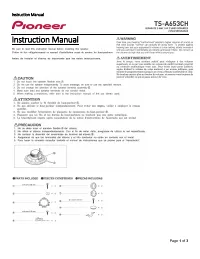 Pioneer TS A653CH
User Manual
Pioneer TS A653CH
User Manual
 Pioneer TS A653FH
User Manual
Pioneer TS A653FH
User Manual
 Pioneer TS A683FH
User Manual
Pioneer TS A683FH
User Manual
 Pioneer TS A693CH
User Manual
Pioneer TS A693CH
User Manual
 Pioneer TS A693FH
User Manual
Pioneer TS A693FH
User Manual
 Pioneer VSX LX805
User Manual
Pioneer VSX LX805
User Manual
 Pioneer PN43 751 24U
User Manual
Pioneer PN43 751 24U
User Manual