Page 2 - After you have finished reading the instructions, keep this man-; Contents
Thank you for buying this Pioneer product. Please read through these operating instructions so you will know how to operate your model properly. After you have finished reading the instructions, keep this man- ual in a safe place for future reference. Before You Start Information to User 6 For Canad...
Page 3 - English
Searching every 10 tracks in the current folder 28 Switching the tag display 28 Using compression and BMX 28 Displaying text information on MP3/WMA/ WAV disc 29 When playing back an MP3/WMA disc 29 When playing back a WAV disc 29 Scrolling text information in the display 29 Selecting tracks from the...
Page 5 - We Want You Listening For A Lifetime; Example
Selecting fine audio equipment such as the unit you’ve just purchased is only the start of your musical enjoyment. Now it’s time to consider how you can maximize the fun and excitement your equipment offers. This manufacturer and the Electronic Industries Association’s Consumer Electronics Group wan...
Page 7 - Precautions; Features; CD playback; About WMA
2 Receive updates on the latest products and technologies. 3 Download owner s manuals, order product catalogues, research new products, andmuch more. Precautions WARNING: Handling the cord on this product or cords asso-ciated with accessories sold with the product willexpose you to lead, a chemical ...
Page 8 - Switching the DSP setting; WARNING; Use a thin standard tip screwdriver to; Resetting the microprocessor; Press RESET with a pen tip or other; About the demo mode
WMA is short for Windows Media Audio and refers to an audio compression technology that is developed by Microsoft Corporation. WMA data can be encoded by using Windows Media Player version 7 or later. Microsoft, Windows Media, and the Windows logo are trademarks, or registered trademarks of Microsof...
Page 9 - Reverse mode; Use and care of the remote; Installing the battery; Using the remote control
Important The red lead (ACC) of this unit should be con-nected to a terminal coupled with ignition switchon/off operations. If this is not done, the vehiclebattery may be drained. Reverse mode If you do not perform an operation within about 30 seconds, screen indications start to reverse, and then c...
Page 10 - FUNCTION; AUDIO; About the XM READY mark
FUNCTION button and AUDIO button You can also select the desired mode by FUNCTION button and AUDIO button on the remote control. But operation of FUNCTION button and AUDIO button on the remote con- trol differs from the operation of MULTI-CONTROL on the head unit. When op- erating the remote control...
Page 12 - b c; What
c FUNCTION button Press to select functions. d Joystick Move to do manual seek tuning, fast for- ward, reverse and track search controls. Also used for controlling functions. ! You can perform same operation as MULTI-CONTROL on the head unit, ex- cept the turning operation. e DIRECT button Press to ...
Page 13 - Loading a disc; Basic Operations
Turning the unit on % Press SOURCE to turn the unit on. When you select a source the unit is turned on. Selecting a source You can select a source you want to listen to. To switch to the built-in CD player, load a disc in the unit (refer to this page). % When using the head unit, press SOURCE to sel...
Page 14 - Adjusting the volume; Switching the warning tone; Removing the front panel
! If you cannot insert a disc completely or ifafter you insert a disc the disc does not play,check that the label side of the disc is up.Press EJECT to eject the disc, and check the disc for damage before inserting it again. ! You can eject the CD by pressing and holding EJECT with opening the front...
Page 15 - Put the front panel into the protective; Attaching the front panel; Make sure the inner cover is closed.
Release button 3 Put the front panel into the protective case provided for safe keeping. Attaching the front panel 1 Make sure the inner cover is closed. 2 Replace the front panel by clipping it into place. Basic Operations En 15 English Section 03
Page 16 - Listening to the radio; Tuner
Listening to the radio 1 2 5 3 4 These are the basic steps necessary to operate the radio. More advanced tuner operation is explained starting on the next page. 1 LOC indicator Shows when local seek tuning is on. 2 Stereo ( 5 ) indicator Shows that the frequency selected is being broadcast in stereo...
Page 17 - Storing and recalling
Introduction of advanced tuner operation 1 2 1 Function name tag Shows the function currently selected in highlighted manner. 2 Function display Shows the function status. 1 Press MULTI-CONTROL to display the main menu. FUNCTION , AUDIO and ENTERTAINMENT appear on the display. 2 Use MULTI-CONTROL to...
Page 19 - Playing a CD; Selecting a trackdirectly
Playing a CD 1 3 2 These are the basic steps necessary to play a CD with your built-in CD player. More ad- vanced CD operation is explained starting on the next page. 1 Play time indicator Shows the elapsed playing time of the cur- rent track. 2 Track number indicator Shows the track currently playi...
Page 20 - Repeating play
Introduction of advanced built-in CD player operation 1 2 1 Function name tag Shows the function currently selected in highlighted manner. 2 Function display Shows the function status. 1 Press MULTI-CONTROL to display the main menu. FUNCTION , AUDIO and ENTERTAINMENT appear on the display. 2 Use MUL...
Page 21 - Selecting the search method
Playing tracks in a random order Random play lets you play back tracks on the CD in a random order. 1 Use MULTI-CONTROL to select RANDOM. The function name tag RANDOM is high- lighted. 2 Press MULTI-CONTROL to turn random play on. Random mode :ON appears in the display. Tracks will play in a random ...
Page 23 - Move the cursor to the last position by; Using CD TEXT functions; Displaying titles on CD TEXT discs; DISPLAY; Scrolling titles in the display; Press DISPLAY and hold until the title; Selecting tracks from the track; Turn MULTI-CONTROL to switch to the
6 Move the cursor to the last position by pushing MULTI-CONTROL right after enter- ing the title. When you push MULTI-CONTROL right one more time, the entered title is stored in mem- ory. 7 Press BAND/ESC to return to the play- back display. Notes ! Titles remain in memory, even after the disc has b...
Page 25 - Selecting a trackdirectly in; When using the remote control, you can select; The track of entered number will play.
! When playing back files recorded as VBR(variable bit rate) files, the play time will not becorrectly displayed if fast forward or reverseoperations are used. ! If the inserted disc contains no files that canbe played back, No audio is displayed. ! If the inserted disc contains WMA files thatare pr...
Page 26 - Introduction of advanced
Introduction of advanced built-in CD player (MP3/ WMA/WAV) operation 1 2 1 Function name tag Shows the function currently selected in highlighted manner. 2 Function display Shows the function status. 1 Press MULTI-CONTROL to display the main menu. FUNCTION , AUDIO and ENTERTAINMENT appear on the dis...
Page 27 - Scanning folders and tracks; playback
Playing tracks in a random order Random play lets you play back tracks in a random order within the repeat range, Folder and Disc . 1 Select the repeat range. Refer to Repeating play on the previous page. 2 Use MULTI-CONTROL to select RANDOM. The function name tag RANDOM is high- lighted. 3 Press MU...
Page 28 - Searching every 10 tracks in; Switching the tag display; Using compression and BMX
2 Press MULTI-CONTROL to select the search method. Press MULTI-CONTROL until the desired search method appears in the display. ! FF/REV Fast forward and reverse ! ROUGH Searching every 10 tracks Searching every 10 tracks in the current folder If the current folder contains over 10 tracks, you can se...
Page 29 - Displaying text information; When playing backan MP3/; When playing backa WAV disc; Scrolling text information
2 Press MULTI-CONTROL to select your fa- vorite setting. Press MULTI-CONTROL repeatedly to switch between the following settings: OFF COMP 1 COMP 2 OFF BMX 1 BMX 2 Displaying text information on MP3/WMA/WAV disc Text information recorded on an MP3/WMA/ WAV disc can be displayed. When playing backan ...
Page 30 - File name list lets you see the list of file names
Selecting tracks from the file name list File name list lets you see the list of file names (or folder names) and select one of them to playback. 1 Turn MULTI-CONTROL to switch to the file name list mode. Names of files and folders appear in the dis- play. 2 Use MULTI-CONTROL to select the de- sired...
Page 31 - You can use this unit to control a multi-CD
Playing a CD 1 4 3 2 You can use this unit to control a multi-CD player, which is sold separately. These are the basic steps necessary to play a CD with your multi-CD player. More advanced CD operation is explained starting on the next page. 1 Play time indicator Shows the elapsed playing time of th...
Page 32 - Selecting discs from the disc title list
2 Press 0 9 buttons to enter the desired track number. # You can cancel the input number by pressing CLEAR . 3 Press DIRECT. The track of entered number will play. Note After entering the number input mode, if you donot perform an operation within about eight sec-onds, the mode is automatically canc...
Page 33 - Playing tracks in a random; Scanning CDs and tracks
Notes ! When playing a CD TEXT disc on a CD TEXTcompatible multi-CD player, you cannotswitch to D.TITLE INPUT . The disc title will have already been recorded on a CD TEXTdisc. ! If you do not operate the function within about30 seconds, the display is automatically re-turned to the playback display...
Page 34 - Pausing CD playback; Using ITS playlists; Creating a playlist with ITS; Playbackfrom your ITS playlist
4 When you find the desired track (or disc) press MULTI-CONTROL to turn scan play off. Scan mode :OFF appears in the display. The track (or disc) will continue to play. # If the display has automatically returned to the playback display, select SCAN again by using MULTI-CONTROL . Note After track or...
Page 35 - Erasing a trackfrom your ITS; Playback from your ITS playlist; Erasing a CD from your ITS playlist; Using disc title functions
1 Select the repeat range. Refer to Repeating play on page 33. 2 Use MULTI-CONTROL to select ITS PLAY. The function name tag ITS PLAY is high- lighted. 3 Press MULTI-CONTROL to turn ITS play on. ITS play mode :ON appears in the display. Playback begins of those tracks from your playlist within the p...
Page 36 - Entering disc titles; Selecting discs from the disc
Entering disc titles Use the disc title input feature to store up to 100 CD titles (with ITS playlist) into the multi- CD player. Each title can be up to 10 charac- ters long. 1 Play the CD that you want to enter a title for. Push MULTI-CONTROL up or down to select the CD. 2 Use MULTI-CONTROL to sel...
Page 37 - You can use these functions only with a CD
# No disc is displayed next to the disc number when there is no disc in the magazine. # To return to the playback display, press BAND/ESC . Using CD TEXT functions You can use these functions only with a CD TEXT compatible multi-CD player. Some discs have certain information encoded on the disc duri...
Page 38 - You can use these functions only with a multi-; OFF
Using compression and bass emphasis You can use these functions only with a multi- CD player that supports them. Using COMP (compression) and DBE (dy- namic bass emphasis) functions lets you ad- just the sound playback quality of the multi- CD player. Each of the functions has a two- step adjustment...
Page 39 - Listening to the XM; You can use this unit to control a XM satellite di-; XM tuner
Listening to the XM 1 2 5 3 4 You can use this unit to control a XM satellite di- gital tuner (GEX-P910XM), which is sold separately. For details concerning operation, refer to the XMtuner s operation manuals. This section provides information on XMoperations with this unit which differs from that d...
Page 41 - Selecting the XM channel; Display the ID code; Channel number select setting
Selecting the channel in the channel category 1 Press CLOCK and hold to select Category. Press CLOCK and hold repeatedly to switch between the following channel select settings: Channel Number (channel number select set- ting) Category (channel category select setting) # You can also switch the XMch...
Page 42 - Watching the TV tuner; You can use this unit to control a TV tuner,; TV tuner
Watching the TV tuner 3 1 2 You can use this unit to control a TV tuner, which is sold separately. For details concerning operation, refer to the TV tuner s operation manuals. This section provides information on TV operations with this unit which differs from that described in the TV tuner s operat...
Page 44 - Playing a disc; You can use this unit to control a DVD player or; Selecting a disc; DVD Player
Playing a disc 1 2 4 3 5 You can use this unit to control a DVD player or multi-DVD player, which is sold separately. For details concerning operation, refer to the DVD player s or multi-DVD player s operation manual. This section provides information on DVD operations with this unit which differs f...
Page 46 - Using ITS; Entering
Pausing disc playback 1 Use MULTI-CONTROL to select PAUSE. The function name tag PAUSE is highlighted. 2 Press MULTI-CONTROL to turn pause on. Pause :ON appears in the display. Play of the current track pauses. # To turn pause off, press MULTI-CONTROL again. Playing tracks in a random order ! You ca...
Page 47 - Operation modes; Operation mode marks; Standard mode; Adjusting the audio easily; POSI; Adjusting the audio finely; POSI; Audio Adjustments
Operation modes This unit features two operation modes: the 3- way network mode (NW) and the standard mode (STD). You can switch between modes as desired. Initially, the DSP setting is set to the standard mode (STD). (Refer to Switching the DSP setting mode on page 8.) ! The 3-way network mode (NW) ...
Page 49 - Using the position selector; Using balance adjustment
band graphic equalizer) BBE (BBE) ASL (automatic sound levelizer) SLA (source level adjustment) FAD/BAL (balance adjustment) POSI (posi- tion selector) TA 1 (time alignment setting) TA 2 (time alignment adjusting) LOUD (loudness) G.EQ 1 (graphic equalizer) G.EQ 2 (13-band graphic equalizer) SW 1 (su...
Page 50 - Adjusting the time alignment
Using balance adjustment You can select a fader/balance setting that provides an ideal listening environment in all occupied seats. 1 Use MULTI-CONTROL to select FAD/BAL. The function name tag FAD/BAL is high- lighted. 2 Push MULTI-CONTROL up or down to adjust front/rear speaker balance. Each pushin...
Page 51 - About the network; Adjustable parameters; Reproduced frequency band
4 Push MULTI-CONTROL left or right to select the speaker to be adjusted. Each pushing MULTI-CONTROL left or right selects the speaker in the following order: High L (high-range left) High R (high-range right) Mid R (middle-range right) Mid L (middle-range left) Low L (low-range left) Low R (low-rang...
Page 52 - Normal phase
Slope Adjusting the HPF/LPF slope (filter attenuation slope) lets you adjust the continuity of sound between speaker units. ! The slope indicates the number of decibels (dB) the signal is attenuated when the fre- quency is one octave higher (lower) (Unit: dB/oct.). The steeper the slope, the more th...
Page 53 - Adjusting network
2 Push MULTI-CONTROL left or right to select the speaker unit (filter) to be ad- justed. Each pushing MULTI-CONTROL left or right selects the speaker unit (filter) in the following order: Low LPF (low-range speaker LPF) Mid HPF (middle-range speaker HPF) Mid LPF (mid- dle-range speaker LPF) High HPF...
Page 54 - Using subwoofer output; Adjusting subwoofer settings
# You can adjust the parameters for other speaker units (filters) in the same way. 10 Press BAND/ESC to cancel the network adjustment mode. Using subwoofer output This unit is equipped with a subwoofer output which can be switched on or off. When a sub- woofer is connected to this unit, turn the sub...
Page 55 - Using the high pass filter
Using the high pass filter When you do not want low sounds from the subwoofer output frequency range to play from the front or rear speakers, turn on the HPF (high pass filter). Only frequencies higher than those in the selected range are outputted from the front or rear speakers. Muting the speaker...
Page 56 - Using the auto-equalizer; Auto TA and; Recalling equalizer curves; Adjusting equalizer curves
4 Push MULTI-CONTROL left or right to select cut-off frequency. Each pushing MULTI-CONTROL left or right selects cut-off frequencies in the following order: 50 63 80 100 125 160 200 (Hz) Only frequencies higher than those in the se- lected range are output from the rear speak- ers. 5 Push MULTI-CONT...
Page 57 - Adjusting 13-band graphic; Using BBE sound
1 Use MULTI-CONTROL to select G.EQ 1. The function name tag G.EQ 1 is highlighted. 2 Push MULTI-CONTROL left or right to select an equalizer curve. 3 Push MULTI-CONTROL up or down to adjust the equalizer curve. Each pushing MULTI-CONTROL up or down increases or decreases the equalizer curve re- spec...
Page 58 - Adjusting loudness; Adjusting source levels
3 Push MULTI-CONTROL up or down to adjust the level of BBE. Each pushing MULTI-CONTROL up or down increases or decreases the level of BBE. +4 4 is displayed as the level is increased or decreased. Note Manufactured under license from BBE Sound,Inc. The mark BBE is a trademark of BBE Sound,Inc. Adjus...
Page 59 - Before operating the auto TA
Notes ! The AMtuner volume level can also be ad-justed with source level adjustments. ! The built-in CD player and the multi-CD playerare set to the same source level adjustmentvolume automatically. ! External unit 1 and external unit 2 are set tothe same source level adjustment volumeautomatically....
Page 60 - Carrying out auto TA and EQ
! The time alignment value calculated by auto TA and EQ may differ from the actual distance in the following circumstances. However, the distance has been calculated by computer to be the optimum delay to give accurate results for the circum- stances, so please continue to use this value. When the r...
Page 61 - standing auto TA and EQ error messages
9 Get out of the car and close the door within 10 seconds when the 10-second count-down starts. The measurement tone (noise) is outputted from the speakers, and auto TA and EQ be- gins. # When all speakers are connected, auto TA and EQ is completed in about six minutes. # To stop auto TA and EQ, pre...
Page 62 - Switching the auxiliary setting
Adjusting initial settings 1 2 Initial settings lets you perform initial setup of different settings for this unit. 1 Function name tag Shows the function currently selected in highlighted manner. 2 Function display Shows the function status. 1 Press SOURCE and hold until the unit turns off. 2 Press...
Page 63 - Switching the dimmer setting; Adjusting the brightness; Initial Settings
1 Use MULTI-CONTROL to select AUX. The function name tag AUX is highlighted. 2 Press MULTI-CONTROL to turn AUX on. AUX :ON appears in the display. # To turn AUX off, press MULTI-CONTROL again. Switching the dimmer setting To prevent the display from being too bright at night, the display is automati...
Page 65 - Press MULTI-CONTROL to turn the Ever; Switching the flap auto open; Use MULTI-CONTROL to select
2 Press MULTI-CONTROL to turn the Ever Scroll on. Ever-scroll :ON appears in the display. # To turn the Ever Scroll off, press MULTI-CONTROL again. Switching the flap auto open For theft protection, the front panel opens automatically and easily detaches. Flap auto open is on as a default. 1 Use MUL...
Page 66 - Using the AUX source; Selecting AUX as the source; Setting the AUX title; Other Functions
Turning the clockdisplay on or off You can turn the clock display on or off. % Press CLOCK to turn the clock display on or off. Each press of CLOCK turns the clock display on or off. Note Even when the sources and the feature demo areoff, the clock display appears on the display.Pressing CLOCK turns...
Page 70 - CD player and care
Message Cause Action CD ERROR CD player error Press EJECT and check the disc. CD ERROR A0 Electrical error Turn the ignition ON and OFF. Disc ERROR The disc does not contain the ne- cessary data Press EJECT and replace the disc. Download ERROR, Trans- mit ERROR Writing error Press EJECT and retry th...
Page 71 - MP3, WMA and WAV files; MP3 additional information; Additional Information
! This unit conforms to the track skip func- tion of the CD-R/CD-RW disc. The tracks containing the track skip information are skipped automatically (in case of audio data (CD-DA)). ! If you insert a CD-RW disc into this unit, time to playback will be longer than when you insert a conventional CD or...
Page 72 - About folders and MP3/; First level
! There is no m3u playlist compatibility. ! There is no compatibility with the MP3i (MP3 interactive) or mp3 PRO formats. ! The sound quality of MP3 files generally be- comes better with an increased bit rate. This unit can play recordings with bit rates from 8 kbps to 320 kbps, but in order to be a...
Page 74 - DSP adjustment value record sheet; Equalizer curves
DSP adjustment value record sheet 3-way networkmode Network setting Filter Low LPF Mid HPF Mid LPF High HPF Cut-off frequency Level Slope Phase Time alignment setting Speaker unit High L High R Mid L Mid R Low L Low R Distance Standard mode Network setting Filter SW 1 , SW 2 , SW 3 F-HPF 1 , F-HPF 2...
Page 75 - Terms; Bit rate
Terms Bit rate This expresses data volume per second, or bps units (bits per second). The higher the rate, the more information is available to reproduce the sound. Using the same encoding method (such as MP3), the higher the rate, the better the sound. ID3 tag This is a method of embedding track-re...
Page 77 - Specifications; General
Specifications General Power source ............................. 14.4 V DC (10.8 15.1 V al- lowable) Grounding system ................... Negative type Max. current consumption ..................................................... 10.0 A Dimensions (W × H × D): DIN Chassis ..................... 178...
Page 78 - AM tuner
Distortion ..................................... 0.3 % (at 65 dBf, 1 kHz, stereo) 0.1 % (at 65 dBf, 1 kHz, mono) Frequency response ............... 30 15,000 Hz (±3 dB) Stereo separation .................... 45 dB (at 65 dBf, 1 kHz) Selectivity .................................... 80 dB (±200 kHz) T...
Page 79 - Nous vous prions de lire ces instructions d; Français; Table des matières
Nous vous remercions d avoir acquis cet appareil Pioneer. Nous vous prions de lire ces instructions d utilisation afin que vous sachiez utiliser votre appareil correctement. Quand vous aurez fini la lecture de ces instructions, rangez ce mode d emploi dans un endroit sûr pour référence ultérieure. A...
Page 83 - Nous voulons que vous écoutiez pendant toute votre vie
La sélection d’un équipement audio de qualité comme l’unité que vous venez d’acheter n’est que le début de votre plaisir musical. Maintenant, il est temps de penser à la manière de profiter au maximum des plaisirs que vous offre votre équipement. Ce fabricant et le Groupe “Consumer Electronics Group...
Page 85 - Précautions; Lecture de CD; Quelques mots sur WMA
3 Téléchargez les modes d emploi, commandez les catalogues des produits, recherchez denouveaux produits, et bien plus. Précautions ! Conservez ce mode d emploi à portée de main afin de vous y référer pour les modes opératoires et les précautions. ! Maintenez le niveau d écoute à une valeur telle que...
Page 86 - ATTENTION
Remarques ! Cet appareil peut ne pas fonctionner correcte-ment avec des fichiers WMA encodés aumoyen de certaines applications. ! Avec certaines applications utilisées pour en-coder les fichiers WMA, les noms des albumset d autres informations textuelles peuvent ne pas s afficher correctement. Chang...
Page 87 - Utilisation et soin du; Installation de la pile; Utilisation de la télécommande; Avant de commencer
Mode inverse Si vous n effectuez pas une opération dans un délai d environ 30 secondes, les indications de l écran commencent à s inverser, puis conti- nuent à s inverser toutes les 10 secondes. Ap- puyer sur la touche 5 quand l alimentation de cet appareil est coupée alors que le contact d allumage...
Page 88 - Quelques mots sur la
Touche FUNCTION et touche AUDIO Vous pouvez aussi sélectionner le mode désiré avec les touches FUNCTION et AUDIO du boî- tier de télécommande. Mais le fonctionne- ment des touches FUNCTION et AUDIO du boîtier de télécommande diffèrent du fonction- nement du MULTI-CONTROL sur l appareil central. Quan...
Page 90 - sation de la touche PGM; Description de l
a Touches VOLUME Appuyez sur cette touche pour augmenter ou diminuer le niveau sonore. b Touche AUDIO Appuyez sur cette touche pour choisir les di- verses commandes de correction sonore. c Touche FUNCTION Appuyez sur cette touche pour choisir des fonctions. d Joystick Déplacez-le pour exécuter les c...
Page 93 - Détache de la face avant; Prenez garde de ne pas la serrer trop fort ni de; Pose de la face avant; Opérations de base
cela se produit, vos doigts pourraient être co-incés dans la face avant; gardez donc vosmains à l écart. ! Quand vous retirez la face avant, assurez-vousde maintenir la touche de libération canneléeà l arrière de la face avant pendant que vous tirez. Détache de la face avant 1 Appuyez et maintenez l...
Page 97 - La liste des canaux présélectionnés vous per-; Syntoniseur
Sélection des stations à partir de la liste des canaux présélectionnés La liste des canaux présélectionnés vous per- met de voir la liste des stations préréglées et de sélectionner celle que vous voulez recevoir. 1 Tournez MULTI-CONTROL pour passer en mode liste de canaux présélectionnés. 2 Utilisez...
Page 98 - Sélection directe d; Lecteur de CD intégré
Écoute d un CD 1 3 2 Voici les étapes élémentaires pour lire un CD avec votre lecteur de CD intégré. Une utilisa- tion plus élaborée du CD est expliquée à partir de la page suivante. 1 Indicateur de temps de lecture Il indique le temps de lecture depuis le début de la plage en cours de lecture. 2 In...
Page 99 - Introduction au
Remarque Après être passé en mode saisie de numéro, cemode est automatiquement annulé si vous n ef- fectuez aucune opération dans les huit secondesenviron. Introduction au fonctionnement détaillé du lecteur de CD intégré 1 2 1 Étiquette nom de fonction Indique la fonction actuellement sélection- née...
Page 101 - thode de recherche
2 Appuyez sur MULTI-CONTROL pour ac- tiver l examen du contenu. Scan mode :ON apparaît sur l afficheur. Les 10 premières secondes de chaque plage sont lues. 3 Quand vous trouvez la plage désirée appuyez sur MULTI-CONTROL pour arrêter l examen du contenu du disque. Scan mode :OFF apparaît sur l affic...
Page 103 - Utilisation des fonctions CD; Affichage des titres sur les
4 Poussez MULTI-CONTROL vers le haut ou vers le bas pour choisir une lettre de l al- phabet. Chaque poussée sur MULTI-CONTROL vers le haut affiche une lettre de l alphabet dans l or- dre A B C ... X Y Z , les chiffres et les symboles dans l ordre 1 2 3 ... @ # < . Chaque poussée sur MULTI-CONTROL...
Page 104 - Choix de plages à partir de la
Défilement des titres sur l afficheur Cet appareil peut afficher les 14 (22) premières lettres du titre du disque, du nom de l in- terprète du disque, du titre de la plage et du nom de l interprète de la plage. Quand l infor- mation textuelle dépasse 14 (22) lettres, vous pouvez faire défiler l écra...
Page 105 - Lecture de fichiers MP3/
Lecture de fichiers MP3/ WMA/WAV 1 4 3 2 5 Voici les étapes élémentaires pour lire un fi- chier MP3/WMA/WAV avec votre lecteur de CD intégré. Une utilisation plus élaborée des fichiers MP3/WMA/WAV est expliquée à partir de la page 107. 1 Indicateur de temps de lecture Il indique le temps de lecture ...
Page 106 - Quand vous utilisez le boîtier de télécom-; Appuyez sur DIRECT.
Remarques ! Quand vous jouez des disques contenant desfichiers MP3/WMA/WAV et des données audio(CD-DA) tels que les CDs CD-EXTRA etMIXED-MODE, vous pouvez lire les deux typesseulement en changeant entre les modesMP3/WMA/WAV et CD-DA avec BAND/ESC . ! Si vous avez basculé entre la lecture de fi-chier...
Page 107 - Répétition de la lecture
Introduction au fonctionnement détaillé du lecteur de CD (MP3/WMA/ WAV) intégré 1 2 1 Étiquette nom de fonction Indique la fonction actuellement sélection- née en la mettant en surbrillance. 2 Afficheur des fonctions Il indique l état de la fonction. 1 Appuyez sur MULTI-CONTROL pour affi- cher le me...
Page 108 - Écoute des plages musicales; Examen du contenu des; Répétition; WAV
! Si pendant la répétition Track , vous recher- chez une plage musicale, ou commandez uneavance rapide ou un retour rapide, le mode derépétition changera en Folder . ! Quand Folder est sélectionné, il n est pas pos- sible de jouer un sous-dossier de cedossier. Écoute des plages musicales dans un ord...
Page 110 - Utilisation de la compression; Si vous lisez un disque MP3/WMA
1 Utilisez MULTI-CONTROL pour choisir TAG READ. L étiquette du nom de la fonction TAG READ est mis en surbrillance. 2 Appuyez sur MULTI-CONTROL pour mettre en service l affichage de l étiquette. Tag read mode :ON apparaît sur l afficheur. # Appuyez à nouveau sur MULTI-CONTROL pour mettre l affichage...
Page 111 - Si vous lisez un disque WAV
Si vous lisez un disque WAV % Appuyez sur DISPLAY. Appuyez de manière répétée sur DISPLAY pour passer d un des paramètres suivants à l autre: :nom du fichier :nom du fichier et : nom du fichier fréquence d échantillonnage # Vous pouvez seulement lire des fichiers WAV aux fréquences 16, 22,05, 24, 32...
Page 112 - Vous pouvez utiliser cet appareil pour comman-; Lecteur de CD à chargeur
Écoute d un CD 1 4 3 2 Vous pouvez utiliser cet appareil pour comman- der un lecteur de CD à chargeur, vendu séparé- ment. Voici les étapes élémentaires pour lire un CD avec votre lecteur de CD à chargeur. Une utili- sation plus élaborée du CD est expliquée à partir de la page suivante. 1 Indicateur...
Page 113 - Choix d
Sélection directe d une plage Quand vous utilisez le boîtier de télécom- mande, vous pouvez sélectionner une plage directement en saisissant le numéro de plage désiré. 1 Appuyez sur DIRECT. L écran de saisie du numéro de plage s affi- che. 2 Appuyez sur les touches 0 9 pour saisir le numéro de plage...
Page 114 - Répétition de la
# Vous pouvez aussi parcourir les fonctions dans l ordre inverse en tournant MULTI-CONTROL dans le sens contraire des ai- guilles d une montre. # Appuyez sur BAND/ESC pour revenir à l affi- chage des conditions de lecture. Remarques ! Lors de la lecture d un disque CD TEXT sur un lecteur de CD à cha...
Page 115 - Création d
Examen du contenu des disques et des plages Quand vous utilisez Disc , le début de chaque plage du disque sélectionné est joué pendant environ 10 secondes. Quand vous utilisez MCD , le début de la première plage de chaque disque est joué pendant environ 10 secondes. 1 Choisissez l étendue de répétit...
Page 116 - Lecture à partir de votre liste; Suppression d; Lecture à partir de
3 Sélectionnez la plage désirée en pous- sant MULTI-CONTROL vers la gauche ou vers la droite. 4 Poussez MULTI-CONTROL vers le haut pour mémoriser la plage en cours de lec- ture dans la liste de lecture. Memory complete s affiche brièvement et la sélection en cours de lecture est ajoutée à votre list...
Page 117 - Utilisation des fonctions de; Saisie des titres de disque
Suppression d un CD de votre liste ITS Si vous voulez supprimer toutes les plages d un CD de votre liste ITS, vous le pouvez si la lecture ITS n est pas active. 1 Jouez le CD que vous voulez supprimer. Poussez MULTI-CONTROL vers le haut ou vers le bas pour choisir le CD. 2 Utilisez MULTI-CONTROL pou...
Page 118 - Vous ne pouvez utiliser ces fonctions que si le
6 Après avoir frappé le titre, placez le cur- seur sur la dernière position en poussant MULTI-CONTROL vers la droite. Lorsque vous poussez une nouvelle fois MULTI-CONTROL vers la droite, le titre saisi est mis en mémoire. 7 Appuyez sur BAND/ESC pour revenir à l affichage des conditions de lecture. R...
Page 119 - Vous pouvez utiliser ces fonctions lorsque le lec-
% Maintenez la pression sur DISPLAY jusqu à ce que le titre commence à défiler sur l écran. Les titres défilent. Remarque Quand la fonction Ever Scroll est mise en servicelors du réglage initial, les informations textuellesdu CD défilent en permanence. Si vous voulez af-ficher temporairement les 14 ...
Page 120 - Utilisation du syntoniseur TV; Mise en mémoire et rappel
Utilisation du syntoniseur TV 3 1 2 Vous pouvez utiliser cet appareil pour comman- der un syntoniseur TV, vendu séparément. Pour avoir des détails sur ce mode de fonc- tionnement, reportez-vous aux modes d em- ploi du syntoniseur TV. Cette section donne des informations sur les opérations TV qui dif...
Page 121 - Mise en mémoire séquentielle; Syntoniseur TV
Remarques ! La mémoire peut contenir 12 stations, six pourchacune des deux bandes TV. ! Vous pouvez rappeler les canaux présélection-nés P01 P12 en poussant MULTI-CONTROL vers le haut ou vers le bas. ! Vous pouvez aussi mettre la station en mé-moire en utilisant la liste des canaux présélec-tionnés....
Page 122 - Sélection des stations à
4 Utilisez MULTI-CONTROL pour choisir la station désirée. Tournez pour changer la station, appuyez pour sélectionner. # Vous pouvez aussi changer de station en poussant MULTI-CONTROL vers le haut ou vers les bas. # Appuyez sur BAND/ESC pour revenir à l affi- chage des canaux. Remarques ! La mise en ...
Page 123 - Sélection d; Lecteur DVD
Lecture d un disque 1 2 4 3 5 Vous pouvez utiliser cet appareil pour comman- der un lecteur de DVD ou un lecteur de DVD à chargeur, vendu séparément. Pour des détails concernant leur utilisation, re- portez-vous aux modes d emploi du lecteur de DVD ou du lecteur de DVD à chargeur. Cette section donn...
Page 125 - Utilisation des listes
Remarques ! Si vous choisissez un autre disque pendant larépétition de la lecture, le mode de répétitionchangera en Disc . ! Si pendant la répétition Track , vous recher- chez une plage musicale, ou commandez uneavance rapide ou un retour rapide, le mode derépétition changera en Disc . Pause de la l...
Page 126 - Saisie
Utilisation des fonctions de titre de disque Vous pouvez saisir les titres des CDs et les affi- cher. Vous pouvez alors facilement rechercher et jouer le disque désiré. Saisie des titres de disque La fonction saisie du titre du disque vous per- met d entrer des titres de CD d une longueur maximum de...
Page 127 - Modes de fonctionnement; Marques indiquant le mode de; mode réseau 3 voies; Mode standard; Réglage facile du système audio; Réglages sonores
Modes de fonctionnement Cet appareil possède deux modes de fonction- nement: le mode réseau de séparation à 3 voies (NW) et le mode standard (STD). Vous pouvez passer d un mode à l autre comme vous voulez. Initialement, le DSP est réglé sur le mode standard (STD). (Reportez-vous à la page 86, Change...
Page 128 - Réglage fin du système audio; Fonctions additionnelles
Réglage fin du système audio En effectuant les réglages/ajustements sui- vants dans l ordre indiqué, vous pouvez sans effort créer un champ sonore paramétré de manière fine. ! Utilisation du sélecteur de position ( POSI ) ! Réglage de l équilibre sonore ( FAD/BAL ) ! Utilisation de la sortie pour ha...
Page 132 - Paramètres réglables; Bande de fréquence reproduite; Points concernant les réglages; Low LPF
Paramètres réglables La fonction réseau permet le réglage des para- mètres suivants. Effectuez les réglages pour qu ils correspondent à la gamme de fréquen- ces reproduite et aux caractéristiques de cha- cune des unités de haut-parleurs connectée. Bande de fréquence reproduite Passe Pente (dB/oct.) ...
Page 133 - Réglage du réseau
duire par une réponse en fréquence dégra- dée. ! Si vous fixez une grande valeur absolue pour la pente (pour avoir une pente raide), la continuité du son entre les unités de haut-parleurs est dégradée, et le son appa- raît séparé. ! Si vous réglez la pente à 0 dB/oct. ( Pass ), le signal audio conto...
Page 134 - Utilisation de la sortie pour
4 Poussez MULTI-CONTROL vers la gau- che ou vers la droite pour sélectionner la fréquence de coupure (fréquence de croise- ment) du haut-parleur (filtre) sélectionné. Chaque poussée de MULTI-CONTROL vers la gauche ou vers la droite sélectionne les fré- quences de coupure (fréquences de croise- ment)...
Page 136 - Réglage du filtre passe-haut
Utilisation du filtre passe- haut Quand vous ne voulez pas que les sons graves de la gamme de fréquence de la sortie haut- parleur d extrêmes graves soient émis par les haut-parleurs avant ou arrière, mettez le filtre passe-haut (HPF) en service. Seules les fré- quences supérieures à celles de la pl...
Page 137 - Utilisation de l; porel automatique et égalisation automatique)
2 Poussez MULTI-CONTROL vers la gau- che ou vers la droite pour choisir la pente. Chaque poussée de MULTI-CONTROL vers la gauche ou vers la droite sélectionne une pente dans l ordre suivant : 12 6 Pass (0) (dB/oct.) # Si vous réglez la pente à 0 dB/oct. ( Pass ), le si- gnal audio contourne le filtr...
Page 139 - Utilisation du son BBE
lectionnée, les paramètres de la courbe d é- galisation seront mémorisés dans CUSTOM1 . ! On peut aussi créer une courbe CUSTOM2 commune à toutes les sources. Si vous ef- fectuez des ajustements quand la courbe CUSTOM2 est sélectionnée, la courbe CUSTOM2 est mise à jour. 1 Rappelez la courbe d égali...
Page 141 - Avant d
3 Poussez MULTI-CONTROL vers le haut ou vers le bas pour ajuster le volume de la source. Chaque poussée de MULTI-CONTROL vers le haut ou vers le bas augmente, ou diminue, le volume de la source. +4 4 sont les valeurs affichées tandis que le niveau de la source augmente ou diminue. Remarques ! Le niv...
Page 142 - Exécution du réglage TA et EQ auto
! Assurez-vous d effectuer les réglages TA et EQ auto en utilisant le microphone fourni. L utilisation d un autre microphone peut empêcher la mesure, ou se traduire par une mesure incorrecte des caractéristiques acoustiques de l habitacle de la voiture. ! Quand les haut-parleurs avant ne sont pas co...
Page 143 - lecteur de position; Comprendre les
3 Placez le contact d allumage sur ON ou ACC. Si la climatisation ou le chauffage de la voiture sont en fonction, coupez-les. Le bruit du venti- lateur de la climatisation ou du chauffage peut empêcher une exécution correcte du ré- glage TA et EQ auto. # Appuyez sur SOURCE pour mettre la source en s...
Page 148 - Mise en service ou hors; Réglages initiaux
2 Appuyez sur MULTI-CONTROL pour mettre la fonction Ever Scroll (défilement permanent) en service. Ever-scroll :ON apparaît sur l afficheur. # Appuyez à nouveau sur MULTI-CONTROL pour mettre la fonction Ever Scroll horsservice. Mise en service ou hors service de l ouverture automatique du volet Pour...
Page 149 - Choix de l; Définition du titre de l
Mise en service ou hors service de l affichage de l horloge Vous pouvez mettre l affichage de l horloge en service ou hors service. % Appuyez sur CLOCK pour mettre l affi- chage de l horloge en service ou hors ser- vice. Chaque pression sur CLOCK provoque l affi- chage de l horloge ou son extinction...
Page 150 - Autres fonctions
5 Après avoir frappé le titre, placez le cur- seur sur la dernière position en poussant MULTI-CONTROL vers la droite. Lorsque vous poussez une nouvelle fois MULTI-CONTROL vers la droite, le titre saisi est mis en mémoire. 6 Appuyez sur BAND/ESC pour revenir à l affichage des conditions de lecture. U...
Page 155 - Informations MP3 additionnelles; Informations
! Le nombre maximum de caractères qui peut être affiché pour un nom de dossier est 64 caractères. ! Dans le cas de fichiers enregistrés selon le système de fichiers Romeo, seuls les 64 premiers caractères peuvent être affichés. ! Quand vous jouez des disques contenant des fichiers MP3/WMA/WAV et des...
Page 156 - Quelques mots sur les dossiers; Premier niveau
! Vous pouvez seulement lire des fichiers WAV aux fréquences 16, 22,05, 24, 32, 44,1 et 48 kHz (LPCM) ou 22,05 et 44,1 kHz (MS ADPCM). La fréquence d échantillonnage affichée peut être arrondie. ! La qualité sonore augmente généralement avec le nombre de bits de quantification. Cet appareil peut lir...
Page 158 - Courbes d
Feuille d enregistrement des valeurs de réglage du DSP mode réseau 3 voies Paramétrage réseau Filtre Low LPF Mid HPF Mid LPF High HPF Fréquence de coupure Niveau Pente Phase Réglage de l alignement temporel Haut-parleur High L High R Mid L Mid R Low L Low R Distance Mode standard Paramétrage réseau ...
Page 159 - Termes utilisés; Débit binaire
Termes utilisés Débit binaire Ce chiffre exprime le volume de données par secondes, ou unités bit/s (bits par seconde). Plus le débit est élevé, plus il existe d informa- tion disponible pour reproduire le son. Dans le cadre d une même méthode de codage (par exemple MP3), plus le débit est élevé, me...
Page 161 - Caractéristiques techniques; Généralités
Caractéristiques techniques Généralités Alimentation .............................. 14,4 V DC (10,8 à 15,1 V ac- ceptable) Mise à la masse ....................... Pôle négatif Consommation maximale ... 10,0 A Dimensions (L × H × P) : DIN Châssis ..................... 178 × 50 × 159 mm Panneau avant ...
Page 162 - Syntoniseur AM
Distorsion .................................... 0,3 % (à 65 dBf, 1 kHz, sté- réo) 0,1 % (à 65 dBf, 1 kHz, mono) Réponse en fréquence .......... 30 15.000 kHz (±3 dB) Séparation stéréophonique ..................................................... 45 dB (à 65 dBf, 1 kHz) Sélectivité .....................
Page 163 - PIONEER CORPORATION
PIONEER CORPORATION 4-1, MEGURO 1-CHOME, MEGURO-KU, TOKYO 153-8654, JAPAN PIONEER ELECTRONICS (USA) INC. P.O. Box 1540, Long Beach, California 90801-1540, U.S.A. TEL: (800) 421-1404 PIONEER EUROPE NV Haven 1087, Keetberglaan 1, B-9120 Melsele, Belgium TEL: (0) 3/570.05.11 PIONEER ELECTRONICS ASIACEN...


 Pioneer AHU
User Manual
Pioneer AHU
User Manual
 Pioneer DMH WT6000NEX
User Manual
Pioneer DMH WT6000NEX
User Manual
 Pioneer DMH 2000NEX
User Manual
Pioneer DMH 2000NEX
User Manual
 Pioneer DMH W3050NEX
User Manual
Pioneer DMH W3050NEX
User Manual
 Pioneer HEAT PUMP
User Manual
Pioneer HEAT PUMP
User Manual
 Pioneer MINI-SPLITS OUTDOOR
User Manual
Pioneer MINI-SPLITS OUTDOOR
User Manual
 Pioneer SL405
User Manual
Pioneer SL405
User Manual
 Pioneer ND BC010
User Manual
Pioneer ND BC010
User Manual
 Pioneer TS A4671F
User Manual
Pioneer TS A4671F
User Manual
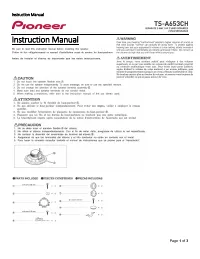 Pioneer TS A653CH
User Manual
Pioneer TS A653CH
User Manual
 Pioneer TS A653FH
User Manual
Pioneer TS A653FH
User Manual
 Pioneer TS A683FH
User Manual
Pioneer TS A683FH
User Manual
 Pioneer TS A693CH
User Manual
Pioneer TS A693CH
User Manual
 Pioneer TS A693FH
User Manual
Pioneer TS A693FH
User Manual
 Pioneer VSX LX805
User Manual
Pioneer VSX LX805
User Manual
 Pioneer PN43 751 24U
User Manual
Pioneer PN43 751 24U
User Manual