Page 3 - IMPORTANT SAFETY INSTRUCTIONS; Read all instructions before using this sewing machine.; DANGER; To reduce the risk of electric shock:; WARNING; used by or near children.; SAVE THESE INSTRUCTIONS
1 IMPORTANT SAFETY INSTRUCTIONS When using an electrical appliance, basic safety precautions should always be followed, including the following: This sewing machine is designed and manufactured for household use only. Read all instructions before using this sewing machine. DANGER — To reduce the ris...
Page 4 - Table of contents; SECTION 2. GETTING READY TO SEW; Removing and Attaching the Presser Foot; SECTION 3. BASIC SEWING
2 Table of contents SECTION 1. ESSENTIAL PARTSNames of Parts .................................................... 3 Setting the Spool Pin ........................................... 3 Standard Accessories ......................................... 4 Extension Table ......................................
Page 5 - Setting the Spool Pin; Spool pin; SECTION 1. ESSENTIAL PARTS; Names of Parts; Design and specifications are subject to
3 Setting the Spool Pin Insert the spool pin into the hole as shown. q Spool pin w Hole q w SECTION 1. ESSENTIAL PARTS Names of Parts qwertyuio!0!1!2!3!4!5!6!7!8!9@0@1@2@3@4@5@6@7@8@9 NOTE: Design and specifications are subject to change without prior notice. NOTE: To carry the sewing machine, hold ...
Page 6 - Standard Accessories; Blind hem foot G; Extension Table; Slot
4 Standard Accessories qwertyuio!0!1 Zipper foot E Blind hem foot G Sliding buttonhole foot Needle set Bobbin x 3 Screwdriver Seam ripper (buttonhole opener) Spool holder (small) Spool holder (large) Spool pin Instruction book Extension Table The extension table provides an extended sewing area and ...
Page 7 - Connecting the Power Supply; Operating Instructions:
5 SECTION 2. GETTING READY TO SEW Connecting the Power Supply z Turn the power switch off. x Insert the machine plug into the machine socket. c Insert the power supply plug into the wall outlet. v Turn the power switch on. q Power switch w Machine plug e Machine socket r Power supply plug t Wall out...
Page 8 - Controlling the Sewing Speed; Foot control; Sewing speed can be varied by the foot control.; Reverse Stitch Lever; Lowered position
6 Controlling the Sewing Speed Foot control Sewing speed can be varied by the foot control. The harder you depress the foot control, the faster the machine runs. Reverse Stitch Lever Push the reverse stitch lever down to sew in reverse. The machine will sew in reverse while the lever is pushed. To D...
Page 9 - Changing the Presser Foot; Setscrew
7 Removing and Attaching the Presser Foot Holder Presser Foot Lifter The presser foot lifter raises and lowers the presser foot. You can raise it about 1/4˝ (0.6 cm) higher than the normal up position for easy removal of the presser foot, or to help you place heavy fabric under the foot. q Lowered p...
Page 10 - Changing Needles
8 Changing Needles CAUTION: Always make sure to turn the power switch off and disconnect the machine from power supply before changing the needle. Raise the needle by turning the handwheel and lower the presser foot. Turn off the power switch. z Loosen the needle clamp screw by turning it counterclo...
Page 11 - Fabric and Needle Chart
9 Fabric Thread Needle Fine Lawn Georgette Tricot Organza Crepe Silk #80-100 Cotton #80-100 Synthetic #80-100 #9/65- 11/75 Medium Sheeting Jersey Broadcloth Fleece Silk #50 Cotton #50-80 Synthetic #50-80 #11/75- 14/90 Heavy weight Denim Tweed Coating Quilting Silk #30-50 Cotton #40-50 Synthetic #40-...
Page 12 - Winding the Bobbin; Setting the spool; Press the large spool holder firmly against the; Removing the bobbin; Lift out the bobbin.
10 q w e (A) (B) z x Winding the Bobbin Setting the spool Place a spool of thread on the spool pin with the thread coming off the spool as illustrated. A: Press the large spool holder firmly against the spool of thread. q Large spool holder B: For a small spool, use the small spool holder. w Small s...
Page 13 - Winding the bobbin; Guide the thread into the bobbin winder
11 c Push the bobbin winder spindle to the right. v Hold the free end of the thread in your hand and start the machine. Stop the machine when the bobbin has been wound a few layers, and cut the thread close to the bobbin. b Start the machine again. When the bobbin is fully wound, it will stop automa...
Page 14 - Inserting the Bobbin; Guide the thread into the front notch on the
12 Inserting the Bobbin z Place the bobbin in the bobbin holder with the thread running off as illustrated. q Thread x Guide the thread into the front notch on the front side of the bobbin holder. Draw the thread to the left, sliding it between the tension spring blades. w Front notch e Tension spri...
Page 15 - Threading the Machine; Left channel
13 Threading the Machine Raise the presser foot. Turn the handwheel toward you to raise the thread take-up lever to its highest position. z Draw the thread from the spool and pass it under the thread guide. q Thread guide x Draw the thread down along the right channel and pull it up around the botto...
Page 16 - Drawing up the Bobbin Thread; Pull 4 ̋ (10 cm) of both threads back and under
14 z c x Drawing up the Bobbin Thread z Raise the presser foot and hold the needle thread lightly with your left hand. q Needle thread x Turn the handwheel slowly toward you one complete turn. Bring the bobbin thread up by pulling the needle thread as illustrated. w Bobbin thread c Pull 4˝ (10 cm) o...
Page 17 - Stitch Length Dial; The “ ” mark shows the adjustment range; Selecting the Stitch Pattern
15 Pattern selector dialTurn the pattern selector dial to set the symbol of the desired stitch pattern at the setting mark. q Pattern selector dial w Setting mark CAUTION: Do not turn the pattern selector dial while the needle is in the fabric, otherwise the needle may bend or break. To select the s...
Page 18 - Adjusting Stretch Stitch Balance
16 Adjusting Stretch Stitch Balance If the stretch stitch patterns are uneven when you sew on a particular fabric, correct them by turning the stitch length dial. If the patterns are drawn out, correct them by setting the dial to the “–” side. If the patterns are compressed, correct them by setting ...
Page 19 - Balancing Needle Thread Tension; The thread tension should be adjusted depending; Needle thread tension is too tight:; Loosen the needle thread tension by moving the; Needle thread tension is too loose:
17 Balancing Needle Thread Tension The thread tension should be adjusted depending on the sewing materials, layers of fabric and sewing method. To adjust the thread tension, turn the tension dial. q Tension dial Balanced tension:The ideal straight stitch has threads locked between two layers of fabr...
Page 20 - Straight Stitch; Machine setting; Changing the Sewing Direction
18 Straight Stitch Machine setting q Stitch selector: A or B w Presser foot: Zigzag foot A e Thread tension: 2 – 6 r Stitch length: 1.5 – 4 Starting to sew Raise the presser foot and position the fabric next to a seam guide line on the needle plate (5/8˝ (1.6 cm) is most common). Lower the needle to...
Page 21 - Using the Seam Guide Lines; Guide lines; Turning a Square Corner; Lower the presser foot and start stitching in the
19 Numbers 10 15 30 40 3/8 1/2 5/8 1 1 1/2 Distance (cm) 1 1.5 3 4 — — — — —Distance (inch) — — — — 3/8 1/2 5/8 1 1 1/2 Using the Seam Guide Lines The seam guides on the needle plate and hook cover help you to measure seam allowance. q Guide lines w Center needle position e Distance from the center ...
Page 22 - SECTION 4. UTILITY STITCHES; Basic Zigzag; Overcasting
20 Simple zigzag stitching is widely used for overcasting, sewing on buttons etc. Adjust the stitch length to suit your sewing needs. NOTE: Use a stabilizer for stretch fabrics such as tricot and knits to prevent puckering. SECTION 4. UTILITY STITCHES The zigzag stitch is used on the seam allowance ...
Page 23 - This stitch is used to finish a raw edge on; Knit Stitch; Tricot Stitch
21 This knit stitch is ideal for sewing swimwear and stretch velour because it provides the greatest amount of elasticity and strength. Place your fabric to allow a 5/8˝ (1.6 cm) seam. Trim the seam allowance after sewing. This stitch is used to finish a raw edge on synthetics and other fabrics that...
Page 24 - Sew on stretch fabrics in any area that you might; Straight Stretch Stitch; A or B; Zigzag Stretch Stitch
22 The pattern is sewn with two stitches forward and one stitch backward, forming a seam that does not rip easily. Use it to reinforce areas such as crotch and armhole seams. Also use it when constructing items such as backpacks for extra strength.Carefully guide the fabric while sewing as the fabri...
Page 25 - Button Sewing; HOHFWLQJWKH6WLWFK3DWWHUQ; DWWHUQVHOHFWRUGLD
23 Unthread the needle. Adjust the stitch width to match it with the span of the holes in the button. Turn the handwheel to check if the needle enters into each hole in the button. Lower the foot to hold the button in place. The holes in the button should align with the slot of the foot. A pin can b...
Page 26 - HQVLRQHGHOILOR
24 4-Step Buttonhole Machine setting q Stitch selector: w Presser foot: Sliding buttonhole e Thread tension: 1 – 5 r Stitch length: 0.5 − 1 z Set the pattern selector dial at “ ”. Carefully mark buttonhole length on fabric. Place the fabric under the foot with the buttonhole marking running toward y...
Page 27 - Corded Buttonhole
25 c z x z With the buttonhole foot raised, hook the filler cord on the spur at the back of the foot. Bring the ends toward you under the foot, clearing the front end. Hook the filler cord into the forks on the front of the foot to hold them tight. q Spur w Forks x Draw both of needle and bobbin thr...
Page 28 - Groove; Fabric preparation; Slider; e r; Zipper Application
26 Attaching the zipper foot A: To sew the left side of the zipper, attach zipper foot with the right side pin. B: To sew the right side of zipper, attach the zipper foot with the left side pin. q Groove w Pin Fabric preparation z Add 3/8˝ (1 cm) to the zipper size. This is the overall opening size....
Page 29 - To sew; Lower layer
27 q w e r y t u i t o !1 !2 z x c v To sew z Attach zipper foot with the right side pin. Fold back the upper layer seam allowance. Fold back the lower layer seam allowance to leave a 1/8˝ (0.4 cm) margin of fabric. q Lower layer w End of the opening e Zipper teeth r 1/8˝ (0.4 cm) margin t Upper lay...
Page 30 - Starting just below zipper bottom stop, sew
28 b Raise and release the foot, and re-attach it with the left side pin. Starting just below zipper bottom stop, sew across fabric to about 3/8˝ (1 cm) distance from the basting line. Turn fabric 90 degrees and sew a seam the entire length of the zipper tape. Before reaching the slider, stop the ma...
Page 31 - B: Fine or medium weight fabric; Blind Stitch Hemming
29 z On heavy weight fabrics that ravel, the raw edge should be overcast first. Fold the hem under the fabric as illustrated for fine or medium fabrics. Fold a hem with the wrong side up forming a 1/8˝ (0.5 cm) allowance. A: Heavy weight fabric B: Fine or medium weight fabric q Wrong side of the fab...
Page 32 - SECTION 5. DECORATIVE STITCHES; times wider than the project width.; Smocking
30 SECTION 5. DECORATIVE STITCHES z Choose a soft and lightweight fabric such as batiste, gingham or challis. Cut the fabric three times wider than the project width. Increase the stitch length to “4” and loosen thread tension to “1”. Sew rows of straight stitches 3/8˝ (1 cm) apart across the area t...
Page 33 - Pin Tucking; Shell Tuck
31 Fold a fabric wrong side together and Lower the needle into the fabric 0.1 – 0.2 cm inside the folded edge. Lower the foot and turn the screw to align the guide on the foot with the folded edge. Sew slowly while guiding the folded edge along the guide. Open the fabric and iron press the tucks. q ...
Page 34 - Patchwork; Decorative Stretch Stitches; A – G
32 Place two layers of the fabric with the right side together. Seam along the edges with the straight stitch. Open fabrics flat and fold each seam allowances. Place the fabric under the foot so that the seam line matches the center of the foot width. Lower the foot and sew the pattern along the sea...
Page 35 - Cleaning the Hook Race and Feed Dogs; SECTION 6. CARE AND MAINTENANCE
33 WARNING: Turn the power switch off and unplug the machine before cleaning. Cleaning the Hook Race and Feed Dogs z Remove the presser foot and needle. Remove screw on the needle plate with the screwdriver. Remove the needle plate and take out the bobbin. q Screw x Lift up the bobbin holder and rem...
Page 36 - Replacing the Bobbin Holder; Insert the bobbin holder into the hook race.
34 Replacing the Bobbin Holder z Insert the bobbin holder into the hook race. x Make sure the knob of the bobbin holder fits next to the stopper on the race. q Knob w Stopper c Replace the bobbin. Attach the needle plate. Tighten the screw firmly with the screwdriver. e Screw q w e z x c
Page 37 - Troubleshooting
35 Condition Cause Reference The needle thread breaks 1. The needle thread is not threaded properly. 2. The needle thread tension is too tight. 3. The needle is bent or blunt. 4. The needle is incorrectly inserted. 5. The needle thread and the bobbin thread are not set under the presser foot when st...


 Janome ArtDecor 7180
User Manual
Janome ArtDecor 7180
User Manual
 Janome ArtDecor 724D
User Manual
Janome ArtDecor 724D
User Manual
 Janome Clio 320
User Manual
Janome Clio 320
User Manual
 Janome Clio 325
User Manual
Janome Clio 325
User Manual
 Janome DC 3050
User Manual
Janome DC 3050
User Manual
 Janome HD1019
User Manual
Janome HD1019
User Manual
 Janome HD1023
User Manual
Janome HD1023
User Manual
 Janome HomeDecor 1300D
User Manual
Janome HomeDecor 1300D
User Manual
 Janome HomeDecor 6180
User Manual
Janome HomeDecor 6180
User Manual
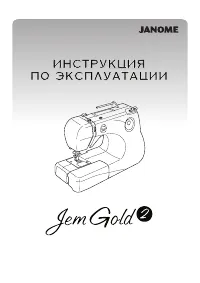 Janome Jem Gold 2
User Manual
Janome Jem Gold 2
User Manual
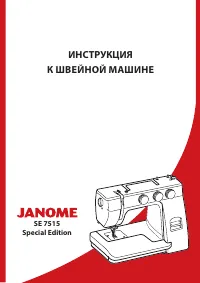 Janome SE 7515
User Manual
Janome SE 7515
User Manual
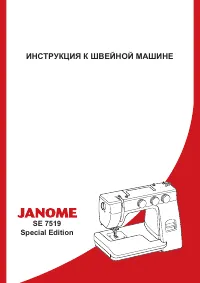 Janome SE 7519
User Manual
Janome SE 7519
User Manual
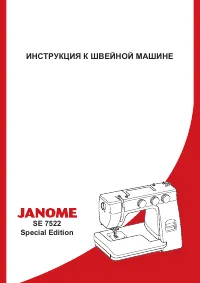 Janome SE 7522
User Manual
Janome SE 7522
User Manual
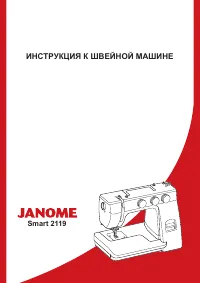 Janome Smart 2119
User Manual
Janome Smart 2119
User Manual