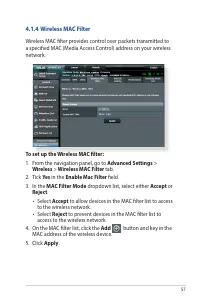
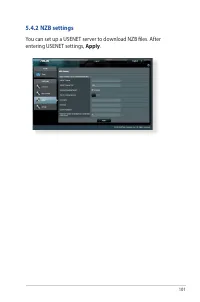
Page 2 - Copyright © 2020 ASUSTeK Computer Inc. All Rights Reserved.
2 Copyright © 2020 ASUSTeK Computer Inc. All Rights Reserved. No part of this manual, including the products and software described in it, may be reproduced, transmitted, transcribed, stored in a retrieval system, or translated into any language in any form or by any means, except documentation kept...
Page 3 - Table of contents; Getting to know your wireless router
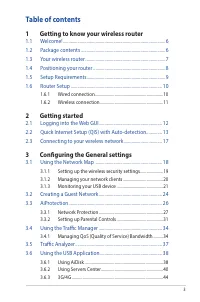
3 Table of contents 1 Getting to know your wireless router 1.1 Welcome! ...........................................................................................61.2 Package contents ...........................................................................61.3 Your wireless router .................
Page 4 - Configuring the Advanced Settings
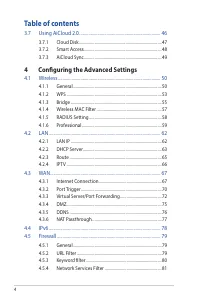
4 Table of contents 3.7 Using AiCloud 2.0 ........................................................................ 46 3.7.1 Cloud Disk ................................................................................ 47 3.7.2 Smart Access .................................................................
Page 5 - Utilities
5 Table of contents 4.6 Administration.............................................................................. 83 4.6.1 Operation Mode .................................................................... 83 4.6.2 System .............................................................................
Page 6 - • If any of the items are damaged or missing, contact ASUS for; Thank; Package contents
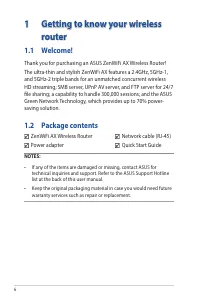
6 1 Getting to know your wireless 1 Getting to know your wireless router router NOTES: • If any of the items are damaged or missing, contact ASUS for technical inquiries and support. Refer to the ASUS Support Hotline list at the back of this user manual. • Keep the original packaging material in cas...
Page 7 - Your wireless router; Plug the adapter into the DCIN port, and press the power; Button and Port Explanations
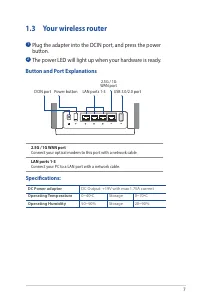
7 1.3 Your wireless router 1 Plug the adapter into the DCIN port, and press the power button. 2 The power LED will light up when your hardware is ready. Button and Port Explanations 2.5G / 1G WAN port Connect your optical modem to this port with a network cable. LAN ports 1-3 Connect your PC to a LA...
Page 8 - Positioning your router; For the best wireless signal transmission between the wireless
8 1.4 Positioning your router For the best wireless signal transmission between the wireless router and the network devices connected to it, ensure that you: • Place the wireless router in a centralized area for a maximum wireless coverage for the network devices. • Keep the device away from metal o...
Page 9 - Setup Requirements; To set up your wireless network, you need a computer that meets
9 1.5 Setup Requirements To set up your wireless network, you need a computer that meets the following system requirements: • Ethernet RJ-45 (LAN) port (10Base-T/100Base-TX/ 1000BaseTX) • IEEE 802.11a/b/g/n/ac wireless capability• An installed TCP/IP service• Web browser such as Internet Explorer, F...
Page 10 - To set up your wireless router via wired connection:
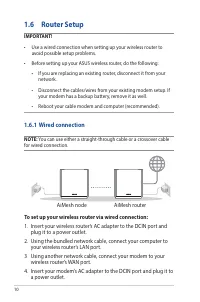
10 1.6 Router Setup IMPORTANT! • Use a wired connection when setting up your wireless router to avoid possible setup problems. • Before setting up your ASUS wireless router, do the following: • If you are replacing an existing router, disconnect it from your network. • Disconnect the cables/wires fr...
Page 11 - To set up your wireless router via wireless connection:; • For details on connecting to a wireless network, refer to the WLAN; Setting up the wireless security settings; in Chapter 3 of this user
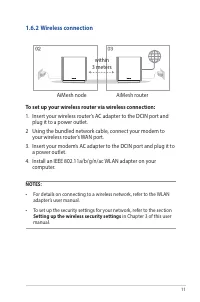
11 1.6.2 Wireless connection To set up your wireless router via wireless connection: 1. Insert your wireless router’s AC adapter to the DCIN port and plug it to a power outlet. 2 Using the bundled network cable, connect your modem to your wireless router’s WAN port. 3. Insert your modem’s AC adapter...
Page 12 - Logging into the Web GUI; Your ASUS Wireless Router comes with an intuitive web graphical; The features may vary with different firmware versions.; To log into the web GUI:; You can now use the Web GUI to configure various settings of; If you are logging into the Web GUI for the first time, you will be
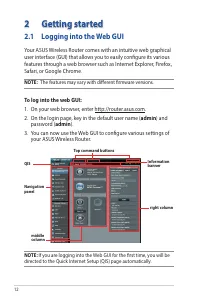
12 2 Getting started 2 Getting started 2.1 Logging into the Web GUI Your ASUS Wireless Router comes with an intuitive web graphical user interface (GUI) that allows you to easily configure its various features through a web browser such as Internet Explorer, Firefox, Safari, or Google Chrome. NOTE: ...
Page 13 - detection; The Quick Internet Setup (QIS) function guides you in quickly; When setting the Internet connection for the first time, press; Log into the Web GUI. The QIS page launches automatically.; NOTES; • For details on changing your wireless router's login username and
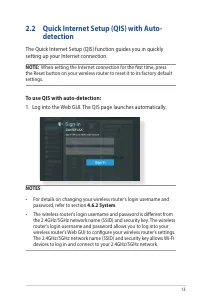
13 2.2 Quick Internet Setup (QIS) with Auto- detection The Quick Internet Setup (QIS) function guides you in quickly setting up your Internet connection. NOTE: When setting the Internet connection for the first time, press the Reset button on your wireless router to reset it to its factory default s...
Page 14 - type is; Dynamic IP; the necessary information for your ISP connection type.; IMPORTANT; Obtain the necessary information from your ISP about
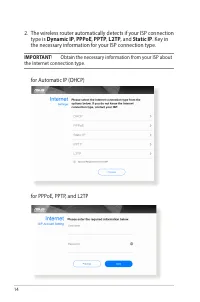
14 2. The wireless router automatically detects if your ISP connection type is Dynamic IP , PPPoE , PPTP , L2TP , and Static IP . Key in the necessary information for your ISP connection type. IMPORTANT ! Obtain the necessary information from your ISP about the Internet connection type. for Automati...
Page 15 - for Static IP; • The auto-detection of your ISP connection type takes place when; Skip to; and manually configure your connection settings.; Assign the wireless network name (SSID) and security key for; Apply; when
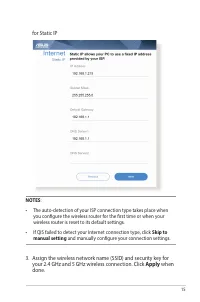
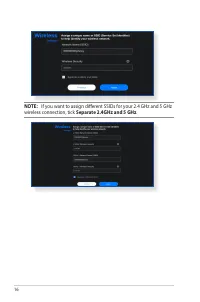
15 for Static IP NOTES : • The auto-detection of your ISP connection type takes place when you configure the wireless router for the first time or when your wireless router is reset to its default settings. • If QIS failed to detect your Internet connection type, click Skip to manual setting and man...
Page 16 - Separate 2.4GHz and 5 GHz
16 NOTE: If you want to assign different SSIDs for your 2.4 GHz and 5 GHz wireless connection, tick Separate 2.4GHz and 5 GHz .
Page 17 - Connecting to your wireless network; To connect to your network:; • Refer to the next chapters for more details on configuring your
17 2.3 Connecting to your wireless network After setting up your wireless router via QIS, you can connect your computer or other smart devices to your wireless network. To connect to your network: 1. On your computer, click the network icon in the notification area to display the available wireless ...
Page 18 - Using the Network Map; Network Map allows you to configure your network’s security
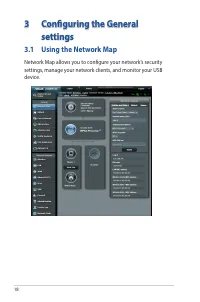
18 3 Configuring the General 3 Configuring the General settings settings 3.1 Using the Network Map Network Map allows you to configure your network’s security settings, manage your network clients, and monitor your USB device.
Page 19 - Setting up the wireless security settings; To set up the wireless security settings:; On the Network Map screen and under; System status; configure the wireless security settings such as SSID, security; NOTE; : You can set up different wireless security settings for 2.4GHz and; GHz security settings
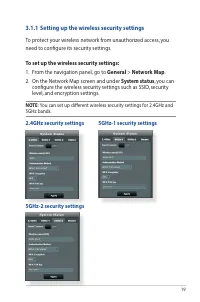
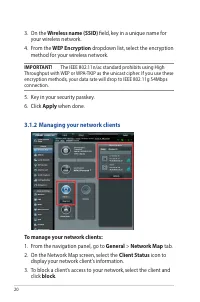
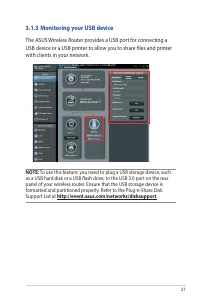
19 3.1.1 Setting up the wireless security settings To protect your wireless network from unauthorized access, you need to configure its security settings. To set up the wireless security settings: 1. From the navigation panel, go to General > Network Map . 2. On the Network Map screen and under S...
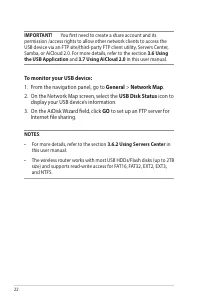
Page 22 - the USB Application; To monitor your USB device:; On the Network Map screen, select the; USB Disk Status; icon to; GO; to set up an FTP server for
22 IMPORTANT! You first need to create a share account and its permission /access rights to allow other network clients to access the USB device via an FTP site/third-party FTP client utility, Servers Center, Samba, or AiCloud 2.0. For more details, refer to the section 3.6 Using the USB Application...
Page 23 - Safely removing the USB disk; : Incorrect removal of the USB disk may cause data; To safely remove the USB disk:; the USB disk is ejected successfully, the USB status shows; Unmounted
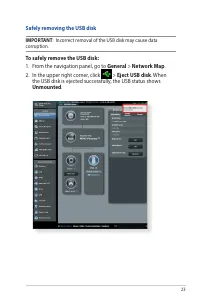
23 Safely removing the USB disk IMPORTANT : Incorrect removal of the USB disk may cause data corruption. To safely remove the USB disk: 1. From the navigation panel, go to General > Network Map . 2. In the upper right corner, click > Eject USB disk . When the USB disk is ejected successfully, ...
Page 24 - Creating a Guest Network; The Guest Network provides temporary visitors with Internet; To create a guest network:; On the Guest Network screen, select 2.4GHz or 5GHz frequency; Enable
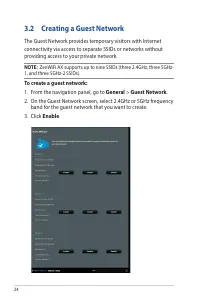
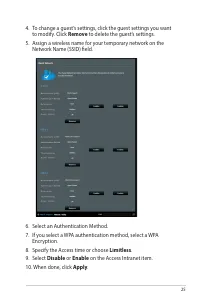
24 3.2 Creating a Guest Network The Guest Network provides temporary visitors with Internet connectivity via access to separate SSIDs or networks without providing access to your private network. NOTE: ZenWiFi AX supports up to nine SSIDs (three 2.4GHz, three 5GHz- 1, and three 5GHz-2 SSIDs). To cre...
Page 27 - Configuring Network Protection; main page, click on
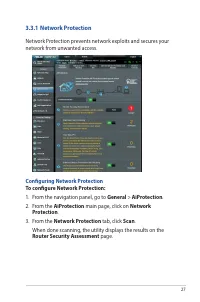
27 3.3.1 Network Protection Network Protection prevents network exploits and secures your network from unwanted access. Configuring Network Protection To configure Network Protection: 1. From the navigation panel, go to General > AiProtection . 2. From the AiProtection main page, click on Network...
Page 29 - Malicious Sites Blocking; Router; Router
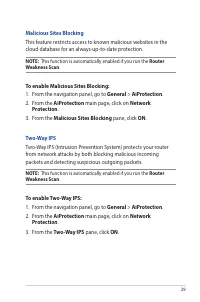
29 Malicious Sites Blocking This feature restricts access to known malicious websites in the cloud database for an always-up-to-date protection. NOTE: This function is automatically enabled if you run the Router Weakness Scan . To enable Malicious Sites Blocking: 1. From the navigation panel, go to ...
Page 30 - Infected Device Prevention and Blocking
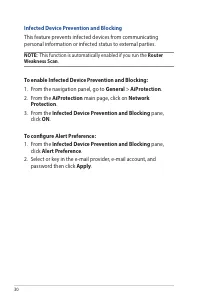
30 Infected Device Prevention and Blocking This feature prevents infected devices from communicating personal information or infected status to external parties. NOTE: This function is automatically enabled if you run the Router Weakness Scan . To enable Infected Device Prevention and Blocking: 1. F...
Page 31 - main page, click on the; Parental
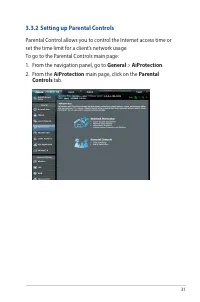
31 3.3.2 Setting up Parental Controls Parental Control allows you to control the Internet access time or set the time limit for a client’s network usage.To go to the Parental Controls main page:1. From the navigation panel, go to General > AiProtection . 2. From the AiProtection main page, click ...
Page 33 - Time Scheduling; Time Scheduling allows you to set the time limit for a client’s; Ensure that your system time is synchronized with the NTP; column, select or key in the client’s; You may also key in the client’s MAC address in the; Client; column. Ensure that the client name does not contain; to add the client’s profile.
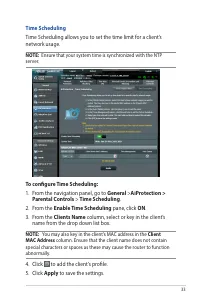
33 Time Scheduling Time Scheduling allows you to set the time limit for a client’s network usage. NOTE: Ensure that your system time is synchronized with the NTP server. To configure Time Scheduling: 1. From the navigation panel, go to General > AiProtection > Parental Controls > Time Sched...
Page 34 - Using the Traffic Manager; Quality of Service (QoS) allows you to set the bandwidth priority; Get the bandwidth information from your ISP.; User-defined QoS rules; or; User-defined Priority
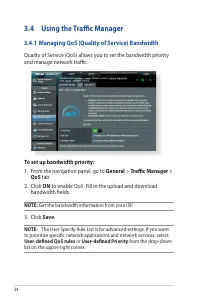
34 3.4 Using the Traffic Manager 3.4.1 Managing QoS (Quality of Service) Bandwidth Quality of Service (QoS) allows you to set the bandwidth priority and manage network traffic. To set up bandwidth priority: 1. From the navigation panel, go to General > Traffic Manager > QoS tab. 2. Click ON to...
Page 35 - Transferred
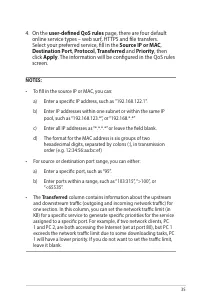
35 4. On the user-defined QoS rules page, there are four default online service types – web surf, HTTPS and file transfers. Select your preferred service, fill in the Source IP or MAC , Destination Port , Protocol , Transferred and Priority , then click Apply . The information will be configured in ...
Page 36 - • Under; Download Bandwidth; for multiple network applications in corresponding order.
36 5. On the User-defined Priority page, you can prioritize the network applications or devices into five levels from the user- defined QoS rules ’ dropdown list. Based on priority level, you can use the following methods to send data packets: • Change the order of upstream network packets that are ...
Page 37 - Traffic Analyzer; The traffic monitor feature allows you to access the bandwidth
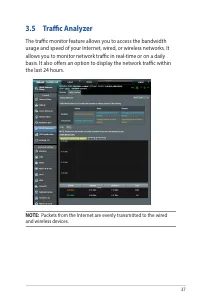
37 NOTE: Packets from the Internet are evenly transmitted to the wired and wireless devices. 3.5 Traffic Analyzer The traffic monitor feature allows you to access the bandwidth usage and speed of your Internet, wired, or wireless networks. It allows you to monitor network traffic in real-time or on ...
Page 38 - Using the USB Application; To use the server functions, you need to insert a USB; General
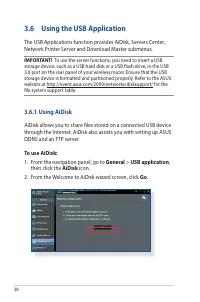
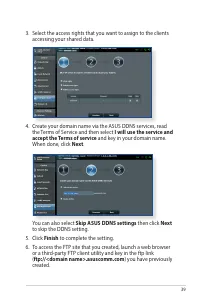
38 3.6 Using the USB Application The USB Applications function provides AiDisk, Servers Center, Network Printer Server and Download Master submenus. IMPORTANT! To use the server functions, you need to insert a USB storage device, such as a USB hard disk or a USB flash drive, in the USB 3.0 port on t...
Page 40 - Using Media Server; : Before using the DLNA Media Server function, connect your
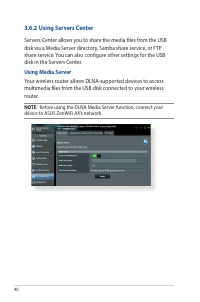
40 3.6.2 Using Servers Center Servers Center allows you to share the media files from the USB disk via a Media Server directory, Samba share service, or FTP share service. You can also configure other settings for the USB disk in the Servers Center. Using Media Server Your wireless router allows DLN...
Page 41 - Using Network Place (Samba) Share service
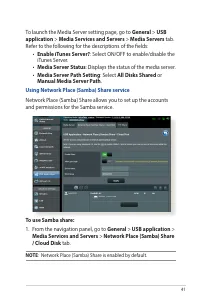
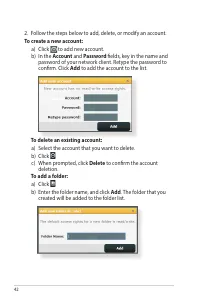
41 To launch the Media Server setting page, go to General > USB application > Media Services and Servers > Media Servers tab. Refer to the following for the descriptions of the fields: • Enable iTunes Server? : Select ON/OFF to enable/disable the iTunes Server. • Media Server Status : Displ...
Page 43 - Using the FTP Share service; USB disk may cause data corruption.; Safely removing; under
43 3. From the list of folders, select the type of access permission that you want to assign for specific folders: • R/W: Select this option to assign read/write access. • R: Select this option to assign read-only access. • No : Select this option if you do not want to share a specific file folder. ...
Page 47 - account and password. For better user experience, we; Google Chrome; Firefox; You can now start accessing Cloud Disk files on devices; When accessing the devices that are connected to the network,
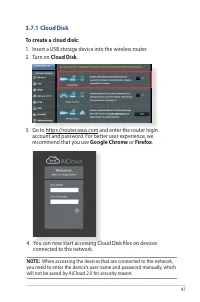
47 3.7.1 Cloud Disk To create a cloud disk: 1. Insert a USB storage device into the wireless router.2. Turn on Cloud Disk . 3. Go to https://router.asus.com and enter the router login account and password. For better user experience, we recommend that you use Google Chrome or Firefox . 4. You can no...
Page 48 - • You can create a domain name for your router with ASUS DDNS. For
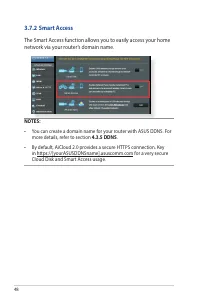
48 3.7.2 Smart Access The Smart Access function allows you to easily access your home network via your router’s domain name. NOTES: • You can create a domain name for your router with ASUS DDNS. For more details, refer to section 4.3.5 DDNS . • By default, AiCloud 2.0 provides a secure HTTPS connect...
Page 49 - to enable AiCloud Sync.; Add new account; Enter your ASUS WebStorage account password and select the
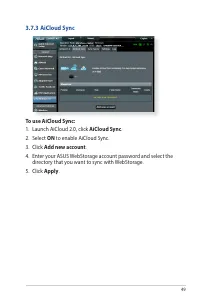
49 3.7.3 AiCloud Sync To use AiCloud Sync: 1. Launch AiCloud 2.0, click AiCloud Sync . 2. Select ON to enable AiCloud Sync. 3. Click Add new account . 4. Enter your ASUS WebStorage account password and select the directory that you want to sync with WebStorage. 5. Click Apply .
Page 50 - The General tab allows you to configure the basic wireless
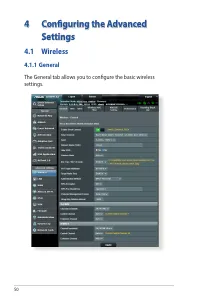
50 4 Configuring the Advanced 4 Configuring the Advanced Settings Settings 4.1 Wireless 4.1.1 General The General tab allows you to configure the basic wireless settings.
Page 51 - To configure the basic wireless settings:; : You can assign unique SSIDs for the 2.4 GHz and 5GHz frequency
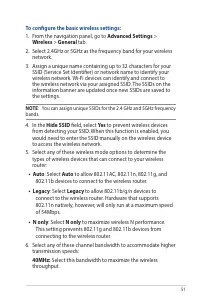
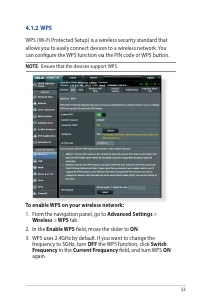
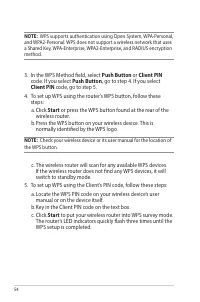
51 To configure the basic wireless settings: 1. From the navigation panel, go to Advanced Settings > Wireless > General tab. 2. Select 2.4GHz or 5GHz as the frequency band for your wireless network. 3. Assign a unique name containing up to 32 characters for your SSID (Service Set Identifier) o...
Page 55 - Advanced Settings
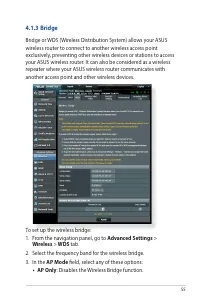
55 4.1.3 Bridge Bridge or WDS (Wireless Distribution System) allows your ASUS wireless router to connect to another wireless access point exclusively, preventing other wireless devices or stations to access your ASUS wireless router. It can also be considered as a wireless repeater where your ASUS w...
Page 58 - : Please refer to section; field, key in your RADIUS server’s IP
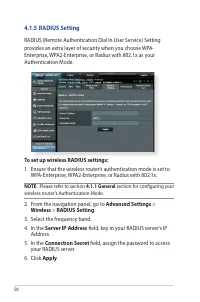
58 4.1.5 RADIUS Setting RADIUS (Remote Authentication Dial In User Service) Setting provides an extra layer of security when you choose WPA- Enterprise, WPA2-Enterprise, or Radius with 802.1x as your Authentication Mode. To set up wireless RADIUS settings: 1. Ensure that the wireless router’s authen...
Page 59 - We recommend that you use the default values on this page.
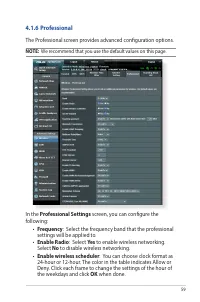
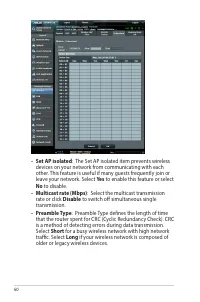
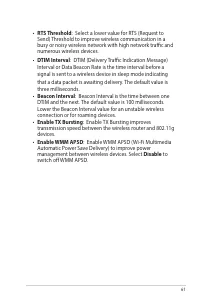
59 In the Professional Settings screen, you can configure the following: • Frequency : Select the frequency band that the professional settings will be applied to. • Enable Radio : Select Yes to enable wireless networking. Select No to disable wireless networking. • Enable wireless scheduler : You c...
Page 62 - The LAN IP screen allows you to modify the LAN IP settings of your; Any changes to the LAN IP address will be reflected on your; and
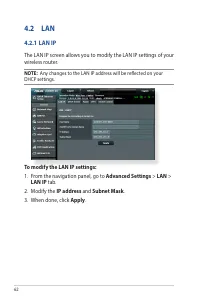
62 4.2 LAN 4.2.1 LAN IP The LAN IP screen allows you to modify the LAN IP settings of your wireless router. NOTE: Any changes to the LAN IP address will be reflected on your DHCP settings. To modify the LAN IP settings: 1. From the navigation panel, go to Advanced Settings > LAN > LAN IP tab. ...
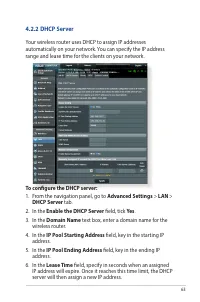
Page 64 - DNS and Server Settings
64 NOTES: • We recommend that you use an IP address format of 192.168.1.xxx (where xxx can be any number between 2 and 254) when specifying an IP address range. • An IP Pool Starting Address should not be greater than the IP Pool Ending Address. 7. In the DNS and Server Settings section, key in your...
Page 65 - : We recommend that you do not change the default route
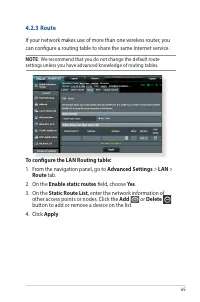
65 4.2.3 Route If your network makes use of more than one wireless router, you can configure a routing table to share the same Internet service. NOTE : We recommend that you do not change the default route settings unless you have advanced knowledge of routing tables. To configure the LAN Routing ta...
Page 66 - an ISP or a LAN. The IPTV tab provides the configuration settings
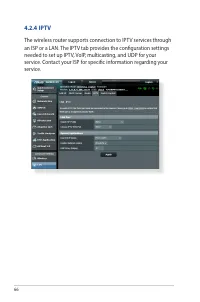
66 4.2.4 IPTV The wireless router supports connection to IPTV services through an ISP or a LAN. The IPTV tab provides the configuration settings needed to set up IPTV, VoIP, multicasting, and UDP for your service. Contact your ISP for specific information regarding your service.
Page 69 - MAC Address
69 • MAC Address : MAC (Media Access Control) address is a unique identifier for your networking device. Some ISPs monitor the MAC address of networking devices that connect to their service and reject any unrecognized device that attempt to connect. To avoid connection issues due to an unregistered...
Page 71 - Trigger Port; : Specify a trigger port to open the incoming; Protocol; : Specify an incoming port to receive inbound
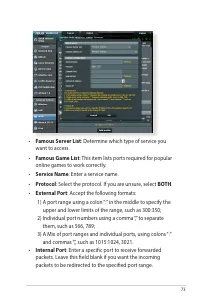
71 • Trigger Port : Specify a trigger port to open the incoming port. • Protocol : Select the protocol, TCP, or UDP. • Incoming Port : Specify an incoming port to receive inbound data from the Internet. NOTES: • When connecting to an IRC server, a client PC makes an outgoing connection using the tri...
Page 74 - work properly. Refer to section; To check if Port Forwarding has been configured successfully:
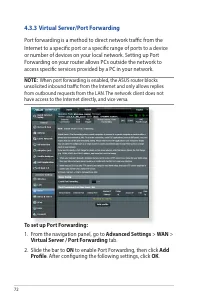
74 • Internal IP Address : Key in the client’s LAN IP address. • Source IP : If you want to open your port to a specific IP address from the Internet, input the IP address you want to give access to in this field. NOTE : Use a static IP address for the local client to make port forwarding work prope...
Page 77 - Enable wildcard; : Enable wildcard if your DDNS service; DDNS service will not work under these conditions:; NAT Passthrough allows a Virtual Private Network (VPN); click
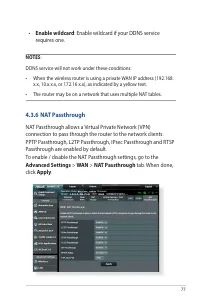
77 • Enable wildcard : Enable wildcard if your DDNS service requires one. NOTES : DDNS service will not work under these conditions: • When the wireless router is using a private WAN IP address (192.168. x.x, 10.x.x.x, or 172.16.x.x), as indicated by a yellow text. • The router may be on a network t...
Page 78 - . The configuration options vary; : Please refer to your ISP regarding specific IPv6 information for
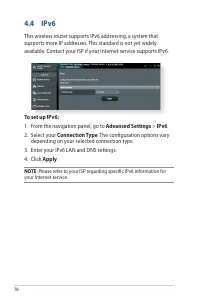
78 4.4 IPv6 This wireless router supports IPv6 addressing, a system that supports more IP addresses. This standard is not yet widely available. Contact your ISP if your Internet service supports IPv6. To set up IPv6: 1. From the navigation panel, go to Advanced Settings > IPv6 . 2. Select your Co...
Page 79 - : The Firewall feature is enabled by default.; : The URL Filter is based on a DNS query. If a network client has
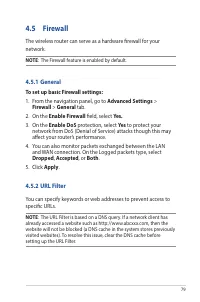
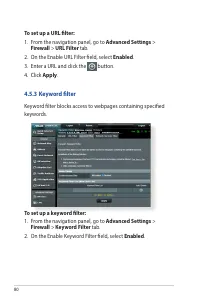
79 4.5 Firewall The wireless router can serve as a hardware firewall for your network. NOTE : The Firewall feature is enabled by default. 4.5.1 General To set up basic Firewall settings: 1. From the navigation panel, go to Advanced Settings > Firewall > General tab. 2. On the Enable Firewall f...
Page 81 - Enter a word or phrase and click the; Add; The Keyword Filter is based on a DNS query. If a network client has; The Network Services Filter blocks LAN to WAN packet exchanges
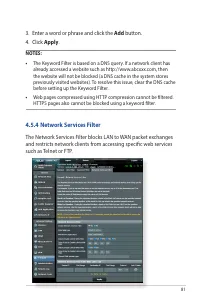
81 3. Enter a word or phrase and click the Add button. 4. Click Apply . NOTES: • The Keyword Filter is based on a DNS query. If a network client has already accessed a website such as http://www.abcxxx.com, then the website will not be blocked (a DNS cache in the system stores previously visited web...
Page 83 - : The router will reboot when you change the modes.
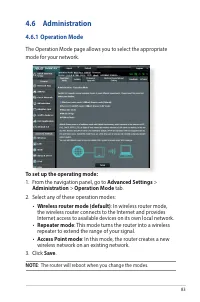
83 4.6 Administration 4.6.1 Operation Mode The Operation Mode page allows you to select the appropriate mode for your network. To set up the operating mode: 1. From the navigation panel, go to Advanced Settings > Administration > Operation Mode tab. 2. Select any of these operation modes: • Wi...
Page 85 - Service; : This feature allows you to configure Enable Telnet/
85 the IP addresses of devices that are allowed to access to the wireless router GUI settings from WAN/LAN. • Service : This feature allows you to configure Enable Telnet/ Enable SSH/SSH Port/Allow Password Login/Authorized Keys/Idle Timeout. 3. Click Apply .
Page 86 - : Download the latest firmware from the ASUS website at; • When the upgrade process is complete, wait for some time for the; Firmware Restoration; settings. Do not restore the router to its default settings.
86 4.6.3 Firmware Upgrade NOTE : Download the latest firmware from the ASUS website at http://www.asus.com . To upgrade the firmware: 1. From the navigation panel, go to Advanced Settings > Administration > Firmware Upgrade tab. 2. In the New Firmware File field, click Browse to locate the dow...
Page 87 - System Log contains your recorded network activities.; System log resets when the router is rebooted or powered off.; To view your system log:; You can view your network activities in any of these tabs:
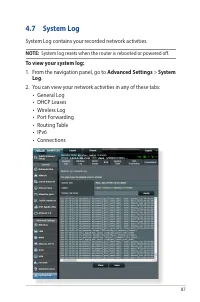
87 4.7 System Log System Log contains your recorded network activities. NOTE: System log resets when the router is rebooted or powered off. To view your system log: 1. From the navigation panel, go to Advanced Settings > System Log . 2. You can view your network activities in any of these tabs: •...
Page 88 - • The utilities are not supported on MAC OS.; Device Discovery; Device Discovery is an ASUS WLAN utility that detects an ASUS; When you set the router to Access Point mode, you need to use
88 5 Utilities 5 Utilities NOTES: • Download and install the wireless router's utilities from the ASUS website: • Device Discovery v1.4.7.1 at http://dlcdnet.asus.com/pub/ASUS/ LiveUpdate/Release/Wireless/Discovery.zip • Firmware Restoration v1.9.0.4 at http://dlcdnet.asus.com/pub/ ASUS/LiveUpdate/R...
Page 89 - Firmware Restoration; Launch the rescue mode on the router before using the; To launch the rescue mode and use the Firmware Restoration
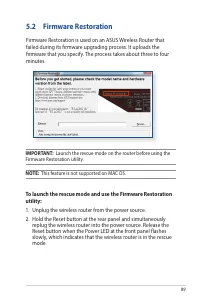
89 5.2 Firmware Restoration Firmware Restoration is used on an ASUS Wireless Router that failed during its firmware upgrading process. It uploads the firmware that you specify. The process takes about three to four minutes. IMPORTANT: Launch the rescue mode on the router before using the Firmware Re...
Page 90 - : This is not a firmware upgrade utility and cannot be used on; Chapter 4: Configuring the; Setting up your printer server; ASUS EZ Printing Sharing utility allows you to connect a USB
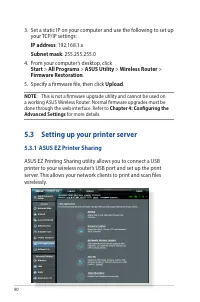
90 3. Set a static IP on your computer and use the following to set up your TCP/IP settings: IP address : 192.168.1.x Subnet mask : 255.255.255.0 4. From your computer’s desktop, click Start > All Programs > ASUS Utility > Wireless Router > Firmware Restoration . 5. Specify a firmware fi...
Page 91 - The print server function is supported on Windows® 7, Windows®; To set up the EZ Printer sharing mode:; to download the network printer utility.; Network printer utility is supported on Windows® 7, Windows®; Use LPR protocol for sharing printer; Unzip the downloaded file and click the Printer icon to run the
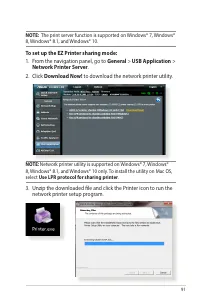
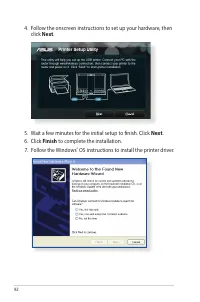
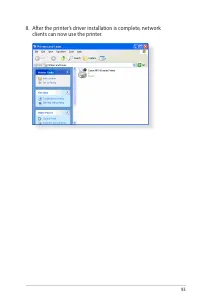
91 NOTE: The print server function is supported on Windows® 7, Windows® 8, Windows® 8.1, and Windows® 10. To set up the EZ Printer sharing mode: 1. From the navigation panel, go to General > USB Application > Network Printer Server . 2. Click Download Now! to download the network printer utili...
Page 94 - You can share your printer with computers running on Windows®; Sharing your LPR printer; to run the
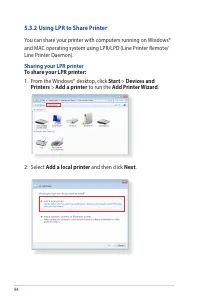
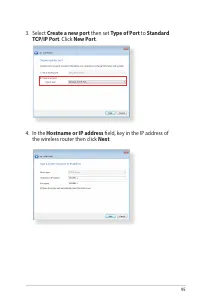
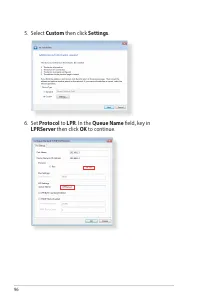
94 5.3.2 Using LPR to Share Printer You can share your printer with computers running on Windows® and MAC operating system using LPR/LPD (Line Printer Remote/ Line Printer Daemon). Sharing your LPR printer To share your LPR printer: 1. From the Windows® desktop, click Start > Devices and Printers...
Page 97 - Next; to finish setting up the standard TCP/IP port.; Have Disk; to manually install the
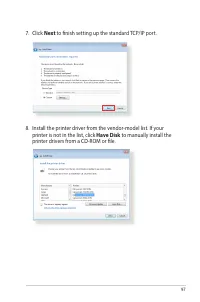
97 7. Click Next to finish setting up the standard TCP/IP port. 8. Install the printer driver from the vendor-model list. If your printer is not in the list, click Have Disk to manually install the printer drivers from a CD-ROM or file.
Page 98 - to accept the default name for the printer.; Finish; to complete the installation.
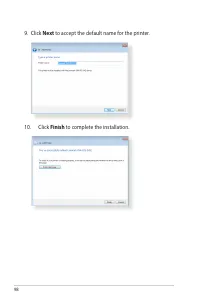
98 9. Click Next to accept the default name for the printer. 10. Click Finish to complete the installation.
Page 99 - Download Master; You need a USB device connected to the wireless router to use; To use Download Master:; If you have more than one USB drive, select the USB device you; For details on Bit Torrent, refer to section; Bit Torrent download settings
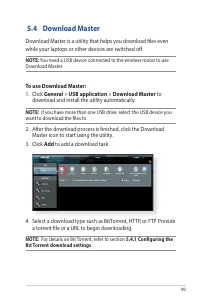
99 5.4 Download Master Download Master is a utility that helps you download files even while your laptops or other devices are switched off. NOTE: You need a USB device connected to the wireless router to use Download Master. To use Download Master: 1. Click General > USB application > Downloa...
Page 100 - Configuring Bit Torrent download settings
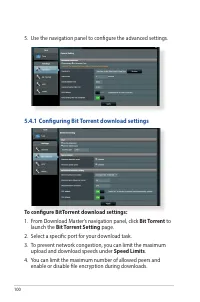
100 5. Use the navigation panel to configure the advanced settings. To configure BitTorrent download settings: 1. From Download Master’s navigation panel, click Bit Torrent to launch the Bit Torrent Setting page. 2. Select a specific port for your download task.3. To prevent network congestion, you ...
Page 102 - Basic Troubleshooting; Upgrade Firmware to the latest version.
102 6 Troubleshooting 6 Troubleshooting This chapter provides solutions for issues you may encounter with your router. If you encounter problems that are not mentioned in this chapter, visit the ASUS support site at: https://www.asus.com/support/ for more product information and contact details of A...
Page 104 - Network Map; page, and hover the mouse pointer; Client Status
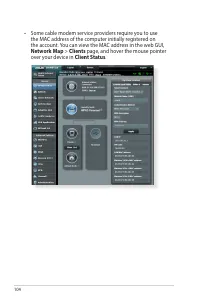
104 • Some cable modem service providers require you to use the MAC address of the computer initially registered on the account. You can view the MAC address in the web GUI, Network Map > Clients page, and hover the mouse pointer over your device in Client Status .
Page 105 - I cannot access the router GUI using a web browser; • The commands for deleting cookies and files vary with web
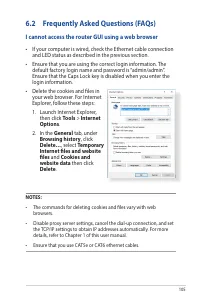
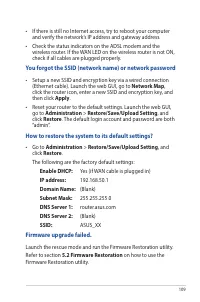
105 6.2 Frequently Asked Questions (FAQs) I cannot access the router GUI using a web browser • If your computer is wired, check the Ethernet cable connection and LED status as described in the previous section. • Ensure that you are using the correct login information. The default factory login name...
Page 106 - The client cannot establish a wireless connection with the; If you are having issues connecting to 5GHz network, make; described in section
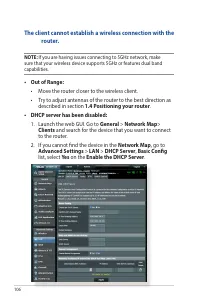
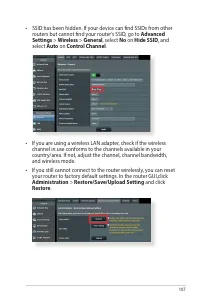
106 The client cannot establish a wireless connection with the router. NOTE: If you are having issues connecting to 5GHz network, make sure that your wireless device supports 5GHz or features dual band capabilities. • Out of Range: • Move the router closer to the wireless client. • Try to adjust ant...
Page 108 - Internet is not accessible.
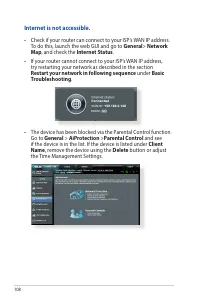
108 Internet is not accessible. • Check if your router can connect to your ISP’s WAN IP address. To do this, launch the web GUI and go to General > Network Map , and check the Internet Status . • If your router cannot connect to your ISP’s WAN IP address, try restarting your network as described ...
Page 110 - Cannot access Web GUI; Windows; to launch the browser.
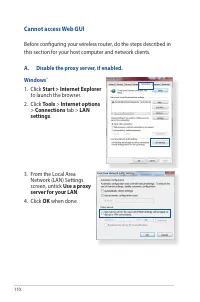
110 Cannot access Web GUI A. Disable the proxy server, if enabled. Windows ® 1. Click Start > Internet Explorer to launch the browser. 2. Click Tools > Internet options > Connections tab > LAN settings . Before configuring your wireless router, do the steps described in this section for ...
Page 111 - MAC OS; From your Safari; Refer to your browser's help feature for details on disabling the; B. Set the TCP/IP settings to automatically obtain an IP; then click the network connection to display its status window.
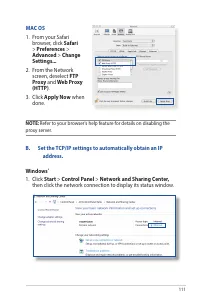
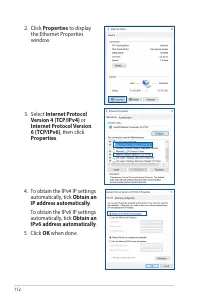
111 MAC OS 1. From your Safari browser, click Safari > Preferences > Advanced > Change Settings... 2. From the Network screen, deselect FTP Proxy and Web Proxy (HTTP) . 3. Click Apply Now when done. NOTE: Refer to your browser's help feature for details on disabling the proxy server. B. Set...
Page 113 - Refer to your operating system’s help and support feature for
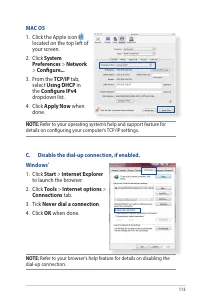
113 MAC OS 1. Click the Apple icon located on the top left of your screen. 2. Click System Preferences > Network > Configure... 3. From the TCP/IP tab, select Using DHCP in the Configure IPv4 dropdown list. 4. Click Apply Now when done. NOTE: Refer to your operating system’s help and support f...
Page 114 - Notices; ASUS Recycling/Takeback Services
114 Appendices Appendices Notices This device is an Energy Related Product (ErP) with High Network Availability (HiNA), the power consumption will be less than 12 watts when the system is in network standby mode (idle mode). ASUS Recycling/Takeback Services ASUS recycling and takeback programs come ...
Page 115 - CAUTION; : Any changes or modifications not expressly approved by
115 Prohibition of Co-location This device and its antenna(s) must not be co-located or operating in conjunction with any other antenna or transmitter. IMPORTANT NOTE: Radiation Exposure Statement: This equipment complies with FCC radiation exposure limits set forth for an uncontrolled environment. ...
Page 116 - NCC; 警語; 「產品之限用物質含有情況」之相關資訊,請參考下表:; 請勿在產品上放置其他物品,請勿將任何物品塞入產品內,以
116 instructions for satisfying RF exposure compliance. To maintain compliance with FCC exposure compliance requirement, please follow operation instruction as documented in this manual. This equipment should be installed and operated with a minimum distance of 15 cm between the radiator and any par...
Page 117 - 市場訊息
117 避免引起組件短路或電路損壞。 - 請保持机器在干燥的環境下使用,雨水、濕氣、液体等含有礦物質會腐蝕電子線路,請勿在雷電天气下使用調製解調器。 - 請勿堵塞產品的通風孔,以避免因散熱不良而導致系統過熱。 - 請勿使用破損的電源線、附件或其他周邊產品。 - 如果電源已損壞,請不要嘗試自行修復,請將其交給專業技術服務人員或經銷商來處理。 - 為了防止電擊風險,在搬動主機前,請先將電源線插頭暫時從電源插座上拔除。 使用警語: 使用警語: - 推薦您在環境溫度為 0°C(32°F) ~ 40°C(104°F)的情況下使用 本產品。 - 請依照產品底部的電源功率貼紙說明使用符合此功率的電源變壓器。...
Page 118 - Precautions for the use of the device
118 Precautions for the use of the device a. Pay particular attention to the personal safety when use this device in airports, hospitals, gas stations and professional garages. b. Medical device interference: Maintain a minimum distance of at least 15 cm (6 inches) between implanted medical devices ...
Page 119 - Условия эксплуатации:
119 Условия эксплуатации: - Температура эксплуатации устройства: 0-40 °C. Не используйте устройство в условиях экстремально высоких или низких температур. - Не размещайте устройство вблизи источников тепла, например, рядом с микроволновой печью, духовым шкафом или радиатором. - Использование несовме...
Page 120 - ASUSTeK Computer Inc.; ESENTEPE MAH. BUYUKDERE CAD. ERCAN HAN B; KOYUNCU ELEKTRONiK BiLGi iSLEM SiST. SAN. VE DIS; SANCAKTEPE ISTANBUL
120 AEEE Yönetmeliğine Uygundur. IEEE Yönetmeliğine Uygundur. - Bu Cihaz Türkiye analog şebekelerde çalışabilecek şekilde tasarlanmıştır. - Cihazın ayrıntılı kurulum rehberi kutu içeriğinden çıkan CD içerisindedir. Cihazın kullanıcı arayüzü Türkçe’dir. - Cihazın kullanılması planlanan ülkelerde herh...
Page 121 - GNU General Public License; Licensing information
121 GNU General Public License Licensing information This product includes copyrighted third-party software licensed under the terms of the GNU General Public License. Please see The GNU General Public License for the exact terms and conditions of this license. All future firmware updates will also ...
Page 128 - NO WARRANTY
128 NO WARRANTY 11 BECAUSE THE PROGRAM IS LICENSED FREE OF CHARGE, THERE IS NO WARRANTY FOR THE PROGRAM, TO THE EXTENT PERMITTED BY APPLICABLE LAW. EXCEPT WHEN OTHERWISE STATED IN WRITING THE COPYRIGHT HOLDERS AND/OR OTHER PARTIES PROVIDE THE PROGRAM “AS IS” WITHOUT WARRANTY OF ANY KIND, EITHER EXPR...
Page 151 - ASUS Contact information; Address; Technical Support
151 ASUS Contact information ASUSTeK COMPUTER INC. (Asia Pacific) Address 4F, NO. 150, LI-TE Rd., PEITOU, TAIPEI 112, TAIWAN Telephone +886-2-2894-3447 Fax +886-2-2890-7798 Web site https://www.asus.com Technical Support Telephone +86-21-38429911 Online support https://qr.asus.com/techserv ASUS COMP...