Philips HR1916/70 - User Manual
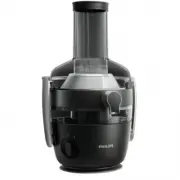
Philips HR1916/70 – User Manual, read for free online in PDF format. We hope this helps you resolve any issues you may have. If you have further questions, please contact us through the contact form.


Table of Contents:
- Page 2 – DEUTSCH; Hinweis: Wenn der Fruchtfleischbehälter seine maximale; ESPAÑOL; Nota: Cuando el depósito de pulpa ha alcanzado su capacidad
- Page 3 – FRANÇAIS; Remarque : lorsque le réservoir à pulpe est plein, la pulpe se; ITALIANO; Nota: quando il contenitore polpa ha raggiunto la capacità
- Page 4 – NEDERLANDS; Opmerking: wanneer de pulpopvangbak zijn maximale capaciteit; PORTUGUÊS
ENGLISH
Introduction
Congratulations on your purchase and welcome to Philips! To fully
benefit from the support that Philips offers, register your product at
www.philips.com/welcome
.
General description
1
Motor unit
-
A Driving shaft
-
B Locking arm
-
C Control knob
-
D Cord storage facility
-
E Overload protection button
2
Juicer
-
F Cover of pusher
-
G Pusher with pre-clean function
-
H Feeding tube
-
I Lid
-
J Sieve
-
K Juice collector with (L) spout with drip stop function
-
M Pulp container
3
Juice jug lid with integrated foam separator
4
Juice jug
Important
Read this user manual carefully before you use
the appliance and save it for future reference.
Danger
-
Never immerse the motor unit in water or any
other liquid, nor rinse it under the tap.
-
Do not clean the motor unit in the
dishwasher.
Warning
-
Check if the voltage indicated on the base of
the appliance corresponds to the local mains
voltage before you connect the appliance.
-
Do not use the appliance if the plug, the
mains cord or other components are
damaged.
-
If the mains cord is damaged, you must
have it replaced by Philips, a service centre
authorised by Philips or similarly qualified
persons in order to avoid a hazard.
-
This appliance can be used by persons
with reduced physical, sensory or mental
capabilities or lack of experience and
knowledge if they have been given
supervision or instruction concerning use
of the appliance in a safe way and if they
understand the hazards involved.
-
This appliance shall not be used by children.
Keep the appliance and its cord out of the
reach of children.
-
Children shall not play with the appliance.
-
Never let the appliance operate unattended.
-
Always disconnect the appliance from the
mains if you leave it unattended or before
you assemble, disassemble or clean it.
-
Do not use the appliance if the sieve or the
lid is damaged in any way or shows visible
cracks and contact the nearest Philips service
centre.
-
Never reach into the feeding tube with your
fingers or an object while the appliance
is operating. Only use the pusher for this
purpose.
-
Do not touch the small cutting blades in the
base of the sieve. They are very sharp.
-
Do not insert other items than fruits,
vegetables or the pusher into the feeding
tube.
-
Always place and use the appliance on a dry,
stable and level surface.
-
To ensure that the appliance stands stably,
keep the surface on which the appliance
stands and the bottom of the appliance
clean.
-
Do not eat the pulp or use for preparing
dishes.
-
This appliance is intended for household use
only.
Caution
-
Do not hold the appliance by the locking arm
when you carry it.
-
Always unwind the power cord totally from
the cord storage area before use.
-
Never use any accessories or parts from
other manufacturers or that Philips does
not specifically recommend. If you use
such accessories or parts, your guarantee
becomes invalid.
-
Make sure all parts are correctly assembled
before you switch on the appliance.
-
Only use the appliance when the locking arm
is in locked position.
-
Before you disassemble the appliance and
before you clean it, set the control knob to
off position and remove the plug from the
wall socket. Then lower the locking arm to
unlocked position.
-
Only lower the locking arm to unlocked
position after you have switched off the
appliance and the sieve has stopped
rotating.
-
Always unplug the appliance after use.
-
Noise level: Lc = 78 dB(A).
Safety feature
This appliance is fitted with a safety feature which safeguards
against overheating due to excessive loads. In case of overheating,
the juicer automatically activates the overload protection and
switches itself off. If this occurs, set the control knob to 0, unplug
the appliance and let it cool down for 15 minutes. Remove the juice
jug and detach the lid, the juice collector and the pulp container
and then press the overload protection button on the bottom of the
motor unit.
Electromagnetic fields (EMF)
This Philips appliance complies with all applicable standards and
regulations regarding exposure to electromagnetic fields.
Before first use
Thoroughly clean the parts that come into contact with food before
you use the appliance for the first time (see chapter ‘Cleaning’).
Note
-
Always check the sieve before use. If you detect any cracks or
damage, do not use the appliance.
-
Make sure the locking arm is locked into position.
Using the appliance
Juicing
You can use the juicer to produce fruit, vegetable and green juice.
Tips
-
Do not operate the juicer for more than 60 seconds at a time
when you juice heavy loads and let it cool down sufficiently
afterwards.
-
Before you start juicing make sure that the spout is in correct
juice position, the opening of the spout should point downwards.
-
To avoid splashing of juice, place the juice jug with properly
assembled juice jug lid below the spout.
-
Turn the control knob to setting 1 (low speed) or 2 (normal speed).
-
Speed 1 is especially suitable for soft fruits and vegetables such
as watermelons, grapes, tomatoes and cucumbers.
-
Speed 2 is suitable for all other kinds of fruit and vegetables such
as apples, carrots and beetroots.
Note
-
Always switch on the device and be sure it is running at full
speed before you insert fruits or vegetables into the feeding tube.
-
Do not exert too much pressure on the pusher, as this could
affect the quality of the end result. It could even cause the sieve
to come to a halt.
-
Never insert your fingers or an object into the feeding tube.
-
If the pulp container becomes full during use, switch off the
appliance and detach the lid and the juice collector. Then
carefully remove the pulp container and empty it.
-
For optimal performance clean the unit (lid, sieve, pulp container)
after each jug of juice.
Drip Stop
-
After you have processed all ingredients and the juice flow has
stopped, turn the spout clockwise by about 120° to activate the
drip stop function.
Empty the pulp container
Note: When the pulp container has reached its maximum capacity,
pulp ends up in the juice collector, lid and in the juice.
If the pulp container becomes overfilled, the appliance may become
blocked. When this occurs, switch off the appliance and remove the
pulp from the pulp container. Let the appliance cool down for 15
minutes and press the overload protection button on the bottom of
the motor unit to reset.
The transparent pulp container helps you to see when the pulp
container is full. Also check the level indication on the juice jug.
When the pulp reaches the level of the juice collector, the pulp
container needs to be emptied.
Tips
Preparations
-
Use fresh fruit and vegetables, as they contain more juice.
Pineapples, beetroots, celery stalks, apples, cucumbers, carrots,
spinach, melons, tomatoes, oranges and grapes are particularly
suitable for processing in the juicer.
-
The juicer is not suitable for processing very hard and/or fibrous
or starchy fruits or vegetables such as sugar cane.
-
Leaves and leaf stalks of e.g. lettuce can also be processed in the
juicer. To get most out of your leafy greens, roll them up before
juicing and juice the greens in-between hard fruits like apples or
carrots.
-
Remove stones from cherries, plums, peaches, etc. You do not
have to remove cores or seeds from fruits like melons, apples and
grapes.
-
When you use the juicer, you do not have to remove thin peels
or skins. Only remove thick peels that you would not eat, e.g.
those of oranges, pineapples, kiwis, melons, pomegranates and
uncooked beetroots.
-
When you prepare apple juice, take into consideration that the
thickness of the apple juice depends on the kind of apple you
use. The juicier the apple, the thinner the juice. Choose a kind of
apple that produces the type of juice you prefer.
-
If you want to process citrus fruits with the juicer, remove the peel
as well as the white pith. The white pith gives juice a bitter taste.
-
Fruits that contain starch, such as bananas, papayas, avocados,
figs and mangoes are not suitable for processing in the juicer. Use
a food processor, blender or hand blender to process these fruits.
-
To extract the maximum amount of juice, always press down the
pusher slowly.
Serving
-
Drink the juice immediately after you have extracted it.
-
If you want clear juice without a foam layer, put the lid with
integrated foam separator on the juice jug. If you want cloudy
juice with a foam layer, remove the lid with integrated foam
separator from the juice jug and stir the juice before you pour it in
a glass.
-
Apple juice turns brown very quickly. To slow down this process,
add a few drops of lemon juice.
-
When you serve cold drinks, add a few ice cubes.
Cleaning
Never use scouring pads, abrasive cleaning agents or aggressive
liquids such as alcohol, petrol or acetone to clean the appliance.
The appliance is easier to clean if you do so immediately after use.
To keep your kitchen clean, all detachable parts (pulp container, juice
collector, sieve and lid) can be carried to the sink in one go.
Tip: Use a sponge to clean the sieve.
Pre-clean function
When you use the pre-clean function, the lid and the sieve are
rinsed with water.
Use speed 2 for the pre-clean function to achieve the best results.
Use the pre-clean function:
-
To make the juicer easier to clean.
-
To rinse the juicer when you switch to a different fruit or
vegetable and want to avoid mixing flavours.
-
To dilute the juice with water and catch even the last drop of
juice.
Storage
To store the cord, wind it round the cord storage facility in the base
of the appliance.
Caution: Do not hold the appliance by the locking arm or spout
when you carry it.
Ordering accessories
To buy accessories or spare parts, visit
www.shop.philips.com/service
or go to your Philips dealer. You can
also contact the Philips Consumer Care Centre in your country (see
the worldwide guarantee leaflet for contact details).
Recycling
-
This symbol means that this product shall not be
disposed of with normal household waste (2012/19/EU).
-
Follow your country’s rules for the separate collection of
electrical and electronic products. Correct disposal helps
prevent negative consequences for the environment
and human health.
Guarantee and support
If you need information or support, please visit
www.philips.com/support
or read the separate worldwide
guarantee leaflet.
3
4
1
2
10
11
120°
12
1
2
3
6
4
7
8
9
5
4203 064 65091 D
www.philips.com
A
F
G
H
I
J
K
L
M
B
C
E
D
c
a
b
d
1
2
3
4
1/2
HR1915, HR1916
HR1917
"Loading the manual" means you need to wait until the file loads and becomes available for online reading. Some manuals are very large, and the time they take to appear depends on your internet speed.
Was this manual helpful?
About this manual
- Brand
- Philips
- Model
- HR1916/70
- Document type
- User Manual
- Language(s)
- German, English, Spanish, French, Italian, Dutch, Russian
- Pages
- 4
- File size
- 2.8 MB
- Format
Summary
DEUTSCH Einführung Herzlichen Glückwunsch zu Ihrem Kauf und willkommen bei Philips! Um den Support, den Philips bietet, vollständig nutzen zu können, registrieren Sie Ihr Produkt unter www.philips.com/welcome . Allgemeine Beschreibung 1 Motoreinheit - A Antriebsachse - B Verriegelungsarm - C Drehsch...
FRANÇAIS Introduction Félicitations pour votre achat et bienvenue dans l’univers Philips ! Pour profiter pleinement de l’assistance offerte par Philips, enregistrez votre appareil à l’adresse suivante : www.philips.com/welcome . Description générale 1 Bloc moteur - A Axe d’entraînement - B Bras de v...
NEDERLANDS Introductie Gefeliciteerd met uw aankoop en welkom bij Philips! Registreer uw product op www.philips.com/welcome om optimaal gebruik te kunnen maken van de door Philips geboden ondersteuning. Algemene beschrijving 1 Motorunit - A. Aandrijfas - B. Vergrendelarm - C. Bedieningsknop - D. Sno...
Ask a question
Related manuals
Popular Philips Other


More Philips Other models
 Philips HR1856/70 User Manual
 Philips HR1869/01 User Manual
 Philips HR1871/10 User Manual
 Philips HR1888/70 User Manual
 Philips HR1889/70 User Manual
 Philips HR1889/71 User Manual
 Philips HR1918/80 User Manual
 Philips HR1921/20 User Manual
 Philips HR1946/70 User Manual
 Philips HR1949/20 User Manual
 Philips HR1949/20R1 User Manual
 Philips HR2041/00 User Manual