Page 2 - Contents
Contents 2 Warning and Safety instructions ............................................................................... 4 Before using for the first time ..................................................................................... 12 Installation ............................................
Page 4 - Warning and Safety instructions; Correct application
Warning and Safety instructions 4 This microwave oven complies with current safety requirements.Inappropriate use can, however, lead to personal injury andmaterial damage.Read the operating instructions carefully before using theappliance. They contain important information on safety,installation, u...
Page 5 - Safety with children
Warning and Safety instructions 5 The oven compartment is fitted with a special lamp to cope with particular conditions (e.g. temperature, moisture, chemicalresistance, abrasion resistance and vibration). This special lamp mustonly be used for the purpose for which it is intended. It is not suitab...
Page 7 - While the microwave oven is under warranty, repairs should only; Correct use; Always ensure that food is sufficiently cooked or reheated.
Warning and Safety instructions 7 Unauthorised or incorrect repairs can cause considerable danger to users. Repairs may only be carried out by a Miele authorisedtechnician or by the Miele Customer Service Department. While the microwave oven is under warranty, repairs should only be undertaken b...
Page 8 - and
Warning and Safety instructions 8 It is important that the temperature in the food being cooked is evenly distributed and sufficiently high. This can be achieved by stirring or turning the food, and observing asufficiently long standing time (see charts), which should be added tothe time needed fo...
Page 9 - This is particularly important when preparing food for babies,; After reheating food, especially food
Warning and Safety instructions 9 Be careful when removing dishes from the appliance. Although heat is not normally produced in the container itself by the microwaves (apartfrom stoneware), heat transfer from the food to the container may beconsiderable, making the container itself hot. The dish i...
Page 10 - Food which is stored in the oven or left in it to be kept warm can
Warning and Safety instructions 10 Food which is stored in the oven or left in it to be kept warm can dry out and the moisture released can lead to corrosion damage inthe microwave oven. This can also cause damage to the controlpanel, worktop and surrounding kitchen furniture. Always cover foodtha...
Page 11 - Accessories
Warning and Safety instructions 11 Eggs heated in their shells using microwave power can burst, even after they have been taken out of the oven. Eggs can only be cookedin their shells in a specially designed egg-boiling device. Do not reheat hard-boiled eggs in the microwave oven. Food with a th...
Page 12 - Before using for the first time
Before using for the first time 12 After transportation, let the unpackedappliance stand for approx. 2 hoursat room temperature before using it. This is to allow time for the temperatureto equalise between the temperature inthe room and the appliance. This isimportant for the correct electronicfunct...
Page 13 - Installation; Installation dimensions
Installation *INSTALLATION* 13 When building in the appliance,ensure that there is adequateventilation to the front of theappliance.Do not obstruct the air vents withany objects! Ensure that the distanceto the surrounding furniture fronts isa minimum 2.5 mm at the sides and4 mm at the top. The appli...
Page 14 - Side view
Installation *INSTALLATION* 14 595 450 562 500 +2 +6 Side view 455.5 460.5 5 20
Page 15 - Connection
Installation *INSTALLATION* 15 Connection 15 62 460.5 595 1 2 3 a Front view b Mains connection cable, Length = 1600 mm c No connections permitted in this area
Page 16 - Carrying out installation
Installation *INSTALLATION* 16 Building-in kit The following items are supplied in theaccessory pack for installing theappliance: Carrying out installation The appliance must be built in beforeit can be used. There are three spacers in the accessorypack: one for the right-hand side (R) andtwo for th...
Page 18 - Electrical connection
Installation *INSTALLATION* 18 Electrical connection Risk of injury caused by a faulty appliance.Before connecting the appliance,ensure that it has not been damagedin any way.Never use a faulty appliance. The appliance is supplied ready forconnection with a cable and plug. Fire hazard due to ove...
Page 19 - Caring for the environment; Disposing of your old appliance
Caring for the environment 19 Disposing of the packagingmaterial The packaging material is used forhandling and protects the appliancefrom transport damage. The packagingmaterial used is selected from materialswhich are environmentally friendly fordisposal and can generally be recycled.Recycling the...
Page 20 - Guide to the appliance
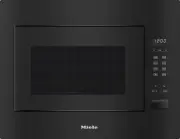
Guide to the appliance 20 a Door b Door lock c Control panel d Turntable
Page 21 - Control panel
Control panel 21 a Display for showing the time of dayand information on operation b Arrow buttons and for scrolling through lists and changing values c OK button for confirming values, selecting functions and savingsettings d Various power levels of themicrowave oven e Automatic programmes f...
Page 22 - Description of function
Description of function 22 The microwave oven contains amagnetron. This converts electricalenergy into electromagnetic waves(microwaves). These microwaves aredistributed evenly throughout the ovencompartment, and are reflected off themetal appliance walls. This enables themicrowaves to reach the foo...
Page 23 - Modes of operation; Functions; Microwave Solo mode
Modes of operation 23 Food is cooked, reheated or defrostedquickly in a microwave oven.You can use the microwave oven in thefollowing ways:– Food can be defrosted, reheated orcooked by entering a power setting anda duration.– Deep-frozen, ready meals can bedefrosted and then reheated or cooked.– The...
Page 24 - Suitable containers for microwave ovens; Material and shape; Metal
Suitable containers for microwave ovens 24 Microwaves: - are reflected by metal. - pass through glass, porcelain, plastic and cardboard. - are absorbed by food. Fire hazard due to unsuitable container.Containers which are not suitable foruse in microwave ovens can be badlydamaged and cause damage ...
Page 26 - Single-use containers
Suitable containers for microwave ovens 26 Single-use containers Fire hazard due to unsuitable container.Single-use containers made ofplastic, paper or other inflammablematerials can ignite.Do not leave the applianceunattended when reheating orcooking food in single-use containersmade of plastic, ...
Page 27 - A heat-retaining cover; Do not use a heat-retaining cover
Suitable containers for microwave ovens 27 A heat-retaining cover - prevents too much steam escaping, especially when cooking foods withlonger reheating times. - speeds up the reheating process.- prevents food from drying out.- helps keep the oven compartment clean. When using Microwave Solo mode,...
Page 28 - Setting the time; Altering the time of day
Before using for the first time 28 The microwave oven must be built inbefore it can be operated. The microwave oven is ready to use assoon as it has been connected to theelectricity supply. Setting the time Connect the appliance to theelectricity supply. 12:00 will appear in the display. Thenumber...
Page 29 - Operation; Opening the door
Operation 29 Opening the door Press the door release to open thedoor. If the microwave oven is in use, openingthe door will interrupt the cookingprocess. Placing the dish in the oven Ideally the dish should be placed in themiddle of the oven. Turntable If the appliance is built-in or installed ata...
Page 30 - “door” message; Altering settings; microwave power level; Cancelling a programme
Operation 30 - the type and texture of the food. Fresh vegetables contain more water andcook more quickly than storedvegetables. - the frequency of stirring or turning the food. Frequent stirring or turning heats thefood more evenly, and it is thereforeready in a shorter time. - the amount of food. ...
Page 31 - At the end of a programme; Changing the time and power level
Operation 31 At the end of a programme An audible tone will sound when thecooking programme is complete. Theinterior lighting goes off.The audible tone will sound briefly as areminder every 5 minutes for20 minutes after the end of theprogramme. If you want to stop the audible tone,press the Stop/C...
Page 32 - System lock; Activating the system lock; Deactivating the system lock
Operation 32 System lock The system lock prevents the appliancebeing used by children, for example. Activating the system lock Press and hold the OK sensor for 6 seconds, which counts down in thedisplay, until a buzzer sounds and thekey symbol appears in the display: The key symbol will go out aft...
Page 33 - Using the minute minder; Altering a minute minder entry; Deleting the minute minder duration
Operation 33 Using the minute minder The minute minder can be used to timeany activity in the kitchen, e.g. boilingeggs. The time set counts down in onesecond steps. Press the button. Use the arrow buttons to set theminutes for the minute minder youwant and confirm with OK . Then enter the ...
Page 34 - Operation - Automatic programmes; Automatic defrosting; Cooking food from frozen
Operation - Automatic programmes 34 All of the automatic programmes areweight dependent.The weight of the food can be displayedas metric (g) or imperial (lb) (see“Changing settings”).After selecting a programme, enter theweight of the food. The applianceautomatically calculates the durationaccording...
Page 35 - Using an automatic programme
Operation - Automatic programmes 35 Using an automatic programme Press the button. Select the programme you want fromthe list of automatic programmesusing the arrow buttons. Confirm your selection with OK . for microwave and the lowest food weight for the selected programme lightup in t...
Page 36 - Recipes for automatic programmes; Vegetables; Ingredients; Method
Recipes for automatic programmes 36 Below are some recipe suggestions forthe “Cooking fresh food” automaticprogrammes. These can be adapted tosuit your requirements. If the weight guidelines for therelevant programme are exceeded,the food will not cook sufficiently.It is important to follow the weig...
Page 38 - Changing settings; Appliance setting
Changing settings 38 Some of the standard settings for the appliance have an alternative.Please consult the chart for the different options for appliance settings.The factory settings are marked with a star* on the chart.To change a setting, proceed as follows: Press the button. The display sho...
Page 40 - Reheat; Tips on reheating
Reheat 40 Select the following microwave powerlevels to reheat food: Drinks 900 W Food 600 W Food for babies andchildren 450 W Risk of burning due to hot food. Food for babies and children mustnot be too hot.Only heat it for 1/2 to 1 minute at450 watts. Tips on reheating Danger of explosion due ...
Page 41 - After reheating
Reheat 41 After reheating Be careful when taking out acontainer. It may be hot. Although the container is not normallyheated by the microwaves (apart fromstoneware), heat may transfer from thefood to the container.Allow food to stand for a few minutes atroom temperature at the end of areheating proc...
Page 42 - Cooking; rice; semolina; Tips on cooking; Food with a thick skin or peel; After cooking
Cooking 42 Place the food in a microwave safecontainer and cover it.When cooking, it is a good idea to selecta power level of 900 W to start withand then when the food is hot reducethe power level to 450 W for moregentle continued cooking.For dishes such as rice or semolina pudding , first select a ...
Page 43 - Defrost; Defrosting and cooking
Defrost 43 Health risk due to refreezing. Thawed or defrosted food losesnutritional value through refreezingand can go off.Do not refreeze food once it hasthawed. Use it as quickly as possible.Defrosted food may only be re-frozenafter it has been cooked. - 80 W for defrosting very delicate food, e...
Page 44 - Examples of use
Examples of use 44 Food Quantity MWpowerlevel (W) Duration(inminutes) Notes Melting butter/margarine 100 g 450 1:00 – 1:10 Do not cover Meltingchocolate 100 g 450 3:00 – 3:30 Do not cover, stir halfwaythrough melting Dissolvinggelatine 1 packet + 5 tbsp water 450 0:10 – 0:30 Do not cover, stir halfw...
Page 45 - Note for test institutes; MW power
Note for test institutes 45 Test food acc. toEN 60705 MW power level (W) Dura- tion (min) Stand- ing time* (min) Notes Custard, 1000 g 300 38–40 120 Container seeStandard, dimensionsat the upper rim (25 x25 cm) Sponge cake, 475 g 600 8 5 Container seeStandard, externaldiameter at the upperrim 220 mm...
Page 46 - Cleaning and care
Cleaning and care 46 Disconnect the microwave oven fromthe power supply before cleaning. Under no circumstances should apressure cleaner be used to clean themicrowave oven.The steam from a steam cleaningappliance could reach live electricalcomponents and cause a shortcircuit. Oven interior and insid...
Page 47 - To clean the interior:; Appliance front
Cleaning and care 47 Health risk caused by a faulty appliance. If any damage to the door is noticed, theappliance should not be used until thefault has been rectified by a Mieleauthorised and trained servicetechnician. Operating a damagedappliance can result in microwaveleakage and present a hazar...
Page 48 - Problem solving guide; Problem
Problem solving guide 48 Many malfunctions and faults that can occur in daily operation can be easilyremedied. You can save time and money in many cases, as you do not need to callthe Miele Customer Service Department.Information to help you rectify faults yourself can be found at www.miele.com/serv...
Page 50 - Service; Contact in the event of a fault
Service 50 Information to help you rectify faultsyourself and about Miele spare partscan be found at www.miele.com/service. Contact in the event of a fault You can book a Miele CustomerService Department call-out online atwww.miele.com/service.Contact information for the MieleCustomer Service Depart...


 Miele WWD380 WCS PWash&Steam&9kg User Manual
 Miele W 1614 Manual
 Miele G 5266 SCVi SFP Active Plus User Manual
 Miele Classic C1 Turbo Team PowerLine - SBAN0 User Manual
![Miele PDR 307 [EL]](https://manualsarea.com/img/product/thumbs/48/ba/fd/bafde84806e8abc8b420f34eaf8fcd6e.webp) Miele PDR 307 [EL] User Manual
Miele PDR 307 [EL] User Manual Miele F 1911 Vi Manual
![Miele PDR 908 [EL MAR 3N AC 400V 50-60Hz]](https://manualsarea.com/img/product/thumbs/48/05/b7/05b705998b251f92b271e908423e1ecb.webp) Miele PDR 908 [EL MAR 3N AC 400V 50-60Hz] Installation Manual
Miele PDR 908 [EL MAR 3N AC 400V 50-60Hz] Installation Manual Miele K 9757 iD Manual
 Miele M-Nr 09 798 370 Manual
 Miele M 613 G Manual
 Miele M 626 EG Manual
 Miele M 2224 SC User Manual
 Miele M 2234 SC User Manual
 Miele M 2241 SC User Manual
 Miele M 6012 SC User Manual
 Miele M 7140 TC User Manual
 Miele M 7240 TC User Manual
 Miele M 7240 TC AM User Manual
 Miele M 8151-1 Manual