Page 2 - Contents
Contents 2 Warning and Safety instructions ...................................................................... 4 Caring for the environment .............................................................................. 14 Installation .................................................................
Page 4 - Warning and Safety instructions; Correct application; This appliance is intended for domestic use only for cooling and
Warning and Safety instructions 4 This refrigeration appliance complies with current safety require-ments. Inappropriate use can, however, lead to personal injury andmaterial damage. Please read the operating and installation instructions carefully be-fore using the refrigeration appliance for the f...
Page 5 - Safety with children
Warning and Safety instructions 5 This refrigeration appliance is not suitable for storing and keeping cool medicines, blood plasma, laboratory preparations or similarsubstances or products that are subject to the Medical Device Dir-ective. Incorrect use of the refrigeration appliance for such pur...
Page 6 - Technical safety; The coolant circuit has been checked for leaks. The refrigeration
Warning and Safety instructions 6 Technical safety The coolant circuit has been checked for leaks. The refrigeration appliance complies with statutory safety requirements and the ap-propriate EU directives. This refrigeration appliance contains the refrigerant isobutane (R600a), a natural gas wh...
Page 9 - Proper installation
Warning and Safety instructions 9 Proper installation When installing the refrigeration appliance, it is a mandatory re- quirement to follow the installation instructions supplied with it. Two people are required to install the refrigeration appliance. Change the door hinging (if necessary) as...
Page 10 - Accessories and spare parts
Warning and Safety instructions 10 Danger of injury and damage to the appliance. Do not store cans or bottles containing carbonated drinks or liquids which could freezein the freezer zone. Otherwise they could burst. Danger of injury and damage to the appliance. When cooling drinks quickly in th...
Page 11 - Cleaning and care
Warning and Safety instructions 11 Cleaning and care Do not use any oils or grease on the door seals, as these will cause the seals to deteriorate and become porous with time. Do not use a steam cleaning appliance to clean or defrost this ap- pliance. Steam could reach electrical components and ...
Page 12 - Transport
Warning and Safety instructions 12 Transport Always transport the appliance in an upright position and in its ori- ginal transport packaging to avoid damage in transit. Danger of injury and damage to the appliance. The refrigeration appliance is very heavy and must be transported by two people. ...
Page 13 - Splashes of coolant can damage the eyes. Be careful not to dam-; Symbol on the compressor (depending on model); The oil in the compressor can be fatal if swallowed or if it penet-
Warning and Safety instructions 13 Splashes of coolant can damage the eyes. Be careful not to dam- age any part of the pipework whilst awaiting disposal, e.g. by - puncturing the coolant channels in the condenser, - bending any pipework, or - scratching the surface coating. Symbol on the compresso...
Page 14 - Caring for the environment
Caring for the environment 14 Disposal of the packing mater-ial The packaging is designed to protectthe appliance from damage duringtransportation. The packaging materialsused are selected from materials whichare environmentally friendly for disposaland should be recycled. Recycling the packaging re...
Page 15 - Installation; Installation site
Installation *INSTALLATION* 15 Installation site Risk of damage and danger of injury due to the refrigeration appli-ance tipping over.This refrigeration appliance is veryheavy and can tip forwards when theappliance door is open.Keep the appliance door(s) closeduntil the refrigeration appliance has...
Page 16 - Risk of damage due to high hu-
Installation *INSTALLATION* 16 Risk of damage due to high hu- midity.In environments with high humidity,condensation can build up on ex-ternal refrigeration appliance panels. This condensate can cause corrosionon external appliance panels.Install the refrigeration appliance in adry and/or air-cond...
Page 17 - Climate range
Installation *INSTALLATION* 17 Climate range This refrigeration appliance is designedfor use within specific ambient temper-atures (climate range). Do not use inambient temperatures for which it is notdesigned.A lower room temperature leads to thecompressor switching off for longerperiods. This can ...
Page 18 - Horizontal and vertical gaps; Fit a spacer between the housing
Installation *INSTALLATION* 18 Furniture door (valid for KD(N) 7714 E, KD(N) 7724 E) Horizontal and vertical gaps Depending on the style of kitchen fur-niture the thickness and edge radius ofthe furniture door panel and the gapthat runs around the door, vertically andhorizontally, are specified. It ...
Page 19 - Weight of the furniture door
Installation *INSTALLATION* 19 Weight of the furniture door If the furniture door panel is too heavy, this can cause damage.Fitting a furniture door panel which isheavier than the maximum permittedweight could damage the hinges.This can cause subsequent func-tional problems. The maximum permissibl...
Page 20 - Building-in dimensions; Installation in a tall unit/side view
Installation *INSTALLATION* 20 Building-in dimensions Installation in a tall unit/side view KD(N) 7714 E, KD(N) 7724 E All dimensions are given in mm. ≥ 550* 1772 +8 560 +8 ≥ 40 ≥ 7 02 1772 + 8 3 1 * The declared energy consumption was calculated in a 560 mm deep niche. Therefrigeration appliance is...
Page 21 - All dimensions are given in mm.
Installation *INSTALLATION* 21 KD(N) 7713 E All dimensions are given in mm. ≥ 550* 1772 +8 560 +8 ≥ 40 ≥ 677 1772 + 8 83 * The declared energy consumption was calculated in a 560 mm deep niche. Therefrigeration appliance is fully functional in a 550 mm niche but the energy con-sumption will be sligh...
Page 22 - Connections and ventilation
Installation *INSTALLATION* 22 Connections and ventilation All dimensions are given in mm. 48 52 541 ≥ 40 ≥ 40 a View from the front b Mains connection cable, length = 2200 mm A longer mains connection cable is available to order from the Miele CustomerService Department. c Ventilation cross-section...
Page 23 - Electrical connection; Risk of fire from overheating.
Installation *INSTALLATION* 23 Electrical connection The refrigeration appliance must only beconnected to an earthed socket usingthe mains connection cable supplied. The socket must be easily accessibleafter the refrigeration appliance hasbeen installed. If the socket is not easilyaccessible, ensure...
Page 25 - Saving energy; Use
Saving energy 25 How to save energy: Installationsite The refrigeration appliance has to cool more often at higher am-bient temperatures and consumes more energy in the process.Therefore, you should: - Install the refrigeration appliance in a well-ventilated room. - Do not install the refrigeration ...
Page 26 - Guide to the appliance
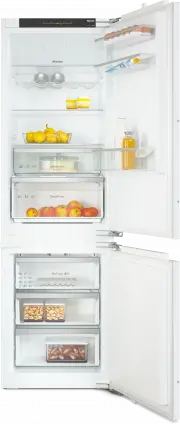
Guide to the appliance 26 DailyFresh NoFrost DailyFresh ExtraCool This drawing is for illustration purposes only.
Page 28 - For setting the temperature
Guide to the appliance 28 a For switching the SuperCool/SuperFreeze functions on and off (Party mode) b For setting the temperature c Temperature range d For switching the refrigeration appliance on/off
Page 29 - Adjusting the interior fittings; Moving the door shelf/bottle shelf
Guide to the appliance 29 Adjusting the interior fittings Moving the door shelf/bottle shelf Only move the door/bottle shelves inthe appliance door when they areempty. Push the door/bottle shelves up-wards, then remove them by pullingthem forwards. Replace the door/bottle shelves atthe required ...
Page 30 - Accessories supplied; Flexible bottle rack; Optional accessories; Multi-purpose microfibre cloth
Guide to the appliance 30 Accessories supplied Egg tray (depending on model) Bottle holder (depending on model) Flexible bottle rack Ice cube tray Optional accessories A range of useful Miele accessories andcare products are available for your ap-pliance. SoftClose hinges (KD(N) 7714 E,KD(N) 7724 E)...
Page 31 - Switching on and off; Before using for the first time
Switching on and off 31 Before using for the first time Remove all packaging material andprotective film. Clean the inside of the appliance andthe accessories (see “Cleaning andcare”). Connecting the refrigeration appli-ance Connect the refrigeration appliance tothe electricity supply as descr...
Page 32 - The correct temperature
The correct temperature 32 It is very important to set the correcttemperature to ensure the shelf life offood. Reducing the temperature re-duces the growth rate of microorgan-isms. Food does not spoil as quickly. The temperature in the refrigeration ap-pliance will rise: - The more often the applian...
Page 33 - Temperature display; required; Setting the temperature
The correct temperature 33 Temperature display The temperature display on the controlpanel always shows the required tem- perature. Setting the temperature Tap the sensor control on the con- trol panel until the required temperat-ure is displayed. Health risk caused by decom- posing food.The p...
Page 35 - Door alarm; Switching the door alarm off early
Door alarm 35 The refrigeration appliance is fittedwith a warning system to avoid in-creased energy consumption and foodbecoming warm if the appliance dooris left open. The alarm tone will sound if one of theappliance doors is left open for morethan a couple of minutes. The interior lighting will fl...
Page 36 - Storing food in the refrigerator section; Different storage zones; Warmest area
Storing food in the refrigerator section 36 Risk of explosion due to flam- mable mixes of gases.Electrical components can causeflammable mixes of gases to ignite.Do not store explosive materials inthe refrigeration appliance or anyproducts containing propellants (e.g.spray cans). The spray cans in...
Page 37 - Store food in such a way that it
Storing food in the refrigerator section 37 Tip: Store food in such a way that it does not touch the rear wall of the refri-gerator section. Otherwise it couldfreeze to the rear wall. Temperature indicator for the coldestarea The temperature indicator for the cold-est area is located on the left-han...
Page 38 - Notes on buying food
Storing food in the refrigerator section 38 Food which is not suitable forstorage in the refrigerator sec-tion Not all food is suitable for refrigerationat temperatures below 5 °C, because itmay be sensitive to cold. Depending onthe type of food, the appearance, con-sistency, flavour and/or vitamin ...
Page 39 - Storing food in the DailyFresh zone; DailyFresh ExtraCool drawer; - Fresh fish and shellfish
Storing food in the DailyFresh zone 39 DailyFresh ExtraCool drawer The DailyFresh ExtraCool drawer has atemperature of approx. 0 °C when atemperature of 2 °C has been set inthe refrigerator section. The humidity in the DailyFresh Ex-traCool drawer is not increased andcannot be regulated. The DailyFr...
Page 40 - Selecting low humidity
Storing food in the DailyFresh zone 40 Changing the humidity level in theDailyFresh drawer The humidity level in the DailyFreshdrawer largely depends on the typeand quantity of food being stored, ifstored unwrapped.If the quantity of food being stored inthis compartment is small, the humid-ity level...
Page 42 - Freezing and storing food; Freezing fresh food; Health risk caused by decom-; Storing frozen food; - That the packaging is not damaged
Freezing and storing food 42 Freezing fresh food Health risk caused by decom- posing food.If the temperature in the freezer re-mains above -18 °C for a long time,the frozen food can start to defrost.This will reduce the storage life of thefood.Check whether the frozen food hasstarted to defrost. I...
Page 43 - Home freezing; Before placing food in the freezer
Freezing and storing food 43 Home freezing Before placing food in the freezer When freezing more than 2 kg offresh food, switch on the Party modefunction for approx. 24 hours be- fore placing the food in the freezer(see “Using Party mode (SuperCool/SuperFreeze)”). This helps the frozen food whi...
Page 44 - You can expand the space avail-; Storage time for frozen food; Food group; Cooling drinks quickly; not left in
Freezing and storing food 44 – VarioRoom: freezing the maximumamount of food (see data plate) Tip: You can expand the space avail- able in the freezer section. If you wish tofreeze large items such as a turkey orgame, the freezer drawers can be re-moved. Remove the upper freezer drawersand place t...
Page 45 - Using accessories; Making ice cubes
Freezing and storing food 45 Using accessories Making ice cubes Fill the ice cube tray 3/4 full with wa-ter and place it on the bottom of oneof the freezer drawers. Once frozen, use a blunt instrument,for example a spoon handle, to re-move the ice tray from the freezer if itis stuck. Tip: Ice cu...
Page 46 - Defrosting; Fridge zone; Freezer section
Defrosting 46 Fridge zone The refrigerator section defrosts auto-matically. Condensate and frost can build up onthe back wall of the refrigerator sectionwhilst the compressor is running. Youdo not need to remove this. The condensate drains through a chan-nel and drain hole into an evaporationsystem ...
Page 47 - Cleaning agents; do not use the following:
Cleaning and care 47 The data plate located inside the in-terior cabinet of the refrigeration appli-ance must not be removed. It containsinformation which is required in theevent of a fault. Do not let water get into the elec-tronic unit or the lighting. Risk of damage due to moisture ingress.The ...
Page 48 - Switch the refrigeration appliance off.
Cleaning and care 48 Preparing the refrigeration ap-pliance for cleaning Switch the refrigeration appliance off. Take any food out of the refrigerationappliance and store it in a cool place. Take out any removable parts forcleaning. Cleaning the inside of the ap-pliance The refrigeration appli...
Page 49 - Dismantling an adjustable shelf; Cleaning the door seal; Risk of damage as a result of in-; Cleaning the ventilation gaps
Cleaning and care 49 Dismantling an adjustable shelf Place the shelf on a worktop coveredwith a soft material (e.g. a tea towel). Before cleaning the shelf, remove theplastic trim and protective strip at theback of the shelf as follows: 1. First pull the plastic trim off, starting from one side....
Page 50 - After cleaning; Switch the refrigeration appliance on.
Cleaning and care 50 After cleaning Replace all shelves and accessoriesin the refrigeration appliance. Switch the refrigeration appliance on. Switch on the Party mode function for a while so that the refrigeratorsection and freezer section can cooldown quickly. Place food in the refrigera...
Page 51 - Problem solving guide; Problem
Problem solving guide 51 Many malfunctions and faults that can occur in daily operation can be easilyremedied. Time and money will be saved because a service call will not beneeded. The following guide may help you to find the reason for a malfunction or a fault,and to correct it. To prevent unneces...
Page 55 - Other problems
Problem solving guide 55 Other problems Problem Cause and remedy The sensor control forsetting the temperature lights up until the temperature displayflashes. An alarm tonesounds. The fan in the freezer section has failed. Touch the sensor control. The alarm tone will stop. The set temperat...
Page 57 - The interior lighting is not working.
Problem solving guide 57 The interior lighting is not working. Problem Cause and remedy The interior lighting isnot working. The refrigeration appliance has not been switchedon. Switch the refrigeration appliance on. To avoid overheating, the lighting switches itself offautomatically after approx....
Page 58 - Noises; What is causing them?
Noises 58 The refrigeration appliance is producing various noises during operation. If the cooling performance is low, the refrigeration appliance will conserve energybut operate for longer. The volume will be lower. Food will be chilled faster if the cooling performance is high. The volume will be ...
Page 59 - Service; Contact in the event of a fault
Service 59 Contact in the event of a fault In the event of any faults which youcannot remedy yourself, please contactyour Miele dealer or the Miele CustomerService Department. You can book a Miele Customer Ser-vice Department call-out online atwww.miele.com/service. Contact information for the Miele...


 Miele WWD380 WCS PWash&Steam&9kg User Manual
 Miele W 1614 Manual
 Miele G 5266 SCVi SFP Active Plus User Manual
 Miele Classic C1 Turbo Team PowerLine - SBAN0 User Manual
![Miele PDR 307 [EL]](https://manualsarea.com/img/product/thumbs/48/ba/fd/bafde84806e8abc8b420f34eaf8fcd6e.webp) Miele PDR 307 [EL] User Manual
Miele PDR 307 [EL] User Manual Miele F 1911 Vi Manual
![Miele PDR 908 [EL MAR 3N AC 400V 50-60Hz]](https://manualsarea.com/img/product/thumbs/48/05/b7/05b705998b251f92b271e908423e1ecb.webp) Miele PDR 908 [EL MAR 3N AC 400V 50-60Hz] Installation Manual
Miele PDR 908 [EL MAR 3N AC 400V 50-60Hz] Installation Manual Miele K 9757 iD Manual
 Miele K 31222 Ui User Manual
 Miele K 31222 Ui-1 User Manual
 Miele K 31242 UiF-1 User Manual
 Miele KD 4072 E Active User Manual
 Miele KDB 37232 iD Manual
 Miele KDN 7713 E Active User Manual
 Miele KDN 9713 iD Manual
 Miele KDN12823S Manual
 Miele KDN 37132 iD Manual
 Miele KF1901VI Manual
 Miele KF 1911 SF Manual
 Miele KF 1911 Vi Manual