Page 2 - Motherboard
Motherboard GA-P67A-UD3R Oct. 26, 2010 Oct. 26, 2010 M oth erb oa rd GA-P67A-UD3R
Page 4 - Table of Contents; -2 Product Specifications
- 4 - Table of Contents Box Contents ...................................................................................................................6Optional Items .................................................................................................................6GA-P67A-UD3R Mothe...
Page 5 - -2 Configuring Audio Input and Output
- 5 - 3-3 Technical Manuals .......................................................................................... 563-4 Contact ........................................................................................................... 573-5 System .................................................
Page 6 - Box Contents; Motherboard driver disk; Optional Items
- 6 - Box Contents GA-P67A-UD3R motherboard Motherboard driver disk User's Manual Quick Installation Guide Four SATA cables I/O Shield Optional Items 2-port USB 2.0 bracket (Part No. 12CR1-1UB030-5*R) 2-port SATA power cable (Part No. 12CF1-2SERPW-0*R) COM port cable (Part No. 12CF1-1CM001-3*R) • Th...
Page 9 - Hardware Installation; -1 Installation Precautions; electrostatic shielding container.; Chapter 1 Hardware Installation
- 9 - Hardware Installation 1-1 Installation Precautions The motherboard contains numerous delicate electronic circuits and components which can become damaged as a result of electrostatic discharge (ESD). Prior to installation, carefully read the user's manual and follow these procedures: • Prior t...
Page 10 - Support for Extreme Memory Profile (XMP) memory modules
Hardware Installation - 10 - 1-2 Product Specifications CPU Support for Intel ® Core ™ i7 processors/Intel ® Core ™ i5 processors/ Intel ® Core ™ i3 processors/Intel ® Pentium ® processors/ Intel ® Celeron ® processors in the LGA1155 package (Go to GIGABYTE's website for the latest CPU support lis...
Page 13 - -3 Installing the CPU and CPU Cooler; Read the following guidelines before you begin to install the CPU:
- 13 - Hardware Installation 1-3 Installing the CPU and CPU Cooler 1-3-1 Installing the CPU A. Locate the alignment keys on the motherboard CPU socket and the notches on the CPU. Read the following guidelines before you begin to install the CPU: • Make sure that the motherboard supports the CPU. (Go...
Page 16 - -4 Installing the Memory; the memory to prevent hardware damage.
Hardware Installation - 16 - 1-4-1 Dual Channel Memory Configuration This motherboard provides four DDR3 memory sockets and supports Dual Channel Technology. After the memory is installed, the BIOS will automatically detect the specifications and capacity of the memory. En - abling Dual Channel memo...
Page 17 - install your memory modules in the memory sockets.
- 17 - Hardware Installation 1-4-2 Installing a Memory Notch DDR3 DIMM Before installing a memory module, make sure to turn off the computer and unplug the power cord from the power outlet to prevent damage to the memory module.DDR3 and DDR2 DIMMs are not compatible to each other or DDR DIMMs. Be su...
Page 18 - -5 Installing an Expansion Card
Hardware Installation - 18 - 1-5 Installing an Expansion Card Read the following guidelines before you begin to install an expansion card: • Make sure the motherboard supports the expansion card. Carefully read the manual that came with your expansion card. • Always turn off the computer and unplug ...
Page 19 - -6 Back Panel Connectors; PS/2 Keyboard or Mouse Port; Use this port to connect a PS/2 keyboard or mouse.; Optical S/PDIF Out Connector; device and then remove it from the motherboard.
- 19 - Hardware Installation 1-6 Back Panel Connectors USB 2.0/1.1 Port The USB port supports the USB 2.0/1.1 specification. Use this port for USB devices such as a USB key - board/mouse, USB printer, USB flash drive and etc. PS/2 Keyboard or Mouse Port Use this port to connect a PS/2 keyboard or mo...
Page 21 - -7 Internal Connectors; ATX
- 21 - Hardware Installation 1-7 Internal Connectors Read the following guidelines before connecting external devices: • First make sure your devices are compliant with the connectors you wish to connect. • Before installing the devices, be sure to turn off the devices and your computer. Unplug the ...
Page 23 - low level, or the CMOS values may not be accurate or may be lost.
- 23 - Hardware Installation 3/4/5) CPU_FAN/SYS_FAN1/SYS_FAN2/PWR_FAN (Fan Headers) The motherboard has a 4-pin CPU fan header (CPU_FAN), a 4-pin (SYS_FAN2) and a 3-pin (SYS_FAN1) system fan headers, and a 3-pin power fan header (PWR_FAN). Most fan headers possess a foolproof insertion design. When ...
Page 25 - PW; is reading or writing data.; RES; if the computer freezes and fails to perform a normal restart.; CI
- 25 - Hardware Installation 9) F_PANEL (Front Panel Header) Connect the power switch, reset switch, speaker, chassis intrusion switch/sensor and system status indicator on the chassis to this header according to the pin assignments below. Note the positive and negative pins before connecting the ca...
Page 27 - cord from the power outlet to prevent damage to the USB bracket.
- 27 - Hardware Installation 12) F_USB1/F_USB2/F_USB3 (USB Headers) The headers conform to USB 2.0/1.1 specification. Each USB header can provide two USB ports via an optional USB bracket. For purchasing the optional USB bracket, please contact the local dealer. DEBUG PORT G.QBOFM 10 9 2 1 Pin No. D...
Page 28 - Load Optimized Defaults; Saver
Hardware Installation - 28 - 14) CLR_CMOS (Clearing CMOS Jumper) Use this jumper to clear the CMOS values (e.g. date information and BIOS configurations) and reset the CMOS values to factory defaults. To clear the CMOS values, place a jumper cap on the two pins to temporarily short the two pins or u...
Page 29 - Chapter 2 BIOS Setup
- 29 - BIOS Setup BIOS (Basic Input and Output System) records hardware parameters of the system in the CMOS on the motherboard. Its major functions include conducting the Power-On Self-Test (POST) during system startup, saving system parameters and loading operating system, etc. BIOS includes a BIO...
Page 30 - Full Screen LOGO Show; vice setting as needed.
BIOS Setup - 30 - 2-1 Startup Screen The following screens may appear when the computer boots. A. The LOGO Screen (Default) B. The POST Screen Function Keys: <TAB>: POST SCREEN Press the <Tab> key to show the BIOS POST screen. To show the BIOS POST screen at system start-up, refer to the...
Page 31 - BIOS Setup Program Function Keys; Load Optimized Defaults
- 31 - BIOS Setup 2-2 The Main Menu Once you enter the BIOS Setup program, the Main Menu (as shown below) appears on the screen. Use ar-row keys to move among the items and press <Enter> to accept or enter a sub-menu. (Sample BIOS Version: F4d) Main Menu Help The on-screen description of a hig...
Page 32 - BIOS Setup; F11: Save CMOS to BIOS; mary display adapter.
BIOS Setup - 32 - The Functions of the <F11> and <F12> keys (For the Main Menu Only) F11: Save CMOS to BIOS This function allows you to save the current BIOS settings to a profile. You can create up to 8 profiles (Profile 1-8) and name each profile. First enter the profile name (to e...
Page 34 - Advanced Frequency Settings; Advanced CPU Core Features; CPU Clock Ratio
BIOS Setup - 34 - M.I.T. Current Status This screen provides information on CPU/memory frequencies/parameters. Advanced Frequency Settings (Note 1) This item is present only when you install a memory module that supports this feature.(Note 2) This item is present only when you install a CPU that...
Page 35 - ratios according to the CPU specifications.; CPU Cores Enabled
- 35 - BIOS Setup (Note) This item is present only when you install a CPU that supports this feature. For more information about Intel CPUs' unique features, please visit Intel's website. CPU Frequency Displays the current operating CPU frequency. Real-Time Ratio Changes in OS (Note) Enabled allows ...
Page 36 - CPU Thermal Monitor; CPU EIST Function; Auto; Bi-Directional PROCHOT; Enabled
BIOS Setup - 36 - CPU Thermal Monitor (Note 1) Enables or disables Intel CPU Thermal Monitor function, a CPU overheating protection function. When enabled, the CPU core frequency and voltage will be reduced when the CPU is overheated. Auto lets the BIOS automatically configure this setting. (Default...
Page 37 - Profile1; Profile VTT Voltage; tomatically configure this setting.; Rank Interleaving; cally configure this setting.; Advanced Memory Settings
- 37 - BIOS Setup (Note) This item is present only when you install a memory module that supports this feature. Extreme Memory Profile (X.M.P.) (Note) , System Memory Multiplier (SPD), Memory Frequency(Mhz) The settings under the three items above are synchronous to those under the same items on the...
Page 39 - This option is configurable only when
- 39 - BIOS Setup Command Rate(CMD) Options are: Auto (default), 1~3. >>>>> Channel A/B Misc Timing Control IO Latency Options are: Auto (default), 1~31. Round Trip Latency Options are: Auto (default), 1~255. Advanced Voltage Settings CMOS Setup Utility-Copyright (C) 1984-2010 Award...
Page 40 - Isochronous Support
BIOS Setup - 40 - >>> DRAM DRAM Voltage The default is Auto . DRAM VRef. The default is Auto . DRAM Termination The default is Auto . Ch-A Data VRef. The default is Auto . Ch-B Data VRef. The default is Auto . Ch-A Address VRef. The default is Auto . Ch-B Address VRef. The default is Auto ....
Page 41 - Manual; CHS; IDE Channel 2, 3 Master; Configure your SATA devices by using one of the two methods below:; None; -4 Standard CMOS Features
- 41 - BIOS Setup Date (mm:dd:yy) Sets the system date. The date format is week (read-only), month, date and year. Select the desired field and use the up arrow or down arrow key to set the date. Time (hh:mm:ss) Sets the system time. For example, 1 p.m. is 13:0:0. Select the desired field and use th...
Page 42 - These fields are read-only and are determined by the BIOS POST.
BIOS Setup - 42 - Capacity Approximate capacity of the currently installed hard drive. Cylinder Number of cylinders. Head Number of heads. Precomp Write precompensation cylinder. Landing Zone Landing zone. Sector Number of sectors. Halt On Allows you to determine whether the system will stop for an ...
Page 43 - -5 Advanced BIOS Features; Hard Disk Boot Priority; Set Supervisor/User Password; item in
- 43 - BIOS Setup (Note) This item is present only when you install a CPU that supports this feature. For more information about Intel CPUs' unique features, please visit Intel's website. 2-5 Advanced BIOS Features Hard Disk Boot Priority Specifies the sequence of loading the operating system from t...
Page 44 - Limit CPUID Max. to 3; for Windows; for legacy operating system such as Windows NT4.0.; No-Execute Memory Protect; Disabled; displays; Init Display First; PCI
BIOS Setup - 44 - Limit CPUID Max. to 3 (Note) Allows you to determine whether to limit CPUID maximum value. Set this item to Disabled for Windows XP operating system; set this item to Enabled for legacy operating system such as Windows NT4.0. (Default: Disabled) No-Execute Memory Protect (Note) Ena...
Page 45 - -6 Integrated Peripherals; PCH SATA Control Mode (Intel P67 Chipset); IDE; USB Controllers; USB Legacy Function
- 45 - BIOS Setup 2-6 Integrated Peripherals eXtreme Hard Drive (Intel P67 Chipset) Enables or disables the X.H.D function for the SATA controllers integrated in the Intel P67 Chipset. When set to Enabled , the PCH SATA Control Mode item below will be set to RAID(XHD) automatically. For details on u...
Page 46 - SMART LAN; fields of all four pairs of wires will show
BIOS Setup - 46 - USB Storage Function Determines whether to detect USB storage devices, including USB flash drives and USB hard drives during the POST. (Default: Enabled) Azalia Codec Enables or disables the onboard audio function. (Default: Auto) If you wish to install a 3rd party add-in audio car...
Page 47 - Onboard LAN Boot ROM
- 47 - BIOS Setup Onboard LAN Boot ROM Allows you to decide whether to activate the boot ROM integrated with the onboard LAN chip. (Default: Disabled) Onboard USB3.0 Controller (Renesas D720200 USB Controller, USB Connectors on the Back Panel) Enables or disables the Renesas D720200 USB controller. ...
Page 48 - ACPI Suspend Type; Specifies the ACPI sleep state when the system enters suspend.; PME Event Wake Up; -7 Power Management Setup
BIOS Setup - 48 - ACPI Suspend Type Specifies the ACPI sleep state when the system enters suspend. S1(POS) Enables the system to enter the ACPI S1 (Power on Suspend) sleep state. In S1 sleep state, the system appears suspended and stays in a low power mode. The system can be resumed at any time. S3(...
Page 49 - This item is configurable only when the; HPET Support
- 49 - BIOS Setup (Note) Supported on Windows 7/Vista operating system only. Resume by Alarm Determines whether to power on the system at a desired time. (Default: Disabled) If enabled, set the date and time as following: Date (of Month) Alarm: Turn on the system at a specific time on each day or on...
Page 50 - Case Opened; Reset Case Open Status; -8 PC Health Status
BIOS Setup - 50 - Reset Case Open Status Keeps or clears the record of previous chassis intrusion status. Enabled clears the record of previous chassis intrusion status and the Case Opened field will show "No" at next boot. (Default: Disabled) Case Opened Displays the detection status of the...
Page 52 - -10 Load Optimized Defaults
BIOS Setup - 52 - Press <Enter> on this item and then press the <Y> key to load the safest BIOS default settings. In case system instability occurs, you may try to load Fail-Safe defaults, which are the safest and most stable BIOS settings for the motherboard. 2-9 Load Fail-Safe Defaults...
Page 54 - -13 Exit Without Saving
BIOS Setup - 54 - Press <Enter> on this item and press the <Y> key. This saves the changes to the CMOS and exits the BIOS Setup program. Press <N> or <Esc> to return to the BIOS Setup Main Menu. 2-12 Save & Exit Setup CMOS Setup Utility-Copyright (C) 1984-2010 Award Softw...
Page 55 - -1 Installing Chipset Drivers; Chapter 3 Drivers Installation
- 55 - Drivers Installation 3-1 Installing Chipset Drivers Chapter 3 Drivers Installation • Before installing the drivers, first install the operating system. • After installing the operating system, insert the motherboard driver disk into your optical drive. The driver Autorun screen is automatical...
Page 56 - Drivers Installation; -2 Application Software; Install; button on the right of an item to install it.; -3 Technical Manuals
Drivers Installation - 56 - 3-2 Application Software This page displays all the utilities and applications that GIGABYTE develops and some free software. You can click the Install button on the right of an item to install it. 3-3 Technical Manuals This page provides GIGABYTE's application guides, co...
Page 58 - Download Center; button to link to the GIGABYTE
Drivers Installation - 58 - 3-6 Download Center To update the BIOS, drivers, or applications, click the Download Center button to link to the GIGABYTE website. The latest version of the BIOS, drivers, or applications will be displayed. 3-7 New Utilities This page provides a quick link to GIGABYTE's ...
Page 59 - Chapter 4 Unique Features; -1 Xpress Recovery2; FAT32, and FAT16 file systems, Xpress Recovery2 can back up data on; Installation and Configuration:; A. Installing Windows 7 and Partitioning the Hard Drive
- 59 - Unique Features Chapter 4 Unique Features 4-1 Xpress Recovery2 Xpress Recovery2 is a utility that allows you to quickly compress and back up your system data and perform restoration of it. Supporting NTFS, FAT32, and FAT16 file systems, Xpress Recovery2 can back up data on PATA and SATA hard ...
Page 61 - If you wish to remove the backup file, select
- 61 - Unique Features D. Using the Restore Function in Xpress Recovery2 E. Removing the Backup F. Exiting Xpress Recovery2 Select RESTORE to restore the backup to your hard drive in case the system breaks down. The RESTORE option will not be present if no backup is created before. Select REBOOT to ...
Page 62 - -2 BIOS Update Utilities; design, which enhances protection for the; What is DualBIOS; update the backup BIOS manually.
Unique Features - 62 - Because BIOS flashing is potentially risky, please do it with caution. Inadequate BIOS flashing may result in system malfunction. 4-2 BIOS Update Utilities GIGABYTE motherboards provide two unique BIOS update tools, Q-Flash ™ and @BIOS ™ . GIGABYTE Q-Flash and @BIOS are easy-t...
Page 63 - Unique Features; sumes that you save the BIOS file to a USB flash drive.; Update BIOS from Drive; The; Save Main BIOS to Drive; option allows you to save the current BIOS file.; Make sure the BIOS update file matches your motherboard model.
- 63 - Unique Features Q-Flash Utility v2.17 Flash Type/Size................................. MXIC 25L3206E 4M Keep DMI Data Enable Load CMOS Default Enable Update BIOS from Drive Save BIOS to Drive Enter : Run hi :Move ESC:Reset F10:Power Off B. Updating the BIOS When updating the BIOS, choose the ...
Page 64 - dure is complete after the system restarts.
Unique Features - 64 - Step 4:Press <Esc> and then <Enter> to exit Q-Flash and reboot the system. As the system boots, you should see the new BIOS version is present on the POST screen. Step 5:During the POST, press <Delete> to enter BIOS Setup. Select Load Optimized Defaults and p...
Page 65 - C. After Updating the BIOS
- 65 - Unique Features 4-2-2 Updating the BIOS with the @BIOS Utility A. Before You Begin 1. In Windows, close all applications and TSR (Terminate and Stay Resident) programs. This helps prevent unexpected failures when performing a BIOS update. 2. During the BIOS update process, ensure the Internet...
Page 66 - The EasyTune 6 Interface; Tab
Unique Features - 66 - 4-3 EasyTune 6 GIGABYTE's EasyTune 6 is a simple and easy-to-use interface that allows users to fine-tune their system settings or do overclock/overvoltage in Windows environment. The user-friendly EasyTune 6 interface also includes tabbed pages for CPU and memory information,...
Page 67 - -4 Dynamic Energy Saver; without sacrificing computing performance.; The Dynamic Energy Saver
- 67 - Unique Features 4-4 Dynamic Energy Saver ™ 2 GIGABYTE Dynamic Energy Saver ™ 2 (Note 1) is a revolutionary technology that delivers unparalleled power savings with a click of the button. Featuring an advanced proprietary hardware and software design, GIGA-BYTE Dynamic Energy Saver ™ 2 is able...
Page 68 - e first time; o work with the user-defined power saving settings, even after the; Total Mode - Button Information Table
Unique Features - 68 - B. Total Mode In Total Mode, users are able to see how much total power savings they have accumulated in a set period of time since activating Dynamic Energy Saver ™ 2 for th e first time (Note 3) . (Note 1) Before using the Dynamic Energy Saver ™ 2 function, make sure the CPU...
Page 69 - l. After configuring your LAN connection settings and; Directions for using Q-Share; in the notification area and right-click on this icon; Options Descriptions
- 69 - Unique Features 4-5 Q-Share Q-Share is an easy and convenient data sharing too l. After configuring your LAN connection settings and Q-Share, you are able to share your data with computers on the same network, making full use of Internet resources. Directions for using Q-Share After installin...
Page 70 - SMART QuickBoost; Enable; SMART QuickBoot
Unique Features - 70 - 4-6 Smart 6 ™ GIGABYTE Smart 6 ™ (Note 1) is designed with user-friendliness in mind, and offers a combination of 6 innovative software utilities that provide easier and smarter PC system management. Smart 6 ™ allows you to speed up system performance, reduce boot-up time, man...
Page 71 - SMART Recovery 2; Backup Now; Settings; Allows you to recover your files from the backup image
- 71 - Unique Features SMART Recovery 2 Smart Recovery 2 allows you to back up a partition as an image file every hour. You can use these images to restore your system or files when needed. • Supported operating systems: Windows 7 and Vista. • Smart Recovery 2 only supports NTFS file system. • You n...
Page 72 - SMART DualBIOS
Unique Features - 72 - SMART DualBIOS SMART DualBIOS is a new feature that can record personal passwords and important dates, and remind users of the dates. It also stores the recorded data in the main and backup BIOS simultaneously, which can prevent loss of the data in case the system/hard drive f...
Page 73 - files copying. Entering the Smart 6; SMART Recorder
- 73 - Unique Features (Note 1) When launching Smart 6 ™ for the first time, the system will request you to set up a password. This password is required when you activate SMART DualBIOS or when you want to make changes to the SMART Recorder or SMART TimeLock settings. (Note 2) You will not be able t...
Page 74 - Selecting a system energy saving mode:; Configure; Con
Unique Features - 74 - 4-7 Auto Green Auto Green is an easy-to-use tool that provides users with simple options to enable system power savings via a Bluetooth cell phone. When the phone is out of the range of the computer's Bluetooth receiver, the sys- tem will enter the specified power saving mode....
Page 75 - Step 1: Configure the system BIOS
- 75 - Unique Features With GIGABYTE eXtreme Hard Drive (X.H.D) (Note 1) , users can quickly configure a RAID- ready system for RAID 0 when a new SATA drive is added. For a RAID 0 array that al- ready exists, users also can use X.H.D to easily add a hard drive into the array to expand its capacity. ...
Page 76 - A. Launching Cloud OC
Unique Features - 76 - 4-9 Cloud OC Cloud OC (Note 1) is an easy-to-use overclocking utility designed for system overclock- ing via virtually any Internet-connected device, such as a smart phone, iPhone, note-book PC, etc. By simply connecting to an Internet browser via LAN, wireless LAN, or Bluetoo...
Page 77 - Appendix; Chapter 5 Appendix; and operating system.; Before you begin; Motherboard driver disk.
- 77 - Appendix Chapter 5 Appendix 5-1 Configuring SATA Hard Drive(s) To configure SATA hard drive(s), follow the steps below: A. Install SATA hard drive(s) in your computer. B. Configure SATA controller mode in BIOS Setup. C. Configure a RAID array in RAID BIOS. (Note 1) D. Install the SATA RAID/AH...
Page 78 - B. Configuring SATA controller mode in BIOS Setup; PCH SATA Control Mode
Appendix - 78 - The BIOS Setup menus described in this section may differ from the exact settings for your moth-erboard. The actual BIOS Setup menu options you will see shall depend on the motherboard you have and the BIOS version. B. Configuring SATA controller mode in BIOS Setup Make sure to confi...
Page 79 - C. Configuring a RAID array in RAID BIOS; Figure 2; If you want to create a RAID array, select; Create RAID; Volume in; MAIN MENU; Figure 3
- 79 - Appendix C. Configuring a RAID array in RAID BIOS Enter the RAID BIOS setup utility to configure a RAID array. Skip this step and proceed with the installation of Windows operating system for a non-RAID configuration. Step 1:After the POST memory test begins and before the operating system bo...
Page 80 - CREATE VOLUME MENU; screen, enter a volume name with 1~16 letters (letters cannot; Name; Figure 4
Appendix - 80 - Step 3: After entering the CREATE VOLUME MENU screen, enter a volume name with 1~16 letters (letters cannot be special characters) under the Name item and press <Enter>. Then, select a RAID level (Figure 4). RAID levels supported include RAID 0, RAID 1, Recovery, RAID 10, and R...
Page 81 - Create Volume; item to begin creat-; TION; in; Figure 6
- 81 - Appendix Step 5:Enter the array capacity and press <Enter>. Finally press <Enter> on the Create Volume item to begin creat- ing the RAID array. When prompted to confirm whether to create this volume, press <Y> to confirm or <N> to cancel (Figure 6). When completed, you...
Page 84 - To delete a RAID array, select; Delete RAID Volume; MAIN MENU
Appendix - 84 - Delete RAID Volume To delete a RAID array, select Delete RAID Volume in MAIN MENU and press <Enter>. In the DELETE VOLUME MENU section, use the up or down arrow key to select the array to be deleted and press <Delete>. When prompted to confirm your selection (Figure 12), ...
Page 85 - -1-2 Installing the SATA RAID/AHCI Driver and Operating System; A. Installing Windows XP; For the Intel P67, copy all of the files in the; RAID Controller
- 85 - Appendix 5-1-2 Installing the SATA RAID/AHCI Driver and Operating System With the correct BIOS settings, you are ready to install Windows 7/Vista/XP onto your hard drive(s). A. Installing Windows XP To install Windows XP, you need to install the SATA RAID/AHCI controller driver during the OS ...
Page 86 - C. Rebuilding an Array; Enabling Automatic Rebuild; icon
Appendix - 86 - C. Rebuilding an Array Rebuilding is the process of restoring data to a hard drive from other drives in the array. Rebuilding applies only to fault-tolerant arrays such as RAID 1, RAID 5 or RAID 10 arrays. The procedures below assume a new drive is added to replace a failed drive to ...
Page 88 - of the Intel RAID Configuration Utility. On the
Appendix - 88 - • Restoring the Master Drive to a Previous State (for Recovery Volume only) When two hard drives are set to Recovery Volume in Update on Request mode, you can restore the master drive data to the last backup state when needed. For example, in case the master drive detects a virus, yo...
Page 89 - A. Configuring Speakers; jack for microphone functionality.; HD Audio Manager
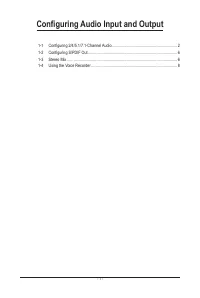
- 89 - Appendix 5-2-1 Configuring 2/4/5.1/7.1-Channel Audio The motherboard provides six audio jacks on the back panel which support 2/4/5.1/7.1-channel (Note) audio. The picture to the right shows the default audio jack assignments. The integrated HD (High Definition) audio provides jack retasking ...
Page 90 - the type of speaker configuration you wish to set up. Then; B. Configuring Sound Effect; You may configure an audio environment on the; C. Activating an AC'97 Front Panel Audio Module
Appendix - 90 - Step 2:Connect an audio device to an audio jack. The The cur- rent connected device is dialog box appears. Select the device according to the type of device you connect. Then click OK . Step 3:On the Speakers screen, click the Speaker Configura - tion tab. In the Speaker Configuratio...
Page 91 - screen to configure further settings if you use the S/PDIF Out; Digital
- 91 - Appendix 5-2-2 Configuring S/PDIF Out The S/PDIF Out jacks (Note 1) can transmit audio signals to an external decoder for decoding to get the best audio quality. 1. Connecting a S/PDIF Out Cable: S/PDIF Coaxial Cable Connect a S/PDIF coaxial cable or a S/PDIF optical cable (either one) to an ...
Page 92 - -2-3 Enabling the Dolby Home Theater Function; click on this icon. Select
Appendix - 92 - 5-2-3 Enabling the Dolby Home Theater Function Before Dolby Home Theater is enabled, you get only 2-channel playback output (from the front speakers) when playing 2-channel stereo sources. You must play 4-, 5.1-, or 7.1- chan-nel content to get 4-, 5.1-, or 7.1- channel audio effects...
Page 93 - panel. Then configure the jack for microphone function; Microphone; will appear in the notification area. Double-click
- 93 - Appendix 5-2-4 Configuring Microphone Recording Step 2:Connect your microphone to the Mic in jack (pink) on the back panel or the Mic in jack (pink) on the front panel. Then configure the jack for microphone function - ality. Note: The microphone functions on the front panel and back panel ca...
Page 94 - * Enabling Stereo Mix
Appendix - 94 - Step 5:After completing the settings above, click Start , point to All Programs , point to Accessories , and then click Sound Recorder to begin the sound recording. Step 1:Locate the icon in the notification area and right- click on this icon. Select Recording Devices . Step 2:On the...
Page 95 - to config; Stereo Mix; Be sure to save the recorded audio file upon completion.; B. Playing the Recorded Sound
- 95 - Appendix Step 4:Now you can access the HD Audio Manager to config - ure Stereo Mix and use Sound Recorder to record the sound. 5-2-5 Using the Sound Recorder A. Recording Sound 1. Make sure you have connected the sound input device (e.g. microphone) to the computer. 2. To record the audio, cl...
Page 96 - Audio Device on High Definition Audio Bus
Appendix - 96 - 5-3 Troubleshooting 5-3-1 Frequently Asked Questions To read more FAQs for your motherboard, please go to the Support & Downloads\FAQ page on GIGABYTE's website. Q: In the BIOS Setup program, why are some BIOS options missing?A: Some advanced options are hidden in the BIOS Setup ...
Page 103 - Contact Us
- 103 - Appendix Contact Us • GIGA-BYTE TECHNOLOGY CO., LTD. Address: No.6, Bau Chiang Road, Hsin-Tien, Taipei 231, Taiwan TEL: +886-2-8912-4000 FAX: +886-2-8912-4003Tech. and Non-Tech. Support (Sales/Marketing) :http://ggts.gigabyte.com.twWEB address (English): http://www.gigabyte.comWEB address (C...
Page 104 - GIGABYTE Global Service System
Appendix - 104 - • G.B.T. TECHNOLOGY TRADING GMBH - Germany WEB address : http://www.gigabyte.de • G.B.T. TECH. CO., LTD. - U.K. WEB address : http://www.giga-byte.co.uk • Giga-Byte Technology B.V. - The Netherlands WEB address : http://www.giga-byte.nl • GIGABYTE TECHNOLOGY FRANCE - France WEB addr...


 Gigabyte GA P55A UD5 rev 1 0 User Manual
 Gigabyte GA P55A UD6 rev 1 0 User Manual
 Gigabyte GA P55A UD7 rev 1 0 User Manual
 Gigabyte GA P55M UD2 rev 1 1 User Manual
 Gigabyte GA P67A UD3 B3 rev 1 1 User Manual
 Gigabyte GA P67A UD3R rev 1 0 User Manual
 Gigabyte GA P67A UD4 rev 1 1 User Manual
 Gigabyte GA PH67A UD3 rev 1 1 User Manual
 Gigabyte GA X58A UD3R rev 1 0 User Manual
 Gigabyte GA X58A UD5 rev 1 0 User Manual
 Gigabyte GA X58A UD7 rev 1 0 User Manual
 Gigabyte X299 UD4 Pro User Manual
 Gigabyte B650 User Manual
 Gigabyte GA 8I848P rev 1 x User Manual
 Gigabyte GA 8I848P rev 2 x User Manual
 Gigabyte GA 8IG1000 Pro rev 2 x User Manual
 Gigabyte GA 8IG1000 rev 1 x User Manual
 Gigabyte GA 8IG1000 rev 3 x User Manual
 Gigabyte GA 8IPE1000 rev 1 x User Manual
 Gigabyte GA 8IPE1000 rev 3 x User Manual