Page 2 - GENERAL SAFETY RULES; PERSONAL SAFETY; TOOL USE AND CARE; SERVICE
2 – English GENERAL SAFETY RULES DANGER: READ AND UNDERSTAND TOOL LABELS AND MANUAL. Failure to follow warnings could result in DEATH or SERIOUS INJURY. SAVE THESE INSTRUCTIONSWORK AREA Keep your work area clean and well lit. Cluttered benches and dark areas invite accidents. Do not operate powe...
Page 3 - SPECIFIC SAFETY RULES; OPERATION
3 – English SPECIFIC SAFETY RULES Know your pneumatic tool. Read operator’s manual carefully. Learn its applications and limitations, as well as the specific potential hazards related to this tool. Following this rule will reduce the risk of electric shock, fire, or serious injury. Always wear e...
Page 4 - AIR SUPPLY AND CONNECTIONS; LOADING TOOL; SAVE THESE INSTRUCTIONS
4 – English SPECIFIC SAFETY RULES Do not drive fasteners on top of other fasteners or with the tool at an overly steep angle as this may cause deflection of fasteners which could cause injury. Do not drive fasteners close to the edge of the work-piece as the wood may split, allowing the fastener...
Page 5 - WARNING; SYMBOLS; CALIFORNIA PROPOSITION 65; SYMBOL
5 – English The following signal words and meanings are intended to explain the levels of risk associated with this product. SYMBOL SIGNAL MEANING DANGER: Indicates an imminently hazardous situation, which, if not avoided, will result in death or serious injury. WARNING Indicates a potentially hazar...
Page 6 - GLOSSARY OF TERMS
6 – English GLOSSARY OF TERMS Activate (operating controls) To move an operating control so that it is in a position that allows the tool to be actuated or that satisfies one requirement for the tool to be actuated. Actuate (tool) To cause movement of the tool component(s) intended to drive a fasten...
Page 7 - FEATURES
7 – English KNOW YOUR ROOFING COIL NAILER See Figure 1, page 15. The safe use of this product requires an understanding of the information on the tool and in this operator’s manual as well as a knowledge of the project you are attempting. Before use of this product, familiarize yourself with all ope...
Page 8 - APPLICATIONS
8 – English ASSEMBLY DANGER: Do not use oxygen, combustible gases or bottled gases as a power source for this tool. The tool will explode and cause death or serious injury. WARNING: Do not allow familiarity with tools to make you careless. Remember that a careless fraction of a second is sufficient ...
Page 9 - PREPARING THE TOOL FOR USE; ADJUSTING THE OFFSET MAGAZINE; LOADING THE TOOL WITH NAILS
9 – English OPERATION PREPARING THE TOOL FOR USE See Figure 2, page 15. Under normal use conditions, the tool should be lubricated before connecting the tool to an air supply. Add air tool lu-bricant into the air fitting on the tool once daily with minimal use, or twice a day with heavy use. Only a ...
Page 10 - USING THE SELECTABLE TRIGGER; SINGLE SEQUENTIAL ACTUATION MODE
10 – English OPERATION WARNING: Use only the nails recommended for use with this tool (refer to the Fastener Guide). The use of any other nails can result in tool malfunction, leading to serious injuries. WARNING: Never load nails with the workpiece contact or trigger activated. Doing so could resul...
Page 11 - SETTING THE AIR PRESSURE; CLEARING A JAMMED FASTENER
11 – English OPERATION SETTING THE AIR PRESSURE The amount of air pressure required will depend on the size of the nail and the workpiece material. Begin testing the depth of drive by driving a test nail into the same type of workpiece material used for the actual job. Drive a test nail with the air...
Page 12 - MAINTENANCE; COLD WEATHER OPERATION; AIR SUPPLY PRESSURE AND VOLUME; GENERAL MAINTENANCE
12 – English MAINTENANCE COLD WEATHER OPERATION For cold weather operation, near and below freezing, the moisture in the air line may freeze and prevent tool operation. We recommend the use of air tool lubricant or permanent antifreeze (ethylene glycol) as a cold weather lubricant. NOTICE: Do not st...
Page 13 - REQUIRED DAILY CHECKLIST; ACCESSORIES
13 – English MAINTENANCE REQUIRED DAILY CHECKLIST See Figure 9, page 16. Disconnect the air supply from the tool and remove all fasteners. Check all screws, nuts, bolts, and pins on the tool. If any of these are loose, they must be tightened with the ap-propriate size wrench. Press the workpie...
Page 15 - RÈGLES DE SÉCURITÉ GÉNÉRALES; SÉCURITÉ PERSONNELLE
2 – Français RÈGLES DE SÉCURITÉ GÉNÉRALES DANGER : LIRE ET VEILLER À BIEN COMPRENDRE LES AUTOCOLLANTS APPOSÉS SUR L’OUTIL ET LE MANUEL. Le non respect de cet avertissement pourrait entraîner des BLESSURES GRAVES ou MORTELLES. CONSERVER CES INSTRUCTIONSLIEU DE TRAVAIL Garder le lieu de travail prop...
Page 16 - RÈGLES DE SÉCURITÉ PARTICULIÈRES; UTILISATION; DÉPANNAGE
3 – Français Apprendre à connaître l’outil. Lire attentivement le manuel d’utilisation. Apprendre les applications et les limites de l’outil, ainsi que les risques spécifiques relatifs à son utilisation. Le respect de cette règle réduira les risques de choc électrique, d’incendie et de blessures g...
Page 17 - CHARGEMENT DE L’OUTIL; CONSERVER CES INSTRUCTIONS.
4 – Français RÈGLES DE SÉCURITÉ PARTICULIÈRES N’actionner l’outil que pour planter un clou dans la pièce à assujettir. Toujours s’assurer que la surface de contact est exactement positionnée sur la pièce à clouer. Un positionnement seulement partiel de la surface de contact sur la pièce à clouer...
Page 18 - SYMBOLES; PROPOSITION 65 DE L'ÉTAT DE CALIFORNIE
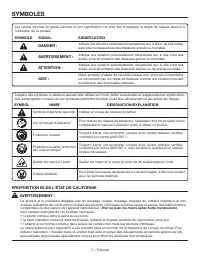
5 – Français SYMBOLES Certains des symboles ci‑dessous peuvent être utilisés sur l’outil. Veiller à les étudier et à apprendre leur signification. Une interprétation correcte de ces symboles permettra d’utiliser l’outil plus efficacement et de réduire les risques. SYMBOL NAME DESIGNATION/EXPLANATION...
Page 19 - GLOSSAIRE
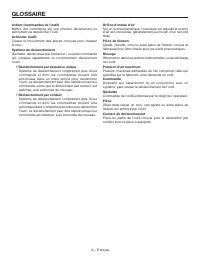
6 – Français GLOSSAIRE Activer (commandes de l’outil) Mettre une commande sur une position déclenchant ou permettant de déclencher l’outil Actionner (outil) Causer le mouvement des pièces conçues pour chasser le clou. Système de déclenchement Gâchette, déclencheur par contact et / ou autre commande ...
Page 20 - TÊTE INTERCHANGEABLE AVEC INSERTS; CARACTÉRISTIQUES
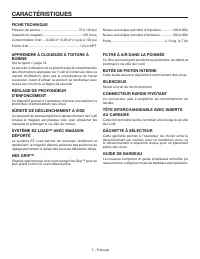
7 – Français APPRENDRE À CLOUEUSE À TOITURE À BOBINE Voir la figure 1, page 15. La sécurité d’utilisation de ce produit exige la compréhension des informations apposées sur l’outil et contenues dans ce manuel d’utilisation, ainsi que la connaissance du travail à exécuter. Avant d’utiliser ce produit...
Page 21 - ASSEMBLAGE
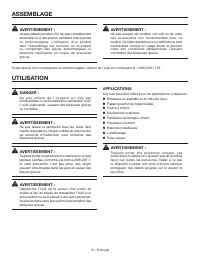
8 – Français DANGER : N e p a s u t i l i s e r d e l ’ o x y g è n e o u d e s g a z combustibles ou en bouteille pour alimenter l’outil. L’outil exploserait, causant des blessures graves ou mortelles. AVERTISSEMENT : Ne pas laisser la familiarité avec les outils faire oublier la prudence. Ne pas o...
Page 22 - PRÉPARATION DE L’OUTIL POUR LE TRAVAIL; RÉGLAGE DU MAGASIN DÉPORTÉ; CHARGEMENT DES CLOUS
9 – Français UTILISATION PRÉPARATION DE L’OUTIL POUR LE TRAVAIL Voir la figure 2, page 15. Dans des conditions d’utilisation normales, l’outil doit être lubrifié avant d’être raccordé à l’alimentation pneumatique. Lubrifier le raccord d’air de l’outil une fois par jour si l’utilisation est minimale ...
Page 23 - DÉCLENCHEMENT PAR SÉQUENCE UNIQUE
10 – Français UTILISATION AVERTISSEMENT : Utiliser exclusivement les clous recommandés pour cet outil (voir le guide des clous). L’usage d’autres clous peut causer un mauvais fonctionnement de l’outil, susceptible d’entraîner des blessures graves. AVERTISSEMENT : Ne jamais charger les clous avec la ...
Page 24 - RÉGLAGE DE LA PRESSION D’AIR; DÉBLOCAGE D’UN CLOU
11 – Français UTILISATION AVERTISSEMENT : Durant l’utilisation normale de l’outil, un recul se produit lorsqu’un clou est planté. Ce recul est normal. Ne pas essayer de l’empêcher en maintenant l’outil contre la pièce à clouer. Cela pourrait causer l’éjection d’un second clou. Tenir la poignée ferme...
Page 25 - ENTRETIEN; ENTRETIEN GÉNÉRAL; UTILISATION PAR TEMPS FROID; PRESSION ET VOLUME D’AIR
12 – Français ENTRETIEN AVERTISSEMENT : Utiliser exclusivement des pièces d’origine pour les réparations. L’usage de toute autre pièce pourrait créer une situation dangereuse ou endommager l’outil. AVERTISSEMENT : Toujours porter une protection oculaire avec écrans latéraux certifiée conforme à la n...
Page 26 - LISTE DE CONTRÔLE QUOTIDIEN; ACCESSOIRES
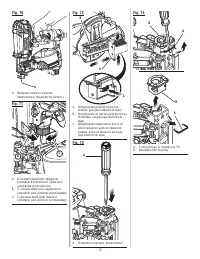
13 – Français ENTRETIEN LISTE DE CONTRÔLE QUOTIDIEN Voir le figure 9, page 16. Débrancher l’alimentation d’air de l’outil et retirer toutes les agrafes. Vérifier toutes les vis et tiges, et tous les écrous et boulons de l’outil. Resserrer au besoin toute pièce à l’aide d’une clé de dimension app...
Page 27 - PROBLÈME
14 – Français DÉPANNAGE ILLUSTRATIONS COMMENÇANT SUR 15 DE PAGE APRÈS LA SECTION ESPAGNOL. PROBLÈME CAUSE POSSIBLE SOLUTION Fuite d’air dans le haut de l’outil ou près de la gâchette Lubrification insuffisante Vis desserrées Joints ou joints toriques usés Lubrifier l’outil Serrer les vis Installer l...
Page 28 - REGLAS DE SEGURIDAD GENERALES; GUARDE ESTAS INSTRUCCIONES; SEGURIDAD PERSONAL; EMPLEO Y CUIDADO DE LA HERRAMIENTA
2 – Español REGLAS DE SEGURIDAD GENERALES PELIGRO: LEA Y COMPRENDA LAS ETIQUETAS DE LAS HERRAMIENTAS Y EL MANUAL. La inobservancia de los avisos de advertencia podría causar la MUERTE o LESIONES SERIAS. GUARDE ESTAS INSTRUCCIONES ÁREA DE TRABAJO Mantenga limpia y bien iluminada el área de trabajo....
Page 29 - REGLAS DE SEGURIDAD ESPECÍFICAS; FUNCIONAMIENTO; SERVICIO
3 – Español REGLAS DE SEGURIDAD GENERALES Familiarícese con su herramienta neumática . Lea cuidadosamente el manual del operador. Aprenda sus usos y limitaciones, así como los posibles peligros específicos de esta herramienta. Con el cumplimiento de esta regla se reduce el riesgo de una descarga ...
Page 30 - SUMINISTRO DE AIRE Y CONEXIONES; CÓMO CARGAR LA HERRAMIENTA; GUARDE ESTAS INSTRUCCIONES.
4 – Español REGLAS DE SEGURIDAD ESPECÍFICAS Las herramientas neumáticas están diseñadas para usarlas con una sola mano. No sujete la herramienta por el frente del cargador. No ponga las manos, la cabeza ni ninguna otra parte del cuerpo cerca de la parte inferior del cargador, por donde salen los ...
Page 31 - SÍMBOLOS; SÍMBOLO
5 – Español Es posible que se empleen en esta herramienta algunos de los siguientes símbolos. Le suplicamos estudiarlos y aprender su significado. Una correcta interpretación de estos símbolos le permitirá utilizar mejor y de manera más segura la herramienta. SYMBOL NAME DESIGNATION/EXPLANATION Aler...
Page 32 - GLOSARIO DE TÉRMINOS
6 – Español GLOSARIO DE TÉRMINOS Activar (los controles de accionamiento) Es mover un control de accionamiento de manera que quede en una posición en la cual se accione la herramienta o cumpla con un requisito necesario para accionar la misma. Accionar (la herramienta) Es producir el movimiento de l...
Page 33 - CARACTERÍSTICAS; TECHAR DE BOBINA; GATILLO DE MODO SELECCIONABLE
7 – Español CARACTERÍSTICAS ESPECIFICACIONES DEL PRODUCTO Presión de funcionamiento ............. De 70 a 120 psi (lb/pulg. cuad.) Capacidad del cargador ..................................... 120 clavosConsumo de aire ........ 0,002 m 3 (0,06 pies 3 )/ciclo a 100 psi Entrada de aire ...................
Page 34 - USOS; ARMADO
8 – Español PELIGRO: No utilice oxígeno, gases combustibles ni gases embotellados como fuente de energía para esta herramienta. La herramienta explotará y causará la muerte o lesiones serias. ADVERTENCIA: No permita que su familarización con las herramientas lo vuelva descuidado. Tenga presente que ...
Page 35 - AJUSTE DEL CARGADOR DESPLAZADO
9 – Español FUNCIONAMIENTO PREPARACIÓN DE LA HERRAMIENTA PARA UTILIZARLA Vea la figura 2, página 15. En condiciones normales, la herramienta debe lubricarse antes de conectarla a un suministro de aire. Vierta lubricante para herramientas neumáticas en la conexión del aire de la herramienta una vez a...
Page 36 - UTILIZACIÓN DEL GATILLO DE MODO
10 – Español FUNCIONAMIENTO ADVERTENCIA: Solamente utilice los clavos recomendados para esta herramienta (consulte la guía de sujetadores). Si se utilizan otros clavos puede producirse un malfuncionamiento de la herramienta y posibles lesiones serias. ADVERTENCIA: Nunca cargue los clavos teniendo ac...
Page 37 - AJUSTE DE LA PRESIÓN DE AIRE; CÓMO RETIRAR UN SUJETADOR ATORADO
11 – Español FUNCIONAMIENTO ADVERTENCIA: Durante el uso normal de la herramienta, ésta se retrae de inmediato después de introducir un sujetador. Así es el funcionamiento normal de la herramienta. No intente impedir la retracción presionando la clavadora contra la pieza de trabajo. Toda restricción ...
Page 38 - MANTENIMIENTO; MANTENIMIENTO GENERAL; REEMPLAZO DE LA BOQUILLA
12 – Español MANTENIMIENTO ADVERTENCIA: Para el servicio de la unidad sólo utilice piezas de repuesto idénticas. El empleo de piezas diferentes puede causar un peligro o dañar el producto. ADVERTENCIA: Siempre póngase protección ocular con protección lateral con la marca de cumplimiento de la norma ...
Page 39 - LISTA DE CONTROL DIARIA OBLIGATORIA; ACCESORIOS
13 – Español MANTENIMIENTO LISTA DE CONTROL DIARIA OBLIGATORIA Vea la figura 9, página 16. Desconecte el suministro de aire de la herramienta y retire todos los sujetadores. Verifique todos los tornillos, tuercas, pernos y vástagos de la herramienta. Si hay alguno suelto, debe ser ajustado con u...
Page 40 - SOLUCIÓN DE PROBLEMAS; PROBLEMA
14 – Español SOLUCIÓN DE PROBLEMAS PROBLEMA CAUSA POSIBLE SOLUCIÓN Fuga de aire cerca de la parte superior de la herramienta o junto al gatillo Lubricación inadecuadaTornillos sueltosJuntas tóricas o sellos gastados o dañados Lubrique la herramientaApriete los tornillosInstale el juego de mantenimie...
Page 44 - OPERATOR’S MANUAL; Customer Service Information:; Información sobre servicio al consumidor:
991000783 11-5-15 (REV:01) OPERATOR’S MANUAL MANUEL D’UTILISATIONMANUAL DEL OPERADORROOFING COIL NAILER CLOUEUSE À TOITURE À BOBINECLAVADORA DE TECHAR DE BOBINA R175RNF ONE WORLD TECHNOLOGIES, INC. P.O. Box 35, Hwy. 8Pickens, SC 29671, USA1-866-539-1710 www.RIDGID.com RIDGID is a registered tradem...






 Ridgid R09891B
User Manual
Ridgid R09891B
User Manual
 Ridgid R09891B-AC87004
User Manual
Ridgid R09891B-AC87004
User Manual
 Ridgid R09891B-AC93044SBN
User Manual
Ridgid R09891B-AC93044SBN
User Manual
 Ridgid R09891B-R09892B
User Manual
Ridgid R09891B-R09892B
User Manual
 Ridgid R09891B-R09897B
User Manual
Ridgid R09891B-R09897B
User Manual
 Ridgid R09891B-R8657B
User Manual
Ridgid R09891B-R8657B
User Manual
 Ridgid R09891K
User Manual
Ridgid R09891K
User Manual
 Ridgid R09891K-R09892B
User Manual
Ridgid R09891K-R09892B
User Manual
 Ridgid R09892B-AC8400802
User Manual
Ridgid R09892B-AC8400802
User Manual
 Ridgid R09892B-AC87004
User Manual
Ridgid R09892B-AC87004
User Manual
 Ridgid R09892B-AC9302
User Manual
Ridgid R09892B-AC9302
User Manual
 Ridgid R09892K
User Manual
Ridgid R09892K
User Manual
 Ridgid R09893B
User Manual
Ridgid R09893B
User Manual
 Ridgid R09894B
User Manual
Ridgid R09894B
User Manual
 Ridgid R09894B-AC102EM21N
User Manual
Ridgid R09894B-AC102EM21N
User Manual
 Ridgid R09894B-AC840060
User Manual
Ridgid R09894B-AC840060
User Manual
 Ridgid R09894B-AC87004
User Manual
Ridgid R09894B-AC87004
User Manual
 Ridgid R09894B-R09891B
User Manual
Ridgid R09894B-R09891B
User Manual
 Ridgid R09894B-R86240B
User Manual
Ridgid R09894B-R86240B
User Manual
 Ridgid R09894B-R86344B
User Manual
Ridgid R09894B-R86344B
User Manual