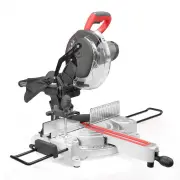
Page 2 - Technical data; Mitre stops; General notes; delivery is complete.; SAFETY INFORMATION
Read the entire operating instructions prior to the assembly and operation of the tool. These operating instructions are intended to make it easier for you lo gel familiar with , your tool and maximize its tool. The operating instructions contain important notes on how to work safely, property and e...
Page 4 - GENERAL SAFETY RULES; READ ALL INSTRUCTIONS
GENERAL SAFETY RULES WARNING: Read and understand all instructions. Failure to follow all instructions listed below, may result in electric shock, fire and/or serious personal injury. READ ALL INSTRUCTIONS ■ KNOWYOUR POWER TOOL. Read the operator's manual carefully. Learn the applications and limita...
Page 6 - SPECIFIC SAFETY RULES
SPECIFIC SAFETY RULES ■ NEVER PERFORM ANY OPERATION FREEHAND. Always place the workpiece to be cut on the miter table and position it firmly against the fence as a backstop. Always use the fence. ■ NEVER hand hold a workpiece that is too small to be clamped. Keep hands clear of the cutting area. ■ N...
Page 7 - SYMBOLS; SYMBOL
SYMBOLS Some of the following symbols may be used on this tool. Please study them and learn their meaning. Proper interpretation of these symbols will allow you to operate the tool better and safer. SYMBOL NAME DESIGNATION/EXPLANATION V Volts Voltage A Amperes Current Hz Hertz Frequency (cycles per ...
Page 8 - SIGNAL; SERVICE; SAVE THESE INSTRUCTIONS
SYMBOLS The following signal words and meanings are intended to explain the levels of risk associated with this product. SIGNAL MEANING DANGER: Indicates an imminently hazardous situation, which, if not avoided, will result in death or serious injury. WARNING: Indicates a potentially hazardous situa...
Page 9 - ELECTRICAL; EXTENSION CORDS; ELECTRICAL CONNECTION; SPEED AND WIRING
ELECTRICAL EXTENSION CORDS Use only 3-wire extension cords that have 3-prong ground- ing plugs and 3-pole receptacles that accept the tool's plug. When using a power tool at a considerable distance from the power source, use an extension cord heavy enough to carry the current that the tool will draw...
Page 10 - GLOSSARY OF TERMS
GLOSSARY OF TERMS Anti-Kickback Pawls (radial arm and table saws) A device which, when properly installed and maintained, is designed to stop the workpiece from being kicked back toward the front of the saw during a ripping operation. Arbor The shaft on which a blade or cutting tool is mounted. Beve...
Page 11 - FEATURES; PRODUCT SPECIFICATIONS
FEATURES PRODUCT SPECIFICATIONS Blade Arbor .............................................................. 5/8 in. Blade Diameter .......................................................... 1 O in. No Load Speed .................................... 4,500 r/min. (RPM) Input ..............................
Page 12 - CARRYING
FEATURES KNOW YOUR COMPOUND MITER SAW See Figure 2. The safe use of this product requires an understanding of the information on the tool and in this operator's manual as well as a knowledge of the project you are attempting. Before use of this product, familiarize yourself with all operating featur...
Page 13 - SLIDE LOCK KNOB; TOOLS NEEDED; PHILLIPS SCREWDRIVER
FEATURES SLIDE LOCK KNOB The slide lock knob locks and unlocks the sliding feature of this tool. SPINDLE LOCK BUTTON See Figure 4. The spindle lock button locks the spindle and stops the blade from rotating. Depress and hold the lock button while installing, changing, or removing blade. SWITCH TRIGG...
Page 14 - LOOSE PARTS LIST
LOOSE PARTS LIST The following items are included with your Compound Miter Saw: Dust Bag Work Clamp Clamp Brackets (2) Blade Wrench Clamp Bracket Screws (2) Table Extensions (2) DUST BAG CLAMP TABLE BRACKETS EXTENSION / CLAMP BRACKET SCREWS Operator's Manual BLADE WRENCH WORK CLAMP TABLE EXTENSION F...
Page 15 - ASSEMBLY; UNPACKING
ASSEMBLY UNPACKING This product requires assembly. ■ Carefully lift saw from the carton by the carrying handle and the saw base, and place it on a level work surface. NOTE: This tool is heavy. To avoid back injury, lift with your legs, not your back, and get help when needed. ■ This saw has been shi...
Page 16 - LOCKING / UNLOCKING THE SAW ARM; DUST BAG
ASSEMBLY NOTE: Many of the illustrations in this manual show only portions of the compound miter saw. This is intentional so that we can clearly show points being made in the illustrations. Never operate the saw without all guards securely in place and in good operating condition. LOCKING / UNLOCKIN...
Page 17 - WORK CLAMP; TABLE EXTENSIONS
ASSEMBLY WORK CLAMP See Figure 11. WARNING: In some operations, the work clamp assembly may interfere with the operation of the blade guard assembly. Always make sure there is no interference with the blade guard prior to beginning any cutting operation to reduce the risk of serious personal injury....
Page 18 - TO INSTALL/ REPLACE THE BLADE
ASSEMBLY TO INSTALL/ REPLACE THE BLADE See Figures 14 - 15. WARNING: A 10 in. blade is the maximum blade capacity of the saw. Never use a blade that is too thick to allow outer blade washer to engage with the flats on the spindle. Larger blades will come in contact with the blade guards, while thick...
Page 19 - ALIGNING THE LASER GUIDE LINE; LINE
ASSEMBLY WARNING: Make sure the spindle lock button is not engaged before reconnecting saw into power source. Never engage spindle lock button when blade is rotating. DANGER: Laser radiation. Avoid direct eye contact with light source. W ARNING: Use of controls or adjustments or performance of proce...
Page 20 - REMOVING / REPLACING THE THROAT
ASSEMBLY REMOVING / REPLACING THE THROAT PLATE See Figure 17. WARNING: The throat plate must be below the saw table. If the throat plate is too high or too low, the workpiece can catch on the uneven edges resulting in binding which could result in serious personal injury. Never operate the saw witho...
Page 21 - SQUARING THE BLADE TO THE FENCE
ASSEMBLY SQUARING THE BLADE TO THE FENCE See Figures 18 -21. ■ Unplug the saw. ■ Pull the saw arm all the way down and engage the lock pin to hold the saw arm in transport position. ■ Loosen the miter lock handle approximately one-half turn. ■ Rotate the miter table until the pointer on the control ...
Page 22 - SQUARING THE BLADE TO THE MITER TABLE
ASSEMBLY SQUARING THE BLADE TO THE MITER TABLE See Figures 22 - 25. ■ Unplug the saw. ■ Pull the saw arm all the way down and engage the lock pin to hold the saw arm in transport position. ■ Loosen the miter lock handle approximately one-half turn. ■ Rotate the miter table until the pointer on the c...
Page 23 - OPERATION; APPLICATIONS
OPERATION WARNING: Do not allow familiarity with tools to make you care- less. Remember that a careless fraction of a second is sufficient to inflict serious injury. WARNING: Always wear safety goggles or safety glasses with side shields when operating power tools. Failure to do so could result in o...
Page 24 - T O MAKE NON-SLIDING C U T S
OPERATION T O MAKE NON-SLIDING C U T S WARNING: Securely tighten the slide lock knob when making any non-sliding cuts. Failure to tighten the knob could result in the saw head moving during the cutting operation. TO MITER CUT/ CROSS CUT See Figures 26 - 27. A cross cut is made by cutting across the ...
Page 25 - TO BEVEL CUT
OPERATION TO BEVEL CUT See Figures 28 - 29. A bevel cut is made by cutting across the grain of the workpiece with the blade angled to the workpiece. A straight bevel cut is made with the miter table set at the zero degree position and the blade set at an angle between 0 ° and 45 ° . ■ Pull out the l...
Page 26 - TO COMPOUND MITER CUT; COMPOUND MITER CUT
OPERATION TO COMPOUND MITER CUT See Figures 30 - 31. A compound miter cut is a cut made using a miter angle and a bevel angle at the same time. This type of cut is used to make picture frames, cut molding, make boxes with sloping sides, and for certain roof framing cuts. To make this type of cut the...
Page 27 - TO SUPPORT LONG WORKPIECES; 5· X 45· COMPOUND MITER CUT
OPERATION TO SUPPORT LONG WORKPIECES See Figure 32. Long workpieces need extra supports. Supports should be placed along the workpiece so it does not sag. The support should let the workpiece lay flat on the base of the saw and work table during the cutting operation. Use the optional work clamp or ...
Page 28 - TO SLIDE CUT; SLIDE CUT
OPERATION WARNING: Never make a cut by pulling the saw toward you as the blade can climb on top of the workpiece and come toward you. Failure to heed this warning could result in serious personal injury. TO SLIDE CUT See Figures 33 - 34. The sliding feature will cut workpieces 12 in. wide by 3-1/2 i...
Page 29 - MAKING AN AUXILIARY FENCE
OPERATION MAKING AN AUXILIARY FENCE See Figure 35. Certain unusual cuts may benefit from a thicker miter fence (auxiliary fence} due to the size and position of the workpiece. The holes provided in the miter fence are there for just this purpose. The miter fence holes are used to secure the auxiliar...
Page 30 - CUTTING COMPOUND MITERS
OPERATION CUTTING COMPOUND MITERS To aid in making the correct settings, the compound angle setting chart below has been provided. Since compound cuts are the most difficult to accurately obtain, trial cuts should be made in scrap material, and much thought and planning made, prior to making the req...
Page 31 - CUTTING CROWN MOLDING
OPERATION CUTTING CROWN MOLDING The compound miter saw does an excellent job of cutting crown molding. In general, compound miter saws do a better job of cutting crown molding than any other tool made. In order to fit properly, crown molding must be compound mitered with extreme accuracy. The two co...
Page 32 - CUTTING WARPED MATERIAL; RIGHT; CLAMPING WIDE WORKPIECES
OPERATION CUTTING WARPED MATERIAL See Figures 37 - 38. When cutting warped material, always make sure it is posi- tioned on the miter table with the convex side against the fence as shown in figure 37. If the warped material is positioned the wrong way as shown in figure 38, it will pinch the blade ...
Page 33 - ADJUSTMENTS; TO ADJUST THE BEVEL PIVOT; HEX NUT
ADJUSTMENTS WARNING: Before performing any adjustment, make sure the tool is unplugged from the power supply. Failure to heed this warning could result in serious personal injury. The compound miter saw has been adjusted at the factory for making accurate cuts. However, some of the components might ...
Page 34 - TRAVEL PIVOT ADJUSTMENT
ADJUSTMENTS TRAVEL PIVOT ADJUSTMENT ■ The saw arm should rise completely to the up position by itself. ■ If the saw arm does not raise by itself or if there is play in the pivot joints, have saw repaired at the nearest authorized service center. DEPTH STOP The depth stop limits the blade's downward ...
Page 35 - MAINTENANCE; GENERAL MAINTENANCE
MAINTENANCE WARNING: When servicing, use only identical replacement parts. Use of any other parts may create a hazard or cause product damage. WARNING: Always wear safety goggles or safety glasses with side shields during power tool operation or when blowing dust. If operation is dusty, also wear a ...
Page 37 - Parts Breakdown
Parts Breakdown Fig# P/N Name/Spec i f i c a t i on Qty. Fig# P/N Name/Spec i f i c a t i on Qty. 1 2120003 HEX SCREW M8X16 1 38 4410007 CARBON BRUSH 2 2 1400005 OUTER FLANGE 1 39 4510005 CARBON BRUSH SET 6. 5X13. 5X18 2 3 BLADE 1 40 4410008 BRUSH HOLDER CAP 2 4 1400007 I NNER FLANGE 1 41 3100044 RE...
Page 39 - OF NOTE; PLEASE READ THE FOLLOWING CAREFULLY; OF REPLACEMENT PARTS THERETO.; SAVE THESE INSTRUCTIONS.; PRODUCT MADE IN CHINA
OF NOTE PLEASE READ THE FOLLOWING CAREFULLY THE MANUFACTURER AND/OR DISTRIBUTOR HAS PROVIDED THE PARTS LIST AND ASSEMBLY DIAGRAM IN THIS MANUAL AS A REFERENCE TOOL ONLY NEITHER THE MANUFACTURER OR DISTRIBUTOR MAKES ANY REPRESENTATION OR WARRANTY OF ANY KIND TO THE BUYER THAT HE OR SHE IS QUALIFIED T...