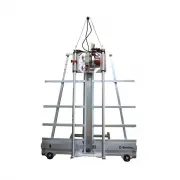
Page 2 - A message from all of us at SAFETY SPEED MANUFACTURING:; Team Safety Speed; Limited Warranty
2 A message from all of us at SAFETY SPEED MANUFACTURING: Thank you for purchasing a Safety Speed Manufacturing (SSM) vertical panel saw. We take pride in building these fine products in the U.S.A. Each SSM product is designed to give years of dependable service. Your new panel saw was built from th...
Page 3 - CONTENTS; Safety
3 CONTENTS Safety…………………………………………………………………. 4 Safety & Warning Label Placement…………………………………………. 4 Safety & Warning Labels Identified….…………………………………….…. 5 Safety Procedures……………………………………………………………... 6 Propostion 65 Warning………………………………………………………… 10 Electrical Safety………………………………………………………………... ...
Page 4 - SAFETY; injury.; Safety & Warning Label Placement
4 SAFETY Read and understand this manual before operating this tool. Failure to follow the safety precautions and instructions can result in serious injury or death. Keep this manual in an accessible and safe location for future reference. Electronic copies of this manual are available at www.safety...
Page 9 - Please Read Before Operating the Saw
9 Do not try to retrieve a piece of cut material while the blade is rotating. This symbol is to remind you: 33. DO NOT DEFEAT THE GUARDS OR OPERATE THE TOOL WITHOUT THE GUARDS IN PLACE. Do not remove the saw motor from the carriage. 34. NEVER STAND ON THE TOOL. Serious injury could occur if the tool...
Page 10 - Electrical Safety
10 Some dust created by power sanding, sawing, grinding, drilling, and other construction activities contains chemicals known to cause cancer, birth defects or other reproductive harm. Some examples of these chemicals are: • Lead from lead-based paint • Crystalline silica from bricks and cement and ...
Page 11 - Extension Cords; Guidelines for Using Extension Cords; Short-Circuit Protection
11 and ordinances. The plug and outlet should look like those in Figure 3. Figure 4 illustrates a temporary adapter available for connecting grounded plugs. The green rigid ear or lug extending from the adapter must be connected to a permanent ground such as a properly grounded outlet box or recepta...
Page 12 - Electrical Connections; Vertical Panel Saw Components
12 ahead of the equipment in the circuit, in accordance with local codes. General guidelines are as follows: 120 volts: 20-amp protection These models can include: C-Series, H-series, 6400/6800 220 volt: 10 amp protection These models can include: C-Series, H-series, 6400/6800 Reference your motor l...
Page 13 - INSTALLATION; Tools Required for Installation; Operating Environment
13 INSTALLATION Your Safety Speed saw comes from the factory assembled and aligned. You will only have to mount the following parts before you can run this tool: • Counterbalance (on Models C-series, and H-Series) • Motor (except for Models 6400/6800) • Cord keeper If you ordered any optional access...
Page 14 - Inventory; Unpacking
14 Inventory Each model incudes the saw frame, motor and counterbalance/counterweight. These items may be installed on the saw or packaged in separate boxes. The C-Series saws include a separate box for the motor, counterbalance and dust bonnet, (Fig.6 C-Series shown). Accessories may be packaged an...
Page 16 - Machine Assembly
16 Machine Assembly Installing the Counterbalance, C-series and H-series, (6400 & 6800, Counterweight is factory installed). To reduce the risk of injury or damage to components, do not attempt to disassemble or repair the Counterbalance. Do not pull on the Counterbalance cable. The cable is und...
Page 19 - Mounting the Motor on the Carriage
19 • If the tool is to be mounted to the floor, a wall or post, it must be securely attached to prevent injury from tipping. Position the saw frame with a 10 – 15 degree angle of back-lean for optimum saw performance. • If installing the optional Folding or Fixed Frame Stand. Follow the mounting ins...
Page 22 - Installing the Blade Guard (aka Dust Bonnet)
22 Figure 19: Installing a Saw Blade (6400 & 6800 series) 3. Tighten the carriage lock. While holding the spindle lock “in” (#16)(located on the bottom side of the motor) remove the blade bolt by turning it clockwise. Remove the outer blade flange, but leave the inner blade flange on the spindle...
Page 23 - Installing the Cord Keeper
23 Figure 20: Installing the Blade Guard (C-Series & H-Series) Figure 21: Installing the Blade Guard (Models 6400, 6800) Adjusting the Crosscut Rulers The saw has one rip ruler mounted vertically, and two crosscut rulers, one attached to the frame on each side of the saw. The rip ruler is set at...
Page 25 - OPERATION; Capacities of the Tool; Small Work pieces
25 have to be extended). Lock the carriage lock in this lowered position. 4. Pull the cord keeper down so it is roughly parallel to the floor as shown. Pull the cord up to remove any slack in it. Then open the rubber stopper and pull it over the cord with the small end of the taper on the bottom. Pr...
Page 26 - Work piece Thickness
26 Work piece Height (Crosscutting) SSM saw crosscut capacity as shown in Table II below. Table II: Maximum work piece height (stock width) for Crosscutting Model Max. Height 6480-20C4 50 in.(1270mm) H4 50 in.(1270mm) C5/H5 64 in.(1625mm) H6 74 in.(1880mm) 6400 64 in.(1625mm) 6800 74 in.(1880mm) Wor...
Page 27 - Selecting a Saw Blade
27 Selecting a Saw Blade The saw blade must be carefully matched to the materials being cut. Improper blade selection can result in reduced tool life, inaccurate and poor quality cuts, and safety risks. NOTE: The following table lists some recommended blades for certain applications. If in doubt, co...
Page 28 - Basic Operating Controls and Functions
28 Basic Operating Controls and Functions Refer to Figure 26 & 27 for the location of operator controls on each model saw. Figure 26: Basic Operating Controls and Components (C & H Series) Figure 27: Basic Operating Controls and Components (6400 & 6800) Removing and Reinstalling the Blad...
Page 29 - Changing the Blade
29 Always install the blade guard before operating the saw (Fig.28 & 29 #21). Figure 28: Removing/Installing the Blade Guard (C and H Series Models) Figure 29: Removing/Installing the Blade Guard (Models 6400, 6800) Changing the Blade Unplug Saw before adjusting 1. Observe appropriate lock-out/t...
Page 30 - Starting and Stopping the Motor
30 4. Use the hex (C & H) or box end (6400 & 6800) wrench provided with the saw to loosen and remove the bolt (Fig. 30 or 31, #12) counterclockwise (C4, C5, H-Series) clockwise (6400/6800), while holding the spindle lock. 5. Remove the outer blade flange (Fig. 30 or 31, #13), blade (#15), an...
Page 32 - General Operating Tips; large; Operating Procedure: Crosscutting
32 5. Make a test cut to verify that the ruler is lined up correctly. General Operating Tips • For smooth, clean, chip-free cuts, you must use industrial carbide saw blades that are sharp . Dull or improperly sharpened blades will cause chipping, unclean cuts, chatter, and motor overloading. If you ...
Page 34 - Operating Procedure: Rip cutting
34 Figure 35: Crosscutting using optional Midway Fence Kit (work extends at least 4” (100mm) beyond saw carriage) Operating Procedure: Rip cutting A rip cut is a horizontal cut that can be done either from the left to the right or from the right to the left, as shown on page 35, Fig. 36, 37. Rip cut...
Page 37 - MAINTENANCE; General Maintenance; Cleaning; Maintaining the Motor
37 MAINTENANCE To reduce the risk of injury, always unplug the tool before doing any maintenance. Never disassemble the tool or try to do any rewiring to its electrical system. Contact a qualified electrician for electrical repairs. Always follow lockout/tag out procedures when servicing electrical ...
Page 38 - Lubricating the Guides; SERVICE; Alignment; Constructing an Alignment Tool
38 Lubricating the Guides The carriage should move smoothly up and down the guide tubes or rails. However, if the guides become caked with dust or debris, the carriage may get stuck or it may not slide smoothly. Periodically clean the guides with a damp cloth, following the directions under “ Cleani...
Page 41 - Step 4: Align the Rollers
41 Step 4: Align the Rollers To check the roller alignment: 1. Remove any Frame Extensions (reattach them after completing all alignment steps). 2. Remove or retract the Frame Stand, if used. Lay the tool flat so the roller nuts are easily accessible. With proper care, you can place the tool on a ta...
Page 42 - ACCESSORIES; ools Required for Accessory Installation; Frame Wheels; Installation
42 ACCESSORIES Safety Speed offers several accessories for the vertical panel saws. T ools Required for Accessory Installation • 9/16” wrench ; Frame Stand, Quick Stop, Stop Bar, Hold Down Bar • 5/8” wrench ; Fixed Stand • ¾” wrench ; Frame Wheels • 9/16” deep socket; Fixed Stand • Center Punch ; St...
Page 43 - Frame Stand
43 Frame Stand The Frame Stand Accessory allows the tool to be freestanding in the shop. It includes two long angle-steel supports that attach to the top of the frame, one bracket that attaches to the bottom of the frame, and U-bolts or other fasteners for mounting them. Slightly different fixed Fra...
Page 45 - Frame Extensions
45 The C-Series Models also can have a retractable stand typically installed on a new machine. This stand can be folded for fast transport of the tool (Fig. 48). To extend, remove included lock pin and reinstall lock pin to secure. Figure 48: Folding Stand installed, C-Series Frame Extensions The Fr...
Page 46 - Dust Collection Kits
46 Dust Collection Kits Dust Collection Kits are recommended if the tool will be used in an enclosed area. They include discharge tubing, hose and a hose roller system to hold the outboard end of the tubing. The dust hose must be attached to an SSM Vacuum or to any high-pressure vacuum source that p...
Page 47 - Operation; Stop Bar
47 Fig. 51: Installed Dust Collection Kit 1. Remove the plastic blade guard dust plug by loosening the hose clamp and pulling dust plug from dust cover. 2. Insert the clear plastic inner tube into the blade guard, and align the tube’s slot with the inner tab. Slide the tube further in (the slot will...
Page 49 - Quick Stop
49 Quick Stop The Quick Stop Accessory provides an easy method of setting an exact repeatable cut length for crosscuts. It consists of an aluminum angle extrusion with movable tape measure, a large aluminum stop block with threaded lock knob, and mounting brackets and screws. The Quick Stop can be a...
Page 50 - Midway Fence
50 5. Attach the brackets to the frame, using four ¼-20 (6.35mm) self-tapping hex-head screws. 6. Measure from the blade and adjust the Quick Stop measuring tape by sliding it in the angle extrusion. Operation 1. Position the stop block at the desired cut length, as shown by the Quick Stop measuring...
Page 52 - Fence Alignment
52 Fig. 59: Midway fence installed 3. Tip the top of the rear support brackets (#9 in Fig. 57) under the upper horizontal frame member (#8), raise the fence, and push the lower ends of the rear support brackets down behind the lower horizontal frame member. The nuts may have to be loosened slightly ...
Page 55 - SPECIFICATIONS; Table IV: Vertical Panel Saw Specifications
55 SPECIFICATIONS Table IV: Vertical Panel Saw Specifications Saw Model Dimensions Maximum Crosscut Cut Thickness* Volts AC** Horse Power Length Height Depth Weight 6480-20C 60”/1525mm 75”/1900mm 14”/356mm 189lbs/86kg 50”/1270mm 1.75”/45mm 120 3.25 C5 60”/1525mm 90”/2286mm 14”/356mm 219lbs/99kg 64”/...