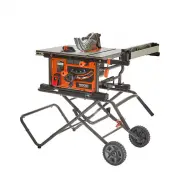
Page 2 - SPECIFICATIONS
TABLE OF CONTENTS FUNCTIONAL DESCRIPTION FUNCTIONAL DESCRIPTION...............................................2 SPECIFICATIONS ................................................................2 FEATURES .......................................................................... 3 IMPORTANT SAFETY INST...
Page 3 - FEATURES
Back View F5 F6 F7 F8 F9 F10 F11 F12 F13 F14 F15 F16 F17 F18 F19 F9 F10 F11 F12 F13 F14 F15 F16 On Board Storage Height Adjustment Wheel Knob Height Adjustment Handwheel Bevel Lock Lever Stand On/Off Switch Saw Body F17 F18 F19 Rails Miter Gauge Riving Knife Anti-Kickback Pawls Dust Chute F1 F2 F3 F...
Page 4 - IMPORTANT SAFETY INSTRUCTIONS
Some of the following symbols may be used on the tool. Please study them and learn their meaning. Proper interpretation on these symbols will allow you to operate the tool better and safer. SYMBOL NAME DESIGNATION/EXPLANATION Safety Alert Indicates a potential personal injury hazard. Read Operator's...
Page 5 - GENERAL POWER TOOL SAFETY WARNINGS
The term “power tool” in the warnings refers to your mains-operated (corded) power tool or BATTERY-operated (cordless) power tool. 1. Work area safety a. Keep work area clean and well-lit. Cluttered or dark areas invite accidents b. Do not operate power tools in explosive atmospheres, such as in the...
Page 6 - TABLE SAW SPECIFIC SAFETY RULES; TABLE SAW SAFETY RULES; TERMINOLOGY
Failure to follow these rules may result in serious personal injury. TABLE SAW SPECIFIC SAFETY RULES WARNING READ ALL SAFETY WARNINGS DESIGNATED BY THE SYMBOL AND ALL INSTRUCTIONS. 1. GUARDING RELATED WARNINGS (FOR TABLE SAW, UL 62841-3-1) a. Keep guards in place. Guards must be in working order and...
Page 9 - KICKBACKS; PROPOSITION 65 WARNING:; SAVE THESE INSTRUCTIONS.
KICKBACKS Kickbacks can cause serious injury. A kickback occurs when a part of the workpiece binds between the saw blade and the rip fence, or other fixed object, and rises from the table and is thrown toward the operator. Kickbacks can be avoided by attention to the following conditions. HOW TO RED...
Page 10 - POWER CONNECTIONS; POWER SOURCE; EXTENSION CORDS; UNPACKING
** Ampere rating (on tool data label) 12A- 16A Cord Length Wire Size 25' 14 AWG 50' 12 AWG ** Used on 12 gauge - 20 amp circuit NOTE: AWG = American Wire Gauge POWER CONNECTIONS POWER SOURCE This saw is equipped with a 15-amp motor for use with a 120- volt, 60-HZ alternating current. For voltage, th...
Page 11 - PACKAGE CONTENTS DESCRIPTION
PACKAGE CONTENTS DESCRIPTION Saw Body Stand Handle Pedal Assembly Upper Stand Assembly Right Support Tube 10 inch Carbide Tipped Blade Miter Gauge Push Stick Left Support Tube Fence Blade Guard Assembly Anti-Kickback Pawls Wheels (2) Support Spreader Bar Throat Plate Open End Blade Wrench Closed End...
Page 12 - CONTENTS OF HARDWARE BAGS
UNPACKING CONTENTS OF HARDWARE BAGS HP1 HP1 HP6 HP5 HP2 HP2 HP7 HP4 HP9 HP4 HP3 HP3 HP8 HP5 HP10 HP11 HP6 HP7 HP8 HP9 HP10 HP11 M6 x 50mm (1 15/16 inch) Hex Bolt (2) Plastic Spacer (8) M8 Locknut (12) M8 x 75mm (2 15/16 inch) Carriage Screw (4) M8 x 37mm (1 15/32 inch) Carriage Screw (4) Wheel Handl...
Page 13 - ASSEMBLY; TOOLS NEEDED FOR ASSEMBLY OR ADJUSTMENTS.
ASSEMBLY • Assemble stand with saw upside down in box, then stand for final assembly. • Stand assembly is an integral and necessary part of the Support Structure for this Saw. • DO NOT modify Saw, use or create Accessories not recommended for use with this Saw. • Make sure Power Switch is in “OFF” p...
Page 14 - ASSEMBLING THE STAND
ASSEMBLY ASSEMBLING THE STAND 1. First remove Nut and outer Washer on each side of the Pedal Assembly PC3 . Then attach the Wheels and place the Washer and Nut back on each side, as shown in Figure 2 . Be sure not to over-tighten the Nut. NOTE: The hardware to attach the Wheels will NOT be found wit...
Page 16 - HEIGHT ADJUSTMENT KNOB; FENCE ADJUSTMENT KNOB
ASSEMBLY 2 1 Figure 10 Figure 11 9. Unlock the Bevel Lock and rotate the Motor Assembly enough to remove the Shipping Foam protecting the Saw Motor as shown in Figure 10. 10. Once the saw is upright disengage the pedal, push down on the handles until the catch is engaged, and then continue the remai...
Page 17 - INSTALLING THE BLADE; UNLOCK
ASSEMBLY INSTALLING THE BLADE 1. Raise the Motor/Arbor Assembly to the upper most position to provide easy access to Riving Knife Lock Lever and Arbor Assembly. 2. Ensure Riving Knife Lock Lever is in unlock position. See Figure 14. 3. Detach the on-board Wrenches located on the right side of the Sa...
Page 18 - THROAT PLATE
ASSEMBLY 1. The Riving Knife MUST be installed for every through cut and for every non-through cut unless the Riving Knife A would interfere with the cut. 2. The Riving Knife provided with the table saw shall be thicker than the body of the matching Saw Blades provided with the Table Saw but thinner...
Page 19 - ANTI-KICKBACK PAWLS AND
ASSEMBLY Figure 20 ANTI-KICKBACK PAWLS AND BLADE GUARD ANTI-KICKBACK PAWLS To reduce the risk of serious personal injury, Anti-Kickback Pawls MUST be in place when making a through cut. 1. Refer to Figure 20 and locate the Anti-Kickback Pawls mounting slot in the middle of the top edge of the Riving...
Page 20 - INSTALLING THE FENCE
ASSEMBLY Figure 24 Figure 25 INSTALLING THE FENCE The fence can be positioned on one of the three pairs of tabs. Two on the right side of the blade and one on the left side. 1. To engage the fence, hold it at an upward angle while engaging the desired tab pair into the front and rear fence notches. ...
Page 21 - SLOTTED
ASSEMBLY ON-BOARD STORAGE Storage is located on the Left side, Right side of the machine as shown in Figures 27 & 28. PC8 Push Stick PC12 Anti-kickback Pawls (Stored behind Blade Guard Assembly) PC16 Open End Wrench PC17 Closed End Wrench PC11 Blade guard assembly PC10 Fence PC7 Miter gauge Figu...
Page 22 - MAKING ADJUSTMENTS; LEVELING THE THROAT PLATE
Leveling screws Leveling screws (4) (4) MAKING ADJUSTMENTS LEVELING THE THROAT PLATE To install throat plate, slip tab into slot at back of saw and push down to secure in place.See Figures 31. NOTE: There are four screws pre-assembled to the throat plate that are used for leveling the throat plate i...
Page 24 - ADJUSTING THE BEVEL STOPS; SQUARING THE BLADE
MAKING ADJUSTMENTS Figure 39 45° CAM CAM ADJUSTING THE BEVEL STOPS If the blade is not vertically square to the table, you MUST adjust the 0° positive stop, located on the far left end of the bevel track as shown in Figures 38 and 38a. 1. Make sure your saw is “OFF” and unplug. 2. Secure the bevel l...
Page 25 - ADJUSTING THE BLADE HEIGHT
MAKING ADJUSTMENTS ADJUSTING THE BLADE HEIGHT 1. For all through cuts, the top of the blade teeth should be above the workpiece and the bottom of the blade gullets are below the top surface of workpiece. 2. For non-through cuts, the top of the blade points should be set to the depth of the cut. 3. T...
Page 26 - USING COLOR CODED SCALES
Figure 44 Figure 45 MAKING ADJUSTMENTS USING COLOR CODED SCALES Each corresponding scale should be used to measure the distance between the inside face of the blade to the inside face of the fence. BLACK TAB The black tabs correspond to the black scale with white numbers. 1. The black tabs in the mi...
Page 27 - ENGAGING THE FLIP DOWN
MAKING ADJUSTMENTS ENGAGING THE FLIP DOWN FENCE When working with large pieces of material that extend beyond the table surface flip the work piece support towards the blade side of the table to provide proper support. 1. Locate work piece support on right side of fence. 2. Push up on Flip Fence and...
Page 28 - RIVING KNIFE HEIGHT SETTINGS; RIVING KNIFE POSITION AND ALIGNMENT
DO NOT operate saw unless riving knife is securely clamped in the raised position for through-cutting or the lowered position for non-through cutting. RIVING KNIFE HEIGHT SETTINGS See Figure 47.The height of the riving knife should be adjusted based on the type of cut being made. For all through cut...
Page 29 - Horizontal Alignment; RIVING KNIFE ALIGNMENT; Parallel Alignment
RIVING KNIFE POSITION AND ALIGNMENT The plane of the riving knife A appears to be twisted in comparison to the plane of the blade. (Can be seen looking straight down on the blade and riving knife.) If the riving knife has horizontal misalignment, adjust as follows using Figure 48 and Figure 51. 1. L...
Page 30 - DUST COLLECTION; OPERATION
DUST COLLECTION Connect a shop vacuum or dust collection hose to dust port on back of saw for best dust collection. See Figure 52. Dust port is designed for a 2 1/2 inch vac hose. Failure to comply with the following warnings may result in serious personal injury. READ ENTIRE MANUAL. In addition to ...
Page 31 - TRANSPORTING THE SAW; TURNING THE SAW ON AND OFF
OPERATION TRANSPORTING THE SAW To fold stand for moving: 1. Return side extension tables to inner position lock side extension into place. 2. Stow Miter Gauge, Blade Guard, and Kickback Pawls. 3. Lower riving knife to the non-through cut position. Then lower the blade below the table. 4. Grasping ha...
Page 32 - MAKING CUTS
Failure to comply with the following warnings may result in serious personal injury. • NEVER touch the free end of the workpiece or a free piece that is cut off, while the power is on and/or the saw blade is rotating. Blade contact or binding may occur, resulting in a thrown workpiece. • When sawing...
Page 33 - RIP CUTS; BEVEL RIPPING
MAKING CUTS Bevel ripping is the same as ripping except the bevel angle A is set to an angle other than 0°. When making a bevel rip cut, place the fence on the right side of the blade so that the blade is tilted away from the fence and hands. See Figure 57. RIP CUTS 1. Remove miter gauge. 2. Make su...
Page 34 - CROSSCUTTING; BEVEL CROSSCUTTING
CROSSCUTTING a larger workpiece, or attach an auxiliary face to the miter gauge and attach workpiece to auxiliary face, For instructions about making auxiliary faces, see Cutting Aids section on page 36 of this manual. 7. Make sure the workpiece is clear of the blade - at least 1 inch or 25mm away -...
Page 35 - COMPOUND MITER CUTS; MAKING A NON-THROUGH CUT
MAKING CUTS This is a combination of bevel crosscutting and mitering. Refer to Figure 60 and follow the instructions for both bevel crosscutting and mitering. Remember to use the right miter slot on the right side of the blade for all bevel cuts. COMPOUND MITER CUTS LARGE PANEL CUTS Place workpiece ...
Page 36 - PUSH STICK; AUXILIARY MITER GAUGE FACING; CUTTING AIDS AND ACCESSORIES
PUSH STICK In order to operate your table saw safely, you MUST use a push stick whenever the size or shape of the workpiece would otherwise cause your hands to be within 6 inches (152mm) of the saw blade or other cutter. A push stick is included with this saw. No special wood is needed to make addit...
Page 37 - PUSH BLOCK; GROOVING AND RABBETING
CUTTING AIDS AND ACCESSORIES PUSH BLOCK 1. Select a piece of wood about 4 inches wide, 6 inches long and 1 to 2 inches thick (a cutoff from a 2 by 4 makes a good blank for a push block). 2. Drill a hole in the block and glue in a dowel to use as a handle (you can angle the hole to provide a more com...
Page 38 - FEATHERBOARD; CUT OFF GAUGE; JIGS
Figure 65 Figure 66 Figure 67 FEATHERBOARD Featherboards are used to keep the workpiece in contact with the fence and table Figure 66, and help prevent kickback. Featherboards are especially useful when ripping small workpieces and for completing non-through cuts. The end is angled with a series of ...
Page 39 - MAINTENANCE; KEEP MACHINE CLEAN; MAINTENANCE REMINDERS
MAINTENANCE To reduce the risk of injury, turn unit off and disconnect it from power source before cleaning or servicing, before installing and removing accessories, before adjusting and when making repairs. An accidental start-up can cause injury. KEEP MACHINE CLEAN Periodically blow out all air pa...
Page 40 - TROUBLESHOOTING; FAILURE TO START; ACCESSORIES
TROUBLESHOOTING For assistance with your machine, visit our website at www.RIDGID.com for a list of service centers or call RIDGID ® Customer Service at (toll free) 1-888-359-4778 or email at [email protected]. FAILURE TO START If your machine fails to start, check to make sure the prongs on the cor...
Page 41 - DPEC; PARTS, SERVICE OR WARRANTY ASSISTANCE
DPEC 2651 New Cut Road Spartanburg, SC 29303 PARTS, SERVICE OR WARRANTY ASSISTANCE Proof of purchase must be presented when requesting warranty service. Limited to RIDGID ® stationary power tools purchased 2/1/21 and after. This product is manufactured by DPEC. The trademark is licensed from RIDGID ...
Page 42 - OPERATOR’S MANUAL; 0 in. PORTABLE CONTRACTOR TABLE SAW; Customer Service Information:
DPEC006337 04-28-21 (REV7) OPERATOR’S MANUAL 10 in. PORTABLE CONTRACTOR TABLE SAW R4550 RIDGID ® is a registered trademark and used under license. Customer Service Information: For parts or service, do not return this product to the store. Contact your nearest RIDGID ® authorized service center. Be ...