Frigidaire FFTR1425VW - Installation Manual
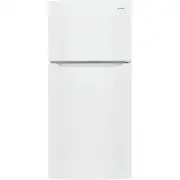
A refrigerator installation manual covers the essential steps required to safely set up a top-mount or superposed appliance, including site preparation, transportation logistics, water and electrical supply connections, leveling adjustments, door alignment, and final verification procedures. The guide emphasizes safety protocols and highlights key components like ice makers and anti-tip systems while providing visual aids such as diagrams for wiring and piping configurations. Safety warnings are central to ensuring proper installation before operation begins.


Table of Contents:
- Page 1 – Top-Mount Refrigerator Installation Procedures
- Page 2 – Refrigerator Installation Guide
- Page 3 – Superposed Refrigerator Installation and Setup
This document should only be removed by the customer after installation.
P/N: A17230501
Not satisfied with the installation of your refrigerator?
Please contact the store from which you purchased your refrigerator.
I n s t a l l a t i o n I n s t r u c t i o n s fo r To p M o u n t Re f r i g e ra t o r
9
Doors
Ƚ Door seals completely to cabinet on all sides
Ƚ Freezer door is level across the top
Leveling
Ƚ Refrigerator is level, side to side and tilted
¼ in. (6mm) front to back
Ƚ Cabinet is setting solid on all corners
Ƚ Anti-tip bracket set
Electrical Power
Ƚ House power turned on
Ƚ Refrigerator plugged in
Ice Maker
Ƚ House water supply connected to
refrigerator (ice maker installed)
Ƚ No water leaks present at all connections -
recheck in 24 hours
Ƚ Ice Maker is turned ON (ice maker installed)
Final Checks
Ƚ Shipping material removed
Ƚ Fresh Food and Freezer controls set
Ƚ Crisper Humidity controls set
Ƚ Registration Card sent in
Installation Check off List
5
Level Refrigerator & Adjust Doors
(if necessary)
NOTE
Raise the front of the refrigerator enough
so the doors close freely when opened
halfway. The refrigerator should slope ¼
inch to ½ in. from front to back. Then level
the refrigerator from side-to-side.
WARNING
The anti-tip device must be
installed according to the
instructions in your Use & Care
Manual. Failure to do so will result
in injury.
Guidelines for final positioning of your refrigerator:
• All 4 corners of the cabinet must rest firmly on the floor.
• The cabinet should be level at the front and rear.
• The sides should tilt ¼ in. (6 mm) from front to back (to
ensure that doors close and seal properly).
• Doors should align with each other and be level.
Setting the Anti-tip device:
The Anti-tip brackets are located on the lower front corners of
the cabinet. Lower the Anti-tip on each side clockwise until they
contact the floor. Do not raise the cabinet
Lower
Anti-Tip Bracket
Controls
7
Freezer Control
When changing controls, wait 24 hours before making additional adjustments.
NOTE
Allow 15 minutes for compressor to start
after initial start up or power interruption.
Refrigerator Control
Humidity Control
8
Door Removal (if necessary)
If you need to remove the doors to get your refrigerator into the house, please see
DOOR
REMOVAL
in your Use & Care Manual.
A
B
Hinge
Pin
Center
Hinge
Screws
Hinge
Hole
Plug
Door
Stopper
Door
Stopper
Screw
Bottom Hinge
Pin
Prepare The Installation Site
1
Include these minimum guidelines in your site preparation:
• Choose a place near a grounded electrical outlet.
• Do not use an extension cord or an adapter plug.
• Avoid direct sunlight and close proximity to a
range, dishwasher or other heat source.
• Floor should be level and able to support a fully
loaded refrigerator.
Allow the following clearances for ease of installation, proper
air circulation, and plumbing and electrical connections:
Top
3.94 in 100mm
Sides
1.57 in 40 mm
Back
1.18 in 30 mm
NOTE
Information about cabinetry construc-
tion for your new appliance is available
for contractors. Call 1-877-435-3287.
CAUTION
Room temperatures below 55°F (13°C)
or above 110°F (43°C) will impair cooling
ability of your refrigerator’s compressor.
Tools Necessary:
Phillips Head
or
Quadrex Head
Screwdriver
Socket
Wrench Set
Adjustable
Wrench
Flathead
Screwdriver
and
or
or
NOTE
These installation instructions are
provided only as a possible customer
option. We recommend you use a
service or kitchen contracting pro-
fessional to install your refrigerator.
WARNING
To avoid electric shock, which can cause death or severe personal injury, do not connect your
refrigerator to an electrical power source until you have completed Step 3 of these instructions.
2
Transport Unpackaged Refrigerator To Site
By now, you have already removed your refrigerator’s shipping carton. You
may still need to use a hand truck to move it through close spaces or en-
trances. If the refrigerator is larger than an entrance, consider two options:
• Remove the entrance door if one exists.
• Remove the refrigerator doors (see how in your Use & Care Guide).
When using a hand truck:
• Load refrigerator from side of cabinet only.
• Do not run retaining straps over handles.
• Do not overtighten retaining straps.
• Remove tape from doors only after the unit is in place.
CAUTION
Shifting the refrigerator from side to
side may damage flooring.
4
Place In Permanent Position
If possible, use a hand truck to position the refrigerator directly in front of its cabinet enclosure.
Be careful not to move the refrigerator beyond its water supply (copper tubing) connections.
Plug in the power cord, and push the refrigerator straight back into place.
CAUTION
•
Shifting the refrigerator from side to side may damage flooring.
• Do not block the lower front of your refrigerator
.
Sufficient air circulation is essential for
proper operation.
Remove Internal Shipping Materials
6
Location of these materials may vary depending on your model.
We use packing foam and tape to secure the internal parts of your refrigerator for shipping. Once
the refrigerator is in position, you can remove this material.
2 pieces of tape
2 pieces of tape
1 piece of tape
4 pieces of tape
2 pieces of tape
2 pieces of tape
2 pieces of tape
2 pieces of tape
2 pieces of tape
2 pieces of tape
2 pieces of tape
2 pieces of foam
3
Water Supply Connection
What you will need:
• Basic Tools: adjustable wrench,
flat-blade screwdriver, and Phillips
TM
screwdriver
• Access to a household cold water
line with water pressure between 30
and 100 psi.
• A water supply line made of ¼ inch (6.4 mm) OD, copper
or stainless steel tubing. To determine the length of tubing
needed, measure the distance from the ice maker inlet valve at
the back of the refrigerator to your cold water pipe. Then add
approximately 7 feet (2.1 meters), so the refrigerator can be
moved out for cleaning (as shown).
• A shutoff valve to connect the water supply line to your
household water system. DO NOT use a self-piercing type
shutoff valve.
• Do not re-use compression fitting or use thread seal tape.
• A compression nut and ferrule (sleeve) for connecting a copper
water supply line to the ice maker inlet valve.
House
plumbing
line
Water line hookup
NOTE
For homes with existing valves,
Frigidaire recommends its Smart
Choice
®
water line kit 5304437642
(with a 6 ft. stainless steel water
line), and for homes without an
existing valve, Frigidaire recom-
mends its Smart Choice
®
water
line kit 5304493869 (with a 6 ft.
polyline water line). Please refer to
www.frigidaire.com/Refrigerator-
Accessories for more information.
CAUTION
To avoid property damage:
• Use a water supply line made
of stainless steel tubing or
polyline.
• Ensure water supply complies
with local plumbing codes.
NOTE
Automatic ice makers are optional accessories that may be
installed in most models at any time. Call your local dealer
for information about Ice Maker Kit 117000.
To Connect Water Supply Line To Ice Maker Inlet Valve
1. Disconnect refrigerator from electric power source.
2. Place end of water supply line into sink or bucket. Turn ON water
supply and flush supply line until water is clear. Turn OFF water
supply at shutoff valve.
3. Remove plastic cap from water valve inlet and discard cap.
4.
If you use copper tubing
- Slide brass compression nut, then
ferrule (sleeve) onto water supply line. Push water supply line
into water valve inlet as far as it will go (¼ inch / 6.4 mm). Slide
ferrule (sleeve) into valve inlet and finger tighten compression nut
onto valve. Tighten another half turn with a wrench; DO NOT over
tighten. See Figure 1.
If you use braided flexible stainless steel tubing
- The nut is
already assembled on the tubing. Slide nut onto valve inlet and finger
tighten nut onto valve. Tighten another half turn with a wrench; DO
NOT over tighten. See Figure 2.
5. With steel clamp and screw, secure water supply line (copper tubing
only) to rear panel of refrigerator as shown.
6. Coil excess water supply line (copper tubing only), about 2½ turns,
behind refrigerator as shown and arrange coils so they do not
vibrate or wear against any other surface.
7. To turn ice maker on, press the ice maker’s On/Off power switch so
the LED is steadily illuminated.
8. Turn ON water supply at shutoff valve and tighten any connections
that leak.
9. Reconnect refrigerator to electrical power source.
NOTE
• The ice maker’s fill valve may operate noisily if the household water supply is shut off.
• After ensuring no water leaks exist at any connection, be sure to check for leaks again in 24 hours.
Figure 1
Brass
Compression
Nut
Water Valve
Bracket
Valve Inlet
Water Valve
Copper water line from
household water supply
Plastic Water Tubing
to Ice Maker
Fill Tube
(Include enough tubing in loop to allow
moving refrigerator out for cleaning.)
Ferrule
(Sleeve)
Copper
Braided
Flexible
Stainless
Steel
Water Line
Water Valve
Bracket
Valve Inlet
Water Valve
6 ft minimum (1.8 m)
braided flexible stainless steel
water line from household water supply
Plastic Water Tubing
to Ice Maker
Fill Tube
(Include enough tubing to allow
moving refrigerator out for cleaning.)
Figure 2
"Loading the manual" means you need to wait until the file loads and becomes available for online reading. Some manuals are very large, and the time they take to appear depends on your internet speed.
Was this manual helpful?
About this manual
- Brand
- Frigidaire
- Model
- FFTR1425VW
- Document type
- Installation Manual
- Category
- Refrigerator
- Language(s)
- English, Spanish, French
- Pages
- 3
- File size
- 2.6 MB
- Format
Other Manuals for Frigidaire FFTR1425VW
Summary
Instructions for installing a top-mount refrigerator, including site preparation, transport, water connection, leveling, door adjustment, power connection, and final checks. Details cover ice maker and anti-tip bracket setup.
Steps for preparing the installation site, transporting the unit, connecting water and electrical supplies, leveling the appliance, and verifying the entire installation process with safety warnings and connection diagrams.
Installation procedures for superposed refrigerators, covering preparation, transportation, water connection, permanent setup, door adjustments, command configuration, piping connections, control panel settings, and troubleshooting notes.
Ask a question
Related manuals
Popular Frigidaire Refrigerators
 Frigidaire FRSS2623AW Installation Manual
 Frigidaire FRSS2323AB Installation Manual
 Frigidaire GRFG2353AF Installation Manual
 Frigidaire EFR749 User Manual
 Frigidaire EFR753-MINT User Manual
 Frigidaire FFHT1425VV Installation Manual
 Frigidaire FFTR1835VS User Manual
 Frigidaire FRSS2323AW Installation Manual
More Frigidaire Refrigerators models
 Frigidaire FFHT2045VS Installation Manual
 Frigidaire FFHT2045VW User Manual
 Frigidaire FFPE3322UM User Manual
 Frigidaire FFPE4533UM User Manual
 Frigidaire FFPS3133UM User Manual
 Frigidaire FFPS4533UM User Manual
 Frigidaire FFTR1814WB User Manual
 Frigidaire FFTR1814WW User Manual
 Frigidaire FFTR1835VB User Manual
 Frigidaire FFTR1835VW User Manual
 Frigidaire FFTR2045VB User Manual
 Frigidaire FFTR2045VS User Manual