Crosley CFEH272ITD0 - Installation Manual
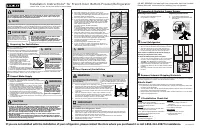
Crosley CFEH272ITD0 – Installation Manual, read for free online in PDF format. We hope this helps you resolve any issues you may have. If you have further questions, please contact us through the contact form.

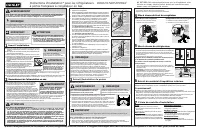
D O N OT R E M O V E t h i s l a b e l u n t i l t h e r e f r i g e ra t o r h a s b e e n l e v e l e d .
P l e a s e f o l l o w a l l i n s t r u c t i o n s f o r l e v e l i n g y o u r r e f r i g e ra t o r.
P/N: A05972703
* P l e a s e r e fe r t o yo u r U s e & C a r e G u i d e fo r m o r e d e t a i l s .
If you are not satisfied with the installation of your refrigerator, please contact the store where you purchased it or call 1-855-224-4987 for assistance.
6
Crosley uses packing foam and tape to secure the internal parts of your refrigerator for shipping.
Once the refrigerator is in position, you can remove this material.
What’ s Nex t?
Congratulations! You are ready to begin enjoying your new Crosley refrigerator.
• For important safety instructions and to learn how to operate your refrigerator, please read
the entire Use & Care Guide.
• You may want to start with the “Normal Operating Sights & Sounds” section of the Guide to
learn what to expect during typical operation.
• Please register your product. You can register online at www.crosley.com or you can simply
send in the Registration Card.
Remove I nternal Ship p ing Materials
I n s t a l l a t i o n I n s t r u c t i o n s * f o r F r e n c h D o o r B o t t o m F r e e z e r / Re f r i g e ra t o r
1
Prep aring For I nstallation
Be sure to coordinate site preparation and installation
with your kitchen contractor.
Include these minimum guidelines in your site preparation:
• Choose a place near a grounded electrical outlet.
• Do not use an extension cord or an adapter plug.
• Avoid direct sunlight and close proximity to a range,
dishwasher or other heat source.
• Floor should be level and able to
support a fully loaded refrigerator.
• The refrigerator’s Ice Dispenser
requires water supply access.
• Plan for easy access to counter tops
when removing food.
• For complete access to drawers and
freezer baskets, doors must be able to
fully open.
• Load refrigerator from side of cabinet only.
• Do not run retaining straps over handles nor overtighten straps.
• Never use refrigerator handles to move the refrigerator.
Allow the following clearances for ease of installation, proper air circulation, and plumbing and
electrical connections: Sides & Top:
3
/
8
inch / Rear: 1 inch
CAUTION
R o o m t e m p e r a t u r e s
b e l o w 5 5 ° F ( 1 3 ° C ) o r
a b o v e 1 1 0 ° F ( 4 3 ° C )
w i l l i m p a i r c o o l i n g
a b i l i t y o f y o u r r e f r i g -
e r a t o r ’ s c o m p r e s s o r .
NOTE
Please call 1-855-224-4987 if you
need assistance with this installation.
2
Before Installing The Water Supply Line, You Will Need:
• Basic Tools: adjustable wrench, flat-blade screwdriver, and
Phillips
TM
screwdriver
• Access to a household cold water line with water pressure
between 30 and 100 psi.
• A water supply line made of ¼ inch (6 mm) OD, copper
or braided, flexible stainless steel tubing. To determine
the length of tubing needed, measure the distance from
the ice maker inlet valve at the back of the refrigerator to
your cold water pipe. Then add approximately 7 feet, so
the refrigerator can be moved out for cleaning.
• A shutoff valve to connect the water supply line to your
household water system. DO NOT use a self-piercing type
shutoff valve.
• A compression nut and ferrule (sleeve) for connecting a copper water supply line to the
ice maker inlet valve.
Connect Water Supply
WARNING
To avoid electric shock,
which can cause death
or severe personal
injury, disconnect the
refrigerator from elec-
trical power before con-
necting a water supply
line to the refrigerator.
CAUTION
To Avoid Prop erty Damag e:
• Copper or Stainless Steel braided, flexible tubing is recommended for
the water supply line. Water supply tubing made of ¼ inch (6 mm)
plastic is not recommended to be used. Plastic tubing greatly increases
the potential for water leaks, and the manufacturer will not be respon-
sible for any damage if plastic tubing is used for the supply line.
•
D o not reuse comp ression f itting or use thread seal tap e.
• D O NOT install water sup p ly tubing in areas where temp eratures f all
below freezing .
• C hemic als from a malfunc tioning sof tener can d amag e the ic e maker.
I f the ic e maker is c onnec ted to soft water, ensure that the sof tener is
maintained and working p rop erly.
To Connect Water Supply Line To Ice Maker Inlet Valve:
NOTE
Check with your local building authority for
recommendations on water lines and associated materials
prior to installing your new refrigerator. Depending on your
local/state building codes, Crosley recommends for homes
with existing valves its Smart Choice 6 ft. Stainless Steel
Refrigerator Water Line Kit 5304490728, and for homes
without an existing valve, Crosley recommends its Smart
Choice 20 ft. Copper Refrigerator Water Line Installation Kit
5304490717 (with a with self-tapping saddle valve). Please
refer to www.Crosley.com for more information.
Plastic Water
Tubing to Ice
Maker Fill
Tube
Steel
Clamp
Brass
Compression
Nut
Ferrule
(Sleeve)
Copper
water line
Water Valve
Bracket
Valve Inlet
Water Valve
Copper water line
from household
water supply
(Include enough tubing in loop to allow
moving refrigerator out for cleaning.)
Figure 1
Steel
Clamp
Braided
Flexible
Stainless
Steel
Water Line
Water Valve
Bracket
Valve Inlet
Water Valve
6 ft (1.8 Meters) Braided flexible
stainless steel water line from
household water supply.
Plastic Water Tubing
to Ice Maker
Fill Tube
(Include enough tubing in loop to allow
moving refrigerator out for cleaning.)
Figure 2
1. Disconnect refrigerator from electric power source.
2. Place end of water supply line into sink or bucket. Turn ON
water supply and flush supply line until water is clear. Turn
OFF water supply at shutoff valve.
3. Remove plastic cap from water valve inlet and discard cap.
4. If you use copper tubing - Slide brass compression nut, then
ferrule (sleeve) onto water supply line. Push water supply
line into water valve inlet as far as it will go (¼ inch). Slide
ferrule (sleeve) into valve inlet and finger tighten nut onto
valve. Tighten another half
turn with a wrench; DO NOT overtighten.
See Figure 1.
If you use braided, flexible stainless steel tubing - The nut
is already assembled on the tubing. Slide nut onto valve
inlet and finger tighten nut onto valve. Tighten another half
turn with a wrench; DO NOT overtighten. See Figure 2.
5. With steel clamp and screw, secure water supply line
(copper tubing only) to rear panel of refrigerator as shown.
6. Coil excess water supply line (copper tubing only), about
2½ turns, behind refrigerator as shown and arrange coils so
they do not vibrate or wear against any other surface.
7. Turn ON water supply at shutoff valve and tighten any
connections that leak.
8. Reconnect refrigerator to electrical power source.
9. To turn ice maker on, lower wire signal arm (freezer ice
maker) or set the ice maker’s On/Off power switch to the
“ON” position (fresh food ice maker).
7
Doors
□
Handles are secure and tight
□
Door seals completely to cabinet on all sides
□
Fresh food doors are level
Leveling
□
Refrigerator is level, side to side and tilted
¼ inch (6 mm) front to back
□
Toe grille is properly attached to refrigerator
□
Cabinet is sitting solid on all corners
Electrical Power
□
House power turned on
□
Refrigerator plugged in
I nstallation C heck List
Ice Maker
□
House water supply connected to
refrigerator
□
No water leaks present at all connections
□
Ice Maker is turned ON.
Final Checks
□
Shipping material removed
□
Fresh Food and Freezer
temperatures set
WARNING
To avoid electric shock, which can cause death or severe personal injury,
do not connect your refrigerator to an electrical power source until you
have completed Step 2 of these instructions.
CAUTION
• Shifting the refrigerator from side to side
may damage flooring.
• Do not block the toe grille on the lower
front of your refrigerator. Sufficient air cir-
culation is essential for proper operation.
IMPORTANT
If you are installing your refrigerator
without connecting it to a water
supply, make sure the ice maker’s
power switch is turned Off (see the
Use & Care Guide for more details).
NOTE
If you need to remove the doors to get your refrigerator into the house, please refer to Section 3:
“Door Removal/Installation,: or, for more detailed instructions, “Removing Doors” in the Use & Care
Guide. These installation instructions are provided only as a possible customer option. Frigidaire
recommends that you use a service or kitchen contracting professional to install your refrigerator.
D oor Removal/I nstallation
Removing the Doors:
3
IMPORTANT
Open the refrigerator doors to a 90° angle before removing or installing the doors on the
lower hinges.
To reinstall the refrig erator d oors:
1. Replace the lower hinges by screwing in place.
2. Hold the door at ~90°, and drop the closure mechanism down into the lower hinge pin.
Then rotate it slightly in either direction until the door/mechanism falls down into place.
Install the top hinge, thus locking the door in place.
3. Insert the water line into the top section of the unit and insert into the connector.
4. Connect the harness at the top of the hinges.
5. Replace the top hinge covers.
WARNING
Turn off power to your refrigerator,
by unplugging the power cord from
the wall outlet.
1. Remove refrigerator doors’ top hinge covers.
2. Disconnect the harness by depressing the latch, and pulling apart.
3. Detatch the water tube from the connector located behind the
refrigerator, the connector releases when you press inward on the
connectors outer sleeve. Pull the water tube out toward the front
of the unit.
4. Open the refrigerator doors to a 90° angle. Remove 2 screws
from the top hinge. Lift and remove door from lower hinge. Be
sure doors are set aside in a secure position where they cannot
fall and cause damage to the doors or the handles.
5. Unscrew the 3 lower hinge screws and remove the hinge.
NOTE
You will be pulling approximately 5 feet of
water tube from the back of the refrigerator.
Use care while pulling the water tube from
the unit to ensure not kinking the tube.
90˚
Top View
Cabinet
Left Door
Right Door
Top View
Cabinet
Removing & Replacing Freezer Drawer
4
Removing Freezer Drawer
1. Remove 4 hex head drawer screws.
2. Lift up drawer to remove.
Remove
Hex Head
Drawer Screw
DO NOT
Remove
Other
Screws
DO NOT
Loosen
or
Remove
These 3
Hex
Screws
Replacing Freezer Drawer
1. Lower drawer back into place.
2. Replace 4 hex head drawer screws
and tighten.
Level Refrigerator
Guidelines for final positioning of your refrigerator
• All four corners of the cabinet must rest firmly on the floor.
• The sides should tilt ¼ inch (6 mm) from front to
back (to ensure that doors close and seal properly).
• Doors should align with each other and be level.
Most of these conditions can be met by raising or
lowering the adjustable front rollers.
To level the cabinet using the front rollers:
1. You can raise or lower each door. Use a
3
/
8
inch socket
wrench to turn the adjustment screws (1 per side).
To raise
: turn adjustment screw clockwise.
To lower
: turn adjustment screw counterclockwise.
2. Ensure both doors are bind-free with their seals
touching the cabinet on all four sides and that cabinet
is stable.
3. After unit is leveled, lower anti-tip leg until it contacts
the floor.
5
Raise
Lower
Anti-tip
Leg
Door
Door
"Loading the manual" means you need to wait until the file loads and becomes available for online reading. Some manuals are very large, and the time they take to appear depends on your internet speed.


